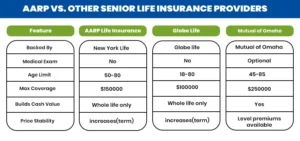
The best alternatives to AARP term life insurance include fully underwritten term policies for healthy individuals, Guaranteed Universal Life (GUL) for those needing coverage beyond age 80, and final expense whole life for small-benefit burial needs. These options often provide fixed premiums and longer coverage periods than AARP’s escalating-rate structure.
Finding the right life insurance as you age requires a balance between affordability, coverage duration, and health requirements. For decades, the AARP Life Insurance Program from New York Life has been a default choice for seniors due to its brand recognition and simplified application process. However, as we navigate 2026, the marketplace for senior-specific insurance has expanded significantly, offering more tailored solutions that often outperform the standard AARP term product in both cost-efficiency and long-term stability.
Understanding the AARP Term Life Model and Its Limitations
To find a suitable alternative, one must first understand the specific mechanics of the AARP term life insurance policy. Underwritten by New York Life, the AARP term product is a "group" policy designed for members aged 50 to 74. While it offers the convenience of "no medical exam" (simplified issue) and a trusted name, it possesses three specific characteristics that drive many consumers to seek alternatives:
- Increasing Premiums (Age Bands): Unlike level-term policies where the price stays the same for 10, 20, or 30 years, AARP term life premiums increase every five years as you enter a new age bracket. This can make the policy prohibitively expensive as you reach your 70s.
- Coverage Expiration: Most AARP term policies terminate when the insured reaches age 80. If you still have a mortgage, a dependent spouse, or want to ensure a legacy beyond age 80, this "expiration cliff" creates a significant protection gap.
- Benefit Caps: Coverage is typically capped at $100,000 or $150,000. For individuals with higher debt loads or complex estate planning needs, these limits are often insufficient.
Because of these factors, the alternatives listed below focus on solving the problems of price instability, early expiration, and low coverage limits.
1. Fully Underwritten Term Life Insurance
If you are in relatively good health, a fully underwritten term life policy is almost always a superior alternative to AARP's simplified issue product. In 2026, "fully underwritten" no longer necessarily means a nurse coming to your home for a blood draw. Many carriers now use accelerated underwriting, which leverages digital health records, prescription databases, and motor vehicle reports to approve policies in days without a physical exam.
Why It’s a Strong Alternative
Unlike the AARP model, these policies offer level premiums. If you buy a 20-year term policy at age 55, your premium in year 19 will be exactly the same as it was in year one. This provides budgetary certainty that AARP’s five-year price hikes cannot match. Furthermore, carriers like Protective, Banner Life, and Lincoln Financial often offer much higher coverage amounts, frequently starting at $250,000 and reaching into the millions.
Who Should Choose This
This is the ideal path for seniors who are non-smokers and have managed health conditions (like well-controlled blood pressure or cholesterol). The cost savings over a 15-year period compared to AARP can often exceed 30% to 50% because the insurance company is rewarding your lower risk profile with lower rates.
2. Guaranteed Universal Life (GUL)
Guaranteed Universal Life is often described as a "lifetime term" policy. It is perhaps the most direct competitor to AARP term life for those who realize they might need coverage past the age of 80. While it is technically a permanent policy, it does not focus on cash value accumulation. Instead, it is designed to provide a guaranteed death benefit at a fixed price.
Solving the "Age 80" Problem
The primary weakness of AARP term is that it ends at age 80. A GUL policy allows you to select a "guaranteed age"—typically 90, 95, 100, or even 121. As long as you pay the level premium, the policy cannot be canceled, and the price will never increase.
In the current 2026 financial climate, GUL policies are favored by retirees who want to ensure their spouse can pay off a remaining mortgage or cover estate taxes regardless of when the death occurs. It eliminates the "gambling" aspect of term insurance, where you might outlive the policy and leave your beneficiaries with nothing.
3. Final Expense and Senior Whole Life Insurance
For many AARP members, the goal of life insurance is not to replace a high salary but to cover "final expenses"—funeral costs, small debts, and legal fees. If your coverage need is between $5,000 and $50,000, a Final Expense Whole Life policy is a robust alternative.
The Advantage of Permanence
AARP term insurance is temporary. Final expense insurance is permanent. It builds a small amount of cash value and, most importantly, the premium is locked in for life. Carriers such as Mutual of Omaha, Transamerica, and Forester’s Financial specialize in this niche.
These policies are also highly accessible. Many offer "Simplified Issue" (answering a few health questions) or "Guaranteed Issue" (no health questions at all, though usually with a two-year waiting period for the full death benefit). If you have significant health issues that would make AARP's term product expensive or difficult to obtain, a graded-benefit whole life policy provides a guaranteed path to coverage.
4. Comparing Top Alternatives: A Technical Overview
When evaluating these options, it is helpful to see how they stack up against the AARP New York Life term product across key metrics.
| Policy Type | Premium Structure | Coverage Duration | Health Requirement | Best For |
|---|---|---|---|---|
| AARP Term Life | Increases every 5 years | Ends at age 80 | Simplified (Health Qs) | Short-term needs < 10 years |
| Fully Underwritten Term | Fixed (Level) | 10, 15, 20, 30 years | Full Underwriting | Healthy seniors; high coverage |
| Guaranteed Universal Life | Fixed (Level) | To age 90, 100, or 121 | Varies (Mid to High) | Lifetime protection; fixed cost |
| Final Expense (Whole) | Fixed (Level) | Lifetime | Simplified or Guaranteed | Burial costs; small debts |
| Group Life (Workplace) | Usually increases | Ends at retirement | Usually none (GI) | Supplemental coverage |
5. Indexed Universal Life (IUL) for Wealth Transfer
While more complex than term insurance, Indexed Universal Life has become a popular alternative for high-net-worth individuals who may have been looking at AARP but realized they need a vehicle for tax-advantaged wealth transfer.
In 2026, IUL policies allow the policyholder to tie the cash value growth to a market index (like the S&P 500) with a "floor" that prevents losses during market downturns. This is not a direct replacement for simple term insurance, but for a 50-year-old AARP member with excess cash flow, it provides a death benefit plus a way to grow assets that can be accessed tax-free in retirement via policy loans. This is a strategic move that term insurance simply cannot offer.
6. Critical Factors to Evaluate Before Switching
Before replacing an existing AARP policy or choosing an alternative, you must conduct a rigorous "suitability check." Insurance is not one-size-fits-all, and moving too quickly can lead to a loss of coverage.
The Contestability Period
Whenever you start a new life insurance policy, a new two-year contestability period begins. During this time, the insurance company can investigate the truthfulness of your original application if a claim is made. If you have had an AARP policy for five years, that period has passed. Moving to a new carrier resets this clock, so absolute honesty on the new application is paramount.
The "Cost of Insurance" Trap
Be wary of "Annual Renewable Term" (ART) policies that look cheap in year one. Like the AARP model, these prices go up. Always ask for a policy illustration that shows the premium for every single year until the policy expires. If the table shows the premium doubling or tripling in the later years, you are likely looking at a structure similar to AARP’s, which may not solve your long-term cost concerns.
Converting Existing Coverage
If you already have an AARP term policy, check if it has a conversion rider. Some term policies allow you to convert a portion of the term coverage into a permanent whole life policy without a medical exam. This is a vital feature if your health has declined since you first bought the policy, as it allows you to secure lifetime coverage that you might otherwise be denied for on the open market.
How to Apply for Alternatives in 2026
The application landscape in 2026 is heavily digitized. To find the best rates among the alternatives listed, follow these steps:
- Gather Your Data: Have a list of your current medications, dosages, and any major diagnoses from the last 10 years.
- Use an Independent Broker: Do not call a single insurance company. Independent agents represent 30+ carriers and can "shop" your health profile to find the carrier most lenient toward your specific conditions (e.g., one carrier might be better for diabetics, while another is better for those with heart history).
- Check Financial Strength: Use A.M. Best or Demotech to verify that the alternative carrier has an "A" rating or better. You want to ensure the company will be around to pay the claim 30 years from now.
- Review the NAIC Complaint Index: The National Association of Insurance Commissioners (NAIC) provides a ratio of complaints to premiums. A low score indicates better customer service and claim handling.
Frequently Asked Questions
Does AARP offer any permanent alternatives?
Yes, AARP/New York Life offers a "Permanent Life" (Whole Life) product. However, it is also a simplified issue product, which means the premiums are often higher than what you could find with a fully underwritten whole life policy from a different carrier if you are in decent health.
Can I have both AARP and an alternative policy?
Absolutely. There is no legal limit to how many life insurance policies you can own, provided your total coverage amount is "justifiable" based on your income, net worth, and financial obligations. Many seniors keep a small AARP policy while they wait for a larger, cheaper underwritten policy to be approved.
What happens if I outlive my term insurance?
If you have a standard term policy (including AARP), the coverage simply ends. You receive no money back unless you purchased a "Return of Premium" (ROP) rider, which is rare and expensive. This is why many seniors are now pivoting toward Guaranteed Universal Life, which ensures the policy stays in force as long as you live.
Are there "no-exam" alternatives that are cheaper than AARP?
Yes. Many carriers now use "Algorithmic Underwriting." If your data (pharmacy records, MIB reports) shows you are healthy, companies like Ethos or Bestow can often offer level-term rates that are lower than AARP's tiered rates, without requiring a medical exam.
Final Recommendation
If you are currently an AARP member or considering their term insurance, your first action should be to determine your "protection horizon." If you only need insurance for the next 5 years to cover a small loan, AARP’s simplified process is convenient.
However, if you are looking for a permanent solution to protect your spouse or leave a legacy, or if you want to avoid the massive price increases that occur after age 70, you should prioritize Guaranteed Universal Life or a Level-Term policy from a highly-rated independent carrier. In the 2026 market, the "convenience" of AARP rarely outweighs the long-term savings and security of a fixed-rate, private market policy.