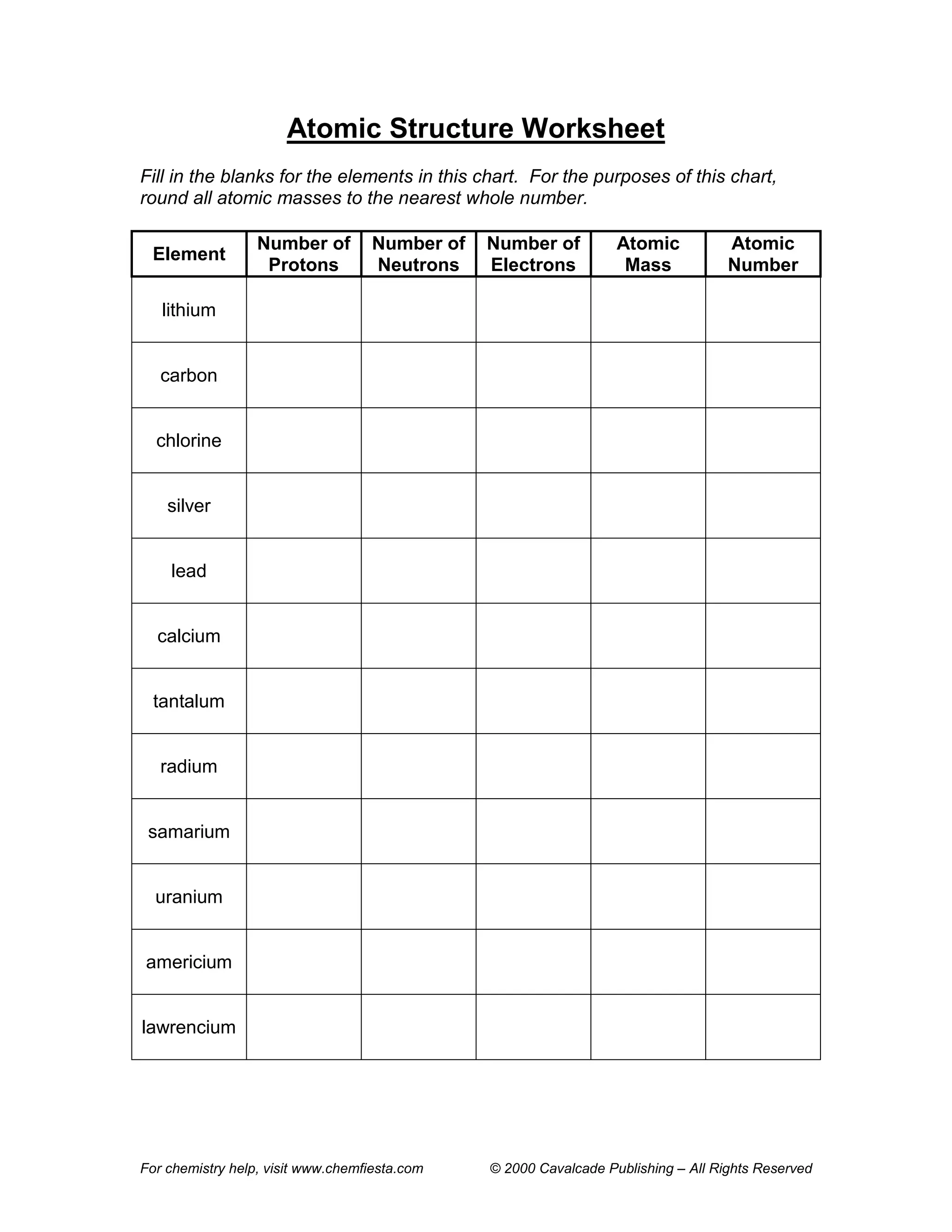
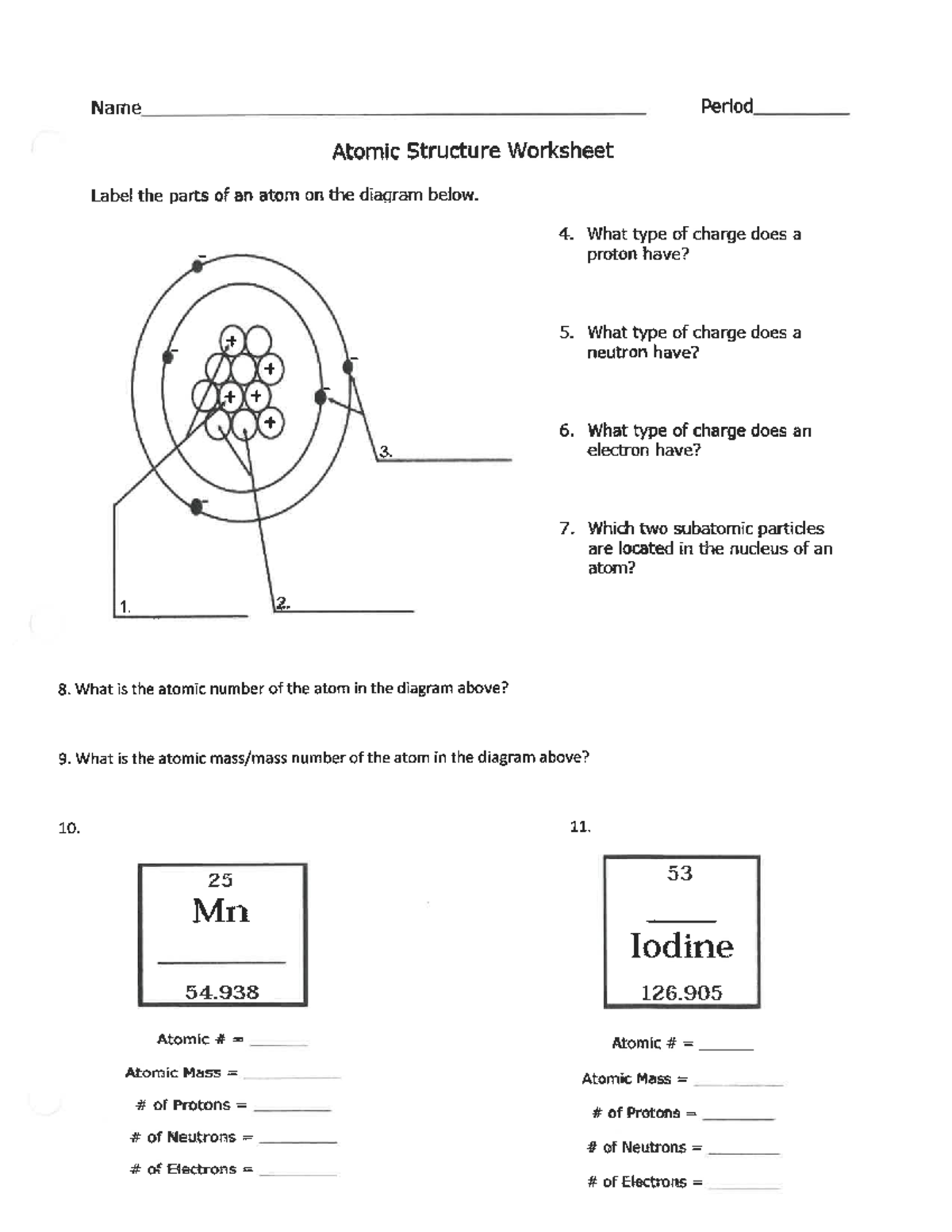
An atomic structure worksheet is a fundamental pedagogical tool used to help students identify and calculate the subatomic components of an atom, including protons, neutrons, and electrons. These resources bridge the gap between abstract chemical theory and practical application, enabling learners to master the periodic table, isotopic notation, and ion formation through repetitive, structured practice.
The Role of Atomic Structure Worksheets in Chemistry Education
In 2026, the study of chemistry remains rooted in the foundational understanding of the atom. While advanced computational modeling has transformed how we visualize molecular interactions, the humble atomic structure worksheet remains the primary method for introducing students to the "building blocks of matter." These worksheets serve several critical functions in the classroom and at home.
First, they provide a structured environment for students to apply the Atomic Number and Mass Number concepts. Without a guided framework, the various numbers found on a periodic table square can be overwhelming. A well-designed worksheet breaks these down into manageable tasks, such as identifying the element symbol, determining the charge, and calculating the specific number of particles in the nucleus versus the electron shells.
Second, these worksheets facilitate the transition from the Bohr model to more complex quantum mechanical descriptions. Even as education standards evolve to include more nuanced views of electron probability clouds, the initial "accounting" of particles remains the same. Students must first understand that the identity of an element is dictated solely by its proton count before they can move on to the complexities of valence shells and chemical bonding.
Core Concepts Covered in Modern Worksheets
To be effective, an atomic structure worksheet must cover several key areas of nuclear and electronic physics. These concepts form the "vocabulary" of chemistry, and mastery of them is a prerequisite for understanding stoichiometry, thermodynamics, and organic reactions.
The Subatomic Particles
Every worksheet begins with the three primary subatomic particles. While 2026 curriculum standards occasionally touch on quarks and gluons, the focus for atomic structure practice remains on:
- Protons: These carry a positive charge (+1) and are located in the nucleus. The number of protons is the "social security number" of the atom; it defines the element. If the proton count changes, the element changes.
- Neutrons: Found alongside protons in the nucleus, these carry no charge (neutral). They provide the "glue" (via the strong nuclear force) that holds the positively charged protons together, preventing them from repelling each other.
- Electrons: These negatively charged (-1) particles orbit the nucleus in specific energy levels or shells. In a neutral atom, the number of electrons equals the number of protons.
Atomic Number vs. Mass Number
One of the most frequent points of confusion for students is the difference between the atomic number and the mass number. Worksheets typically use the APE MAN mnemonic to clarify this:
- A = P = E: Atomic Number equals Protons which equals Electrons (in a neutral atom).
- M - A = N: Mass Number minus Atomic Number equals Neutrons.
The Atomic Number is always the smaller integer on the periodic table square for a given element. The Mass Number represents the total count of protons and neutrons. Because electrons have negligible mass (roughly 1/1836th the mass of a proton), they are not included in the mass number calculation.
Isotopes and Ions
Advanced worksheets introduce variations in the standard atom. Isotopes are atoms of the same element that have the same number of protons but different numbers of neutrons. This changes the mass of the atom without changing its chemical identity. For example, Carbon-12 and Carbon-14 are isotopes used in various scientific fields, including radiocarbon dating.
Ions, on the other hand, are atoms that have gained or lost electrons, resulting in a net electrical charge.
- Cations: Positive ions formed by losing electrons (mostly metals).
- Anions: Negative ions formed by gaining electrons (mostly non-metals).
Worksheets often include tables where students must adjust the electron count based on a +2 or -1 charge, a crucial skill for understanding ionic bonding later in the semester.
Technical Specifications of Subatomic Particles
When filling out an atomic structure worksheet, students must reference specific data points. The following table summarizes the properties of the particles that students are expected to memorize or calculate.
| Particle | Symbol | Location | Relative Charge | Relative Mass (amu) | Discovery Date |
|---|---|---|---|---|---|
| Proton | p+ | Nucleus | +1 | ~1.007 | 1917 (Rutherford) |
| Neutron | n0 | Nucleus | 0 | ~1.008 | 1932 (Chadwick) |
| Electron | e- | Orbitals | -1 | ~0.0005 | 1897 (Thomson) |
How to Solve a Standard Atomic Structure Table
A common feature of these worksheets is a large table with missing values. Completing these tables requires a logical, step-by-step approach. Let’s walk through how to solve for an element like Magnesium-25 with a +2 charge.
Step 1: Identify the Element and Atomic Number
Find Magnesium (Mg) on the periodic table. Its atomic number is 12. This immediately tells you that the number of protons is 12.
Step 2: Determine the Mass Number
In this example, the mass number is provided as 25 (the number following the element name). Note that this is different from the average atomic mass (24.305) found on the periodic table. Always use the specific mass number given in the problem.
Step 3: Calculate Neutrons
Using the formula Mass Number - Atomic Number = Neutrons, we calculate: 25 - 12 = 13 Neutrons.
Step 4: Calculate Electrons based on Charge
For a neutral atom, electrons would be 12. However, this is a +2 ion. A positive charge means the atom has lost electrons. 12 - 2 = 10 Electrons.
This systematic approach prevents the common error of adding electrons for a positive charge or changing the proton count to match the mass.
Different Formats for Different Learning Stages
In 2026, the "worksheet" has evolved beyond the simple photocopied page. Educators now utilize several formats to reach different types of learners:
1. The Classic Grid Worksheet
This remains the gold standard for high-volume practice. It consists of 10 to 20 rows of elements where students fill in Atomic Number, Mass Number, Protons, Neutrons, and Electrons. It is highly effective for building muscle memory in calculations.
2. Bohr Model Diagramming Sheets
These worksheets provide empty "shells" or concentric circles. Students must not only calculate the number of electrons but also place them correctly in the 2, 8, 8, 18 sequence. This visualizes the concept of valence electrons and reactivity.
3. Interactive Digital Worksheets
With the integration of AI-assisted learning platforms in 2026, many students use digital worksheets that provide real-time feedback. If a student calculates the wrong number of neutrons, the system might offer a hint about the Mass Number subtraction rather than just marking it wrong. Websites like PhET Interactive Simulations allow students to "build an atom" digitally, which serves as a live, interactive worksheet.
4. Isotope Notation Practice
These sheets focus on the symbolic representation of atoms, such as: $${^{14}_{6}C}$$ Students must learn that the upper number is the mass number and the lower number is the atomic number. Mastering this notation is essential for reading scientific literature and advanced physics texts.
Common Mistakes and How to Avoid Them
Even with a clear worksheet, students frequently fall into predictable traps. Addressing these early can prevent the formation of "bad habits" in chemical calculation.
- Confusing Mass Number with Atomic Mass: The atomic mass on the periodic table is a weighted average of all natural isotopes. The mass number on a worksheet is a count of particles for one specific atom. Students should never use decimals when counting protons, neutrons, or electrons.
- Misinterpreting Ion Charges: Many students see a "+" sign and think "add." In chemistry, a +2 charge means you have removed two negative electrons. It is helpful to think of it as:
Electrons = Protons - (Charge). - Changing Protons to Match Mass: If a student calculates a different number of neutrons than they expected, they sometimes try to change the proton count. It is vital to reinforce that the proton count is fixed for each element name.
- Neglecting the Nucleus: When drawing atoms, students often focus so much on the electron shells that they forget to label the protons and neutrons in the center. Every atomic structure worksheet should require a clear representation of the nucleus.
Selection Criteria for Educators and Parents
When searching for or creating an atomic structure worksheet in 2026, certain quality markers should be prioritized to ensure the resource is effective:
- Clarity of the Periodic Table Reference: Does the worksheet specify which periodic table version to use? Since average atomic masses are updated by IUPAC (International Union of Pure and Applied Chemistry) periodically, consistency is key.
- Scaffolding: Does the worksheet start with neutral atoms before moving to isotopes and ions? A good resource builds confidence through progressive difficulty.
- Space for Calculations: Crowded worksheets lead to sloppy math. Ensure there is enough physical or digital "white space" for students to show their subtraction steps.
- Inclusion of Transition Metals: Many basic worksheets stick to the first 20 elements. High-quality resources include transition metals to show that the same rules of protons and neutrons apply even to larger atoms.
The Future of Atomic Practice: AI and Personalization
As we move through 2026, the "atomic structure worksheet" is becoming increasingly personalized. Modern educational software can analyze a student's performance on initial problems and generate a customized set of follow-up questions. If a student struggles specifically with anions (negative ions), the "worksheet" will dynamically adjust to provide more practice in that specific area.
Furthermore, augmented reality (AR) apps now allow students to hover their mobile devices over a printed worksheet to see a 3D model of the atom they are calculating. This multi-modal approach ensures that students are not just memorizing numbers but are developing a spatial understanding of how the nucleus and electron cloud relate to one another.
Frequently Asked Questions
What is the most important part of an atomic structure worksheet?
The most important part is the relationship between the atomic number and the identity of the element. If a student understands that the atomic number is the number of protons and that this number never changes for a specific element, they have a solid foundation for all other calculations on the worksheet.
Can an atom have a decimal for a mass number?
No. An individual atom must have a whole number mass because you cannot have a fraction of a proton or neutron. The decimals seen on the periodic table are "average atomic masses," which represent the average of all isotopes found in nature. On a worksheet, you should always use whole numbers for particle counts.
Why do we ignore electrons when calculating mass?
Electrons are significantly smaller than protons and neutrons. A proton is approximately 1,836 times more massive than an electron. In the context of a standard atomic structure worksheet, the mass of the electrons is so small that it does not affect the whole-number mass number used for basic chemical accounting.
How do isotopes change the worksheet calculations?
When dealing with isotopes, the number of protons remains the same as the atomic number, but the number of neutrons changes. This means the mass number will also change. On a worksheet, isotopes are usually identified by a name followed by a number (e.g., Uranium-235), where 235 is the mass number you must use for your calculations.
What is the "APE MAN" rule?
APE MAN is a mnemonic device. APE stands for Atomic Number = Protons = Electrons (in a neutral atom). MAN stands for Mass Number - Atomic Number = Neutrons. It is the most common shortcut used by students to fill out atomic structure tables accurately.
Practical Recommendation
To master atomic structure, do not rely on a single worksheet. Begin with a neutral atom table to solidify your understanding of the APE MAN rule. Once you are comfortable, move to a mixed ion and isotope worksheet. For the best results, use a physical periodic table rather than a digital search, as this helps you learn the locations and trends of the elements. Finally, verify your answers using a trusted chemistry portal or a building-block simulation tool to visualize the particles you have just calculated.