The atmosphere of Earth is a complex layer of gases, known collectively as air, that surrounds the planet and is retained by Earth's gravity. It protects life by creating pressure that allows for liquid water, absorbing ultraviolet solar radiation, warming the surface through the greenhouse effect, and reducing temperature extremes between day and night.
The atmosphere is not a uniform shell; rather, it is a dynamic, multi-layered system that transitions from the breathable air of the surface to the near-vacuum of outer space. As of 2026, our understanding of this system is more critical than ever, as satellite-based monitoring and climate modeling provide high-resolution data on how this gaseous envelope responds to both natural cycles and human-induced changes. This guide provides an exhaustive definition and technical breakdown of the Earth's atmosphere, its chemical makeup, and the distinct layers that define its vertical structure.
The Chemical Composition of Earth's Atmosphere
The atmosphere of Earth is composed of a mixture of permanent gases and variable gases. The permanent gases remain in nearly constant proportions throughout the lower atmosphere, while variable gases fluctuate based on location, time, and environmental conditions.
Permanent Gases
Nitrogen and oxygen make up approximately 99% of the dry atmosphere. Nitrogen ($N_2$) is the most abundant, accounting for roughly 78.08% of the volume. It is largely inert in its gaseous form but is essential for life as a component of amino acids and proteins once "fixed" by bacteria or lightning. Oxygen ($O_2$), at approximately 20.95%, is the biological driver for aerobic respiration and is a byproduct of photosynthesis.
The third most prevalent gas is Argon (Ar), an inert noble gas making up about 0.93%. Despite its significant volume compared to other trace gases, argon does not participate in chemical reactions within the atmosphere, serving primarily as a stable background component.
Variable Gases and Trace Components
While they exist in smaller quantities, variable gases are disproportionately influential regarding Earth’s climate and habitability.
- Water Vapor ($H_2O$): This is perhaps the most important variable gas. Its concentration varies from nearly 0% in arid polar regions to about 4% in humid tropical areas. Water vapor is the primary driver of the Earth's weather systems and the most potent natural greenhouse gas.
- Carbon Dioxide ($CO_2$): As of 2026, atmospheric $CO_2$ concentrations have continued to be a focal point of climate science, hovering near 425-430 parts per million (ppm). $CO_2$ is essential for photosynthesis but acts as a significant forcing agent in the global greenhouse effect.
- Methane ($CH_4$): Though present in much lower concentrations than $CO_2$, methane is significantly more effective at trapping heat over a 20-year horizon.
- Ozone ($O_3$): Concentrated primarily in the stratosphere, ozone filters out harmful ultraviolet-B (UVB) radiation. Near the surface, however, it is a pollutant and a major component of smog.
The Five Principal Layers of the Atmosphere
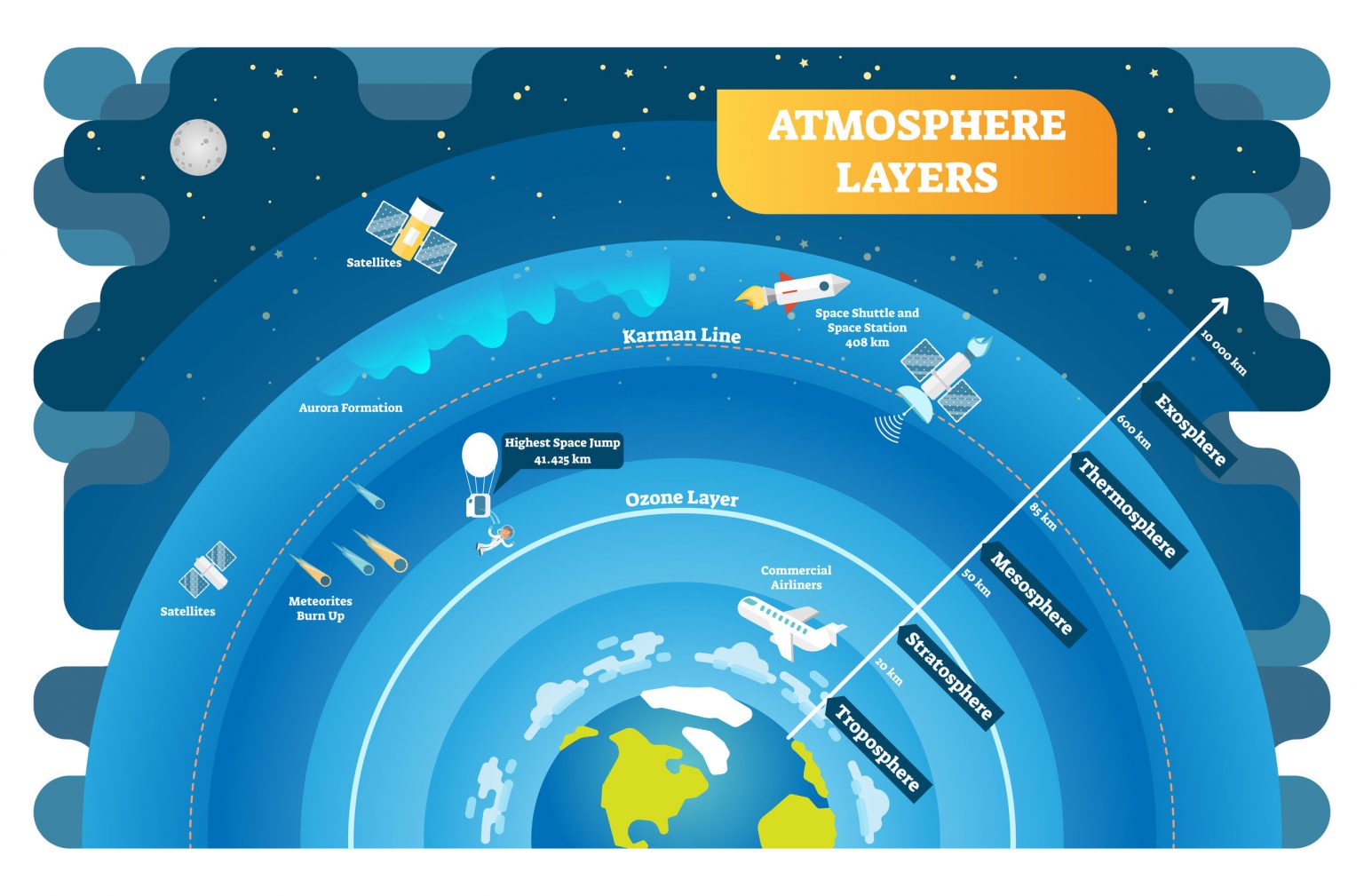
The atmosphere of Earth is divided into five main layers, primarily defined by temperature changes associated with increasing altitude. These transitions are marked by "pauses" where the temperature trend reverses.
1. The Troposphere (0 to 12 km)
The troposphere is the lowest layer and contains approximately 80% of the atmosphere's total mass and 99% of its water vapor. This is the layer where all terrestrial life resides and where nearly all weather phenomena—clouds, rain, and storms—occur.
In the troposphere, temperature typically decreases with altitude at an average rate known as the environmental lapse rate, which is approximately 6.5°C per kilometer. This decrease occurs because the troposphere is heated from the ground up by the Earth's surface, which absorbs solar radiation. The upper boundary of this layer is the tropopause, which varies in height from about 9 km at the poles to 17 km at the equator.
2. The Stratosphere (12 to 50 km)
Extending from the tropopause to about 50 kilometers, the stratosphere is characterized by a temperature inversion: temperatures actually increase with altitude. This warming is caused by the ozone layer, which absorbs ultraviolet (UV) radiation from the sun and converts it into heat.
The stratosphere is highly stable because the warmer air sits above cooler air, preventing the vertical mixing (convection) seen in the troposphere. This stability is why commercial jet aircraft often fly in the lower stratosphere to avoid weather turbulence. The boundary at the top of this layer is the stratopause.
3. The Mesosphere (50 to 85 km)
The mesosphere is the middle layer and is often cited as the least-understood region of the atmosphere because it is too high for weather balloons and too low for most satellites to orbit. In this layer, temperatures once again begin to drop with altitude, reaching the coldest temperatures in the Earth system—as low as -90°C (-130°F) near the mesopause.
The mesosphere is critical for planetary protection; it is the layer where most meteors burn up upon entry due to friction with the increasingly dense (though still very thin) air.
4. The Thermosphere (85 to 600 km)
The thermosphere starts at the mesopause and extends outward. In this layer, temperatures rise sharply, potentially reaching 1,500°C (2,700°F) or higher. However, because the air is so incredibly thin (near-vacuum), there are not enough gas molecules to transfer heat in a way that would "feel" hot to a human or a thermometer.
This layer is home to the International Space Station (ISS) and many low-Earth orbit (LEO) satellites. The high-energy X-rays and UV radiation from the sun are absorbed here, causing ionization. The Ionosphere, a region of charged particles that enables long-distance radio communication, overlaps with the thermosphere.
5. The Exosphere (600 to 10,000 km)
The exosphere is the outermost fringe of Earth's atmosphere. Here, the atmosphere is so thin that gas molecules can travel hundreds of kilometers without colliding with one another. These molecules gradually leak into space, as the Earth's gravity is too weak to hold them permanently at such great distances. There is no clear upper boundary where the exosphere ends and interplanetary space begins; it is generally considered to fade away at about 10,000 km.
Physical Properties: Pressure and Density
One of the defining characteristics of the atmosphere is the rapid decrease in pressure and density with altitude. Because air is compressible, the weight of the overhead air compresses the air at lower levels.
At sea level, the average atmospheric pressure is approximately 1013.25 millibars (or 14.7 pounds per square inch). As you ascend, the amount of air above you decreases, and thus the pressure drops. By the time you reach an altitude of 5.6 km, about half of the atmosphere's mass is below you.
| Layer | Altitude Range | Temperature Trend | Notable Features |
|---|---|---|---|
| Troposphere | 0 – 12 km | Decreases with height | Weather, 80% of total mass, life |
| Stratosphere | 12 – 50 km | Increases with height | Ozone layer, jet streams, stable air |
| Mesosphere | 50 – 85 km | Decreases with height | Meteor combustion, coldest layer |
| Thermosphere | 85 – 600 km | Increases with height | Auroras, Ionosphere, ISS orbit |
| Exosphere | 600 – 10,000 km | Variable | Transition to space, satellite orbits |
The Vital Role of the Atmosphere in Earth's Systems
The atmosphere does not exist in isolation; it interacts constantly with the hydrosphere (water), biosphere (life), and geosphere (rocks).
Radiation Filtering and Protection
The atmosphere acts as a massive filter. The thermosphere and stratosphere absorb high-energy radiation (X-rays and UV), which would otherwise be lethal to life on the surface. Without the ozone layer in the stratosphere, terrestrial life as we know it would be impossible.
The Greenhouse Effect
Natural greenhouse gases—water vapor, carbon dioxide, and methane—trap heat radiated from the Earth's surface. This natural process keeps the Earth's average surface temperature at approximately 15°C (59°F). Without this atmospheric insulation, the Earth's average temperature would be a frigid -18°C (0°F), and the oceans would freeze.
The Hydrological Cycle
The atmosphere is the primary transport mechanism for water around the globe. Through evaporation, transpiration, and condensation, the atmosphere moves moisture from the oceans to the land, providing the freshwater necessary for terrestrial ecosystems.
Measuring and Monitoring the Atmosphere in 2026
Modern atmospheric science relies on a "system of systems" approach. Surface-based stations provided by the World Meteorological Organization (WMO) offer high-accuracy local data, while the National Oceanic and Atmospheric Administration (NOAA) utilizes advanced GOES (Geostationary Operational Environmental Satellite) arrays to monitor atmospheric chemistry and weather patterns from space.
In 2026, the integration of AI-driven forecasting models has allowed for more precise predictions of atmospheric behavior, particularly concerning the movement of the jet stream and the intensification of tropical cyclones. These tools help scientists track the "health" of the atmosphere, specifically the recovery of the ozone layer and the rising concentrations of greenhouse gases.
Common Misconceptions About the Atmosphere
- "Space starts where the air ends": There is no hard "ceiling" to the atmosphere. The Kármán line (100 km) is a widely accepted convention for the beginning of space for aeronautical purposes, but atmospheric gases are still detectable much higher.
- "Oxygen is the most common gas": While vital for us, oxygen is only the second most common gas. Nitrogen is nearly four times more prevalent.
- "The Greenhouse Effect is bad": The natural greenhouse effect is essential for life. The concern for scientists in 2026 is the enhanced greenhouse effect caused by additional emissions, which disrupts the established thermal equilibrium.
FAQs
What is the Kármán line?
The Kármán line is an imaginary boundary located at an altitude of 100 kilometers (62 miles) above Earth's sea level. It is commonly used by the Fédération Aéronautique Internationale (FAI) to define the boundary between the Earth's atmosphere and outer space. At this altitude, the atmosphere becomes too thin to support aeronautical flight, as a vehicle would need to travel at orbital velocity to derive sufficient lift.
Why does the temperature increase in the stratosphere?
The temperature increase in the stratosphere is caused by the presence of the ozone layer. Ozone molecules absorb ultraviolet (UV) radiation from the sun. This absorption process releases energy in the form of heat, creating a temperature inversion where higher altitudes are warmer than lower altitudes within that specific layer.
How does the atmosphere protect us from meteors?
When meteors enter the Earth's atmosphere, they travel at extremely high velocities (often tens of thousands of miles per hour). As they hit the increasingly dense air in the mesosphere, the friction between the meteor and the air molecules generates intense heat. This heat usually causes the meteor to vaporize, creating the visible streaks of light we call "shooting stars."
Is the composition of the atmosphere the same everywhere?
The fundamental ratio of nitrogen to oxygen is relatively constant up to about 80 kilometers (the homosphere). However, the concentration of variable gases like water vapor changes significantly with location and altitude. Furthermore, in the "heterosphere" (above 80 km), gases begin to stratify by their molecular weight, with lighter gases like hydrogen and helium becoming more dominant at extreme altitudes.
What is the difference between the atmosphere and the ionosphere?
The atmosphere is the general term for the entire layer of gases surrounding Earth. The ionosphere is a specific region within the atmosphere (extending through the upper mesosphere and thermosphere) that is ionized by solar radiation. This ionization creates a layer of free electrons and ions that can reflect radio waves back to Earth, facilitating long-distance communication.
Next Steps for Exploration
To gain a deeper understanding of atmospheric dynamics, it is recommended to study the Global Atmospheric Circulation models, which explain how heat is redistributed from the equator to the poles via Hadley, Ferrel, and Polar cells. For those interested in the current state of atmospheric health, reviewing the latest annual reports from the Intergovernmental Panel on Climate Change (IPCC) provides verified data on gas concentrations and their long-term effects on Earth's thermal balance. Understanding the "atmosphere of earth definition" is the first step in appreciating the fragile and complex life-support system that makes our planet unique in the solar system.