Arizona law requires all motor vehicle owners and operators to maintain continuous financial responsibility while operating on public roadways. This requirement is primarily met through a qualifying motor vehicle liability insurance policy issued by an insurer authorized to conduct business in the state. Drivers must meet statutory minimum liability limits, carry physical or electronic proof of financial responsibility, and understand how Arizona's fault-based legal framework affects accident claims.
Minimum Mandatory Auto Insurance Requirements in Arizona
Under Arizona Revised Statutes (A.R.S.) § 28-4009, every motor vehicle registered and operated in Arizona must be covered by a motor vehicle liability policy that provides minimum financial protection against bodily injury and property damage inflicted on third parties.
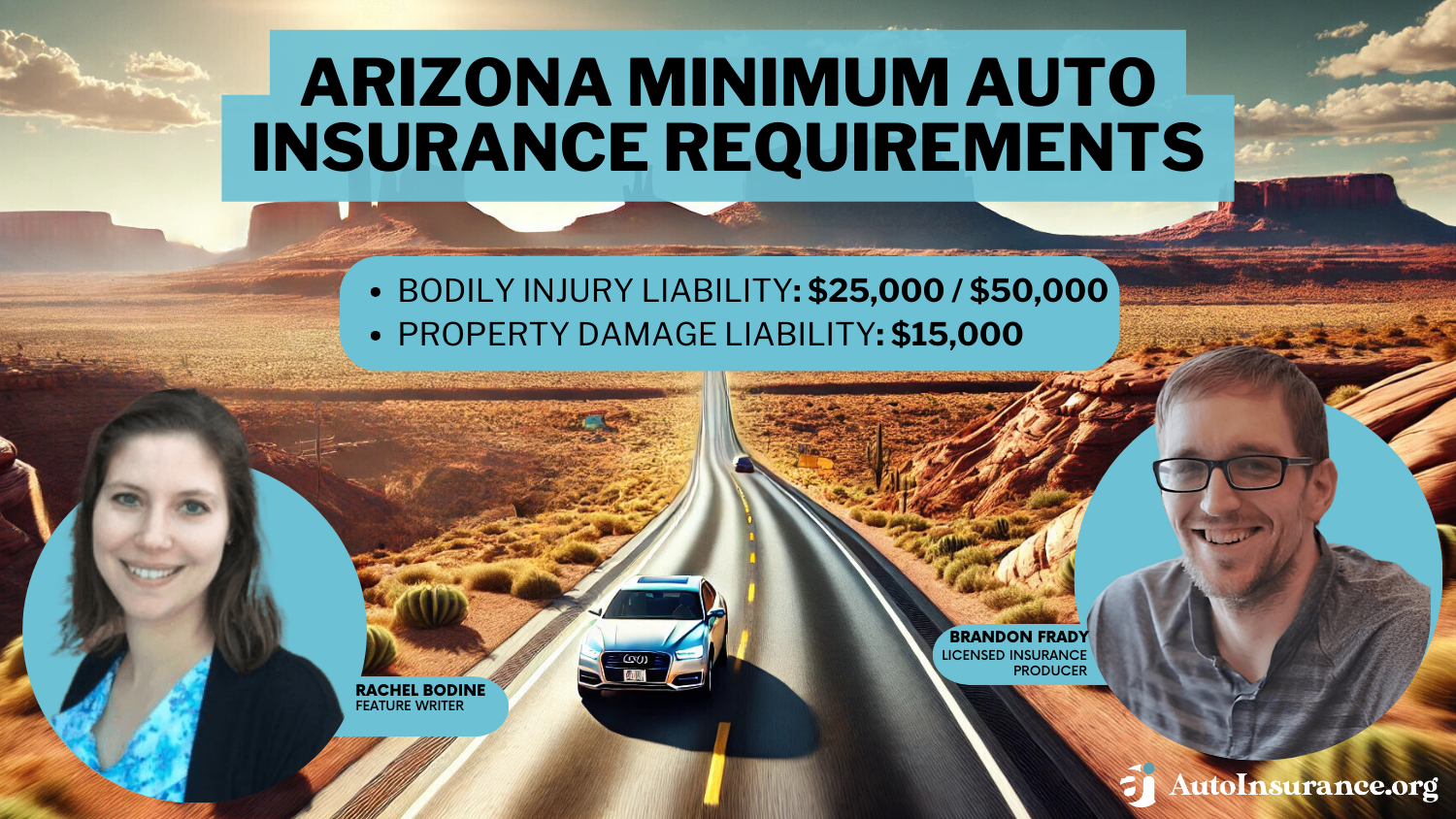
Arizona specifies liability limits using a standard three-number split structure—25/50/15:
- $25,000 for Bodily Injury or Death (Per Person): The maximum amount your insurance carrier pays for medical costs, lost income, and related damages to a single individual injured in an accident for which you are at fault.
- $50,000 for Bodily Injury or Death (Per Accident): The total maximum amount your insurance carrier pays for injuries across all individuals involved in a single accident caused by your vehicle. If multiple people are injured, no single individual can receive more than $25,000, and the total payouts cannot exceed $50,000.
- $15,000 for Property Damage (Per Accident): The maximum amount your insurer pays to repair or replace third-party property, such as another driver's vehicle, street fixtures, utility poles, or buildings damaged in an accident you caused.
| Coverage Type | Statutory Minimum Limit |
|---|---|
| Bodily Injury Liability (Per Person) | $25,000 |
| Bodily Injury Liability (Per Accident) | $50,000 |
| Property Damage Liability (Per Accident) | $15,000 |
It is important to understand that mandatory liability insurance only covers third parties. It does not pay for injuries to the policyholder, damage to the policyholder's own vehicle, or losses resulting from theft, vandalism, or severe weather.
Alternative Forms of Financial Responsibility
While most drivers fulfill the legal mandate through a private vehicle insurance policy, Arizona law allows alternative methods to satisfy financial responsibility under A.R.S. § 28-4076 and related statutes:
- Certificate of Deposit: A cash deposit or certificate of deposit of $75,000 deposited with the Arizona State Treasurer.
- Self-Insurance Certificate: Fleet operators owning 25 or more vehicles registered in Arizona may apply for a certificate of self-insurance through the Arizona Department of Transportation (ADOT) Motor Vehicle Division (MVD), provided they demonstrate sufficient financial solvency to satisfy claims.
Arizona's Fault System and Pure Comparative Negligence
Arizona operates under a traditional tort (fault-based) system for motor vehicle accidents. Unlike "no-fault" states—where drivers rely primarily on their own personal injury protection (PIP) coverage regardless of who caused the crash—in Arizona, the party responsible for causing an accident is financially liable for the resulting physical injuries, personal property destruction, and financial losses.
Pure Comparative Negligence Rule (A.R.S. § 12-2505)
When motor vehicle collisions involve disputing fault, Arizona enforces a pure comparative negligence doctrine under A.R.S. § 12-2505. Under this framework:
- Each party's degree of fault is assigned as a percentage.
- An injured driver can recover monetary damages even if they are largely responsible for the accident.
- The financial recovery awarded to an injured party is reduced directly proportional to their percentage of negligence.
For example, if a court determines that Driver A suffered $100,000 in medical bills and property losses, but Driver A was 30% at fault for speeding, while Driver B was 70% at fault for failing to yield, Driver A can still recover 70% of their total loss ($70,000) from Driver B or Driver B's insurer.
Example Injury Award Calculation (Pure Comparative Fault):
- Total Losses: $100,000
- Driver A Fault Percentage: 30%
- Driver B Fault Percentage: 70%
- Driver A Final Recovery: $70,000 (70% of $100,000)
The primary exception to pure comparative fault occurs if the claimant intentionally caused or contributed to the injury or property damage.
Statute of Limitations
For most personal injury and property damage lawsuits arising from an auto accident in Arizona, A.R.S. § 12-542 establishes a two-year statute of limitations. The clock generally begins ticking on the date the collision occurred. Failing to file a lawsuit within this two-year window usually forfeits the legal right to compensation in court.
ADOT MVD Insurance Verification and Electronic Tracking
The Arizona Department of Transportation Motor Vehicle Division monitors auto insurance compliance statewide through an automated insurance reporting database system.
Insurance Verification Process
Insurance companies authorized to issue policies in Arizona are legally mandated to transmit real-time policy updates directly to ADOT MVD. The system records:
- New policy issuances and bindings
- Policy cancellations and non-renewals
- Lapses or gaps in policy coverage
- Changes in assigned Vehicle Identification Numbers (VINs)
When an insurance company reports a policy cancellation or lapse, MVD automatically cross-references the vehicle's registration record. If the system shows no active policy replacing the cancelled coverage, MVD initiates an automated inquiry process.
MVD Verification Letters and De-Registration
If MVD detects an unverified coverage gap, it mails an Insurance Inquiry Notice to the registered owner. Vehicle owners typically have 15 days from the notice date to provide valid proof of financial responsibility.
If an owner fails to respond or cannot confirm active coverage, MVD immediately suspends the vehicle's registration. Operating a vehicle with a suspended registration in Arizona is a traffic violation that carries additional fines, vehicle impoundment risks, and statutory reinstatement fees.
Penalties for Driving Without Insurance in Arizona
Driving or permitting an uninsured vehicle to operate on public highways in Arizona violates A.R.S. § 28-4135. Courts evaluate non-compliance across sequential offenses committed within a 36-month window.
| Offense Level (36-Mo. Window) | Minimum Fine (Excl. Fees) | License Suspension | Registration Suspension |
|---|---|---|---|
| First Offense | $500 | 3 Months | 3 Months |
| Second Offense | $750 | 6 Months | 6 Months |
| Third+ Offense | $1,000 | 12 Months | 12 Months |
First Offense
- Civil Penalty: Minimum fine of $500 (plus mandatory court surcharges).
- Suspension: Mandatory 3-month suspension of the driver's license, vehicle registration, and license plates.
- Proof Required: Mandatory submission of an SR-22 Certificate of Financial Responsibility for 3 years to clear the suspension.
Second Offense (Within 36 Months)
- Civil Penalty: Minimum fine of $750 (plus statutory court fees).
- Suspension: Mandatory 6-month suspension of the driver's license, vehicle registration, and license plates.
- Proof Required: Submission of an SR-22 filing maintained continuously for 3 years.
Third and Subsequent Offenses (Within 36 Months)
- Civil Penalty: Minimum fine of $1,000 (plus statutory court fees).
- Suspension: Mandatory 12-month suspension of the driver's license, vehicle registration, and license plates.
- Proof Required: Submission of an SR-22 filing maintained continuously for 3 years.
Reductions and Fine Waivers
Judges may reduce or waive financial penalties under A.R.S. § 28-4135 if the driver can prove:
- They have not been convicted of driving uninsured within the preceding 36 months.
- They purchased a compliant six-month auto insurance policy prior to or at their court date.
SR-22 Financial Responsibility Filings in Arizona
An SR-22 is not an insurance policy itself; it is an official certificate issued by an insurance carrier to ADOT MVD certifying that a high-risk driver maintains at least Arizona's mandatory minimum liability insurance limits.
SR-22 Lifecycle & Verification Process
- Suspension Triggered (Lapse, DUI, Uninsured)
- Driver Requests SR-22 Endorsement from Insurer
- Insurer Electronically Transmits SR-22 to MVD
- Mandatory 3-Year Tracking Period Begins
- (Lapse triggers immediate MVD revocation notice)
Triggers for SR-22 Requirements
Arizona drivers are typically required to file an SR-22 following:
- Convictions for driving without mandatory insurance (A.R.S. § 28-4135)
- Driving Under the Influence (DUI) or Extreme DUI convictions
- Reckless driving or aggressive driving convictions
- Suspension due to points accumulation on a driving record
- Involvement in an uninsured accident resulting in injuries or property damage
Duration and Maintenance Rules
- 3-Year Filing Term: Drivers must maintain continuous SR-22 status with MVD for 3 consecutive years.
- Immediate Cancellation Notice (SR-26): If an SR-22 policy lapses, is cancelled, or terminates during the required 3-year term, the insurer must electronically file a Form SR-26 with ADOT MVD.
- Re-suspension Risk: Receipt of an SR-26 prompts MVD to immediately re-suspend the individual's driver's license and vehicle registration. The 3-year requirement clock typically resets upon reinstatement.
Optional Auto Coverages and Statutory Selection Rules
While Arizona statutory law mandates liability insurance, basic liability coverage does not compensate a policyholder for personal physical losses or bodily injuries caused by underinsured third parties. Arizona law dictates specific guidelines for optional coverage selections.
Uninsured and Underinsured Motorist Coverage (A.R.S. § 20-259.01)
Under A.R.S. § 20-259.01, insurance companies writing auto policies in Arizona must offer Uninsured Motorist (UM) and Underinsured Motorist (UIM) coverage in writing:
- Uninsured Motorist (UM): Pays for bodily injuries to you and your passengers if you are hit by a hit-and-run driver or a motorist who carries no liability insurance.
- Underinsured Motorist (UIM): Pays for medical expenses and losses that exceed an at-fault driver's liability coverage limits.
Mandatory Selection/Rejection Form: Insurers must provide policyholders with an official selection/rejection form allowing them to choose UM/UIM limits equal to or less than their liability limits. If a policyholder chooses to reject UM or UIM coverage, the rejection must be executed in writing on an approved form signed by the named insured.
Additional Voluntary Coverages
- Collision Coverage: Covers physical damage to your vehicle resulting from an impact with another vehicle or object, regardless of fault.
- Comprehensive Coverage: Covers physical damage to your vehicle caused by non-collision events, including theft, fire, vandalism, falling objects, hail, flood, or animal collisions.
- Glass Replacement Coverage: Arizona insurance statutes allow policyholders to purchase optional zero-deductible safety glass repair and replacement coverage alongside comprehensive coverage.
- Medical Payments (MedPay): Covers immediate medical, surgical, and funeral expenses for you and your passengers after an accident, regardless of who caused the crash.
- Loan/Lease Gap Insurance: Pays the difference between your vehicle's actual cash value (ACV) and the remaining financial balance owed on a loan or lease if the vehicle is declared a total loss.
Summary of Arizona Vehicle Insurance Coverages
The following matrix compares mandatory legal coverages, common voluntary policies, standard minimum limits, and recommended coverage thresholds for Arizona drivers.
| Coverage Type | Legal Requirement | Minimum Required Limit | Recommended Coverage Limit | Primary Purpose |
|---|---|---|---|---|
| Bodily Injury Liability | Mandatory | $25,000 / $50,000 | $100,000 / $300,000 | Pays third-party medical costs, lost wages, and pain/suffering when you cause an accident. |
| Property Damage Liability | Mandatory | $15,000 per accident | $50,000 to $100,000 | Pays for third-party vehicle repairs and property damage caused by your vehicle. |
| Uninsured Motorist (UM) | Optional (Must be offered in writing) | Rejection form required if declined | Equal to Bodily Injury limits ($100k/$300k) | Pays your medical expenses if struck by an uninsured or hit-and-run driver. |
| Underinsured Motorist (UIM) | Optional (Must be offered in writing) | Rejection form required if declined | Equal to Bodily Injury limits ($100k/$300k) | Covers remaining medical expenses when an at-fault driver's insurance limits are exhausted. |
| Collision Coverage | Optional (Lender required if financed) | Optional (Deductible varies: $500–$1,000) | Actual Cash Value (ACV) of vehicle | Repairs or replaces your vehicle after an accident, regardless of fault. |
| Comprehensive Coverage | Optional (Lender required if financed) | Optional (Deductible varies: $250–$1,000) | Actual Cash Value (ACV) of vehicle | Protects your vehicle against theft, storm damage, flood, vandalism, and animal strikes. |
| Medical Payments (MedPay) | Optional | Optional ($1,000–$5,000 standard) | $5,000 to $10,000 | Pays immediate medical bills for you and passengers regardless of liability. |
| SR-22 Filing | Conditional (Court/MVD mandated) | Mandatory 25/50/15 underlying limits | 25/50/15 minimum (or higher) | State certificate demonstrating active continuous liability insurance for high-risk drivers. |
How to Resolve an MVD Insurance Suspension Step-by-Step
If ADOT MVD issues a notice suspending your vehicle registration or driver's license due to an alleged insurance lapse, follow this procedure to restore full driving privileges.
- Step 1: Check Suspension Status via AZ MVD Now
- Step 2: Obtain Compliant Insurance Coverage (or SR-22 if mandated)
- Step 3: Confirm Electronic Filing Transmission by Insurer to MVD
- Step 4: Pay Reinstatement Fees Online or at an MVD Service Center
- Step 5: Verify Active Driving & Registration Status Before Operating Vehicle
Step 1: Verify Suspension Details
Log into your official AZ MVD Now account or review your physical suspension letter. Note whether the suspension applies to your driver's license, vehicle registration, or both, and confirm if an SR-22 filing is required.
Step 2: Secure Compliant Auto Insurance Coverage
Contact a licensed insurance agent or company operating in Arizona:
- If your policy was erroneously flagged, request that your current insurer resend electronic proof of continuous coverage to MVD.
- If your coverage lapsed, purchase a new policy meeting or exceeding Arizona's 25/50/15 liability limits.
- If an SR-22 is required, explicitly request an SR-22 endorsement when purchasing the policy.
Step 3: Ensure Electronic Transmission to MVD
Arizona MVD requires direct verification from the insurance provider. Do not rely solely on paper insurance cards. Confirm with your insurance company that they have submitted your policy details (or Form SR-22) electronically into the ADOT MVD insurance database.
Step 4: Pay Required Reinstatement Fees
After MVD logs your valid insurance coverage, pay the applicable reinstatement fees:
- Standard Registration Reinstatement Fee: Typically $50 per vehicle.
- Driver's License Reinstatement Fee: Varies based on age and suspension reason (typically ranges from $10 to $50).
- Fees can be paid online via AZ MVD Now or in person at an authorized MVD office or Authorized Third Party provider location.
Step 5: Receive Written Reinstatement Clearance
Verify through AZ MVD Now that your driver's license and vehicle registration statuses show as Active/Valid before operating the vehicle on public roads.
Legal Requirements for Out-of-State Drivers and New Residents
New Arizona Residents
Under A.R.S. § 28-2001, individuals establishing residency in Arizona must register their vehicles and obtain an Arizona driver's license immediately upon establishing residency. Arizona residency is established if you:
- Obtain employment in Arizona
- Place children in a public school without paying out-of-state tuition
- Remain in Arizona for more than seven consecutive months
- Register to vote in Arizona
Out-of-state auto insurance policies are not accepted for registering a vehicle in Arizona. You must transfer your policy to an Arizona-compliant policy written by an insurer licensed by the Arizona Department of Insurance and Financial Institutions (DIFI).
Temporary Visitors and Seasonal Residents ("Snowbirds")
Seasonal visitors who retain their primary legal residence in another state may operate their vehicles in Arizona using valid out-of-state license plates and insurance, provided the vehicle is not housed or operated in Arizona for more than seven months in a calendar year and the driver does not accept local employment.
Frequently Asked Questions
Does Arizona accept digital proof of auto insurance during traffic stops?
Yes. Under Arizona law, drivers may show proof of financial responsibility during traffic stops or after an accident using an electronic device, such as a digital insurance card displayed on a smartphone or tablet. Physical paper insurance cards remain equally valid.
What happens if I store or park an uninsured vehicle in Arizona long-term?
If a registered vehicle is parked or stored on private property and not driven on public roads, you can submit a De-Insured Certificate to ADOT MVD. This official notification informs MVD that the vehicle is temporarily out of service, preventing automatic registration suspension when liability coverage is paused. The vehicle cannot be driven on any public street until active insurance is restored and reported to MVD.
Are insurance rates impacted if I carry an SR-22 in Arizona?
An SR-22 filing itself carries a minor processing fee (typically $15–$25 charged by the insurance carrier), but the underlying driving violations triggering the SR-22 requirement (such as a DUI or driving without insurance) usually cause significant increases in auto insurance premiums. High-risk drivers often face higher rates for the duration of the 3-year SR-22 requirement.
Does auto insurance follow the car or the driver under Arizona law?
In Arizona, auto insurance primarily follows the vehicle. If you lend your insured car to a permissive user (a friend or family member who has your permission to drive), your liability coverage acts as primary insurance in the event of an accident. The driver's insurance policy typically serves as secondary or excess coverage.
What is the legal penalty for presenting fraudulent proof of insurance in Arizona?
Presenting false, forged, or altered proof of financial responsibility to law enforcement or ADOT MVD is a severe offense in Arizona. Under statutory rules, submitting fraudulent insurance documentation can be charged as a Class 2 Misdemeanor, resulting in fines, mandatory driver's license suspension, and potential criminal prosecution.
Strategic Recommendations for Arizona Motorists
- Select Limits Above Mandatory Minimums: Arizona's 25/50/15 minimum liability limits offer basic legal compliance, but modern medical expenses and vehicle replacement costs can easily exceed these figures in a major crash. Carrying higher liability limits (such as 100/300/50 or 250/500/100) helps protect personal assets from court judgments.
- Retain Uninsured/Underinsured Motorist Coverage: Due to the relatively high percentage of uninsured drivers nationwide, rejecting UM and UIM coverage creates substantial financial risk. Maintain UM/UIM limits equal to your primary bodily injury liability limits.
- Avoid Coverage Lapses During Vehicle Storage: Never cancel insurance on a registered vehicle without filing a De-Insured Certificate with MVD. An unannounced cancellation triggers automated registration suspension notices and statutory reinstatement fees.
- Confirm Electronic Insurer Filings: Whenever you switch insurance carriers or renew an SR-22 endorsement, log into AZ MVD Now within 10 days to verify that your new carrier has submitted electronic proof of financial responsibility directly to the state database.
Disclaimer: This guide is provided for educational and informational purposes only and does not constitute legal or financial advice. Statutory limits, administrative rules, and enforcement policies are subject to legislative updates. For official state regulations, consult the Arizona Revised Statutes, the Arizona Department of Transportation (ADOT) Motor Vehicle Division, or a licensed Arizona legal professional.