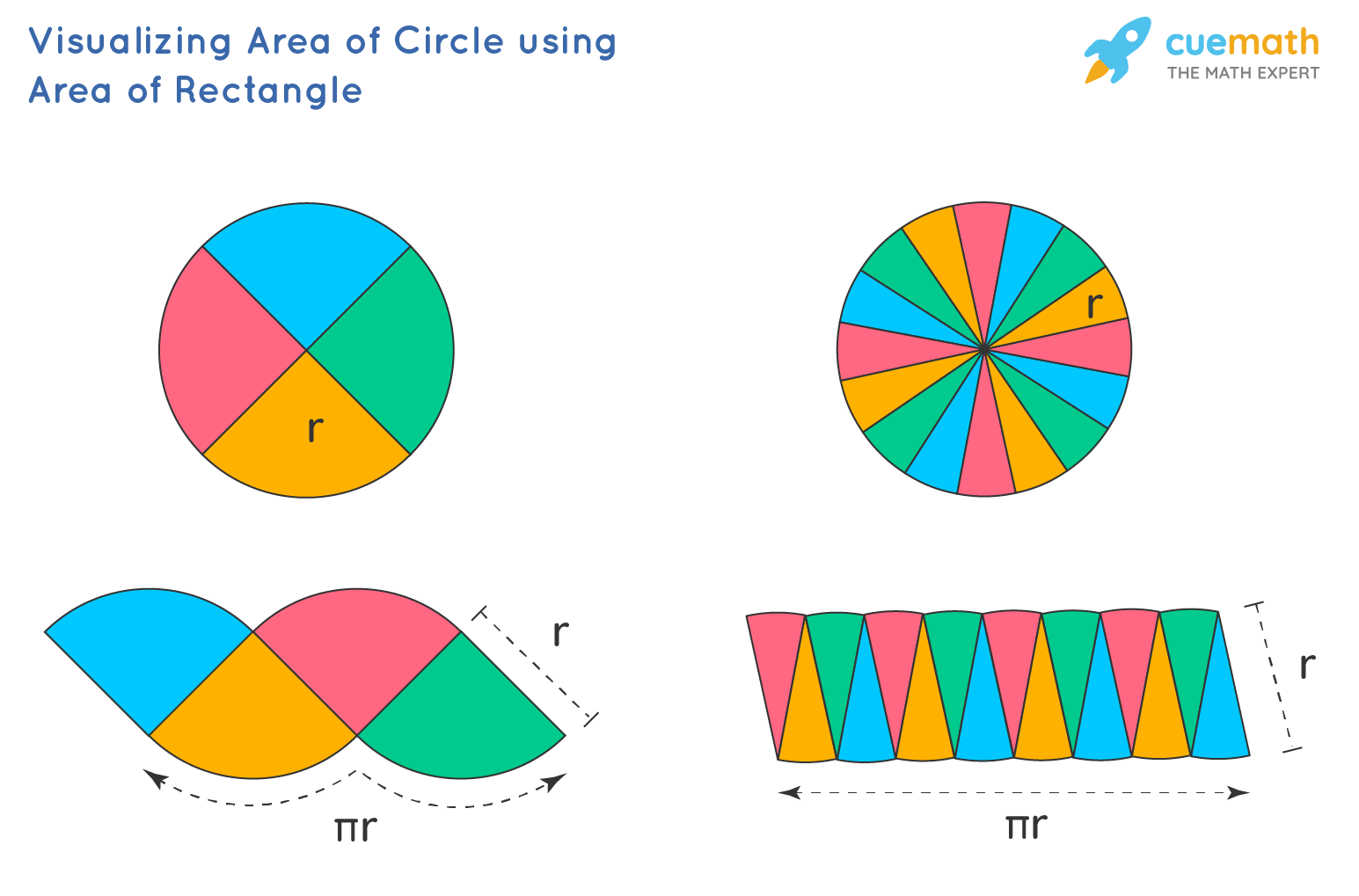
The area of a semicircle is exactly half the area of a full circle with the same radius. To calculate it, you must first determine the area of the full circle using the formula πr² and then divide that result by two, resulting in the expression A = (πr²)/2, where A represents the area and r is the radius of the semicircle.
Understanding the Geometry of a Semicircle
A semicircle is a one-dimensional locus of points that forms half of a circle. Geometrically, it is defined by a diameter—a straight line segment that passes through the center of the circle and connects two points on the circumference—and the arc that connects those same two points. Because a circle is defined by its radius (the distance from the center to any point on the edge), a semicircle inherits this radius.
When we discuss the "area" of a shape, we are measuring the two-dimensional space enclosed within its boundaries. For a full circle, the area is derived from the constant pi (π), an irrational number approximately equal to 3.14159, multiplied by the square of the radius. Since a semicircle is functionally a bisected circle, the spatial calculation requires exactly half of the total plane defined by the full circle's parameters.
The Mathematical Derivation
The standard formula for the area of a full circle is:
A_circle = π × r²
Where:
- A_circle is the area of the circle.
- π (pi) is approximately 3.14159.
- r is the radius (the distance from the center to the edge).
To find the area of a semicircle, we conceptually slice the circle in half along its diameter. Mathematically, this is expressed by dividing the full circle formula by two:
A_semicircle = (π × r²) / 2
It is critical to note that the radius (r) is the distance from the midpoint of the diameter to the outer arc. In some real-world applications, you may only be provided with the diameter (d). Because the diameter is twice the radius (d = 2r), you must first divide the diameter by two to obtain the radius before you can apply the area formula correctly. Failing to convert the diameter to a radius is the most common error in manual geometric calculations.
Step-by-Step Calculation Process
To calculate the area of a semicircle accurately, follow this structured workflow. Ensure that all measurements are in the same units (e.g., centimeters, inches, or meters) before beginning the math.
- Identify the Radius: Determine the length of the radius. If you only have the diameter, divide it by two.
- Square the Radius: Multiply the radius by itself (r × r = r²).
- Multiply by Pi: Take your squared radius and multiply it by π (using 3.14159 for a standard level of precision).
- Divide by Two: Take the resulting product and divide it by two to account for the semicircular shape.
- Assign Units: Ensure your final answer is expressed in square units (e.g., cm², in², m²) because you are measuring area, not length.
Practical Example
If you have a window in the shape of a semicircle with a diameter of 10 feet, the calculation would proceed as follows:
- Radius: 10 / 2 = 5 feet.
- Square the radius: 5 × 5 = 25 square feet.
- Multiply by π: 25 × 3.14159 = 78.53975.
- Divide by two: 78.53975 / 2 = 39.269875.
- Final Result: Approximately 39.27 square feet.
Comparison: Area vs. Perimeter (Circumference)
Beginners often confuse the area of a semicircle with the perimeter of a semicircle. While the area measures the surface, the perimeter measures the distance around the boundary.
| Feature | Area Calculation | Perimeter Calculation |
|---|---|---|
| Formula | (π × r²) / 2 | πr + 2r |
| Dimension | Two-dimensional (Square units) | One-dimensional (Linear units) |
| Core Components | Radius squared and Pi | Radius and Pi plus the diameter |
| Common Use | Floor space, paint coverage, fabric | Fencing, trim, molding, edges |
The perimeter of a semicircle includes both the curved arc (which is half of the circle's circumference, or πr) and the straight diameter line (which is 2r). Therefore, the total perimeter is calculated as πr + 2r. Always verify whether a project requires an area estimate or a perimeter estimate before choosing your formula.
Common Pitfalls and Troubleshooting
Even with a simple formula, technical errors frequently arise in practical settings.
Unit Mismatch
One of the most frequent issues occurs when users calculate the area using mixed units, such as using a radius in inches while trying to determine the area in square feet. Always standardize your measurements at the start. If your measurements are in different units, convert them all to the same unit before performing any multiplication.
The Diameter-Radius Confusion
As mentioned, the formula requires the radius, not the diameter. If you accidentally use the full diameter as the value for "r," your result will be four times larger than it should be (since (2r)² = 4r²). Always double-check your initial measurement label. If the measurement is labeled "diameter," immediately divide by two.
Rounding Errors
When dealing with π, the degree of precision you choose will impact your final result. For most architectural or construction projects, using 3.14 or 3.14159 is sufficient. However, if you are working on high-precision engineering, ensure you use a more precise value or the π function available on your calculator. Consistent rounding—generally to two decimal places—is standard practice for most non-scientific applications.
Choosing the Right Precision
In 2026, most digital tools and CAD software (Computer-Aided Design) handle the value of π to dozens of decimal places automatically. If you are calculating the area of a semicircle for a DIY home project, such as a garden bed or a circular rug cut in half, rounding to two decimal places is usually more than enough. If you are ordering materials based on this calculation, always round up to the nearest whole unit to ensure you have enough supplies.
Frequently Asked Questions
What is the area of a semicircle with a 4-inch radius? To find the area, you square the radius (4 × 4 = 16), multiply by π (16 × 3.14159 ≈ 50.265), and divide by two. The area is approximately 25.13 square inches.
Does the formula change if the semicircle is vertical or horizontal? No. The orientation of the shape does not change its geometric properties. Whether the flat side of the semicircle is at the top, bottom, left, or right, the area calculation remains (πr²)/2.
What is the most accurate value to use for pi? For most practical applications, 3.14159 is sufficient. If you are using a scientific calculator, utilize the dedicated π button, which provides the constant to the maximum precision allowed by the device.
Can I calculate the area if I only know the arc length? Yes, but you must first calculate the radius. The arc length of a semicircle is πr. Therefore, you can find the radius by dividing the arc length by π (r = arc_length / π), and then proceed with the area formula.
Why does the perimeter formula add 2r while the area does not? The area represents the space inside, which is simply half of a circle. The perimeter represents the "skin" or edge of the shape, which includes not only the curved half-circle (πr) but also the straight diameter line (2r) that closes the shape.
Next Steps and Practical Application
To apply this knowledge effectively, identify the specific component of your project. If you are calculating floor space for a semicircular rug or a tiled patio section, use the formula (πr²)/2. If you find yourself frequently needing these calculations, consider using a spreadsheet or a dedicated geometric calculation app where you can input the radius once and receive both the area and the perimeter instantly. Always perform a "sanity check" by rounding your numbers to simple integers to ensure your result falls within a logical range before finalizing any material purchases.