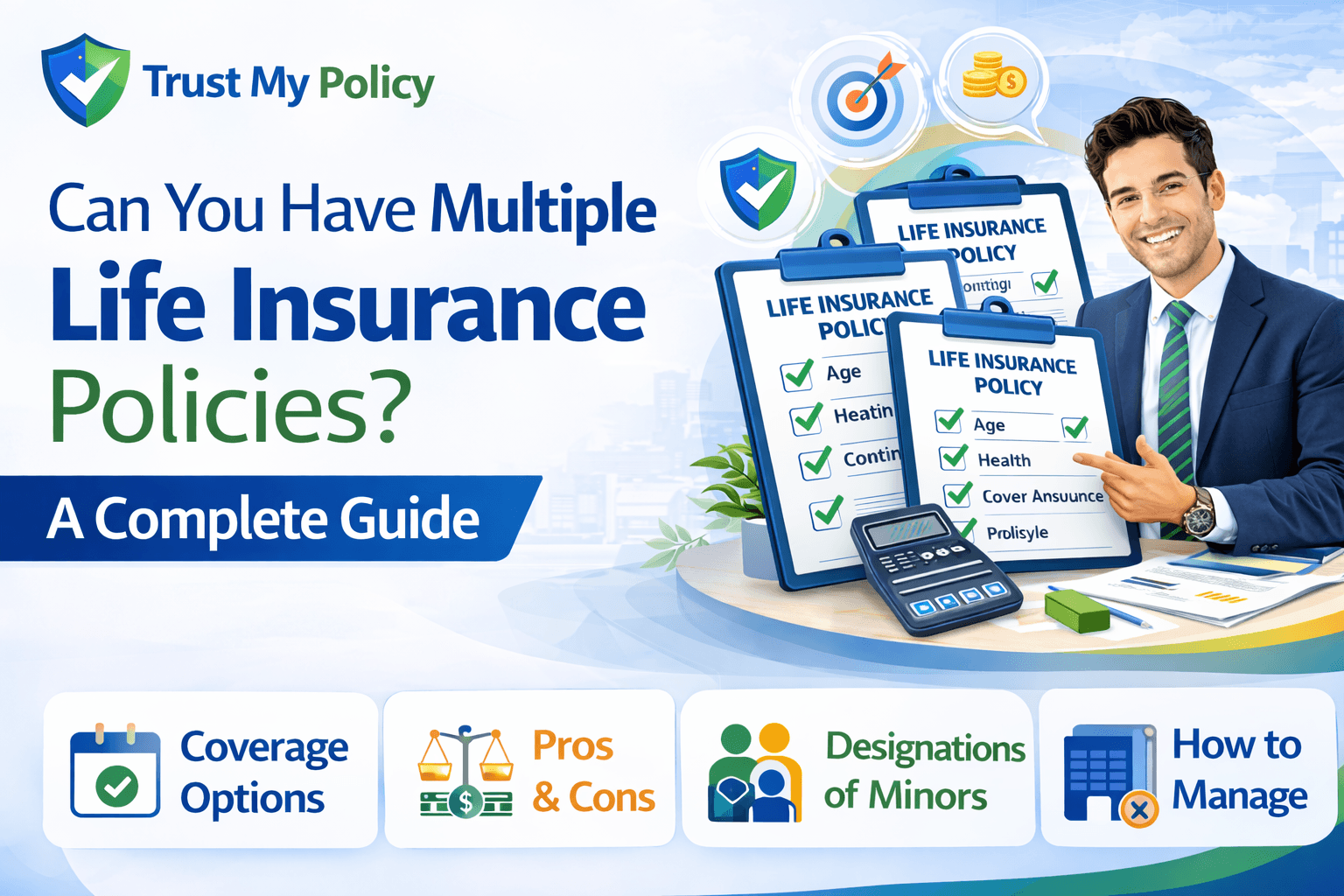
You can legally apply to multiple life insurance companies simultaneously to compare real-time offers or secure total coverage that exceeds a single carrier's capacity. While this strategy helps identify the lowest premiums, you must disclose all active applications to prevent underwriting delays and ensure your total requested death benefit aligns with your financial profile.
The Logic Behind Applying to Multiple Life Insurance Carriers
The life insurance landscape in 2026 remains highly competitive, with carriers utilizing increasingly granular data to price risk. For many consumers, submitting a single application is sufficient. However, specific scenarios make "multi-apping" a sophisticated and necessary financial move. Understanding the motivations behind this strategy is the first step in executing it correctly without triggering fraud alerts or underwriting rejections.
Rate Shopping and Competitive Underwriting
The primary reason for applying to more than one company is price discovery. While online quotes provide a baseline, the final "table rating" (your risk category) is only determined after a full underwriting review. One company might view controlled Type 2 diabetes as a "Standard" risk, while another might offer "Preferred" rates based on more favorable internal data regarding specific A1C levels. By applying to two or three companies, you force carriers to compete for your business, allowing you to accept the most cost-effective policy and withdraw the others.
Diversifying Large-Scale Coverage
High-net-worth individuals often require death benefits exceeding $20 million or $30 million. A single insurance company has a "retention limit"—the maximum amount of risk they are willing to keep on their own books before relying on reinsurance. If your total coverage needs are massive, applying to multiple companies allows you to "layer" your coverage, ensuring that no single carrier is over-exposed and that you aren't subject to the more stringent requirements of a specific reinsurer.
Ensuring Backup Options
If you have a complex medical history or a high-risk occupation (such as aviation or specialty construction), there is a non-negligible chance of a "decline" or an "offer with an exclusion." Applying to a primary carrier and a "backup" carrier simultaneously saves time. If the first company declines the application in 2026, you are already halfway through the process with the second, rather than starting from scratch and losing another 4–6 weeks.
The Role of the MIB and Underwriting Transparency
When you apply for life insurance, you are not acting in a vacuum. Most insurance companies in North America are members of the MIB Group, Inc. (formerly the Medical Information Bureau). This organization acts as a data-exchange clearinghouse designed to prevent fraud and "anti-selection."
How the MIB Tracks Your Applications
The moment you sign a formal application, a record is created in the MIB database. This record does not contain your entire medical file, but it does flag that an application was made and notes any significant medical or lifestyle "impairments" discovered during underwriting. If you apply to Company A and tell them you don't smoke, but Company B discovers nicotine in your lab work, Company A will see an MIB code indicating a discrepancy.
The Requirement of Disclosure
Every life insurance application contains a question similar to: "Do you have any other life insurance applications currently pending or do you intend to apply for other coverage?" You must answer this truthfully. Failure to disclose multiple applications is considered a material misrepresentation. In 2026, underwriters are particularly sensitive to "stacking"—the practice of taking out multiple small policies to circumvent the financial scrutiny applied to one large policy. If an underwriter sees three pending applications for $1 million each but you only reported one, they may suspend your file until the intent of the total $3 million coverage is clarified.
Formal vs. Informal Applications
To manage your record with the MIB and avoid unnecessary "hits" on your file, it is vital to distinguish between formal and informal applications.
The Informal Inquiry (Trial Application)
For those with significant health issues, the "informal" route is the gold standard. In this process, your broker sends an anonymized summary of your health (often called a "quick quote" or "trial app") to several underwriters. Because no formal application is signed, no record is sent to the MIB. The underwriters provide a tentative offer based on the data provided. Once you receive the most favorable tentative offer, you proceed with a single formal application.
The Formal Concurrent Application
This involves submitting full, signed applications to two or more carriers at once. This is common when a consumer is healthy but wants to see which company will provide the fastest "Accelerated Underwriting" (no-exam) approval. In 2026, many carriers use AI-driven algorithms to approve policies within hours. By applying to two, you increase the odds of getting a "jet-issued" policy without a medical exam.
Managing the Medical Exam Requirement
One of the biggest deterrents to applying to multiple companies is the prospect of undergoing multiple medical exams. Fortunately, the industry has standardized the "paramedical exam" process.
Exam Sharing and Portability
If you apply to multiple companies, you should only take one medical exam. These exams are usually performed by third-party vendors like ExamOne or APPS. Once the results are in, you or your broker can request that the "lab slip" and the examiner's report be shared with the other participating insurance companies.
Requirements for successful exam sharing:
- The exam must typically have been completed within the last six months (though some carriers in 2026 accept exams up to 12 months old for younger applicants).
- The exam must have been "authorized" by a carrier that uses the same paramedical vendor.
- The scope of the exam must meet the highest common denominator (e.g., if one company requires a resting EKG but the other does not, you must ensure the EKG is performed during the initial exam).
| Feature | Simultaneous Formal Apps | Sequential Applications | Informal/Trial Inquiries |
|---|---|---|---|
| Speed to Coverage | High (Concurrent) | Low (Step-by-step) | Moderate |
| MIB Impact | Multiple records created | One record at a time | No record created |
| Best For | Healthy rate-shoppers | Undecided buyers | High-risk medical cases |
| Broker Involvement | Highly Recommended | Optional | Essential |
| Financial Scrutiny | Total amount is aggregated | Only current app viewed | No financial deep-dive |
Financial Underwriting and the "Total Line" Limit
Insurance companies perform two types of underwriting: medical and financial. Even if you are in perfect health, you cannot buy an infinite amount of life insurance. Each company has "Income Replacement Multiples" that dictate how much coverage you are eligible for based on your age and earnings.
The Calculation of Over-Insurance
In 2026, a standard multiple for a 40-year-old might be 20 to 25 times their annual income. If you earn $100,000 per year, your total "line" of insurance is generally capped at $2.5 million across all companies.
If you apply to Company A for $2.5 million and Company B for $2.5 million, both companies will see the other’s pending application. Unless you specify that you only intend to choose one of the two, the underwriters will assume you are trying to obtain $5 million in total coverage. If your income does not justify $5 million, both applications may be declined or "postponed" until you prove that one application has been withdrawn.
The Concept of "Jumbo Limits"
For very high death benefits (usually $35 million or more in 2026), carriers enter "Jumbo Limit" territory. This is a threshold where the total amount of insurance in force plus the amount currently being applied for triggers mandatory reinsurance review. If you are applying to multiple companies for large sums, it is critical to coordinate through a single point of contact to ensure you don't inadvertently trip these jumbo limits, which can lead to significantly more invasive financial auditing, including requests for tax transcripts and audited financial statements.
Common Pitfalls When Applying to Multiple Companies
While the benefits of multi-apping are clear, several errors can jeopardize your ability to get covered at all.
- Inconsistent Information: If you tell Company A you have never used tobacco but tell Company B you use occasional cigars, the discrepancy will be flagged via the MIB. Consistency across all applications is mandatory.
- Double-Binding Coverage: It is a mistake to pay the initial premium (binding the coverage) for multiple policies at once unless you actually intend to keep all of them. This can create "coordination of benefits" issues and complicate the refund process during the "Free Look Period."
- Application Fatigue: Managing three or four sets of follow-up questions from different underwriters can be exhausting. Every company has a different "Phone Interview" or "Digital Health Questionnaire."
- Broker Conflict: Applying through multiple different brokers for the same company is a major red flag. It creates "commission "scraps" and can lead to companies refusing to work on the file until one broker is designated as the "Broker of Record."
Using the "Free Look Period" to Your Advantage
In 2026, most jurisdictions mandate a Free Look Period, typically lasting between 10 and 30 days. This is a consumer protection window that begins the day you receive your physical or digital policy contract.
If you have applied to multiple companies and Company A sends you a policy, but you are still waiting on a final decision from Company B, you can accept the policy from Company A to ensure you have coverage in place. If Company B eventually comes back with a significantly lower rate, you can "Free Look" the first policy—canceling it for a full refund of all premiums paid—and move forward with Company B. This ensures you are never without coverage while you wait for the best possible offer.
Strategic Recommendation
For the average consumer in 2026, the most efficient way to handle multiple applications is to work with an independent insurance broker rather than a "captive" agent (who only works for one company).
An independent broker can:
- Submit informal inquiries to 5–10 carriers to gauge interest.
- Narrow the field to the top 2 contenders.
- Submit formal applications to those two companies simultaneously.
- Coordinate a single medical exam to be shared between them.
- Negotiate the final "offer" by playing the two companies against each other.
This "controlled multi-app" strategy provides the benefits of price competition while minimizing the risk of MIB flags or financial underwriting hurdles.
Frequently Asked Questions
Does applying for multiple life insurance policies hurt my credit score?
No. Life insurance companies typically perform a "soft pull" on your credit report or use specialized insurance scores (like LexisNexis Risk Classifier). These inquiries do not impact your FICO score, unlike the "hard pulls" associated with credit cards or mortgages. You can apply to multiple companies without damaging your creditworthiness.
Can I have multiple life insurance policies from different companies?
Yes, you can own as many policies as you like, provided that the total combined death benefit is within the financial limits allowed for your income and net worth. Many people "layer" policies, such as having a 20-year term policy for their mortgage and a permanent whole life policy for estate planning.
What happens if I am declined by one company while applying to others?
A decline is recorded in the MIB. Other companies you have applied to will see that a decline occurred, but they are not required to decline you as well. They will, however, ask for the reason for the decline. If the decline was for a reason that the second company is more lenient about (e.g., a specific high-risk hobby), you may still be approved.
Is it better to apply to companies one after another or at the same time?
If you are in a rush or want to compare current rates, applying at the same time (simultaneously) is better. If you are not in a hurry and want to keep your MIB file "cleaner," applying sequentially allows you to see the result of one application before starting the next. For most, the simultaneous approach with 2 carriers is the ideal balance of speed and competition.
Will multiple applications cause a delay in my approval?
Potentially. If the underwriters see multiple pending applications and you haven't explained why, they may pause the process to ensure you aren't "over-insuring" yourself. Providing a "Cover Letter of Intent" through your broker that explains you are rate-shopping or layering coverage can prevent these delays.
What is "anti-selection" and why does it matter for multiple apps?
Anti-selection occurs when an applicant has more information about their high risk than the insurer does. Applying to many companies simultaneously can sometimes look like an attempt to "find a hole" in the underwriting systems. To avoid this perception, always be transparent about your health and your reasons for seeking multiple quotes.
Specific Action Plan: If you are seeking the best rates in 2026, identify two top-rated carriers through an independent broker. Submit formal applications to both, request a single medical exam, and authorize the vendor to share the results. Ensure your broker includes a note in the "Agent's Remarks" section stating that you are comparing offers to secure the best market rate.