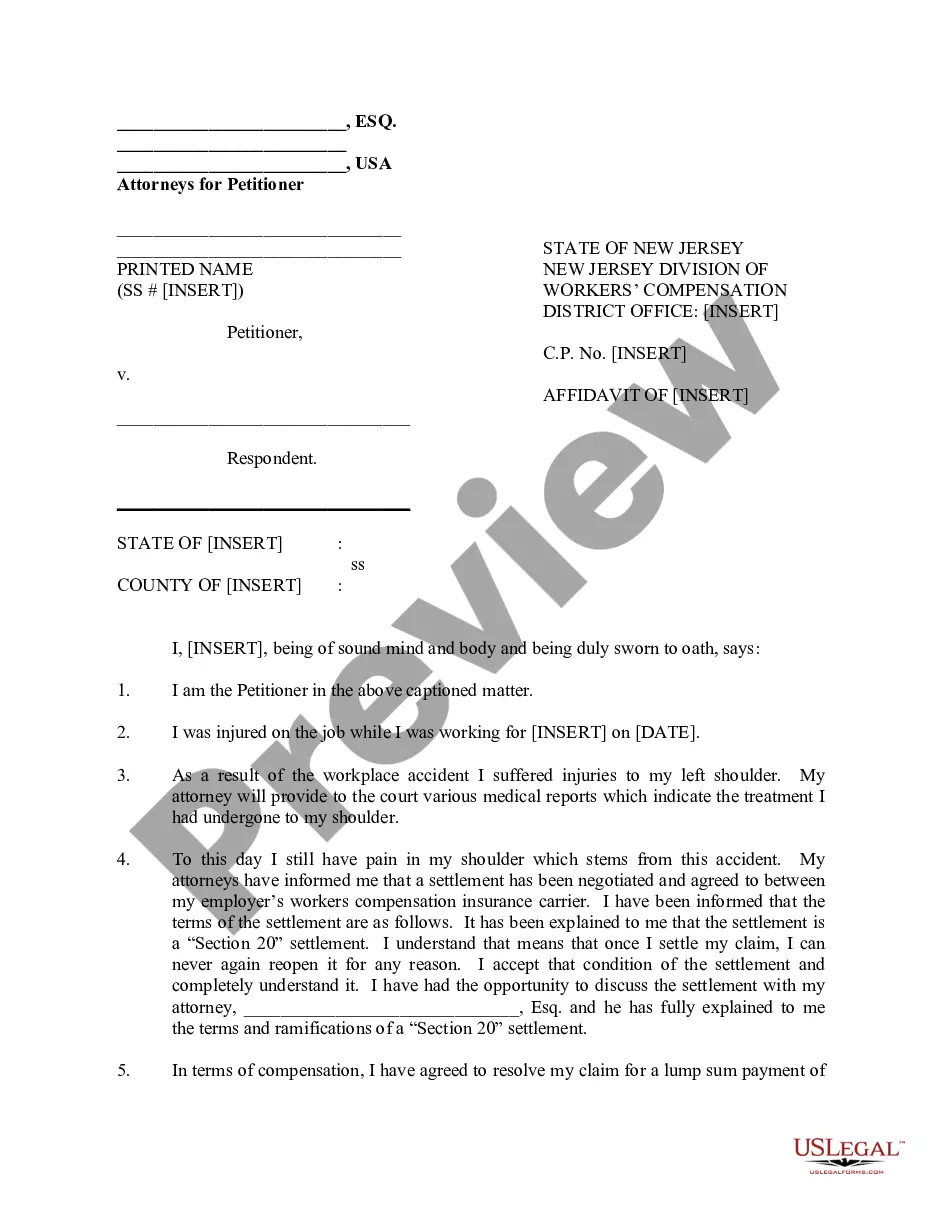
To apply for workers’ compensation in New Jersey, you must first notify your employer of your injury or illness immediately. Your employer then notifies their insurance carrier to open a claim. If benefits are denied or medical treatment is insufficient, you may file a formal Claim Petition or an Application for an Informal Hearing with the New Jersey Division of Workers’ Compensation.
The New Jersey workers' compensation system is a "no-fault" insurance program designed to provide medical treatment, wage replacement, and permanent disability compensation to employees who suffer job-related injuries or illnesses. Unlike a personal injury lawsuit, you do not need to prove your employer was negligent to receive benefits. However, the application process involves strict adherence to deadlines, specific reporting requirements, and a specialized legal framework governed by the New Jersey Department of Labor and Workforce Development.
As of 2026, the procedural requirements remain grounded in the New Jersey Workers' Compensation Act, though specific benefit rates and digital filing systems have evolved. Understanding the distinction between "starting a claim" and "filing a legal petition" is essential for any worker navigating the system.
The First Step: Reporting the Injury to Your Employer
The "application" for workers’ compensation begins the moment you notify your employer. In New Jersey, you are not required to fill out a specific state form to initiate the insurance process; rather, notice to the employer triggers the employer’s obligation to notify their insurance carrier.
Verbal vs. Written Notice
While New Jersey law allows for verbal notice to a supervisor, manager, or personnel office, written notice is highly recommended. A written record provides a timestamp and proof of reporting should the employer later claim they were unaware of the incident. This notice should include:
- The date and time of the accident.
- The specific location where the injury occurred.
- A description of the task you were performing.
- The specific body parts injured.
- Names of any witnesses.
The 14-Day and 90-Day Rules
New Jersey statutes are strict regarding notification timelines. You should report the injury as soon as possible, ideally within 14 days. Failure to provide notice within 90 days can result in a total loss of benefits, unless the employer had "actual knowledge" of the injury. Actual knowledge might occur if a supervisor witnessed the accident or if you were taken from the job site to a hospital by an employer-provided vehicle.
The Employer’s Responsibility and the FROI
Once you have reported the injury, the responsibility shifts to the employer. Under New Jersey law, the employer or their insurance carrier must file a First Report of Injury (FROI) electronically with the Division of Workers’ Compensation.
The Role of the Insurance Carrier
After the FROI is filed, the insurance carrier investigates the claim. They will determine if the injury "arose out of and in the course of employment." If the claim is accepted, the carrier will:
- Assign an authorized medical provider: In New Jersey, the employer or carrier has the legal right to choose the doctor who treats you.
- Initiate medical payments: All necessary and reasonable medical treatment is paid directly by the insurer.
- Calculate Temporary Disability Benefits: If you are unable to work for more than seven days, the carrier will begin paying wage replacement benefits.
Dealing with Authorized Medical Providers
One of the most common friction points in the NJ application process is medical control. If you seek treatment from your own primary care physician without prior authorization, the insurance carrier is generally not responsible for those bills. The only exception is emergency treatment where the employer was unavailable to provide authorization or refused to do so.
Filing a Formal Claim Petition (The Legal "Application")
If your employer denies the claim, stops paying benefits prematurely, or if you believe you have sustained a permanent disability, you must move beyond the administrative claim and file a legal document known as a Claim Petition.
When to File a Petition
Many workers assume that receiving "workers' comp checks" means their case is fully resolved. In reality, an administrative claim with the insurance company does not guarantee compensation for permanent damage. To secure a permanent disability award, you must file a Claim Petition with the Division of Workers’ Compensation.
The Statute of Limitations
In New Jersey, the statute of limitations for filing a formal Claim Petition is two years from the date of the accident or two years from the date of the last payment of compensation (whichever is later). This is a hard deadline. If you fail to file within this window, you lose the right to pursue benefits forever, regardless of the severity of the injury.
The Role of the OSCAR System
As of 2026, all formal filings are handled through the Online System for Claims Administration and Registration (OSCAR). While pro se (self-represented) filings are permitted, the vast majority of Claim Petitions are filed by attorneys. New Jersey law limits attorney fees in workers' compensation cases to 20% of the award, and these fees are only paid if the attorney wins the case. Often, a portion of the fee is paid by the insurance carrier rather than the worker.
Understanding the Two Paths: Informal vs. Formal
The New Jersey Division of Workers’ Compensation provides two distinct avenues for resolving disputes. Choosing the right one depends on the complexity of your case and whether you seek a final, binding judgment.
| Feature | Informal Hearing | Formal Claim Petition |
|---|---|---|
| Purpose | Quick resolution of minor disputes (e.g., unpaid medical bills). | Determination of permanent disability and long-term benefits. |
| Presiding Official | Judge of Compensation (advisory capacity). | Judge of Compensation (binding authority). |
| Binding Nature | Recommendations are non-binding; either party can reject. | Resulting "Order for Judgment" is legally binding. |
| Legal Representation | Encouraged but not mandatory. | Highly recommended due to procedural complexity. |
| Statute of Limitations | Does NOT stop the 2-year clock. | Effectively stops the 2-year statute of limitations. |
| Timeline | Typically resolved in weeks or a few months. | Can take 12 to 24 months for a full resolution. |
Types of Benefits Available in 2026
When you apply for workers' compensation in NJ, you are essentially applying for three primary categories of benefits. The rates for these benefits are adjusted annually based on the New Jersey State Average Weekly Wage (SAWW).
1. Medical Benefits
The employer must provide "necessary and reasonable" medical treatment, prescriptions, and hospital services. In 2026, this includes advanced diagnostic tools and rehabilitation services. There is no monetary cap on medical benefits, provided they are curative or provide relief from the effects of the injury.
2. Temporary Disability Benefits (TTD)
If you are unable to work for more than seven days, you are eligible for TTD. These benefits are paid at 70% of your average weekly wage, subject to state-mandated minimums and maximums. TTD continues until you return to work or reach Maximum Medical Improvement (MMI), which is the point where further treatment will not significantly improve your condition.
3. Permanent Disability Benefits
Once treatment is finished, a worker may be eligible for permanent disability.
- Permanent Partial Disability (PPD): This is based on a "schedule" of body parts (e.g., loss of use of a hand, leg, or eye) or "non-scheduled" injuries (e.g., back or heart). Compensation is determined by the degree of functional loss.
- Permanent Total Disability (PTD): If the injury prevents you from performing any type of gainful employment, you may receive weekly benefits for life, provided you remain totally disabled.
Common Obstacles in the NJ Application Process
Applying for benefits is rarely a seamless process. Several factors can lead to a denial or a "delayed" status on your claim.
The "Independent" Medical Examination (IME)
The insurance carrier will often require you to attend an IME with a doctor of their choosing. This doctor is not there to treat you; they are there to evaluate the extent of your injury. If the IME doctor reports that you are fit to return to work, the insurance carrier will likely terminate your TTD benefits, even if your personal doctor disagrees. This is a common trigger for filing a formal Claim Petition.
Pre-existing Conditions
New Jersey law allows for compensation even if you had a pre-existing condition, provided the work accident aggravated, accelerated, or exacerbated that condition. However, insurance carriers frequently deny claims by arguing the injury is purely degenerative (related to age or prior health) rather than traumatic (work-related).
Retaliation and Job Security
A frequent concern is the fear of being fired for filing a claim. It is illegal in New Jersey for an employer to discharge or discriminate against an employee because they claimed or attempted to claim workers' compensation benefits (N.J.S.A. 34:15-39.1). While New Jersey is an "at-will" employment state, retaliation for a workers' comp claim is a specific legal exception that can lead to separate civil litigation.
How to Handle a Denied Claim
If you receive a denial letter from the insurance carrier, the "application" moves into the litigation phase. Do not assume a denial is the final word.
- Request a Reason in Writing: Ensure you understand exactly why the claim was denied (e.g., "not a work-related injury," "late reporting," or "independent contractor status").
- File an Application for an Informal Hearing: This is a low-pressure way to have a Judge of Compensation review the facts and make a recommendation to the insurance carrier.
- File a Motion for Medical and Temporary Benefits: If the denial is causing immediate financial or physical hardship, your attorney can file a motion that forces a judge to hear the case on an expedited basis.
Frequently Asked Questions
Can I choose my own doctor in New Jersey?
Generally, no. Under NJ law, the employer or their insurance carrier has the right to select the treating physician for workers' compensation claims. If you treat with your own doctor without authorization, you may be responsible for the medical bills. You can only choose your doctor if the employer refuses to provide medical care or in a life-threatening emergency.
What if I am an independent contractor?
Workers' compensation only applies to "employees." However, many workers in New Jersey are misclassified as independent contractors. The Division of Workers’ Compensation uses the "Right to Control" test and the "Relative Nature of the Work" test to determine employment status. If the company controls your hours, provides your tools, and you are an integral part of their business, you may be legally considered an employee eligible for benefits regardless of your 1099 status.
Does workers' comp cover mental health or stress?
Yes, New Jersey recognizes "psychiatric" or "mental-mental" claims, but they are subject to a higher burden of proof. You must demonstrate that the psychological injury was caused by work conditions that were "extraordinary and unusual" compared to the stresses of everyday life and that the work conditions were the "prevailing cause" of the condition.
How are attorney fees handled?
In New Jersey workers' compensation court, you do not pay an attorney upfront. Fees are "contingent," meaning the lawyer only gets paid if they recover money for you. The Judge of Compensation sets the fee, which is capped at 20% of the settlement or award. Usually, the judge orders the insurance company to pay 12% and the worker to pay 8% from their award.
What is the Second Injury Fund?
The Second Injury Fund (SIF) is a state fund designed to encourage employers to hire workers with pre-existing disabilities. If a work injury combines with a prior disability to render a worker totally and permanently disabled, the employer may only be responsible for the portion of the disability caused by the most recent accident, while the SIF pays the remainder.
Final Recommendations for Injured Workers
Navigating the workers' compensation application process in New Jersey requires proactive communication and meticulous record-keeping. To protect your rights in 2026, follow these three essential actions:
- Report immediately and in writing: Never rely on a casual conversation with a co-worker; ensure a supervisor or HR representative has a written account of the injury.
- Follow the authorized medical path: Even if you disagree with the company doctor, attend the appointments. Refusing to see the authorized provider can give the insurance carrier a legal reason to suspend your benefits.
- Consult a specialist: Because the statute of limitations is an absolute bar to recovery, consulting with a certified workers' compensation attorney early in the process ensures that all legal petitions are filed timely in the OSCAR system, securing your right to a permanent disability evaluation.