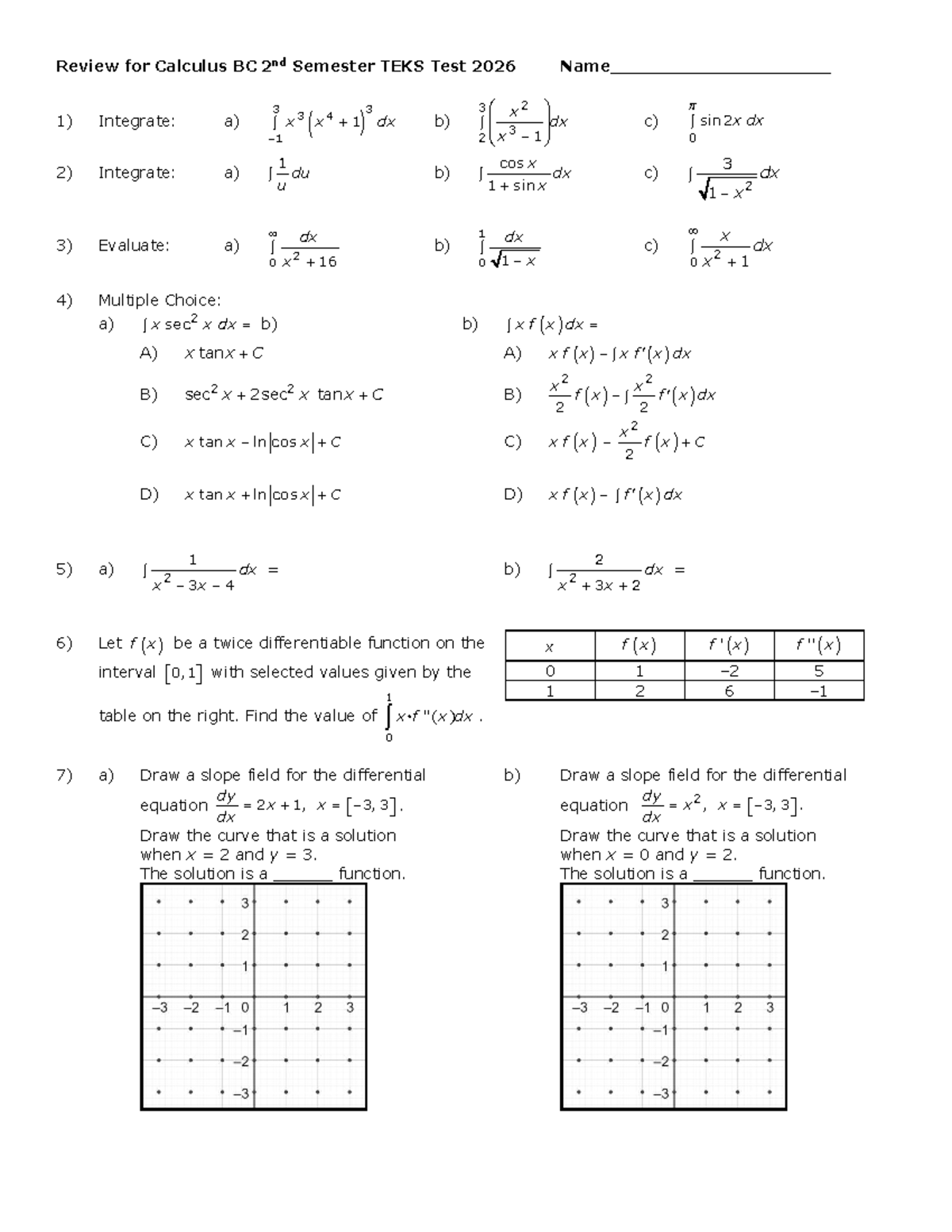
To succeed on the 2026 AP Calculus AB or BC exam, students must master the application of limits, derivatives, and integrals while demonstrating proficiency in both calculator-active and non-calculator environments. Focused review of the Fundamental Theorem of Calculus and, for BC students, Taylor Series, remains essential for achieving a top score of 5.
The AP Calculus exams, administered by the College Board, represent the culmination of a rigorous year of mathematical study. As we approach the May 2026 testing window, students must navigate not only the complex mathematical theorems but also the specific formatting and calculator requirements that define these exams. Whether you are enrolled in Calculus AB, which covers the equivalent of a first-semester college calculus course, or Calculus BC, which encompasses two full semesters, a structured review plan is the most reliable path to a high score.
Understanding the 2026 Exam Format and Digital Transition
For the 2026 testing cycle, the AP Calculus AB and BC exams maintain their traditional structure in terms of question count and timing, though many students will now interface with the exam via the Bluebook digital testing application. Regardless of whether your school administers a paper-based or digital version, the cognitive demands remain identical.
The exam is divided into two primary sections, each accounting for 50% of the total score.
Section I: Multiple Choice
- Part A: 30 questions in 60 minutes. No calculator is permitted. This section tests your ability to perform algebraic manipulations, recognize derivative and integral forms, and apply basic theorems quickly.
- Part B: 15 questions in 45 minutes. A graphing calculator is required. These questions often involve complex functions where numerical derivation or integration is necessary.
Section II: Free Response (FRQ)
- Part A: 2 questions in 30 minutes. A graphing calculator is required. These are typically multi-part "word problems" involving rates of change, area/volume, or particle motion.
- Part B: 4 questions in 60 minutes. No calculator is permitted. During this hour, you can also go back to Part A questions, but you may not use a calculator to do so.
In 2026, the emphasis remains heavily on "Mathematical Practices," which include implementing mathematical processes, connecting representations (graphical, numerical, analytical, and verbal), and justifying work with proper notation.
Core Content Mastery for AP Calculus AB
The AB curriculum is organized into eight units. To review effectively for the 2026 exam, you must move beyond memorizing formulas and understand the "why" behind each operation.
Limits and Continuity
Limits form the foundational language of calculus. You should be comfortable evaluating limits analytically using algebraic simplification, such as factoring or rationalizing. Special attention should be paid to L'Hôpital's Rule, which is frequently tested in both multiple-choice and free-response sections when encountering indeterminate forms like 0/0 or ∞/∞. Understanding the formal definition of continuity—where the limit exists, the function is defined, and they equal one another—is a common prerequisite for applying higher-level theorems.
Differentiation: Fundamentals and Applications
Units 2 through 5 cover the mechanics and applications of derivatives. You must have the power, product, quotient, and chain rules at your fingertips. However, the 2026 exam will likely prioritize Related Rates and Optimization. These problems require you to translate a verbal description into a mathematical model, often using geometric formulas (cones, spheres, or cylinders) and differentiating with respect to time.
The Mean Value Theorem (MVT) and Extreme Value Theorem (EVT) are critical for the "Justification" portion of the FRQs. When asked if a certain value must exist, you must verify the hypothesis (continuity and differentiability) before invoking the theorem.
Integration and Accumulation of Change
Units 6 through 8 transition into integration. This includes understanding the definite integral as the limit of a Riemann sum. In 2026, students often struggle with the Fundamental Theorem of Calculus (FTC). You must be able to differentiate an integral function and understand that the integral of a rate of change gives the net change. Common applications include finding the area between curves and the volume of solids with known cross-sections or solids of revolution using the disk/washer methods.
Extended Topics for AP Calculus BC
Calculus BC includes all AB topics plus two additional units (Units 9 and 10) and several sub-topics interspersed throughout the earlier units.
Parametric Equations, Polar Coordinates, and Vector-Valued Functions
Unit 9 requires a shift in how you perceive motion. Instead of $y$ as a function of $x$, you will deal with $x(t)$ and $y(t)$. Mastery of the formulas for arc length in parametric and polar forms is essential. Polar area problems—integrating $\frac{1}{2}r^2 d\theta$—are a staple of the BC FRQs and require a strong grasp of trigonometric identities and boundaries.
Infinite Sequences and Series
Unit 10 is often considered the most challenging part of the BC curriculum. Review for 2026 must focus on the various convergence tests: the Ratio Test, P-series Test, Geometric Series Test, and the Alternating Series Test. Furthermore, you must be able to construct Taylor and Maclaurin polynomials and determine the Radius and Interval of Convergence. The Lagrange Error Bound is a frequent "part d" in Section II, requiring you to estimate the maximum possible error of a Taylor polynomial approximation.
Essential Theorems and Justification Requirements
A significant portion of the free-response points is awarded for "justification." In 2026, the College Board continues to penalize students who provide a correct numerical answer without showing the "setup" or the underlying theorem.
- Intermediate Value Theorem (IVT): Use this to prove a function reaches a specific $y$-value. Ensure you state that the function is continuous on the closed interval $[a, b]$.
- Mean Value Theorem (MVT): Use this to prove the existence of a specific derivative value ($f'(c)$). You must state that the function is continuous on $[a, b]$ and differentiable on $(a, b)$.
- Fundamental Theorem of Calculus (FTC): Always write the integral setup. For example, if finding the position $s(5)$ given $s(0) = 10$ and a velocity function $v(t)$, write: $s(5) = 10 + \int_{0}^{5} v(t) dt$.
Strategic Use of the Graphing Calculator
For the 2026 exam, your calculator is a tool, not a crutch. The College Board Calculator Policy permits most TI and Casio graphing calculators. You are expected to use the calculator for four specific tasks:
- Graphing a function within an arbitrary window.
- Solving an equation numerically (finding zeros or intersections).
- Calculating a numerical derivative at a point.
- Calculating a definite integral numerically.
For all other steps, such as finding an antiderivative or a symbolic derivative, you should show your work manually to ensure full credit. When using the calculator, round your final answer to at least three decimal places unless otherwise specified.
2026 AP Calculus Topic Weighting Comparison
The following table outlines how the various units are weighted in the 2026 exam for both AB and BC versions. Use this to prioritize your study time.
| Unit Number | Topic Name | AB Weighting | BC Weighting |
|---|---|---|---|
| 1 | Limits and Continuity | 10–12% | 4–7% |
| 2 | Differentiation: Definition and Fundamental Properties | 10–12% | 4–7% |
| 3 | Differentiation: Composite, Implicit, and Inverse Functions | 9–13% | 4–7% |
| 4 | Contextual Applications of Differentiation | 10–15% | 6–9% |
| 5 | Analytical Applications of Differentiation | 15–18% | 8–11% |
| 6 | Integration and Accumulation of Change | 17–20% | 17–20% |
| 7 | Differential Equations | 6–12% | 6–9% |
| 8 | Applications of Integration | 10–15% | 6–9% |
| 9 | Parametric, Polar, and Vector Functions | N/A | 11–12% |
| 10 | Infinite Sequences and Series | N/A | 17–18% |
A Strategic Study Timeline for 2026
Effective review begins months before the May exam date. Following a structured timeline ensures you aren't cramming complex series convergence tests the night before the test.
- January – February 2026: Focus on consolidating Units 1-5. This is the "Differential Calculus" phase. Ensure your algebraic fluency is high. Practice finding derivatives of inverse trig functions and log functions, which are often forgotten.
- March 2026: Dedicate this month to Integration (Units 6-8). Mastery of U-substitution and Integration by Parts (BC only) is vital. Start working through one FRQ per week from the AP Central archives.
- April 2026: This is the "Simulation Phase." For BC students, Unit 10 (Series) needs daily attention. For all students, take at least two full-length timed practice exams. Focus on "pacing"—knowing when to skip a difficult multiple-choice question to return to it later.
- May 2026 (Pre-Exam Week): Review "Mistake Lists." Look at your previous practice tests and identify recurring errors, such as forgetting the "+ C" on indefinite integrals or failing to use parentheses in the power rule.
Common Pitfalls and How to Avoid Them
Even high-achieving students can lose points due to technicalities. In the 2026 exam, stay vigilant about the following:
- Units of Measure: If a problem provides units (e.g., "feet per second"), your answer must include the correct units. Many FRQ parts are worth one point specifically for the units.
- Rounding Errors: Do not round intermediate steps. Keep the full decimal in your calculator and only round the final answer to three decimal places.
- Notation Literacy: Avoid "calculator-speak." Never write
fnInt(f(x),x,0,5)on your paper. Instead, write the mathematical integral notation: $\int_{0}^{5} f(x) dx$. - The "+ C" Requirement: For indefinite integrals or solving differential equations, the constant of integration must be included at the first step where integration occurs. If you forget it initially, you often cannot earn any subsequent points for that problem.
Frequently Asked Questions
When is the 2026 AP Calculus Exam?
The AP Calculus AB and BC exams are typically scheduled for the first Monday of the AP testing window in May. For 2026, the primary test date is Monday, May 4, 2026. Schools may offer late testing in the following week if there are scheduling conflicts, but this requires official coordination through the school's AP Coordinator.
Is the 2026 exam fully digital?
Starting with the 2024-2025 school year, the College Board accelerated the transition to digital testing. For 2026, many subjects, including AP Calculus, utilize a "Hybrid" or "Digital" format in the Bluebook app. In the hybrid format, students view questions on their screens but complete their work and graphs on a paper Response Booklet. Check with your specific school to see which version they will administer.
What is the difference between AB and BC for college credit?
Generally, a high score (4 or 5) on the AP Calculus AB exam earns credit for "Calculus 1" at most universities. The AP Calculus BC exam covers both "Calculus 1" and "Calculus 2." Students who take the BC exam receive an "AB Subscore," which allows them to potentially earn credit for Calculus 1 even if they do not perform well on the BC-specific portions of the exam.
Can I use a calculator on the entire exam?
No. Both the AB and BC exams are split into calculator-active and no-calculator sections. Approximately 66% of the Multiple Choice section and 66% of the Free Response section prohibit the use of a calculator. This is designed to test your conceptual understanding and algebraic skills alongside your ability to use technology for complex computations.
How are the scores curved for AP Calculus?
The College Board does not use a traditional "curve" based on student performance in a single year. Instead, they use a process called "equating" to ensure that a score of 5 in 2026 represents the same level of mastery as a 5 in previous years. Historically, students typically need to earn approximately 65-70% of the total available points to secure a score of 5.
Final Recommendation for 2026 Candidates
The most effective way to prepare for the 2026 AP Calculus exam is to combine conceptual study with official practice. Start by utilizing resources like Khan Academy’s AP Calculus AB or BC modules for topic-specific drills. Once you have a firm grasp of the units, transition to AP Classroom to take progress checks. Finally, ensure you have timed yourself on at least three years of released FRQs to build the stamina and precision required for the actual test day. Success is less about innate "math genius" and more about the disciplined application of established procedures and theorems.