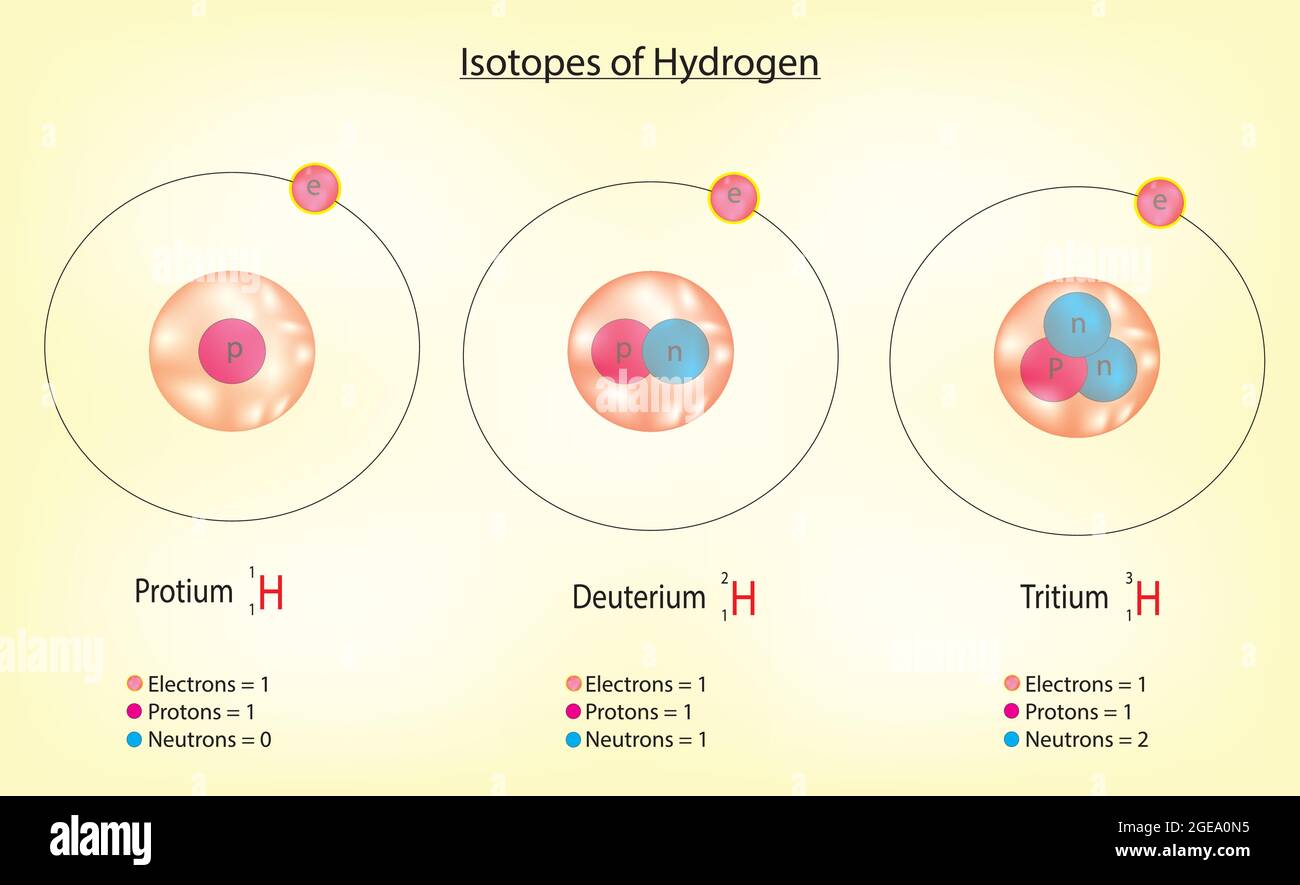
Hydrogen does indeed have isotopes, and it is unique among all chemical elements because its primary isotopes are given distinct names and chemical symbols: Protium, Deuterium, and Tritium. While most elements have isotopes that are discovered primarily in laboratories or characterized by heavy radioactive decay, hydrogen’s distinct variants play major roles in everything from standard quantum mechanics to advanced nuclear fusion research, cosmological stellar evolution, and industrial biochemistry.
Understanding the isotopic makeup of the universe's most abundant element requires looking past a simple "yes" or "no" answer. Examining the structural differences, natural abundances, production methods, and physical properties of these isotopes reveals why hydrogen's nuclear diversity is so profoundly important to modern science.
The Fundamental Structure of Hydrogen and Its Isotopes
To understand hydrogen isotopes, one must first look at the atomic architecture of a standard hydrogen atom. At its core, an atom consists of a nucleus containing positively charged protons and neutral neutrons, surrounded by a cloud of negatively charged electrons. The atomic number of an element is determined strictly by the number of protons in its nucleus. Hydrogen, with an atomic number of 1, possesses a single proton.
Isotopes are variants of a particular chemical element that share the exact same number of protons but differ in the number of neutrons contained within their nuclei. Because they share the same number of protons and electrons, isotopes exhibit nearly identical chemical behaviors. However, their differing neutron counts give them different atomic masses and distinct nuclear properties. Some isotopes are entirely stable, while others are radioactive and undergo spontaneous radioactive decay over time.
Hydrogen is unique in the periodic table because its isotopes are so widely recognized that they have historical, widely accepted proper names rather than just mass-number designations. These three primary isotopes are:
- Protium ($^1\text{H}$): The most common isotope, consisting of one proton and zero neutrons.
- Deuterium ($^2\text{H}$ or $\text{D}$): A stable isotope consisting of one proton and one neutron.
- Tritium ($^3\text{H}$ or $\text{T}$): A radioactive isotope consisting of one proton and two neutrons.
In addition to these three primary isotopes, advanced laboratory experiments have synthesized heavier, highly unstable hydrogen isotopes ranging from hydrogen-4 up to hydrogen-7. These artificial isotopes decay in fractions of a zeptosecond through neutron emission.
Detailed Breakdown of the Three Primary Hydrogen Isotopes
Each of the three main isotopes of hydrogen possesses distinct physical characteristics, natural distributions, and practical applications that separate it from its atomic siblings.
1. Protium ($^1\text{H}$)
Protium is by far the most abundant isotope of hydrogen, accounting for approximately 99.985% of all hydrogen found naturally on Earth. Its nucleus is remarkably simple: a single standalone proton with no neutrons. Because of this, its atomic mass is roughly 1.0078 atomic mass units (u).
When scientists refer to "hydrogen" in standard chemistry textbooks, industrial applications, or biological contexts, they are almost always referring to protium. It forms the backbone of water ($\text{H}_2\text{O}$), organic molecules, hydrocarbons, and acids. Because it lacks neutrons, protium does not experience the neutron-capture cross-sections that heavier isotopes do, making it fundamentally important to standard chemical kinetics, though its lighter mass causes it to react faster than its heavier counterparts—a phenomenon known as the kinetic isotope effect.
2. Deuterium ($^2\text{H}$ or $\text{D}$)
Often referred to as "heavy hydrogen," deuterium contains one proton and one neutron in its nucleus. It is a stable, non-radioactive isotope with a natural abundance on Earth of about 0.0115% to 0.0156%, meaning roughly 1 out of every 6,400 hydrogen atoms in Earth's oceans is a deuterium atom.
Because its nucleus is roughly twice the mass of protium, deuterium alters the physical properties of the molecules it incorporates into. For example, water made with deuterium instead of protium is known as heavy water ($\text{D}_2\text{O}$ or deuterium oxide). Heavy water has a higher boiling point (101.4 °C) and a higher density (1.11 g/cm³) than regular water.
Deuterium plays a critical role in nuclear engineering. Because it has a very low neutron absorption cross-section while effectively slowing down fast neutrons, heavy water is frequently used as a neutron moderator in certain types of nuclear reactors, such as the CANDU reactor design, allowing sustained nuclear fission reactions utilizing natural uranium without requiring expensive uranium enrichment facilities.
3. Tritium ($^3\text{H}$ or $\text{T}$)
Tritium is the heaviest naturally occurring isotope of hydrogen, possessing one proton and two neutrons. Unlike protium and deuterium, tritium is radioactive. It undergoes beta-minus decay, transforming into helium-3 ($\text{3He}$) with a half-life of approximately 12.32 years, emitting a low-energy beta particle (electron) in the process.
Tritium occurs only in trace quantities naturally in the Earth's atmosphere, generated primarily through cosmic ray interactions with atmospheric gases such as nitrogen. Most tritium used commercially is produced artificially by bombarding lithium-6 targets with neutrons inside nuclear reactors.
Because of its radioactivity and low-energy emission, tritium is widely used in self-powered lighting applications (such as emergency exit signs, watch dials, and firearm sights) where it excites phosphors to produce a steady glow without external electricity. Furthermore, tritium is a vital fuel source, paired with deuterium, in thermonuclear fusion reactions and experimental magnetic confinement fusion devices like tokamaks.
Comparison of Hydrogen Isotopes
To clearly contrast the physical and nuclear properties of the three main isotopes of hydrogen, the following table summarizes their fundamental characteristics:
| Isotope Name | Symbol | Mass Number | Protons | Neutrons | Status | Natural Abundance | Key Applications |
|---|---|---|---|---|---|---|---|
| Protium | $^1\text{H}$ | 1 | 1 | 0 | Stable | ~99.985% | Organic chemistry, water, acids, hydrocarbons |
| Deuterium | $^2\text{H}$ (D) | 2 | 1 | 1 | Stable | ~0.015% | Nuclear reactors (moderator), NMR spectroscopy, tracing |
| Tritium | $^3\text{H}$ (T) | 3 | 1 | 2 | Radioactive ($t_{1/2} = 12.32$ yrs) | Trace (Cosmogenic) | Fusion research, radioluminescent lighting, nuclear weapons |
Natural Abundance and Cosmological Context
The distribution of hydrogen isotopes is not uniform across the universe. While protium dominates terrestrial environments, the cosmic history of these isotopes is tied directly to Big Bang nucleosynthesis and stellar evolution.
During the first few minutes of the universe, Big Bang nucleosynthesis forged nearly all of the primordial matter. This process produced almost exclusively protium and helium, alongside trace amounts of deuterium and helium-3. Almost all lithium, beryllium, and boron were formed later through cosmic ray spallation or stellar processes.
As stars burn through their lifecycles, they fuse hydrogen into helium. However, intermediate stages of stellar nucleosynthesis involve the creation of deuterium as an essential stepping stone in the proton-proton chain reaction. Over billions of years, stellar winds and supernova events have redistributed these elements throughout interstellar space, though protium remains by far the dominant isotopic form found in nebulae, gas giants, and main-sequence stars.
On Earth, isotopic fractionation processes alter the baseline ratio of protium to deuterium. Because molecules containing deuterium are slightly heavier, they evaporate more slowly and precipitate out of clouds more readily than protium-containing water molecules. This variance allows climatologists and geologists to use hydrogen isotope ratios in ice cores and ocean sediment to reconstruct historical global temperatures and climate patterns over hundreds of thousands of years.
Practical Uses and Advanced Applications
The existence of hydrogen isotopes is far more than a textbook chemical curiosity; it underpins critical technologies across multiple scientific and industrial domains.
Nuclear Fusion and Energy Research
The ultimate promise of clean, virtually limitless baseload energy relies heavily on hydrogen isotopes. The primary reaction pursued in magnetic confinement and inertial confinement fusion involves fusing a deuterium nucleus and a tritium nucleus together ($D-T$ fusion). This reaction yields a helium-4 nucleus, a high-energy neutron, and a massive release of energy:
$$\text{D} + \text{T} \rightarrow ^4\text{He} (3.5\text{ MeV}) + n (14.1\text{ MeV})$$
Because deuterium is abundant in seawater and tritium can be bred from lithium blankets surrounding a fusion reactor core, this isotopic pairing represents a cornerstone of future sustainable energy strategies.
Analytical Chemistry and Pharmacology
Deuterium is extensively used in nuclear magnetic resonance (NMR) spectroscopy. Because normal protium-rich solvents create massive background signals in NMR analysis, chemists frequently utilize deuterated solvents (such as deuterated chloroform, $\text{CDCl}_3$, or heavy water) to analyze the molecular structures of organic compounds without interference.
Furthermore, pharmaceutical researchers utilize deuterated drugs. By replacing specific hydrogen atoms with deuterium in a drug molecule, scientists can alter the metabolic breakdown rate of the medication via the kinetic isotope effect. This can improve a drug's safety, efficacy, and duration of action within the human body without changing its fundamental pharmacological target.
Radiolabeling and Biological Tracers
Both deuterium and tritium serve as effective isotopic tracers in biochemistry and medical research. By introducing labeled molecules containing heavy hydrogen into metabolic pathways, researchers can track how nutrients, drugs, and toxins are processed, absorbed, and eliminated by living organisms. Tritium's low-energy radioactivity makes it exceptionally easy to detect using liquid scintillation counting, allowing ultrasensitive measurements in molecular biology laboratories.
Common Misconceptions About Hydrogen Isotopes
When studying hydrogen isotopes, students and enthusiasts frequently encounter several persistent misconceptions. Clarifying these points prevents common scientific misunderstandings.
- Misconception: All isotopes of an element are radioactive.
- Fact: Radioactivity depends entirely on the stability of the nuclear configuration. While tritium is radioactive, both protium and deuterium are completely stable and do not decay over time.
- Misconception: Deuterium and tritium are completely different elements from hydrogen.
- Fact: Because they possess only one proton, they are chemically classified as hydrogen. Their chemical reactivity is fundamentally similar to protium, though modified by mass and quantum mechanical zero-point energy differences.
- Misconception: Heavy water is dangerous and toxic to drink.
- Fact: Pure heavy water is not radioactive. While consuming massive quantities can disrupt cellular mitosis in animals due to metabolic kinetic isotope effects, drinking small amounts of heavy water has no acute toxic effects on humans.
Conclusion and Next Actions
Hydrogen does indeed have isotopes, featuring a fascinating spectrum that ranges from the completely neutron-free protium to the stable heavy hydrogen known as deuterium, and onward to the radioactive, energy-dense isotope tritium. Each variant expands hydrogen's utility far beyond simple chemistry, driving innovations in nuclear physics, climatology, and pharmacology.
For those looking to explore this topic further, recommended next steps include reviewing foundational nuclear physics literature on stellar nucleosynthesis, studying the mechanics of the proton-proton chain reaction, or examining how nuclear magnetic resonance spectroscopy utilizes isotopic substitution to decode complex organic molecular structures.