Yes, California has a comprehensive lemon law officially known as the Song-Beverly Consumer Warranty Act. This law protects consumers who purchase or lease new or used vehicles covered by a manufacturer’s express warranty. If a vehicle has a substantial defect that the dealership or manufacturer cannot fix after a reasonable number of repair attempts, the law requires the manufacturer to replace the vehicle or refund its purchase price.
Disclaimer: This article provides general informational content regarding California consumer protection laws as of 2026. It does not constitute formal legal advice. For specific legal representation, consult a licensed California attorney.
What Is the California Lemon Law?
The legal foundation for lemon protection in California is the Song-Beverly Consumer Warranty Act (California Civil Code Section 1790 et seq.), supplemented by the Tanner Consumer Protection Act (California Civil Code Section 1793.22). Enacted to shield consumers from unfixable, defective products, the law applies broadly to consumer goods, but its most frequent and robust application is in motor vehicle sales and leases.
Under California law, manufacturers that distribute vehicles in the state must uphold the written express warranties they offer. When a vehicle exhibits a nonconformity—a legal term for a defect or condition that substantially impairs the vehicle’s use, value, or safety—the manufacturer is legally bound to repair it within a reasonable number of attempts. If the manufacturer fails to meet this obligation, the consumer is entitled to either a full repurchase (buyback) or a replacement vehicle, alongside reimbursement for related out-of-pocket expenses.
California’s lemon law is widely recognized as one of the most consumer-friendly statutes in the United States. Unlike some states that restrict coverage strictly to new personal cars, California covers a broad array of vehicles, including leased cars, certified pre-owned (CPO) vehicles, and certain business vehicles, while placing the burden of legal costs on the manufacturer when a consumer prevails.
Vehicles Covered Under California Law
To qualify for protection under the California Lemon Law, a vehicle must meet specific statutory criteria regarding its purchase status, warranty coverage, and vehicle class.
- Is the vehicle covered under an active manufacturer warranty or CPO?
- YES
- Does the defect impair safety, value, or operational use?
- YES
- Has the dealer had a reasonable number of repair attempts (or 30+ days total)?
- YES
- Qualifies for Lemon Law Relief: Repurchase (Buyback) or Replacement
Eligible Vehicle Types
The statute extends protection to:
- New and Used Cars, Trucks, SUVs, and Vans: Personal vehicles bought or leased for personal, family, or household purposes.
- Leased Vehicles: Lessees enjoy identical rights to buyers, provided the lease includes a manufacturer warranty.
- Chassis and Drivetrain of Motor Homes: The automotive components (chassis, engine, transmission) of recreational vehicles are covered, though non-automotive living quarters (cabinets, appliances) are generally governed by separate warranty rules.
- Dealer Demonstrators and Executive Vehicles: Dealer floor models sold with the balance of a new car warranty.
- Small Business Vehicles: Vehicles registered to a business or commercial entity, provided the business has no more than five motor vehicles registered in California and the vehicle's gross vehicle weight (GVW) is under 10,000 pounds.
Active Warranty Requirement
A critical factor for lemon law eligibility is that the defect must first occur during the manufacturer’s express warranty period. This includes:
- The original bumper-to-bumper or powertrain factory warranty.
- An official manufacturer Certified Pre-Owned (CPO) warranty.
- An express written warranty issued directly by the manufacturer or authorized distributor.
Third-party extended warranties or service contracts purchased from independent dealerships do not qualify a vehicle under the Song-Beverly Act, as those contracts are governed by insurance and contract laws rather than statutory manufacturer warranty laws.
What Qualifies as a "Reasonable Number" of Repair Attempts?
The law does not set a single, rigid limit for how many repair attempts constitute a "reasonable" effort. Instead, reasonableness depends on the severity of the defect. However, California law establishes a legal presumption under California Civil Code Section 1793.22 that automatically classifies a vehicle as a lemon if specific benchmarks are met.
The 18-Month / 18,000-Mile Legal Presumption
The California Lemon Law Presumption applies during the first 18 months from delivery or 18,000 miles on the odometer, whichever comes first. During this presumption window, the vehicle is legally presumed to be a lemon if any of the following conditions are met:
- Two or More Repair Attempts for Severe Safety Defects: The dealership has attempted to repair the same defect at least twice, and that defect is likely to cause death or serious bodily injury if the vehicle is driven (e.g., brake failure, steering loss, unintended acceleration, severe electrical fires).
- Four or More Repair Attempts for General Defects: The dealership has attempted to repair the same non-safety defect at least four times, and the defect substantially impairs the vehicle’s use, value, or safety (e.g., persistent transmission slipping, air conditioning failure, engine stalling, fuel leaks).
- 30 or More Days Out of Service: The vehicle has been out of service at an authorized repair facility for a cumulative total of more than 30 calendar days (not necessarily consecutive) for repairs of any warranty-covered defects.
Claims Outside the Presumption Window
A common misconception is that a lemon law claim cannot be filed after 18 months or 18,000 miles. This is incorrect.
The 18-month/18,000-mile rule merely shifts the burden of proof. Within that window, the vehicle is presumed to be a lemon, requiring the manufacturer to prove it is not. Outside that window, the consumer can still win a lemon law case—they simply must present evidence demonstrating that the defect occurred while the original factory warranty was active and that a reasonable number of repair attempts took place. In California, the statutory period to file a lemon lawsuit is four years from the date the consumer discovered or should have discovered that the vehicle was a lemon.
The Repurchase vs. Replacement Remedy
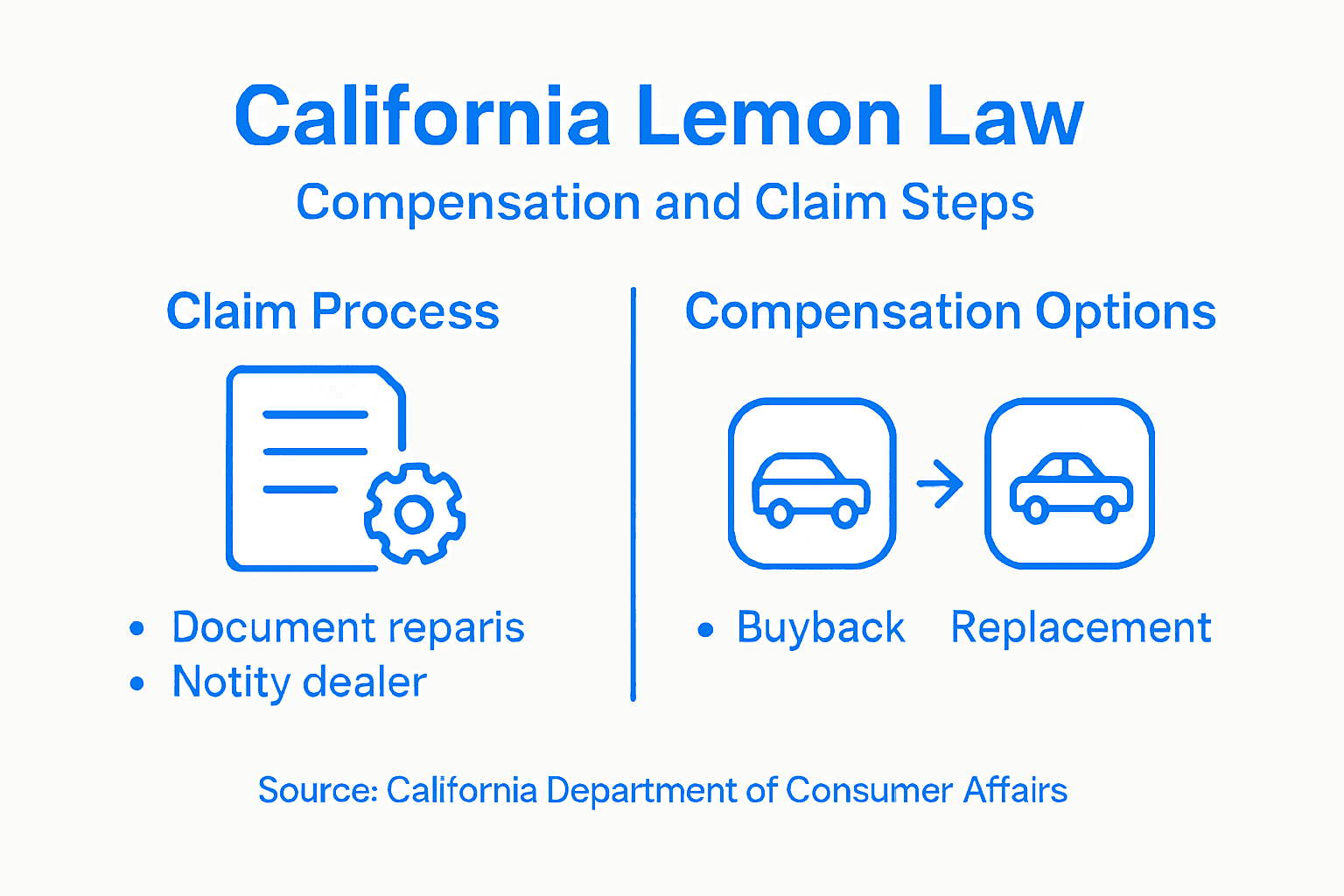
When a vehicle qualifies as a lemon, California law gives the consumer the primary choice between a repurchase (refund) or a replacement vehicle. The manufacturer cannot force a consumer to accept a replacement if the consumer prefers a full refund.
1. The Lemon Law Refund (Buyback)
If the consumer chooses a buyback, the manufacturer must refund all financial expenses tied to the purchase or lease. This includes:
- Initial Down Payment and Trade-In Value: The actual cash value credited for any trade-in vehicle plus cash paid upfront.
- Monthly Loan or Lease Payments: All principal and interest paid to date.
- Loan Payoff Amount: The manufacturer must pay off the remaining balance of the auto loan directly to the lender.
- Official Fees: Sales tax, registration fees, license fees, and finance charges.
- Incidental Costs: Out-of-pocket expenses directly resulting from the lemon defect, such as towing fees, rental car costs, and repair bills incurred prior to warranty recognition.
Statutory Mileage Offset Formula
The manufacturer is entitled to deduct a specific amount for the miles driven before the owner first took the vehicle to an authorized dealer for repair of the qualifying defect. This deduction is calculated using a statutory formula mandated by California Civil Code § 1793.2(d)(2)(C):
$$\text{Mileage Deduction} = \left( \frac{\text{Miles at 1st Repair Attempt}}{\text{120,000}} \right) \times \text{Actual Purchase Price}$$
Example Calculation:
- Vehicle Purchase Price: $40,000
- Odometer Reading at First Repair Attempt: 12,000 miles
$$\text{Mileage Deduction} = \left( \frac{12,000}{120,000} \right) \times $40,000 = 0.10 \times $40,000 = $4,000$$
In this scenario, the manufacturer repurchases the vehicle for $40,000 minus a $4,000 usage offset, resulting in a net cash refund/loan payoff total of $36,000 (plus reimbursement of official fees and incidental charges).
2. The Replacement Option
If the consumer elects a replacement, the manufacturer must provide a new vehicle that is substantially identical to the original vehicle, complete with all options, features, and manufacturer warranties. The manufacturer must also pay all registration, shipping, and licensing fees associated with the new vehicle. The consumer remains responsible for any mileage offset accrued prior to the first repair attempt of the original vehicle.
Comparison of Lemon Law Qualifications and Rights
The table below summarizes key criteria, thresholds, and rights under California’s lemon law framework:
| Feature / Criteria | Standard Defects | Severe Safety Defects | Used / Leased Vehicles | Business Vehicles |
|---|---|---|---|---|
| Minimum Repair Attempts | 4 or more attempts | 2 or more attempts | 2 to 4 attempts (varies by severity) | 2 to 4 attempts (varies by severity) |
| Out-of-Service Threshold | > 30 cumulative days | > 30 cumulative days | > 30 cumulative days | > 30 cumulative days |
| Warranty Requirement | Active express factory warranty | Active express factory warranty | Active factory warranty or CPO warranty | Active factory warranty |
| Presumption Window | 18 mos / 18,000 miles | 18 mos / 18,000 miles | 18 mos / 18,000 miles | 18 mos / 18,000 miles |
| Max Business Fleet Limit | N/A | N/A | N/A | 5 registered vehicles max |
| Max Business Vehicle Weight | N/A | N/A | N/A | Under 10,000 lbs GVW |
| Statute of Limitations | 4 years from discovery | 4 years from discovery | 4 years from discovery | 4 years from discovery |
| Legal Fee Protection | Manufacturer pays | Manufacturer pays | Manufacturer pays | Manufacturer pays |
Lemon Rights for Used Vehicles and Private Purchases
A frequent point of confusion involves used car coverage in California. The application of the law depends heavily on how and from whom the used vehicle was acquired.
Covered Used Vehicles
A used car is covered under California Lemon Law if:
- It was purchased from a dealership with the balance of the original manufacturer warranty remaining.
- It was sold as a Certified Pre-Owned (CPO) vehicle accompanied by a written manufacturer-backed CPO warranty.
- It was sold with an explicit, written warranty directly provided by the selling dealer (governed under California's dealer warranty statutes).
Uncovered Used Vehicles
A used car is not covered under California Lemon Law if:
- It was purchased in an "As-Is" transaction from a dealership with a properly displayed FTC Used Car Buyer’s Guide indicating no warranty.
- It was purchased in a private-party transaction from an individual, even if the vehicle is relatively new, unless the manufacturer’s warranty is officially transferrable and active at the time of purchase.
- The defect arose entirely after the expiration of all factory and CPO express warranties.
Step-by-Step Guide: How to Pursue a California Lemon Law Claim
Pursuing a lemon law claim requires systematic documentation and adherence to formal procedures to maximize the likelihood of a successful buyback or replacement.
- Step 1: Collect All Repair Orders & Invoices
- Step 2: Ensure Symptoms Match Written Service Records
- Step 3: Contact Manufacturer / State Arbitration (Optional)
- Step 4: Consult a Licensed California Lemon Law Attorney
- Step 5: File Legal Notice & Negotiate Buyback / Refund
Step 1: Document Every Service Visit
The foundation of any lemon claim is paper documentation. Every time you bring the vehicle to an authorized dealership for service:
- Demand a clear, written Repair Order (Work Order) when dropping off the vehicle detailing your specific complaints.
- Ensure the service advisor writes down your exact symptoms (e.g., "transmission surges between 2nd and 3rd gear") rather than generic phrasing like "customer states vehicle drives rough."
- Request a detailed Repair Invoice upon picking up the vehicle, showing the entry date, completion date, mileage in, mileage out, diagnostic steps performed, and parts replaced.
Step 2: Track Cumulative Days in the Shop
Keep a personal log of all dates your vehicle spends at the dealership, including days when it sat waiting for backordered parts. If the vehicle is parked at the dealership for repair, those days count toward the statutory 30-day out-of-service limit.
Step 3: Review State-Certified Arbitration Options
California operates the California Department of Consumer Affairs Arbitration Certification Program. Some manufacturers participate in state-certified dispute resolution programs (such as BBB AUTO LINE).
While consumer arbitration is designed to be informal and free, it is not always mandatory. Consumers can choose to consult a lemon law attorney before entering arbitration, as arbitrated decisions can sometimes limit future recovery options if accepted blindly.
Step 4: Consult a California Lemon Law Attorney
Under California Civil Code Section 1794, when a consumer wins a lemon law claim, the court requires the manufacturer to pay all reasonable attorney fees, court costs, and expert witness expenses. Because of this fee-shifting provision:
- Reputable lemon law attorneys represent consumers on a contingency basis, charging zero upfront retainer or legal fees out-of-pocket.
- Legal fees are billed directly to the manufacturer upon settlement or court victory.
Step 5: File a Formal Demand and Reach Settlement
Your legal counsel will submit a formal demand package to the manufacturer. If the manufacturer agrees that the vehicle is a lemon, a repurchase agreement is drafted, calculating loan payoffs, refunds, and usage offsets. If the manufacturer disputes the claim or acts in bad faith by willfully ignoring statutory duties, consumers may seek civil penalties up to two times the amount of actual damages.
Common Mistakes That Hurt Lemon Law Claims
- Failing to Get Written Repair Records: Leaving a car at a dealer without obtaining a physical work order creates a gap in proof. Always demand a hard copy.
- Describing Symptoms Inconsistently: Telling one service advisor the engine "rattles" and another that it "stalls" can make it appear as though you are reporting distinct minor issues rather than a single persistent defect.
- Delaying Repairs Until the Warranty Expires: If you notice a defect, bring the vehicle in immediately while the express warranty is active.
- Accepting Trade-In Deals Over Buybacks: Dealerships may offer to "trade you out" of a defective car into a new model. This is often structured as a standard trade-in rather than a legal lemon buyback, forcing you to absorb depreciation and roll negative equity into a new car loan.
- Modifying the Vehicle: Installing non-factory aftermarket parts (suspension lifts, engine tuning chips, unauthorized electrical work) allows manufacturers to argue that the defect was caused by user modifications rather than factory errors.
Frequently Asked Questions
Does California lemon law cover used cars bought from private sellers?
No. Private-party sales between individuals are exempt from California Lemon Law. The statute applies strictly to vehicles sold or leased with an active express warranty issued by a manufacturer or authorized dealer. However, if the car is young enough that the original factory warranty is still active and fully transferable, repairs covered under that remaining factory warranty can still count toward lemon qualification.
How much does it cost to hire a lemon law lawyer in California?
Hiring a lemon law lawyer in California typically costs the consumer $0 out of pocket. Under California Civil Code § 1794(d), the manufacturer must pay all reasonable legal fees and court costs incurred by the consumer if the consumer prevails in their claim. Reputable attorneys handle these cases with no upfront fees or retainers.
How long does a California lemon law buyback process take?
A straightforward lemon law claim where the manufacturer agrees to repurchase the vehicle often resolves within 30 to 90 days. However, if the manufacturer disputes the defect, argues that repairs were reasonable, or refuses to settle, formal litigation can take several months to over a year depending on county court schedules.
Can modified or tuned vehicles qualify under California lemon law?
Vehicle modifications do not automatically invalidate lemon law protections, but they introduce significant challenges. If the manufacturer demonstrates that an aftermarket modification (such as ECU tuning or non-OEM exhaust work) directly caused or contributed to the vehicle defect, the claim for that specific issue will likely be denied. Unrelated defects (e.g., a leaking sunroof on a car with an aftermarket intake) remain fully protected.
What happens if the manufacturer refuses to honor the lemon law?
If a manufacturer refuses to honor a legitimate lemon claim after receiving adequate notice and opportunity to repair, the consumer can file a civil lawsuit in court. Under California law, if the court determines that the manufacturer's failure to comply was "willful," the judge or jury can award the consumer civil penalties up to double the amount of actual damages, in addition to statutory refunds and legal fees.
Recommended Next Actions
If you suspect your vehicle is a lemon, take the following steps immediately to protect your rights:
- Organize Your Documentation: Gather all purchase/lease contracts, registration documents, repair invoices, and work orders in chronological order.
- Verify Warranty Status: Confirm that your first repair visit took place while the factory or CPO warranty was active.
- Request Complete Service Histories: Visit your local dealership service manager and request a complete printout of the vehicle's internal warranty claim history.
- Consult State Guidance: Review consumer guides provided by the California Office of the Attorney General for state oversight details.
- Seek a Free Legal Case Evaluation: Contact an experienced California lemon law attorney to review your repair history. Most attorneys provide free case evaluations to confirm whether your vehicle meets statutory standards for a buyback or replacement.