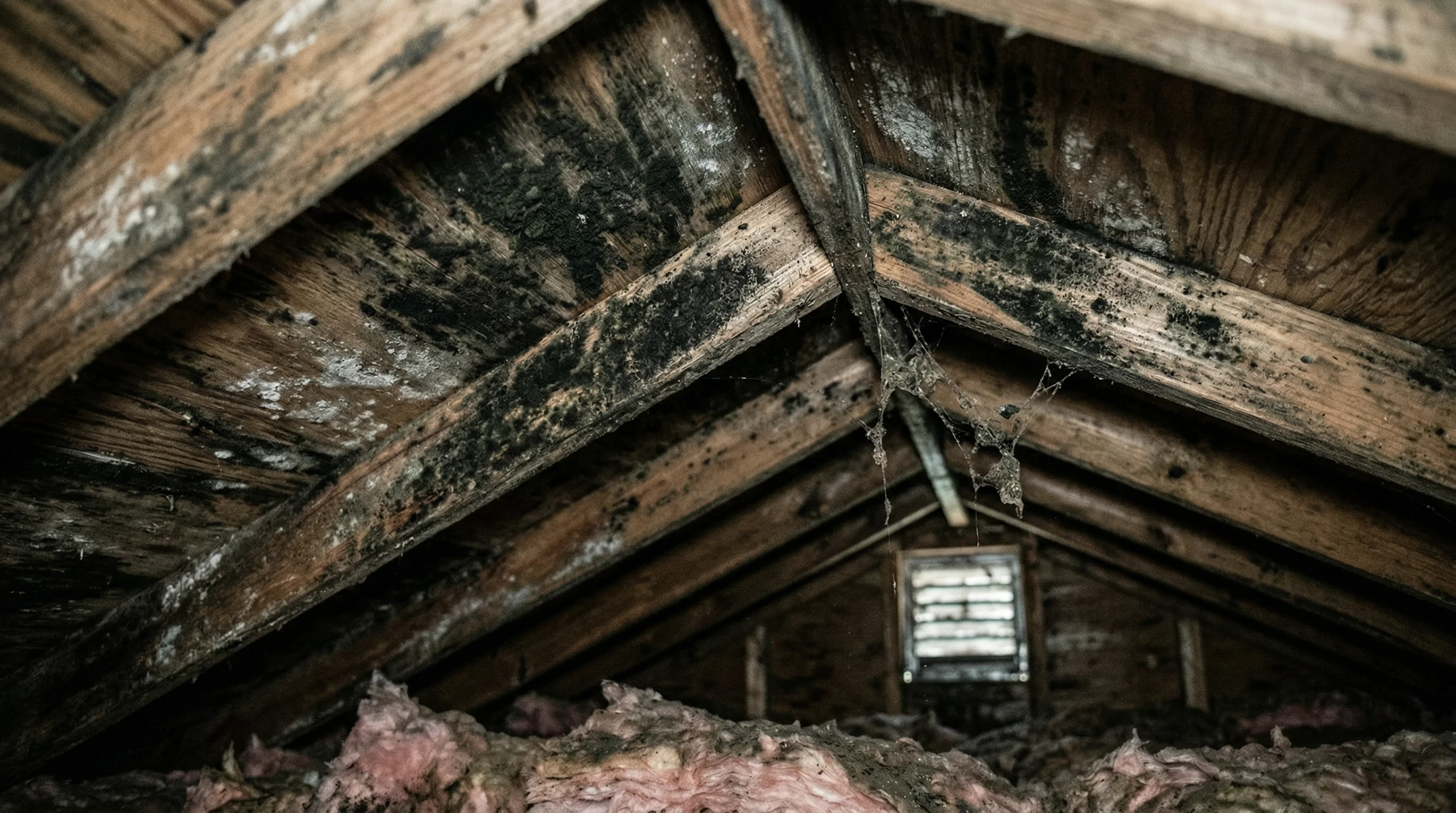
Attic mold remediation in Lake Forest Park, Washington, requires addressing dense tree canopy shade, persistent Pacific Northwest moisture, and architectural ventilation flaws. Homeowners face choices between chemical fogging, abrasive blasting, and structural redesign, alongside sharp controversies regarding ozone use, encapsulated air sealing, post-remediation testing validity, and contractor scare tactics.
Lake Forest Park presents a unique microclimate within King County. Characterized by steep hillsides, mature stands of western red cedar and Douglas fir, and proximity to the northern shoreline of Lake Washington, the city experiences lower ambient solar gain and prolonged humidity. When moist indoor air escapes into unconditioned attics, these local conditions turn structural roof decking into an ideal incubator for fungal colonization.
Successfully treating an attic mold outbreak requires an understanding of building science, remediation protocols, local building codes, and the contentious practices within the mold remediation trade.
The Lake Forest Park Microclimate and Attic Ecology
Attic mold rarely originates from roof leaks alone; in Western Washington, it is primarily an airflow and condensation problem. Lake Forest Park features some of the highest tree canopy density in suburban King County. While this canopy provides neighborhood character and summer cooling, it severely restricts direct sunlight on residential roofs. Consequently, attic roof decks remain cold for prolonged periods from October through May.
- Warm, Moist Indoor Air (Living Space)
- Bypass through unsealed ceiling penetrations
- Cold Attic Space (Under-ventilated / Shaded Roof Deck)
- Dew point reached on cold OSB or plywood
- Condensation & Surface Saturation (>19% Wood Moisture Equivalent)
- Fungal Colonization (Cladosporium, Penicillium, Aspergillus)
Building physics dictates that warm air holds more moisture than cold air. In typical Lake Forest Park split-levels, mid-century daylight basements, and craftsman homes, interior air warmed by furnaces or heat pumps carries humidity generated by cooking, showering, and human respiration. Through stack effect, this warm air naturally rises, penetrating through attic access hatches, recessed light cans, plumbing chases, and unsealed top plates.
When this warm, vapor-laden air strikes structural roof sheathing that has been chilled by ambient temperatures and shaded by tall conifers, the air cools to its dew point. Liquid moisture condenses directly onto the underside of plywood or oriented strand board (OSB). If wood moisture equivalent (WME) levels exceed 19% consistently, dormant fungal spores germinate. The resulting growth typically features species such as Cladosporium, Penicillium, and Aspergillus, which feed on the cellulose in wood fiber and paper insulation backing.
Core Remediation Options: Comparing Methodologies
Remediation is not a one-size-fits-all process. Depending on the depth of the fungal hyphae, attic clearance, and the budget of the property owner, contractors deploy varying mechanical and chemical approaches.
1. Abrasive Blasting (Dry Ice Blasting and Media Blasting)
Dry ice blasting is widely regarded within structural preservation circles as the gold standard for attic remediation. Technicians use compressed air to blast solid carbon dioxide pellets at supersonic speeds against contaminated surfaces. The kinetic energy, combined with the thermal shock of -109.3°F (-78.5°C) CO2, causes the fungal hyphae to freeze and fracture instantly from the substrate. Upon impact, the dry ice sublimates directly into gas, leaving no secondary media waste behind—only the dislodged mold particulate, which is captured using commercial High-Efficiency Particulate Air (HEPA) vacuum systems.
- Advantages: Deep physical removal of root structures from porous wood without harsh chemical fumes; leaves the wood sheathing looking nearly new; creates minimal cleanup volume beyond the mold spores.
- Disadvantages: Highly labor-intensive; requires heavy equipment and generators parked outside; significantly more expensive than chemical methods; dangerous in confined, low-pitch attics due to CO2 displacement, requiring specialized air monitoring and ventilation for worker safety.
2. Manual HEPA Vacuuming, Sanding, and Wire Brushing
For attics with complex geometries, delicate historic framing, or tight roof pitches where blasting equipment cannot maneuver, technicians perform physical abatement by hand. The process involves systematically vacuuming all surfaces with true HEPA-filtered equipment (retaining 99.97% of particles down to 0.3 microns), hand-sanding or wire-brushing the wood grain, and vacuuming a second time.
- Advantages: High precision; no heavy machinery noise or pressure hazards; well-suited for historic or fragile homes common in older Lake Forest Park neighborhoods.
- Disadvantages: Labor costs can surpass media blasting; vulnerable to human error if technicians tire and skip hard-to-reach eaves or truss junctions.
3. Chemical Treatments and Antimicrobial Washdowns
Chemical washing relies on direct surface application of specialized compounds to eliminate fungal spores and alter the chemical viability of the surface. Contractors typically apply solutions formulated with quaternary ammonium compounds, hydrogen peroxide-based surfactants, or sodium hypochlorite variants engineered for timber applications.
- Advantages: Lower labor costs; fast application; effective for widespread, superficial surface mold that has not deeply penetrated the wood grain.
- Disadvantages: May introduce high volumes of moisture into an already damp attic if not properly managed; does not always eliminate the cosmetic staining, leaving questions for future home buyers; strong off-gassing may require occupants to vacate temporarily.
4. Antimicrobial Encapsulants and Sealants
Following physical removal, many contractors apply an antimicrobial coating—often colloquially termed "mold-resistant paint" or encapsulant. These acrylic or polymer elastomeric barriers frequently contain zinc or silver additives to inhibit future spore colonization.
- Advantages: Provides a clean, white, or clear barrier; chemically prevents residual microscopic spores from proliferating; reassures prospective buyers during home sales.
- Disadvantages: Misused by disreputable operators to paint over active mold without mechanical removal; can alter the natural perm-rating (breathability) of structural lumber if applied incorrectly.
Detailed Comparison of Remediation Methods
The following table contrasts the primary remediation methodologies utilized across King County residential projects.
| Method | Primary Mechanism | Average Cost Range (Standard Attic) | Pros | Cons / Operational Limits |
|---|---|---|---|---|
| Dry Ice Blasting | Cryogenic thermal shock + kinetic energy | $3,500 – $7,500+ | Deepest substrate clean; no secondary waste; chemical-free. | Requires high attic clearance; high equipment overhead; asphyxiation hazard during work. |
| Manual HEPA Abrasion | Direct physical sanding/wire brushing | $2,500 – $5,500 | Precise; low structural disruption; adaptable to shallow roof pitches. | Extremely labor-intensive; human fatigue can leave untreated areas. |
| Chemical Wash & Wipe | Oxidation or cellular disruption via surfactants | $1,800 – $4,000 | Lower upfront cost; rapid turnaround; reaches into grain pores. | Introduces liquid moisture; strong chemical odors; doesn't always lift dark staining. |
| Surface Encapsulation | Polymer barrier coating with fungistat | $1,200 – $3,000 (often an add-on) | Resists moisture penetration; visually uniform; seals trace particles. | High risk of contractor abuse (covering up uncleaned mold); locks in wood moisture if applied prematurely. |
| Gaseous Ozone / Hydroxyl | Ambient oxidation of organic cellular matter | $800 – $2,000 | Non-invasive; permeates framing joints and tight roof voids. | Ineffective as a standalone treatment; potential rubber/wire degradation; health hazard. |
Critical Controversies in the Mold Remediation Industry
Homeowners researching attic mold remediation in Lake Forest Park routinely encounter conflicting advice. The industry contains significant scientific and commercial debates, ranging from deceptive sales techniques to genuine disagreements between environmental health scientists and mechanical engineers.
1. Fogging and "No-Scrub" Treatments vs. Physical Removal
One of the sharpest rifts in the industry is the conflict between low-cost "dry fogging" companies and standard structural remediation contractors.
Certain franchises claim they can remediate an attic in hours by introducing a cold-fogged sterilant or biocide without containment, HEPA vacuuming, or manual abrasion. They assert that their proprietary particles neutralize spores on contact.
However, standards published by the Institute of Inspection, Cleaning and Restoration Certification (IICRC)—specifically the IICRC S520 Standard for Professional Mold Remediation—state explicitly that mold must be physically removed, not merely neutralized or killed.
According to scientific literature and the U.S. Environmental Protection Agency (EPA), dead mold spores retain their cellular proteins and can still trigger allergenic reactions, inflammatory immune pathways, and respiratory symptoms. Relying entirely on "no-scrub" chemical fogging leaves dead fungal biomass on the roof decking, which can serve as a prime food source for future infestations the moment condensation returns.
THE REMEDIATION HIERARCHY OF CONTROL
- ELIMINATE MOISTURE SOURCE (Air bypasses, vents, leaks)
- PHYSICAL REMOVAL (HEPA vacuuming, dry ice, sanding)
- CLEAN-UP & RESIDUAL PARTICLE REMOVAL (HEPA containment)
- OPTIONAL: Surface encapsulation or post-testing
*WARNING: Skipping Step 2 invalidates IICRC S520 compliance
2. The Dangers and Limitations of Ozone and Hydroxyl Generators
Another contentious issue is the deployment of high-output ozone machines. Contractors sometimes run ozone generators in attics to neutralize odors and oxidize mold spores.
Both the EPA and public health agencies strongly advise against ozone deployment in occupied structures. Ozone ($O_3$) is a potent lung irritant that damages mucosal membranes. Furthermore, high concentrations of ozone oxidize natural rubber, carpet underlayment, electrical wire shielding, and specialized air barriers, causing irreversible material degradation.
Hydroxyl generators—which produce free radicals ($OH^−$) to oxidize organic compounds using UV radiation and atmospheric moisture—are marketed as a safer alternative to ozone. While hydroxyls are less damaging to synthetic materials, their ability to penetrate deep into structural roof decking to kill root hyphae remains chemically limited. Relying on gas treatments in lieu of physical abatement is widely considered an incomplete remediation tactic.
3. The Encapsulation Dispute: Protection or Cover-Up?
Encapsulation triggers fierce debate during Pacific Northwest real estate transactions. When a home buyer's inspector sees an attic roof deck coated in stark white paint, suspicion frequently arises: Was the mold properly scraped and vacuumed, or did the seller hire a contractor to simply paint over the rot?
Legitimate remediation requires that wood sheathing be dried below 15% moisture content and meticulously cleaned before applying an encapsulant. If a vapor-impermeable paint is applied over damp wood, it traps moisture inside the OSB or plywood. This trapped moisture accelerates subterranean fungal rot and structural decay, completely hidden beneath a cosmetic white coating until the roof deck compromises structurally. Many independent home inspectors in Washington recommend that contractors use clear-drying, breathable antifungals instead of opaque paints, as this allows all parties to verify that the substrate was physically cleaned.
4. Post-Remediation Air Clearance Testing
Contractors frequently charge $400 to $800 for "clearance testing" performed by their own technicians, taking Spore Trap air samples inside the attic immediately after spraying.
Independent industrial hygienists warn that this practice constitutes an inherent conflict of interest. A contractor has no financial incentive to fail their own remediation work. Furthermore, taking air samples in an unconditioned attic space is inherently problematic. Because attics are ventilated directly to the outdoors via soffit and ridge vents, background spore levels fluctuate based on whether outdoor winds are blowing past Lake Forest Park's damp cedar groves.
An accurate clearance test should involve:
- Hiring an independent, third-party indoor environmental professional (IEP) with no financial ties to the remediation company.
- Direct surface sampling (tape lifts) of the timber, rather than relying solely on ambient attic air.
- Rigorous visual inspection under white light to confirm the complete physical absence of dust, debris, and staining.
5. Sales Scams and "Toxic Black Mold" Scare Tactics
Contractors sometimes leverage local anxiety over Stachybotrys chartarum (often sensationalized as "toxic black mold") to drive up remediation estimates.
While Stachybotrys can colonize attic spaces, it requires saturated, continuous liquid water contact (such as an active, persistent roof leak over gypsum board or wood), rather than standard atmospheric condensation.
The vast majority of attic mold in Western Washington is Cladosporium or Penicillium, which can cause respiratory irritation and allergic reactions, but rarely produce the severe mycotoxins associated with public panic. Contractors who claim, based on visual observation alone, that an attic is infested with "deadly toxic mold" are violating industry ethics. True identification requires laboratory microscopic analysis.
Solving the Root Cause: Ventilation and Building Envelope Science
Remediating existing fungal colonies is merely a temporary fix if the building dynamics that caused the condensation remain unchanged. A permanent solution requires fixing ventilation and thermal dynamics within the home.
The Balancing Act: Intake vs. Exhaust
Building codes, including the Washington State Residential Code (WAC 51-51), require a balanced attic ventilation ratio—typically 1 square foot of net free ventilating area (NFVA) for every 150 square feet of attic floor space (or 1:300 if a certified vapor retarder is installed).
- Attic Space
- Soffit Vent (Cool Air Intake)
- Ridge Vent (Continuous Warm Air Exhaust)
The air balance must be distributed: 50% lower intake (soffit or eave vents) and 50% upper exhaust (ridge vents or box vents).
In Lake Forest Park, two common ventilation failures fuel mold growth:
- Blocked Soffits from Blown-In Insulation: Homeowners add dense fiberglass or cellulose over their ceiling joists to improve thermal efficiency, accidentally covering the soffit vents. Without intake air entering the low eaves, the attic pulls air directly from the heated house below through bypass holes, carrying massive amounts of moisture upward. Baffles (proper vents) must be installed at the eaves to maintain an unobstructed channel between the exterior and the attic.
- Short-Circuiting Airflow: Mixing exhaust types—such as running an active power attic fan alongside continuous ridge vents—can reverse airflow. The powered fan may pull air backward through the ridge vent instead of the soffits, creating negative pressure that draws indoor heated air directly through ceiling penetrations.
Bath Fan Duct Failures
A staggering proportion of attic mold cases in King County trace back to improperly terminated bathroom exhaust fans. Home builders and unpermitted remodelers frequently vent high-humidity exhaust fans:
- Directly into the attic insulation.
- Pointed at a nearby soffit (where exterior breezes simply push the moist air right back inside).
- Connected to long, uninsulated corrugated flex pipes where steam condenses into liquid water, runs back down into the ceiling, or leaks through duct seams onto framing.
All exhaust fans must terminate cleanly through the exterior roof or gable wall using a dedicated, insulated duct pipe with an operational backdraft damper.
Step-by-Step Remediation Protocols: What to Expect
When working with a certified, reputable remediation professional, the process should follow a clear, standardized sequence designed to protect the home's living envelope.
- Step 1: Containment Setup & Negative Air Pressure Creation
- Step 2: Source Extraction & Saturated Material Removal
- Step 3: Mechanical Wood Sheathing Remediation (HEPA/Blasting)
- Step 4: Air Scrubbing & Fine Detail Vacuuming
- Step 5: Structural Building Envelope Repairs (Baffles, Bypasses, Ducts)
- Step 6: Third-Party Clearance Evaluation
1. Containment and Engineering Controls
Technicians establish critical containment by hanging 6-mil poly sheeting around the attic access point. A HEPA-filtered air scrubber is ducted out of a nearby window to establish negative pressure, ensuring that any spores disturbed in the attic do not migrate downward into the bedrooms or hallways.
2. Discarding Porous Materials
Insulation directly beneath moldy roof decking typically must be removed, especially if it is contaminated by mold spores, animal feces, or condensed water. Blown-in fiberglass and cellulose cannot be effectively laundered or vacuumed clean; they must be vacuumed out via heavy-duty extraction hoses, bagged, and disposed of.
3. Mechanical Remediation
The structural deck, rafters, and joists are remediated using either dry ice blasting or thorough hand abrasion combined with HEPA vacuuming. All visible hyphae must be removed until bare, clean wood remains.
4. Antimicrobial Application
Technicians apply a designated fungistatic agent or clear breathable sealer to inhibit micro-spore germination while the wood continues to dry down to standard equilibrium levels.
5. Corrective Envelope Work
Before laying new insulation, technicians perform extensive air-sealing along the ceiling deck:
- Expanding foam is injected around electrical penetrations, top plates, and plumbing stacks.
- Attic access hatches are weatherstripped and insulated.
- Rigid baffles are installed over soffits to guarantee uninterrupted airflow.
- Bath fan exhaust ducts are replaced with insulated metal piping vented directly to exterior roof caps.
6. Re-Insulating
Once the attic is clean, dry, and air-sealed, new insulation (such as loose-fill fiberglass or cellulose) is blown in to meet current King County energy code performance targets (typically R-49 or R-60).
Local Regulatory and Permitting Considerations
Lake Forest Park enforces the Washington State Building Code, which adopts and amends the International Residential Code (IRC).
While a permit is generally not required for basic cosmetic surface cleaning or simple insulation replacement, structural and mechanical modifications do trigger permit requirements:
- Structural Decking Replacement: If the wood sheathing has degraded structurally from long-term fungal rot and needs to be replaced, building permits through the City of Lake Forest Park Planning and Building Department may be necessary.
- Mechanical Duct Penetrations: Cutting new exterior penetrations through the roof for mechanical exhaust vents may fall under local mechanical code oversight.
- Tree Removal Conflicts: Occasionally, homeowners conclude that the absolute fix for persistent attic moisture is cutting down the mature Douglas firs or western red cedars shading their roof. Homeowners must be aware that Lake Forest Park has strict Tree Canopy Preservation Ordinances (LFPMC Title 16.16). Removing significant trees requires clear municipal permits, professional arborist reports, and mandatory replanting ratios. Addressing attic ventilation and air leaks is virtually always simpler, cheaper, and legally viable compared to attempting tree clearing.
Frequently Asked Questions
Can I clean attic mold myself using household bleach?
No, using standard chlorine bleach on structural attic framing is strongly discouraged by the EPA and building scientists. Bleach is roughly 90% water; the chlorine molecule is too large to penetrate the cellular structure of porous wood, so it remains on the surface while the water soaks in. This often leaves the subterranean fungal roots hydrated, allowing mold to return aggressively weeks later. Additionally, using bleach in an unventilated attic exposes the user to dangerous, corrosive chlorine gas.
How much does professional attic mold remediation cost in Lake Forest Park?
Costs typically range between $2,500 and $8,000 for standard residential homes. The price depends heavily on the chosen remediation method (dry ice blasting sits at the higher end, chemical washing at the lower end), the pitch and clearance of the attic, and whether insulation extraction and full air sealing are bundled into the project scope.
Will homeowner's insurance cover attic mold remediation?
In the vast majority of cases, standard homeowner's insurance policies exclude mold damage. Insurers generally consider attic mold to be a maintenance issue resulting from long-term condensation, humidity, or slow wear-and-tear. Coverage is typically approved only if the mold is the direct result of a covered, sudden, and accidental peril—such as a tree branch puncturing the roof during a windstorm and causing sudden water intrusion.
Is attic mold dangerous to people living downstairs?
It can be, depending on ceiling air leakage and individual occupant health. While the attic is technically outside the conditioned living envelope, the stack effect can drive air downward under certain pressure conditions, or crawl upward and draw air throughout the home via mechanical HVAC systems. Sensitive individuals, asthmatics, children, and immunocompromised persons may experience chronic allergic responses, headaches, or respiratory irritation if the attic air barrier is unsealed.
Do I need to replace my whole roof if there is mold on the underside?
Rarely. Mold feeds on the cellulose within the wood, but unless the moisture problem has persisted unchecked for years, the wood rarely loses structural load-bearing capacity. As long as the plywood or OSB has not experienced delamination, dry rot (Serpula lacrymans), or structural softening (checked via a physical probe or awl test), the wood can be safely cleaned, dried, and preserved without total replacement.
Recommended Next Steps for Homeowners
If you suspect fungal growth in your attic space, avoid rushing to hire the lowest-bidding chemical spraying service. Instead, proceed systematically:
- Verify the Moisture Metrics: Invest in an inexpensive pin-type wood moisture meter. Check the wood sheathing in mid-winter; readings consistently above 19% signal an active airflow or ventilation crisis that requires mechanical correction.
- Conduct an Exhaust Trace: Enter the attic with a high-lumen light source and trace every bathroom and kitchen exhaust duct. Ensure each duct terminates through a dedicated exterior vent cap rather than dumping moisture into the eaves or soffit channels.
- Obtain Multiple Bids Requiring Physical Removal: Solicit estimates from licensed Washington remediation firms holding active IICRC certifications (AMRT - Applied Microbial Remediation Technician). Demand line-item estimates that separate physical removal (blasting or HEPA abrasion) from structural air sealing and chemical treatments. Avoid contractors who rely entirely on "no-scrub" chemical fogging.
- Demand Proof of Dry-Down: Ensure the contractor's scope of work mandates that structural lumber be dried below 15% moisture content prior to the application of any clear antifungals or new insulation installation.