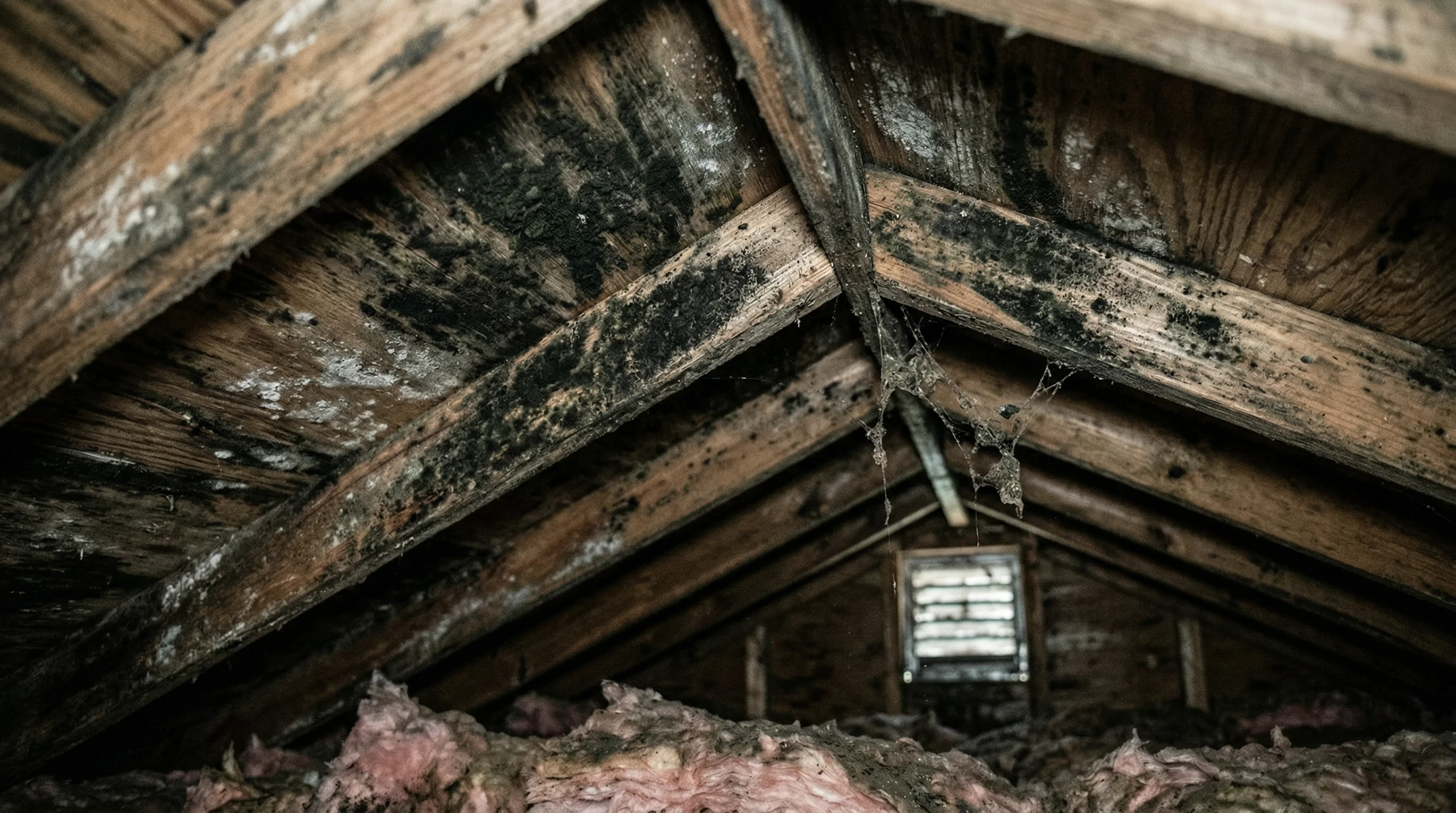
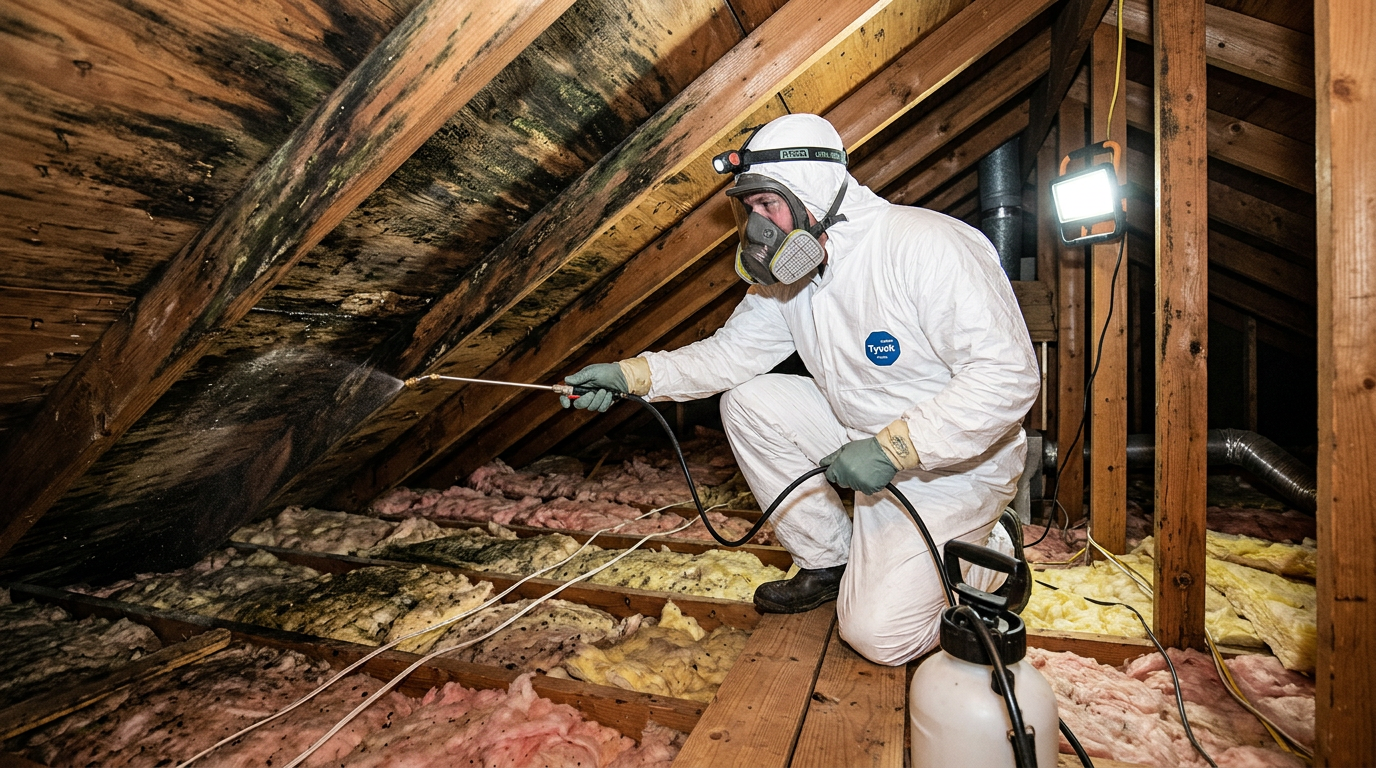
Attic mold remediation services involve inspecting, containing, physically removing fungal growth, and treating structural roof framing according to established indoor environmental standards. Professional remediation neutralizes active spores, cleans stained wood sheathing, safely extracts contaminated insulation, and addresses the root moisture issues—such as ventilation imbalances or duct leaks—to prevent recurrence and safeguard residential air quality.
Why Mold Establishes Rapidly in Attics
Attics present an ideal environment for fungal amplification because they sit at the intersection of thermal boundaries and moisture pathways within a home. Mold spores exist naturally in outdoor and indoor air at baseline levels. However, they require three conditions to colonize and reproduce: viable organic matter, sustained temperatures between 40°F and 100°F, and a relative humidity level exceeding 55% or direct moisture contact.
Structural attics supply an abundance of food in the form of cellulose-rich materials: plywood roof decking, oriented strand board (OSB), pine rafters, and ceiling joists. When excessive moisture collects within an unconditioned attic, microscopic spores germinate on these substrates in as little as 24 to 48 hours.
The moisture that fuels attic mold growth generally originates from one of four structural deficiencies:
- Inadequate or Obstructed Ventilation: Attics rely on continuous airflow to flush out humid air. When soffit intake vents are blocked by blown-in insulation, or when ridge vents are improperly cut, air stagnates. During cold months, warm indoor air collects against cold roof sheathing, causing heavy condensation.
- Improper Appliance Exhaust Termination: One of the most frequent installation errors is venting bathroom exhaust fans, kitchen hoods, or clothes dryers directly into the attic cavity or toward a soffit rather than terminating through the roofline or gable wall. This introduces gallons of warm, water-saturated air directly onto raw timber.
- The Building Stack Effect and Air Leaks: Heated air rises through the living space, drawing moisture from cooking, bathing, and human respiration through unsealed ceiling penetrations—such as recessed lighting, plumbing chases, electrical conduits, and drop-down attic stairs.
- Bulk Water Ingress: Compromised roofing materials, including cracked architectural shingles, failed flashing around chimneys, deteriorated valleys, or deteriorated plumbing boots, allow rainwater to seep down rafters and saturate roof sheathing over extended periods.
The Standard Protocols Governing Attic Remediation
Professional remediators do not simply spray toxic chemicals on wood and consider the job complete. Reputable companies adhere to standard guidelines set by the Institute of Inspection, Cleaning and Restoration Certification, specifically the IICRC S520 Standard for Professional Mold Remediation, alongside guidance from the U.S. Environmental Protection Agency (EPA).
The IICRC framework divides mold contamination into three distinct conditions:
- Condition 1 (Normal Ecology): An indoor environment that may have settled spores, fungal fragments, or traces of actual growth whose types and concentrations reflect those found in normal outdoor environments.
- Condition 2 (Settled Spores): An area contaminated with settled spores or fungal fragments that were dispersed from a fungal colony, but where active growth is not occurring on surfaces.
- Condition 3 (Actual Growth): An area with active fungal growth, visible colonies, and established root structures (hyphae) penetrating the porous substrate.
Attic remediation services specifically target Condition 3 growth, seeking to return the structural wood framing, insulation layer, and air volume to Condition 1 status. Under industry standards, simply killing mold with biocides while leaving dead fungal structures in place is insufficient; dead spores retain allergenic and toxic properties and must be physically removed from structural framing.
Step-by-Step: How Professional Remediation Services Work
A comprehensive attic remediation project follows a disciplined sequence designed to strip out established fungal growth without contaminating the living spaces below.
- Inspection & Moisture Assessment (Thermal/Moisture Meter)
- Critical Barrier Containment & Negative Air Pressure
- Contaminated Insulation Extraction & Safe Disposal
- Surface Cleaning & Wood Remediation (Blasting/Sanding)
- HEPA Vacuuming, Antimicrobial Sealing & Clearance Testing
1. Comprehensive Assessment and Moisture Mapping
Before disturbing any material, an environmental technician inspects the attic space to determine the spatial extent of the mold, identify the moisture intrusion vector, and check the structural integrity of the roof decking. Technicians use direct-contact pin or pinless moisture meters to measure wood moisture equivalent (WME) levels. Clean framing wood generally registers between 9% and 14% WME; readings above 19% signal sustained conditions supporting mold growth and wood-decay fungi. Calibrated infrared thermal imaging cameras identify cold spots indicating wet insulation and hidden air leaks.
2. Isolation and Negative Air Pressure Setup
Because disturbing mold dislodges millions of airborne spores, establishing engineering controls is the first physical step. Remediators isolate the attic access point—whether a scuttle hatch in a hallway ceiling or a drop-down ladder in a garage—using heavy polyethylene plastic sheeting (typically 6-mil thickness) fitted with zipper doorways.
Technicians install commercial negative air machines equipped with certified High-Efficiency Particulate Air (HEPA) filters, which capture 99.97% of particles down to 0.3 microns. These machines pull air from the attic and vent it outside via heavy flexible ducting routed through a window, gable vent, or roof opening. This continuous negative pressure creates a vacuum effect, ensuring that whenever the containment barrier opens, air flows inward toward the contaminated attic rather than outward into the home's living areas.
3. Removal of Contaminated Insulation
When fungal colonies spread across roof decking, spores settle into the loose-fill cellulose, blown fiberglass, or fiberglass batt insulation on the attic floor. Because porous insulation materials cannot be thoroughly disinfected once heavily contaminated with settled spores or direct moisture, they must be removed.
Crews use high-powered, industrial insulation-removal vacuums stationed outside the home. Heavy hoses run through containment straight into the attic, sucking out the insulation without dragging dusty bags through the living rooms. If batts are present, they are bagged in 6-mil plastic, sealed air-tight, wiped down on the exterior, and carried out for disposal.
4. Physical Mold Removal Techniques
Once the framing is fully exposed, technicians remove the fungal roots and surface colonies. The choice of cleaning method depends on attic accessibility, wood type, and contamination depth:
- Abrasive Media Blasting (Dry Ice Blasting): Considered the gold standard for attic wood sheathing. Compressed air propels soft pellets of frozen carbon dioxide (dry ice) at high velocities against the wood. Upon impact, the dry ice sublimes instantly into gas, expanding rapidly and lifting the mold mycelium out of the wood pores without generating secondary abrasive dust (unlike sand or soda blasting).
- HEPA Sanding and Wire Brushing: For smaller localized infestations, or where access prevents large blasting equipment, technicians manually sand or wire-brush the joists and rafters using tools attached directly to HEPA vacuum shrouds.
- Specialized Chemical Treatments: Remediators apply professional-grade hydrogen peroxide-based foaming surfactants or quaternary ammonium formulations. High-strength hydrogen peroxide penetrates wood fibers, lifting embedded root structures through deep oxidation while bleaching out dark staining.
5. HEPA Vacuuming and Detailed Air Scrubbing
Following mechanical removal, technicians vacuum every square inch of the attic—rafters, truss chords, ceiling joists, top plates, and decking—using HEPA-filtered vacuums. This step removes settled fragments and micro-dust generated during blasting or sanding. Continuous air scrubbing runs concurrently to filter dislodged airborne particles from the attic environment.
6. Application of Antimicrobial Coatings and Encapsulants
After the framing is clean and dry, technicians apply an antimicrobial sealer or fungistatic encapsulant. These specialized water-based coatings often contain silver ions, zinc omadine, or other EPA-registered biocides that bond directly to the cleaned wood.
Encapsulants serve two primary functions: they seal in lingering biological pigments (cosmetic stain blocking) and prevent new mold spores from germinating on the wood if brief spikes in ambient humidity occur in the future. Reputable remediators use clear or white semi-permeable coatings that allow the underlying lumber to breathe and dry while repelling liquid moisture.
Remediation Methods Compared
The table below contrasts common professional attic mold removal methods across key structural, cost, and operational dimensions.
| Remediation Method | Primary Mechanism | Surface Penetration | Byproduct & Debris Level | Relative Cost per Sq. Ft. | Best Application Scenario |
|---|---|---|---|---|---|
| Dry Ice Blasting | Micro-thermal shock and pellet sublimation | Deep; extracts roots from porous grain | Low; only dislodged mold and dead wood fiber remain | High | Widespread contamination across complex, multi-truss roof systems |
| Soda / Media Blasting | Mechanical abrasion using sodium bicarbonate | Moderate to deep; strips exterior layer | High; requires intensive vacuuming of residual baking soda | Moderate to High | Heavy mold accompanied by wood char, smoke odor, or severe staining |
| Chemical Oxidation & Scrubbing | Deep-penetrating hydrogen peroxide foam | Deep; chemical action foams spores out of grain | Low; wet residue requires drying before sealing | Moderate | Confined attics with low clearances where blasting equipment cannot operate |
| Manual Sanding & Wire Brushing | Direct mechanical abrasion using hand/power tools | Shallow to moderate; risk of uneven wood removal | Moderate; requires continuous localized HEPA suction | High (labor-intensive) | Small, localized colonies or minor framing spot-treatments |
| Biocide Spray-Only (Surface Fogging) | Chemical contact wash without mechanical scrubbing | Extremely shallow; fails to reach embedded hyphae | None | Low | Not recommended as standalone remediation under IICRC S520 |
2026 Cost Factors and Pricing Expectations
In 2026, homeowners nationwide typically pay between $2,500 and $7,500 for professional attic mold remediation, with severe structural infestations exceeding $10,000. The final cost depends on several interconnected variables:
- Attic Dimensions and Contamination Area: Remediators calculate labor and consumable materials based on contaminated surface square footage (which includes the pitch of the roof decking and both sides of structural rafters, substantially exceeding the flat floor footprint of the attic).
- Roof Geometry and Accessibility: Low-slope roofs, scissor trusses, and compartmentalized attics restrict movement and slow down blast operations, increasing labor hours. Lack of an exterior gable access point requires elaborate interior floor protection and plastic tunnels, adding setup costs.
- Insulation Disposal and Reinstallation: Removing contaminated insulation typically costs $1.50 to $3.00 per square foot, while blowing in new fiberglass or cellulose to meet modern R-value energy codes (R-49 to R-60 depending on climate zone) adds $2.00 to $4.50 per square foot.
- Correction of Root Moisture Problems: Remediation pricing covers fungal removal and encapsulation, but rarely encompasses substantial structural repairs. Rerouting unsealed bathroom ducts to dedicated roof vent caps, replacing failed ridge venting, or installing rafter baffles adds independent carpentry or roofing expenses.
Post-Remediation Verification and Clearance Testing
A reputable mold remediation service does not self-certify its work without objective, verifiable metrics. To eliminate conflicts of interest, homeowners should insist on an independent Post-Remediation Verification (PRV), commonly referred to as clearance testing.
- Remediation Completed by Contractor
- Independent Environmental Consultant Arrives
- Visual Inspection: [Pass: No dust, stains, or residues]
- Moisture Readings: [Pass: Wood frame under 15-17% WME]
- Spore Trap Air Samples: [Pass: Attic counts match outdoor baseline]
- Clearance Certificate Issued
This inspection is conducted by an unaffiliated third-party Indoor Environmental Professional (IEP) or Certified Industrial Hygienist (CIH). The independent inspector conducts three checks:
- Visual Inspection: Using high-output flashlights, the inspector confirms zero visible mold growth, settling dust, or cleaning debris remains across all wood substrates, sheathing seams, and truss plates.
- Moisture Verification: The inspector verifies with calibrated meters that framing lumber has dropped below 16% to 18% moisture content, confirming the environment cannot support immediate re-infestation.
- Spore-Trap Air Sampling: The IEP pulls measured air volumes through calibrated cassettes both inside the contained attic and outdoors to establish baseline reference levels. Under standard clearance criteria, the total concentration of indoor airborne fungal structures must be comparable to or lower than the outdoor control sample, with an absolute absence of pathogenic marker molds such as Stachybotrys chartarum or elevated Chaetomium.
Once passed, the inspector issues a formal written Certificate of Clearance, which provides vital legal documentation when selling the property.
Preventing Recurrence: Structural Moisture Corrections
Remediation without moisture management guarantees fungal resurgence. Homeowners should pair professional remediation with long-term atmospheric controls:
Optimizing Passive Ventilation
Attic ventilation relies on balanced intake and exhaust dynamics. Intake vents located at the lower eaves (soffits) must balance exhaust vents positioned along the ridge or upper gables. The Federal Housing Administration (FHA) sets the standard baseline at a 1:300 ratio (1 square foot of net free ventilating area for every 300 square feet of attic floor space, split evenly 50/50 between intake and exhaust).
Ensure that blown-in insulation does not choke soffit bays. Technicians must install rigid foam or plastic rafter baffles (air chutes) along every rafter bay at the eave wall line to preserve unobstructed air channels between the soffits and roof decking.
Air Sealing the Ceiling Plane
To stop warm, humid household air from entering the attic through the stack effect, air-seal the attic floor before laying down fresh insulation. This requires applying expanding polyurethane foam or acoustic caulk over:
- Joints between interior drywall and ceiling joist top plates.
- Recessed lighting housings (ensuring fixtures are IC-rated).
- Plumbing stacks, chimney chases, and electrical wire penetrations.
- The perimeter of the attic access panel or drop-down stair frame (fitted with a sealed, insulated hatch cover).
Proper Exhaust Duct Routing
All mechanical exhaust fans must vent directly outside using insulated, smooth-walled metal ductwork that slopes slightly downward toward the exterior termination point. Insulating the duct (minimum R-6) prevents internal condensation from accumulating during winter and running back down into the fan housing or pooling onto ceiling drywall.
Evaluating Remediation Contractors
Hiring an unqualified contractor creates risks of active mold spreading into your living areas or recurring within months. When screening providers, use the following criteria:
- Credentials and Standards: Look for technicians certified by recognized certifying bodies, such as the IICRC (holding designations like Applied Microbial Remediation Technician, or AMRT) or the American Council for Accredited Certification (ACAC) (holding Council-certified Microbial Remediation Supervisor, or CMRS credentials).
- Separation of Duties: Avoid companies that demand to perform both the pre-testing, the remediation, and the final post-remediation clearance testing in-house. While a remediator can perform quality-control checks, final clearance testing should always be run by an independent third party to ensure unbiased results.
- Itemized Scope of Work: A detailed proposal must specify the exact containment procedures, engineering controls (HEPA air scrubbers), cleaning techniques (e.g., dry ice blasting versus chemical treatment), waste disposal methods, and the exact antimicrobial coatings intended for application.
- Comprehensive Insurance Coverage: Verify the contractor carries specific Pollution Liability Insurance in addition to standard general liability and workers' compensation coverage. General contractor insurance policies routinely exclude losses, contamination, or damages arising from toxic mold or bio-contaminants.
Frequently Asked Questions
Can I spray bleach on attic mold myself?
No, using chlorine bleach on porous structural wood is ineffective. Bleach consists of roughly 90% water and 10% sodium hypochlorite. The chlorine chemical molecule cannot penetrate the porous structure of wood decking or rafters; it remains on the surface while the water component soaks deep into the grain, providing moisture that can feed the embedded fungal root system. Additionally, dead mold spores left behind after surface bleaching can still cause allergic responses and respiratory irritation.
Is attic mold dangerous to people living in the home?
Yes, attic mold can negatively impact occupants, even if they rarely access the attic. Due to the stack effect and mechanical HVAC duct leakage, attic air migrates into the living spaces below through unsealed ceiling penetrations, recessed fixtures, and open wall cavities. Occupants exposed to airborne mold spores, mycotoxins, and microbial volatile organic compounds (mVOCs) may experience chronic sinus congestion, throat irritation, coughing, headaches, or worsening asthma.
Does homeowners insurance cover attic mold remediation services?
Standard homeowners insurance policies typically exclude mold remediation unless the mold results directly from a sudden, accidental covered peril—such as an abrupt pipe burst or water damage from a falling tree puncturing the roof. Mold caused by long-term condensation, maintenance neglect, humidity buildup, or gradual roof leaks is almost universally excluded from standard property policies.
How long does a professional attic mold remediation take?
A standard residential attic remediation generally takes between one and three business days. Day one focuses on containment setup, negative air deployment, and insulation vacuum extraction. Day two centers on mechanical cleaning, abrasive blasting, and HEPA vacuuming of the framing. Day three involves applying fungistatic encapsulants, conducting quality checks, and accommodating third-party clearance testing before containment teardown and re-insulation.
Do I have to leave my home during the remediation process?
In most cases, homeowners can safely stay in their homes while the attic is being remediated, provided the contractor maintains rigorous containment and negative air pressure. However, because blasting equipment, industrial vacuums, and negative air fans produce substantial noise, many homeowners choose to vacate during the loudest removal phases. If an occupant suffers from severe mold allergies, asthma, or chemical sensitivities to encapsulants, staying elsewhere for the duration of the physical work is advised.
Next Steps
If you notice musty odors, dark fungal staining on roof sheathing, or recurring condensation inside your attic, schedule an evaluation with an independent indoor environmental professional or an IICRC-certified mold remediator. Prioritize identifying and fixing the underlying ventilation or moisture problems immediately; structural drying and mechanical air containment must always precede insulation replacement to protect your home's structural framing and indoor air quality.