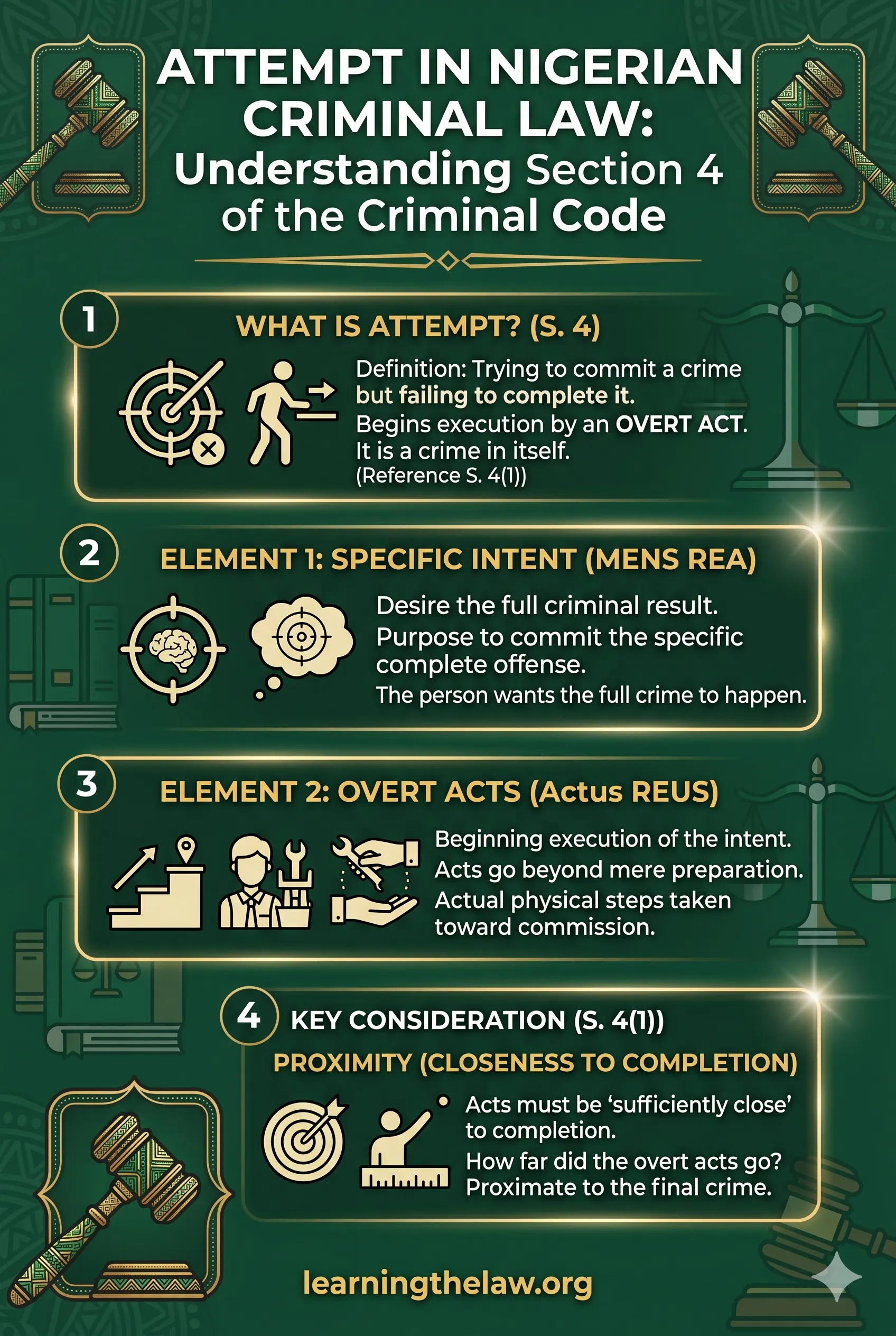
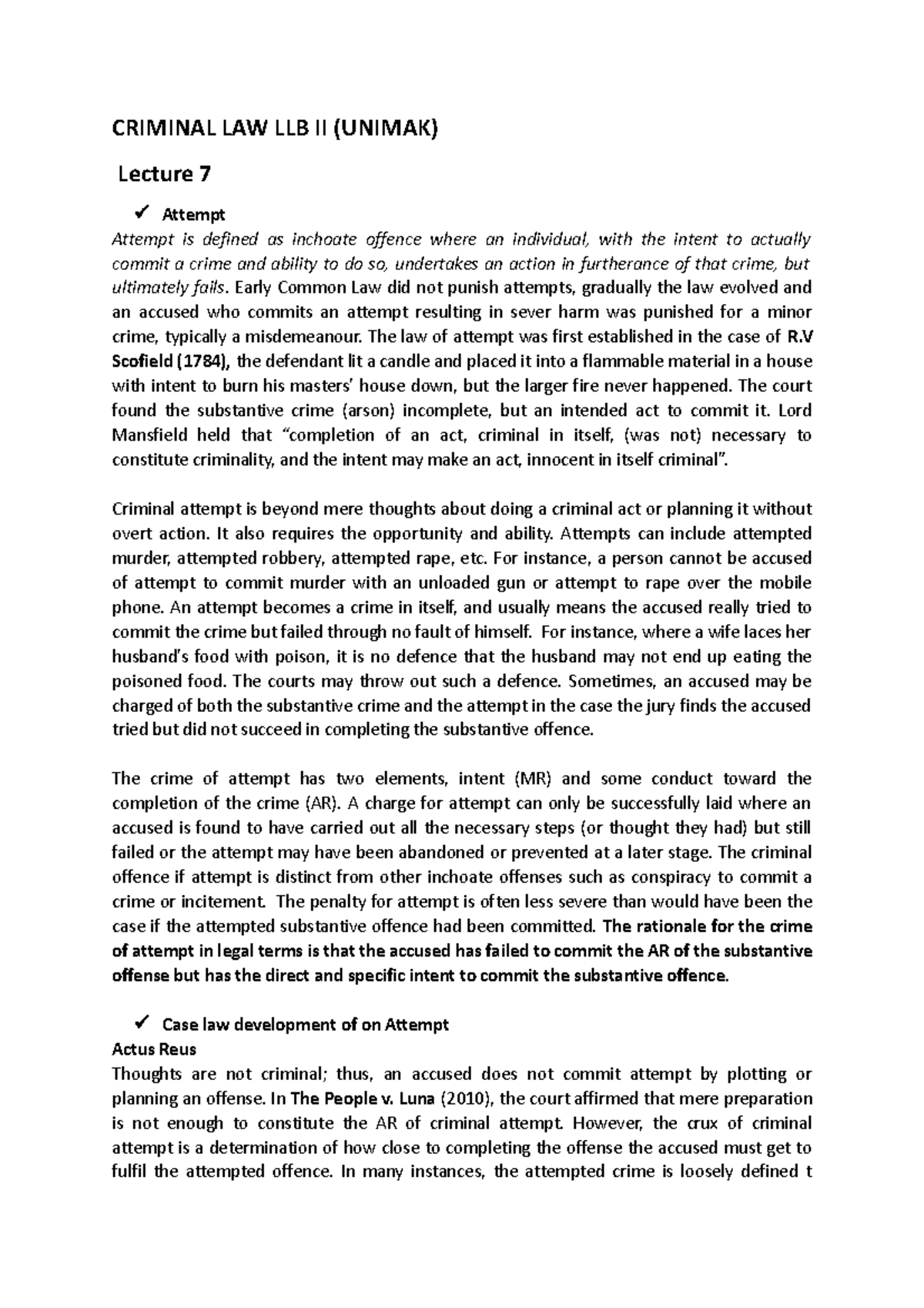
An attempt in criminal law is an inchoate or incomplete offense where an individual takes a substantial step toward committing a crime with the specific intent to complete it, but fails or is prevented from finishing the substantive crime.
In criminal jurisprudence, society has a compelling interest in deterring harmful behavior before a substantive crime fully materializes. Consequently, legal systems punish culpable conduct even when the intended harm is ultimately averted. An attempt in criminal law bridges the gap between dangerous thoughts—which are generally not punishable by themselves—and completed criminal acts.
Understanding this concept requires examining the delicate interplay between a perpetrator's mental state, the actions they execute, and the legal lines separating punishable preparation from actual perpetration.
The Foundations of Inchoate Offenses
Inchoate crimes, derived from a Latin root meaning "to begin," represent preliminary steps directed toward the commission of another crime. While most criminal offenses require a completed harmful result—such as a theft, a battery, or arson—inchoate offenses criminalize conduct that precedes the final harm. The three primary inchoate crimes recognized in most jurisdictions are attempt, solicitation, and conspiracy.
Attempt occupies a unique space among these doctrines because it focuses intensely on individual actions and culpability. Unlike conspiracy, which requires an agreement between two or more people, an individual can commit an attempt entirely alone.
The legal justification for punishing an attempt rests on two primary pillars: deterrence and desert. A person who acts with criminal intent and gets close to committing a crime demonstrates a clear danger to public safety. Society demands protection against individuals who manifest a willingness to break the law, regardless of whether external circumstances fortuitously stopped them from succeeding.
Core Elements of Criminal Attempt
To secure a conviction for criminal attempt, a prosecuting authority must prove two distinct elements beyond a reasonable doubt:
- The specific intent to commit the underlying substantive crime.
- An overt act or substantial step taken in furtherance of that crime.
Without the convergence of both components, a criminal charge of attempt cannot stand. The following subsections analyze these core requirements in detail.
Specific Intent (Mens Rea)
The mental state required for attempt is notably stricter than that required for many completed crimes. While a person might commit manslaughter through recklessness or negligence, an individual cannot generally attempt a crime recklessly.
To be guilty of an attempt, the defendant must possess the specific intent (mens rea) to bring about the exact criminal result prohibited by the target offense. For example, if a statute defines murder as the unlawful killing of a human being with malice aforethought, an attempted murder charge requires proof that the defendant specifically intended to kill the victim. Acting with mere recklessness—such as driving dangerously fast through a crowded street—might support a reckless endangerment charge, but it will not support an attempted murder charge unless prosecutors can demonstrate an actual intent to cause death.
The Overt Act and Substantial Step (Actus Reus)
Establishing a wicked state of mind is insufficient without physical manifestation. The actus reus of attempt requires moving past mere thoughts and preparation into execution. However, drawing the line between innocent preparation and punishable attempt has challenged courts and legal scholars for centuries.
Historically, various legal tests evolved to determine when a defendant crossed the threshold into an attempt:
- The Locus Poenitentiae (Chance for Repentance): An older common-law concept looking at whether the defendant had reached a point where it was practically impossible to turn back.
- The Physical Proximity Test: Concentrated heavily on how close the defendant was physically to completing the crime. Under this view, standing outside a bank with a weapon might be too remote, whereas pointing a gun at a teller would qualify.
- The Probable Desistance Test: Examined whether the perpetrator's conduct would naturally result in the commission of the crime unless interrupted by an outside force.
- The Dangerous Proximity Test: Focuses on the gravity of the crime, the probability of success, and the apprehension caused.
Modern penal codes, heavily influenced by the Model Penal Code (MPC), have largely adopted the Substantial Step Test. Under this standard, a person is guilty of an attempt if, acting with the kind of culpability otherwise required for commission of the crime, they purposely do or omit to do anything that, under the circumstances as they believe them to be, constitutes a substantial step in a course of conduct planned to culminate in their commission of the crime.
The substantial step must be strongly corroborative of the actor's criminal purpose. Examples include searching for a victim, reconnoitering the place contemplated for the commission of the crime, or possessing materials specifically designed for unlawful use under circumstances pointing towards an intended crime.
The Critical Distinction: Preparation Versus Attempt
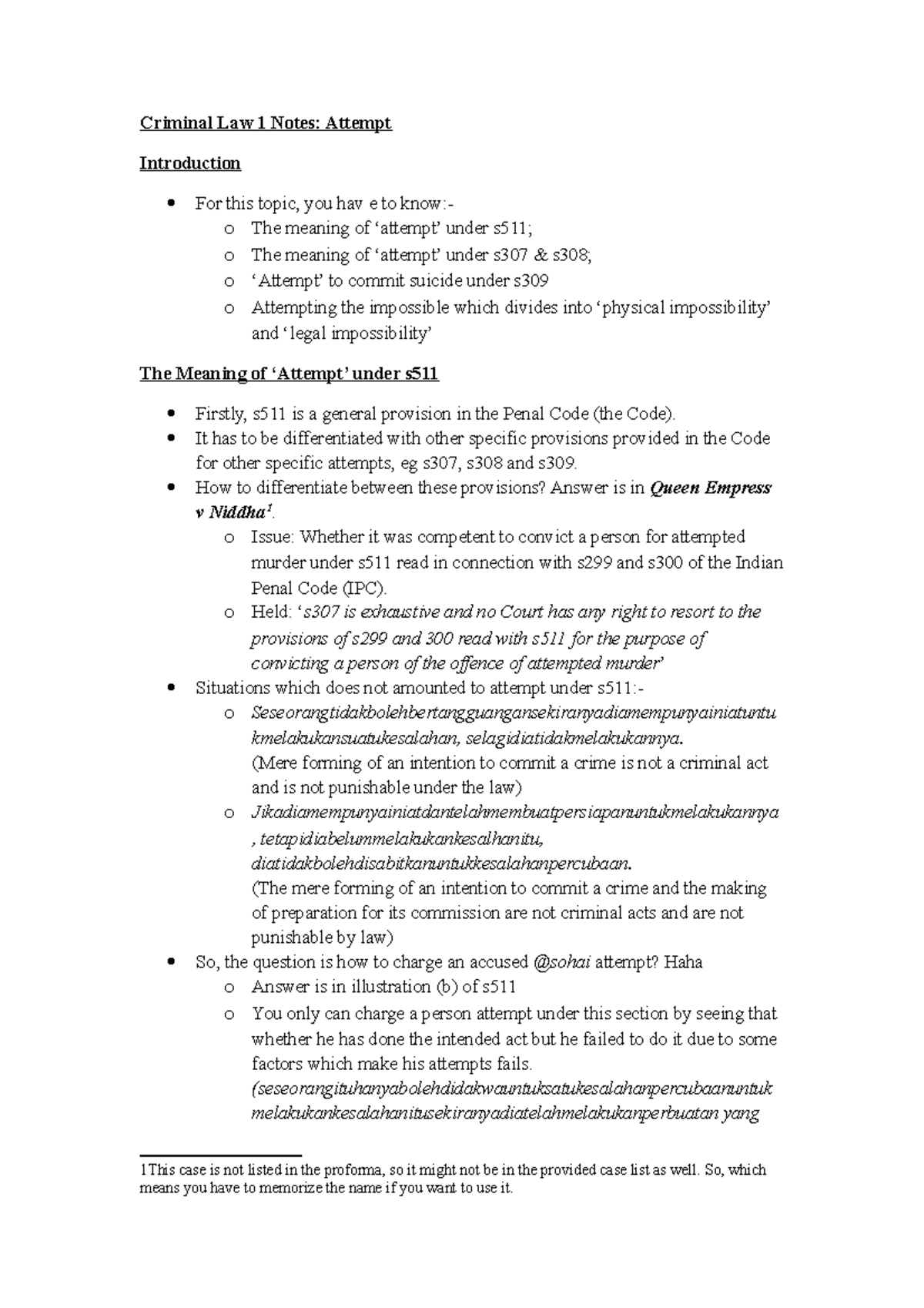
One of the most litigated areas in criminal law involves differentiating between preparation and attempt. Preparing to commit a crime is generally not punishable as an attempt because a person retains the freedom of will to abandon the enterprise before crossing the legal rubicon.
Consider an individual who decides to steal a painting from a museum. Purchasing a guidebook, mapping out the museum exits, and buying dark clothing constitute mere preparation. These acts are ambiguous; they could theoretically be part of a legitimate, lawful activity, such as studying art history or dressing for a costume party.
However, once that same individual conceals lockpicks, enters the museum after hours, and approaches the specific display case housing the painting, their conduct sheds its ambiguous character. The actions now strongly corroborate a firm criminal intent. This clear transition marks the movement from preparation to a criminal attempt.
| Stage of Conduct | Legal Status | Example |
|---|---|---|
| Ideation | Not Punishable | Thinking about robbing a bank. |
| Preparation | Generally Not Punishable | Buying a mask, reading a map, or renting a getaway car. |
| Substantial Step | Punishable as Attempt | Waiting outside the bank with a weapon, wearing the mask, and walking toward the door. |
| Perpetration | Punishable as Substantive Crime | Entering the bank, demanding money, and taking cash. |
Legal Impossibility Versus Fact Impossibility
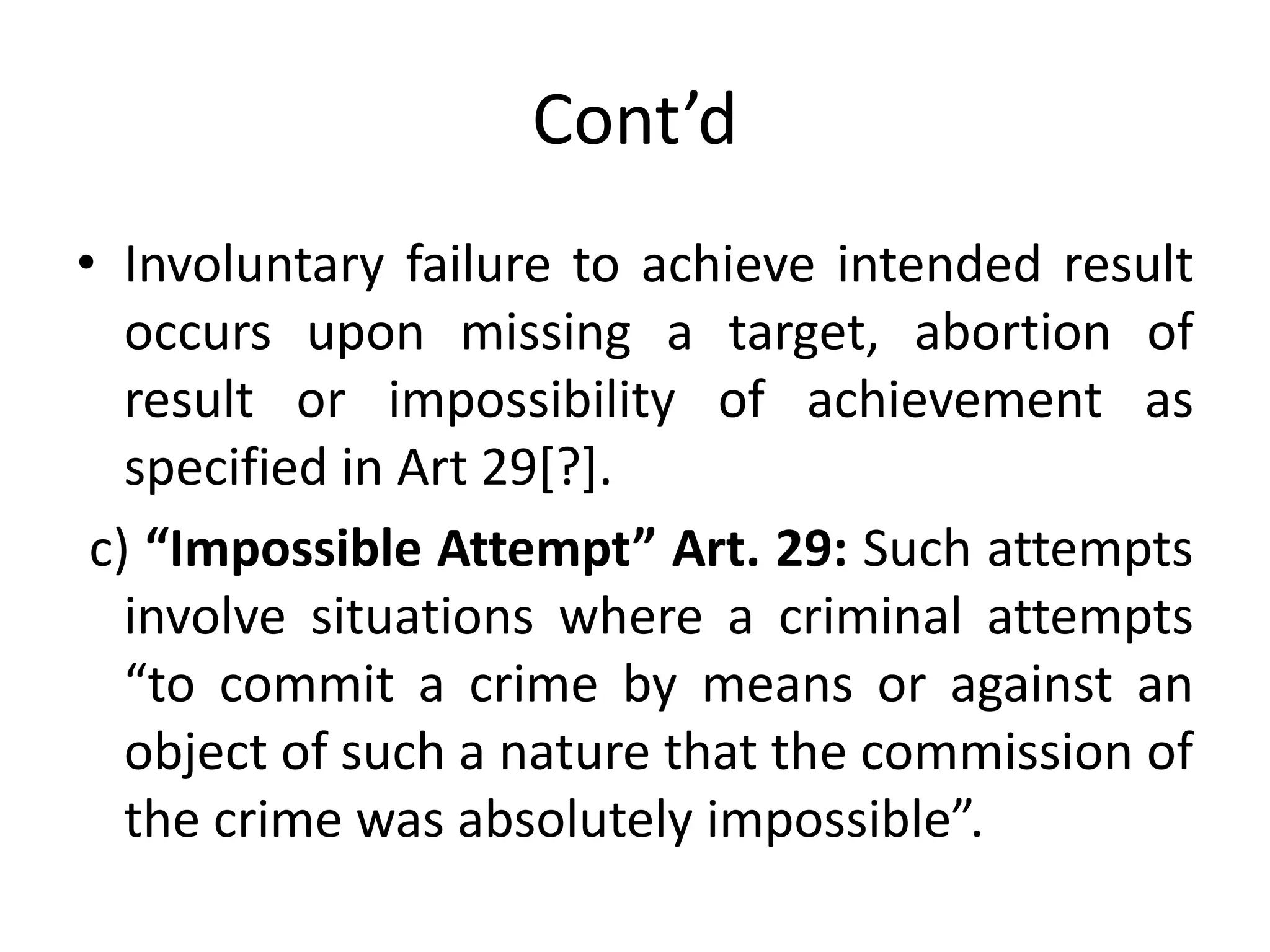
A fascinating and complex issue in attempt law arises when a defendant intends to commit a crime and takes every necessary step, but the crime is fundamentally impossible to complete. Courts and criminal codes categorize impossibility into two main forms: factual impossibility and legal impossibility.
Factual Impossibility
Factual impossibility occurs when extraneous circumstances unknown to the actor or beyond their control prevent the consummation of the crime.
- Classic Example: A pickpocket slips their hand into an empty pocket, intending to steal a wallet. Because the pocket contains no wallet, the theft cannot be completed.
In virtually all modern jurisdictions, factual impossibility is not a defense to a charge of attempt. The defendant's intent was culpable, and they performed the acts necessary to carry it out; only external reality frustrated the final result.
Legal Impossibility
Legal impossibility occurs when the acts the defendant engages in, even if fully carried out, would not constitute a crime under the law.
- Classic Example: A person believes that importing Cuban cigars is a felony and attempts to smuggle them into the country, but federal law permits importation or the items are entirely legal.
Traditionally, legal impossibility was recognized as a valid defense to a criminal attempt charge. If the target behavior is not prohibited by law, attempting it cannot create criminal liability. However, modern statutory frameworks and judicial decisions have largely narrowed true legal impossibility, often recharacterizing historical cases of legal impossibility as instances of "hybrid" or factual impossibility, thereby holding defendants accountable when their subjective intent was to violate what they believed to be valid criminal statutes.
Abandonment and Renunciation
Can a person who initiates a criminal attempt avoid liability by changing their mind? The common-law rule was strict: once an attempt was complete, subsequent abandonment of the criminal enterprise offered no defense.
However, modern codes, influenced by the Model Penal Code, frequently recognize an affirmative defense of abandonment or renunciation. To successfully assert this defense, the defendant must prove by a preponderance of the evidence that they voluntarily and completely renounced their criminal purpose.
Crucially, the abandonment cannot be motivated by circumstances that increase the probability of detection or apprehension, nor can it simply be a postponement to a better time. If a burglar abandons a break-in because a police cruiser drives down the street, the abandonment is not voluntary; it is externally forced. Conversely, if a burglar enters a home, looks at the valuables, experiences a genuine change of heart, and leaves empty-handed without being detected, they may successfully raise the defense of renunciation.
Sentencing and Punishment for Attempt
Because an attempt does not result in the completed harm of the substantive offense, legal systems generally punish attempts less severely than completed crimes.
Legislatures typically structure sentencing guidelines so that an attempt carries a maximum prison term, fine, or probationary period that is a fraction—often half—of the penalty prescribed for the completed substantive offense. For example, if a completed robbery carries a maximum sentence of twenty years in prison, an attempted robbery might carry a maximum sentence of ten years.
However, notable exceptions exist. In many jurisdictions, attempted murder is punished severely, sometimes carrying penalties comparable to or identical to second-degree murder, reflecting the extreme culpability and high risk of loss of life associated with the conduct.
Frequently Asked Questions About Criminal Attempt
Can you be convicted of attempting a crime that requires recklessness?
Generally, no. Because attempt requires a specific intent to bring about a specific criminal result, crimes defined by reckless or negligent behavior—such as involuntary manslaughter—cannot logically be attempted. A person cannot purposefully attempt to act recklessly.
What is the difference between conspiracy and attempt?
Conspiracy is an agreement between two or more people to commit an unlawful act, and it focuses on collective criminality. Attempt focuses on an individual's direct actions and substantial steps toward completing a crime. While conspiracy requires an agreement and often an overt act, attempt requires a substantial step taken by someone intending to execute the crime themselves or through an accomplice.
Does abandonment eliminate criminal liability if the police are already watching?
No. For an abandonment defense to succeed, the renunciation of the criminal goal must be completely voluntary and uninfluenced by outside pressure, such as the realization that law enforcement is present or that the crime is too difficult to complete at that moment.
How do prosecutors prove specific intent for an attempt?
Because direct evidence of a person's state of mind is rarely available, prosecutors rely on circumstantial evidence. This includes the defendant's statements, preparations, the nature of the tools used (such as carrying a firearm or poison), and the surrounding circumstances of the overt acts.
Is solicitation the same as attempt?
No. Solicitation occurs when someone commands, encourages, or requests another person to commit a crime. If the solicited person agrees and takes a step, a conspiracy or attempt may arise, but solicitation itself is a separate inchoate offense focused on inducing another to break the law.
Conclusion and Next Steps
Attempt in criminal law serves as an essential mechanism for maintaining public safety by intervening before criminal plans fully materialize. Navigating charges involving inchoate offenses requires careful analysis of statutory definitions, the exact nature of the overt acts performed, and potential affirmative defenses like renunciation. Individuals facing allegations of criminal attempt should immediately consult with qualified legal counsel specializing in criminal defense to evaluate the evidence, assess jurisdictional standards, and protect their constitutional rights.