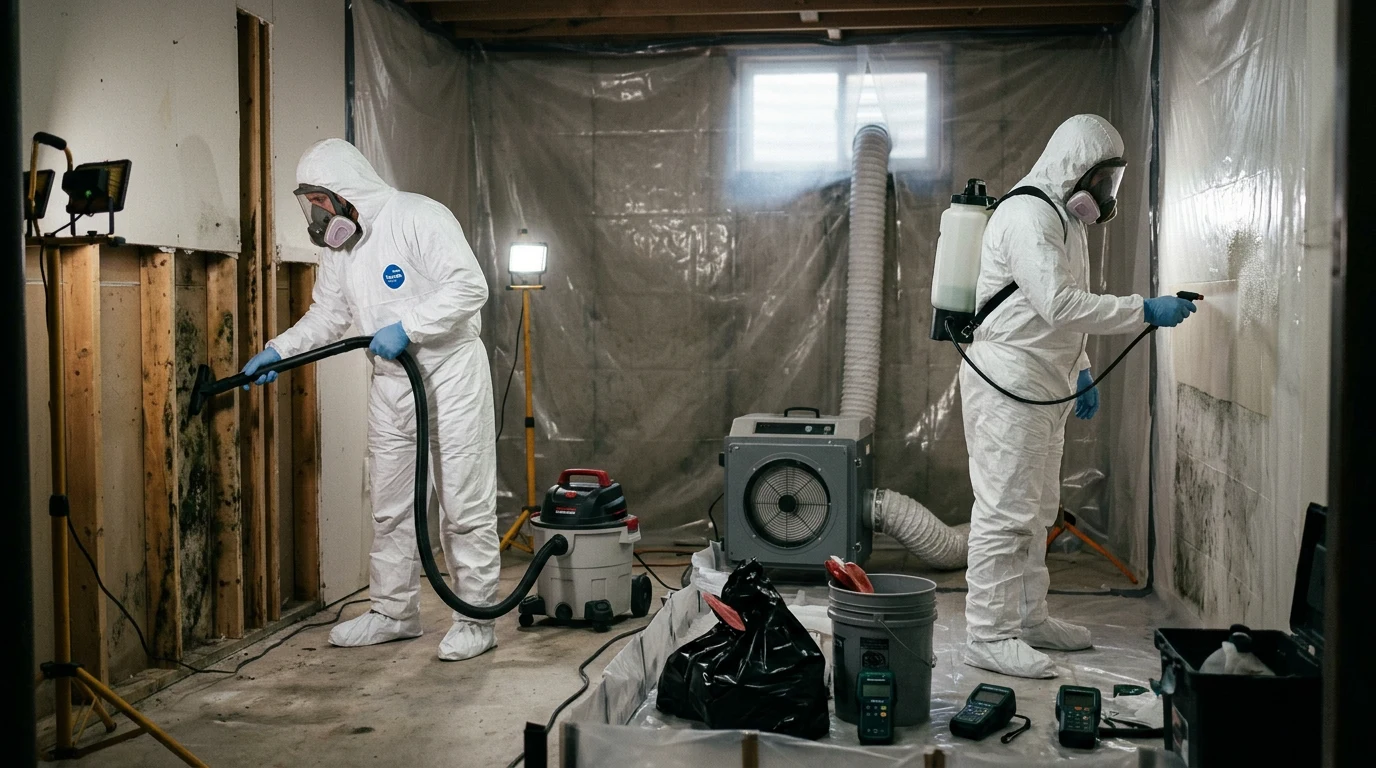
The ARS mold remediation process is a systematic, multi-stage protocol designed to identify, contain, and eliminate fungal growth while restoring indoor air quality. By utilizing high-efficiency particulate air (HEPA) filtration, specialized containment barriers, and moisture control strategies, professionals ensure that mold spores do not spread to unaffected areas during the restoration.
Mold growth is more than an aesthetic nuisance; it is a symptom of underlying moisture imbalances that can compromise structural integrity and respiratory health. When engaging ARS (American Residential Services) or similar professional restoration entities, homeowners must navigate a complex landscape of technical procedures and financial considerations. In 2026, the industry continues to adhere to the IICRC S520 Standard for Professional Mold Remediation, which prioritizes the physical removal of mold over mere topical treatments. Understanding the nuances of this process—from the initial diagnostic assessment to the final post-remediation verification—is essential for ensuring a safe, permanent solution to indoor environmental issues.
Initial Assessment and Diagnostic Protocols
The remediation journey begins with a comprehensive site assessment. ARS technicians do not merely look for visible patches of "black mold"; they perform a forensic evaluation of the building envelope to locate the source of moisture. Without identifying and repairing the water intrusion—whether it be a pinhole pipe leak, hydrostatic pressure in the basement, or poor attic ventilation—any remediation effort will likely fail, leading to recurrence.
During this phase, professionals utilize advanced diagnostic tools. Infrared thermography (thermal imaging) is frequently employed to detect temperature differentials behind drywall, which often indicate hidden moisture pockets. Moisture meters are then used to provide quantitative data on the dampness of structural components like studs, subflooring, and joists. This data-driven approach allows the team to map out the "affected zone" accurately, ensuring that the remediation scope is neither undersized (leaving mold behind) nor oversized (unnecessarily increasing costs).
One critical consideration during the assessment is the determination of the mold "Category" and "Class," similar to water damage assessments. Technicians evaluate the extent of the colonization and the porosity of the materials involved. This dictates whether items can be cleaned in place or must be discarded as "Condition 3" (actual mold growth) materials.
The ARS Containment Strategy
Once the scope is defined, the most critical step in preventing cross-contamination is the establishment of containment. Mold spores are microscopic and become airborne the moment they are disturbed by cleaning or demolition. Without proper containment, a localized kitchen leak could inadvertently spread fungal spores into the HVAC system and bedrooms.
ARS utilizes several levels of containment based on the severity of the infestation:
- Source Containment: Used for small, localized areas (typically under 10 square feet) where the mold is covered with 6-mil polyethylene sheeting before being manipulated.
- Local Containment: Involves the construction of temporary walls using plastic sheeting and tension poles to isolate a specific room or alcove.
- Full Containment: Necessary for extensive mold growth (exceeding 30-100 square feet). This often includes a multi-stage decontamination chamber or "airlock" where technicians put on and take off Personal Protective Equipment (PPE) to ensure no spores leave the work zone on their clothing.
A vital component of this containment is the creation of negative air pressure. By using industrial-grade air movers and ducting air to the outside, technicians ensure that the air pressure inside the containment zone is lower than the pressure outside. This physical law ensures that whenever a door or flap is opened, air flows into the contaminated area rather than escaping out into the rest of the home.
Air Management and HEPA Scrubbing
In 2026, air management remains a cornerstone of the ARS remediation philosophy. While containment stops the bulk spread of spores, the air within the containment zone becomes highly concentrated with particulates during the cleaning process. To manage this, technicians employ HEPA Air Scrubbers.
These machines are designed to circulate the air within the containment zone through a series of filters, culminating in a High-Efficiency Particulate Air (HEPA) filter. A true HEPA filter is rated to capture 99.97% of particles as small as 0.3 microns. Because mold spores typically range from 2 to 20 microns, HEPA filtration is incredibly effective at "scrubbing" the air clean.
The goal is to achieve a specific number of Air Changes per Hour (ACH), usually between 4 and 6, depending on the volume of the space. This continuous filtration removes the airborne mold spores, dust, and microbial volatile organic compounds (mVOCs) that contribute to the "musty" odor associated with mold.
Physical Removal and Decontamination Procedures
The industry standard, and the approach followed by ARS, emphasizes the physical removal of mold rather than "killing" it with bleach. It is a common misconception that dead mold spores are harmless; in reality, even non-viable (dead) mold spores can contain allergens and toxins that trigger respiratory reactions.
Handling Porous vs. Non-Porous Materials
The remediation process treats materials differently based on their porosity:
- Porous Materials (Drywall, Insulation, Carpet): These materials act like sponges. Mold mycelia (the "roots") can grow deep into the fibers. In most cases, these materials are considered "non-salvageable" and are carefully removed, bagged in 6-mil plastic, and disposed of.
- Semi-Porous Materials (Wood, Concrete): If the structural integrity is intact, these can often be saved. ARS technicians use abrasive cleaning methods—such as wire brushing, sanding, or even dry-ice blasting—to remove the mold from the surface.
- Non-Porous Materials (Metal, Glass, Hard Plastics): These can be effectively decontaminated using HEPA vacuuming followed by a "wipe-and-flush" method with antimicrobial detergents.
Following the physical removal, all remaining surfaces are treated with an EPA-registered antimicrobial solution. These solutions serve two purposes: they neutralize any remaining microscopic spores and provide a fungistatic coating that helps inhibit future growth while the area is being dried.
Drying and Moisture Stabilization
Remediation is incomplete until the environment is returned to a "dry" state. Mold thrives in environments where the relative humidity exceeds 60%. As part of the ARS process, industrial-strength dehumidifiers—often LGR (Low Grain Refrigerant) models—are deployed to pull moisture out of the air and the structural materials.
Technicians monitor the "drying goal," which is determined by taking moisture readings of unaffected materials in a different part of the home. The goal is to match the moisture content of the remediated wood or masonry to these "dry standards." This stage is crucial because if the area is reconstructed while the studs are still damp, mold will likely regrow behind the new drywall within days.
Post-Remediation Verification (PRV)
One of the most important considerations for a homeowner is how to verify that the job was done correctly. ARS remediation protocols typically include or recommend Post-Remediation Verification (PRV), also known as clearance testing.
To avoid a conflict of interest, it is a best practice—and in some jurisdictions, a legal requirement—that the clearance testing be performed by an independent, third-party Indoor Environmental Professional (IEP). The IEP will conduct a visual inspection to ensure no dust or debris remains and then perform air sampling.
The criteria for "passing" a mold clearance test generally include:
- The absence of visible mold and dust inside the containment.
- Indoor spore counts that are lower than, or qualitatively similar to, the outdoor "baseline" samples.
- The absence of "marker" fungi (such as Stachybotrys or Chaetomium) which are indicative of active water damage and are not typically found in outdoor air.
Financial and Insurance Considerations
Navigating the costs of mold remediation requires an understanding of how insurance companies view fungal growth. Most standard homeowners' insurance policies have limited coverage for mold, often capped at $5,000 or $10,000, unless the mold was caused by a "covered peril" like a sudden pipe burst.
Mold Remediation Cost Factors in 2026
| Factor | Impact on Cost | Description |
|---|---|---|
| Scale of Growth | High | Larger areas require more labor, more plastic for containment, and more air scrubbers. |
| Accessibility | Medium | Mold in a crawlspace or attic is more expensive to remediate than mold in a living room due to difficult access and the need for specialized PPE. |
| Material Type | Medium | Removing moldy plaster or lath is more labor-intensive than modern drywall removal. |
| Structural Integrity | High | If mold has compromised load-bearing beams, the cost of structural repair is added to the remediation. |
| Testing Fees | Low | Independent air sampling typically adds $300–$800 to the total project cost. |
Homeowners should review their policy for "Mold, Fungi, or Bacteria" endorsements. In 2026, many insurers require that remediation be performed by a certified professional following IICRC standards to qualify for a claim payout. Using a recognized entity like ARS helps ensure that the documentation (moisture logs, photos, and scope of work) meets the rigorous requirements of insurance adjusters.
Summary of Remediation Levels
| Level | Size of Area | Containment Type | Typical PPE Required |
|---|---|---|---|
| Level 1 | < 10 sq. ft. | Minimal (Poly over area) | N-95 Mask, Gloves |
| Level 2 | 10–30 sq. ft. | Limited (Poly on doorways) | N-95, Gloves, Eye Protection |
| Level 3 | 30–100 sq. ft. | Full (Temporary Walls) | Half-face Respirator, Tyvek Suit |
| Level 4 | > 100 sq. ft. | Full with Decon Chamber | Full-face Respirator, Double Suiting |
Frequently Asked Questions
Can I stay in my home during the ARS mold remediation process?
Whether you can remain in the home depends on the location and scale of the mold. If the remediation is isolated to a single room with professional containment and negative air pressure, staying in other parts of the home is usually safe. However, if the HVAC system is contaminated or the mold is in a central living area, professionals often recommend vacating the premises for the duration of the "demolition" phase to avoid exposure to noise and potential particulate bypass.
How long does the average remediation project take?
Most ARS remediation projects take between 3 and 7 days. The first day is dedicated to containment and equipment setup. Days 2 and 3 usually involve the physical removal of materials and cleaning. The remaining days are focused on the "drying phase," where dehumidifiers run continuously to stabilize the environment before the final clearance testing can be conducted.
Does ARS provide the reconstruction services after the mold is gone?
While ARS focuses on the remediation and "clean-up" phase, many branches offer "turn-key" services that include reconstruction. It is important to distinguish between the two: remediation is the removal of the problem, while reconstruction is the installation of new drywall, flooring, and paint. Always clarify in your contract whether reconstruction is included or if you will need to hire a separate general contractor.
Why shouldn't I just use bleach to kill the mold?
Bleach (sodium hypochlorite) is primarily composed of water. When applied to porous surfaces like wood or drywall, the chlorine stays on the surface, while the water soaks in. This can actually provide the moisture mold needs to grow back deeper within the material. Furthermore, bleach does not remove the allergenic proteins found in the mold spores; only physical removal and HEPA vacuuming can truly remediate the site.
Is professional mold remediation a permanent fix?
Remediation is permanent only if the underlying moisture problem is resolved. If a roof leak was the cause and the roof is not fixed, the mold will return regardless of how well the remediation was performed. ARS focuses on moisture stabilization as part of the process, but ongoing maintenance of the home's plumbing, roofing, and HVAC systems is the responsibility of the homeowner.
Practical Recommendations for Homeowners
If you suspect mold growth, the first action should be to stop the water source. Turn off the main water valve if a leak is suspected, or use a dehumidifier to drop the humidity below 50% as a temporary measure. When contacting ARS, request a written "Scope of Work" that references the IICRC S520 standards. This ensures that you are not paying for "fogging" or "spraying" without the necessary physical removal of the mold.
Furthermore, always insist on a third-party clearance test. Do not allow the same company that performed the remediation to tell you the air is clean. An independent lab report is your only objective proof that the home is safe for occupancy and that the property value has been protected.