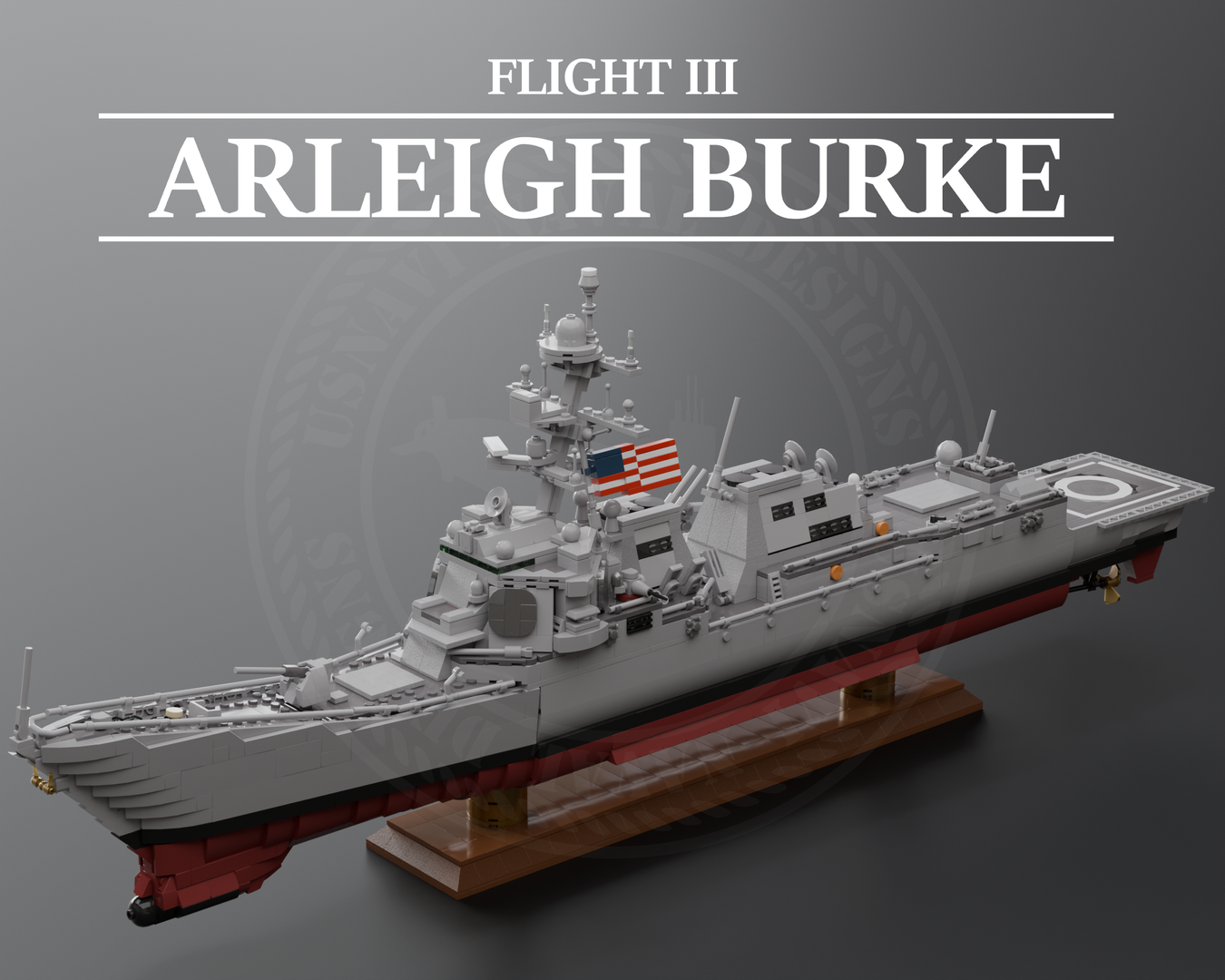
The Arleigh Burke-class Flight III destroyer represents the most significant technological leap in the history of the U.S. Navy’s most prolific surface combatant. Centered on the integration of the AN/SPY-6(V)1 Air and Missile Defense Radar (AMDR) and the Aegis Baseline 10 Combat System, this variant provides the fleet with unprecedented sensitivity and processing power to counter simultaneous ballistic missile and advanced air threats.
The DDG-51 Arleigh Burke-class has been the backbone of the United States Navy’s surface fleet since the early 1990s. However, as the 21st-century threat landscape evolved—characterized by hypersonic missiles, sophisticated electronic warfare, and massed drone swarms—the older Flight I, II, and IIA configurations reached the limits of their power generation and cooling capacities. The Flight III upgrade is not merely a service life extension; it is a fundamental redesign of the ship’s internal "nervous system" and "muscles" to support the most powerful sensor suite ever deployed on a destroyer.
The Strategic Necessity of the Flight III Evolution
By the mid-2010s, the U.S. Navy faced a critical dilemma. The ambitious Zumwalt-class (DDG-1000) program had been truncated to just three hulls, leaving a gap in the long-term plan for a large surface combatant. Simultaneously, the projected DDG(X) next-generation destroyer remained in the conceptual stages. To maintain a competitive edge in the Indo-Pacific and other contested environments, the Navy opted to evolve the proven Arleigh Burke hull into the Flight III configuration.
The primary driver for Flight III was the limitation of the legacy AN/SPY-1 radar. While revolutionary in its time, the SPY-1 is a passive electronically scanned array (PESA) that struggles with the extreme sensitivity required to detect the smaller, faster, and stealthier threats of the 2020s. To house the new AN/SPY-6(V)1 active electronically scanned array (AESA) radar, the Navy had to significantly modify the DDG-51 design, balancing the increased weight and power requirements within a hull that was already densely packed.
As of 2026, the Flight III program is in full-rate production. The lead ship, USS Jack H. Lucas (DDG-125), has paved the way for subsequent hulls like the USS Louis H. Wilson Jr. (DDG-126) and USS Ted Stevens (DDG-128). These vessels are now the standard for forward-deployed naval presence, offering a bridging capability until the DDG(X) enters the fleet in the 2030s.
The Heart of the Ship: AN/SPY-6(V)1 Radar
The defining feature of the Flight III is the AN/SPY-6(V)1 Air and Missile Defense Radar (AMDR). Developed by Raytheon, this radar provides a quantum leap in capability over the legacy SPY-1D(V) found on Flight IIA ships.
Radar Modular Assemblies (RMAs)
The SPY-6 is built using Radar Modular Assemblies. Each RMA is a self-contained radar in a two-foot by two-foot by two-foot box. The Flight III configuration utilizes 37 of these RMAs on each of its four array faces. This modularity allows for "digital beamforming," where the radar can focus multiple beams simultaneously on different tasks, such as high-altitude ballistic missile tracking and low-altitude cruise missile detection.
Enhanced Sensitivity and Range
The technical advantage of the SPY-6 is its sensitivity. It is approximately 30 times more sensitive than the SPY-1D(V). In practical terms, this means the radar can detect objects that are half the size at twice the distance of previous systems. This is critical for defending against "stealthy" anti-ship missiles and providing early warning for carrier strike groups.
Reliability and Maintenance
Because the system is modular, it is inherently more reliable. If a single RMA fails, the radar continues to function with only a negligible loss in performance. Maintenance can often be performed while the ship is at sea by swapping out individual modules, a significant improvement over the complex, centralized transmitters of older Aegis ships.
Re-Engineering the Power and Cooling Systems
Integrating a radar as powerful as the SPY-6 required more than just bolting new panels onto the superstructure. The Flight III necessitated a complete overhaul of the ship's internal infrastructure to support the massive electrical and thermal loads.
The Shift to 4,160-Volt Power
Legacy Arleigh Burke destroyers operate on a 450-volt electrical system. However, the SPY-6 radar requires significantly more energy than the 450V system could efficiently provide. The Flight III architecture introduced a 4,160-volt AC power plant. This high-voltage system, powered by three Rolls-Royce AG9160RF gas turbine generators, allows the ship to transmit large amounts of electricity to the radar and combat systems with less cable weight and higher efficiency.
Advanced Cooling Infrastructure
More power leads to more heat. To prevent the SPY-6 and its associated computers from overheating, the Navy replaced the ship's 200-ton air conditioning plants with 300-ton High-Efficiency Super Capacity (HESC) AC plants. These units utilize a chilled water system that is roughly 50% more powerful than those on Flight IIA ships. This cooling capacity is vital for maintaining the operational tempo of the Aegis Baseline 10 computers during high-intensity combat operations.
Aegis Baseline 10: The Digital Brain
The hardware of the Flight III is managed by the Aegis Baseline 10 Combat System. This software suite is the most advanced iteration of the Aegis Weapon System, designed specifically to integrate the data from the SPY-6 radar and distribute it across the fleet.
Aegis Baseline 10 allows for Integrated Air and Missile Defense (IAMD). In previous versions, a ship often had to choose between focusing on ballistic missile defense (BMD) or traditional anti-air warfare (AAW). Baseline 10 enables the Flight III to perform both missions simultaneously without degrading performance in either.
Furthermore, Flight III ships are equipped with Cooperative Engagement Capability (CEC). This allows a Flight III destroyer to "see" through the sensors of other ships or aircraft, such as the E-2D Advanced Hawkeye. A Flight III could, in theory, launch an interceptor at a target it cannot see on its own radar, using tracking data provided by a remote sensor. This networked approach is the cornerstone of the Navy's Distributed Maritime Operations (DMO) strategy.
Weaponry and Mission Versatility
While the sensors and power systems are the primary upgrades, the Flight III retains the formidable "teeth" that have made the Arleigh Burke-class world-renowned.
- Vertical Launch System (VLS): The ship features 96 Mk 41 VLS cells (32 forward, 64 aft). These cells are multi-purpose, capable of firing the SM-3 for exo-atmospheric ballistic missile defense, the SM-6 for long-range anti-air and surface strikes, the Tomahawk Cruise Missile for land attack, and the Evolved SeaSparrow Missile (ESSM) Block 2 for point defense.
- The 5-inch/62 Caliber Gun: Located on the bow, the Mk 45 Mod 4 gun provides naval gunfire support and can engage surface targets.
- Anti-Submarine Warfare (ASW): The Flight III includes the AN/SQQ-89(V)15 sonar suite, integrating a bow-mounted sonar and the Multi-Function Towed Array (MFTA).
- Aviation: Like the Flight IIA, the Flight III features a full dual-hangar facility for two MH-60R Seahawk helicopters or a combination of manned and unmanned aerial vehicles (UAVs).
Flight III vs. Flight IIA: Key Comparison
The following table highlights the material differences between the previous standard (Flight IIA Technology Insertion) and the current Flight III production models as of 2026.
| Feature | Arleigh Burke Flight IIA (TI) | Arleigh Burke Flight III |
|---|---|---|
| Primary Radar | AN/SPY-1D(V) (Passive Array) | AN/SPY-6(V)1 (Active AESA) |
| Radar Sensitivity | Baseline (1x) | ~30x Sensitivity Increase |
| Electrical System | 450 Volts AC | 4,160 Volts AC |
| Power Generation | 3x 3000kW Generators | 3x 4000kW (AG9160RF) |
| Cooling Capacity | 200-ton AC Plants | 300-ton HESC AC Plants |
| Combat System | Aegis Baseline 9 | Aegis Baseline 10 |
| Displacement | ~9,500 tons | ~10,000+ tons |
| Hull Length | 509 ft 6 in | 509 ft 6 in (Modified internals) |
Construction and Deployment Status in 2026
As of 2026, the production of Flight III destroyers is the primary focus of both Huntington Ingalls Industries (HII) in Mississippi and General Dynamics Bath Iron Works (BIW) in Maine. The Navy has committed to a multi-year procurement strategy to ensure a steady "pipeline" of these ships.
The lead ship, USS Jack H. Lucas (DDG-125), completed its first major operational deployment in late 2025, validating the SPY-6 radar in real-world conditions. Lessons learned from the DDG-125 have been integrated into the construction of later hulls. By 2026, at least four Flight III ships are in active commission, with another dozen in various stages of fabrication or sea trials.
The deployment of Flight III ships is strategically prioritized for the 7th Fleet (Pacific) and 6th Fleet (Mediterranean/Atlantic). In the Pacific, these ships serve as the "goalkeepers" for carrier strike groups, providing a protective umbrella against the increasing threat of long-range anti-ship ballistic missiles (ASBMs). Their ability to detect and track small cross-section targets also makes them invaluable for monitoring regional maritime activity.
Challenges and Operational Limitations
Despite its prowess, the Flight III Arleigh Burke is not without its trade-offs. The DDG-51 hull is over 30 years old, and the Flight III represents the absolute limit of what can be packed into this frame.
- Weight and Stability: The addition of the heavy SPY-6 arrays and the massive power/cooling equipment has pushed the ship's center of gravity higher. This required thickening the hull plating in some areas and adding weight lower in the ship to maintain stability, leading to a total displacement of over 10,000 tons.
- Space Constraints: There is virtually no "growth margin" left in the Flight III design. Future upgrades, such as high-energy laser weapons (above 150kW) or more advanced electronic warfare suites, may struggle to find the physical space or additional power required.
- Cost: Each Flight III destroyer costs approximately $2 billion to $2.2 billion (in 2026 dollars). While cheaper than the experimental Zumwalt-class, they represent a significant portion of the Navy's shipbuilding budget.
Frequently Asked Questions
Is the Arleigh Burke Flight III a stealth ship?
While the Flight III includes some radar-cross-section (RCS) reduction features in its superstructure design, it is not a "stealth" ship like the Zumwalt-class. It relies on its superior sensors and electronic warfare suites (such as SEWIP Block 3) to detect threats early and jam incoming missiles rather than hiding from them entirely.
How many Flight III ships does the Navy plan to build?
The Navy currently plans to build at least 20 to 30 Flight III ships. This number is subject to change based on the development timeline of the DDG(X). The goal is to ensure the fleet remains capable of high-end conflict through the 2040s.
Can Flight III ships intercept hypersonic missiles?
Yes, the combination of the SPY-6 radar and the SM-6 missile is the Navy's primary defense against hypersonic threats. The radar's high sensitivity allows it to track the unique flight profiles of hypersonic glide vehicles, while the SM-6 provides the maneuverability needed for interception.
What is the difference between SPY-1 and SPY-6?
The SPY-1 is a passive system that uses a single central transmitter to send signals. The SPY-6 is an active system where each module (RMA) is its own transmitter. This allows SPY-6 to be more powerful, more precise, and capable of performing multiple types of missions at once without interference.
Will the Flight III replace all older Arleigh Burke ships?
No. The Flight III is being built to replace aging Ticonderoga-class cruisers and older Flight I Arleigh Burkes as they reach the end of their service lives. Flight IIA ships will likely remain in service alongside Flight III for decades to come, often receiving "Technology Insertion" upgrades to keep them relevant.
Recommendations for Further Action
For those interested in the future of naval warfare, monitoring the official U.S. Navy Fact Files is the best way to track the commissioning dates and homeport assignments of new Flight III vessels. Additionally, following the annual budget reports from the Congressional Research Service (CRS) on the "Navy DDG-51 and DDG(X) Destroyer Programs" provides deep insight into the procurement challenges and strategic shifts that influence the production of these advanced warships.
As the Flight III becomes the standard surface combatant of the 2020s, understanding its capabilities—and its limitations—is essential for anyone following global maritime security and the technological evolution of the United States Navy.