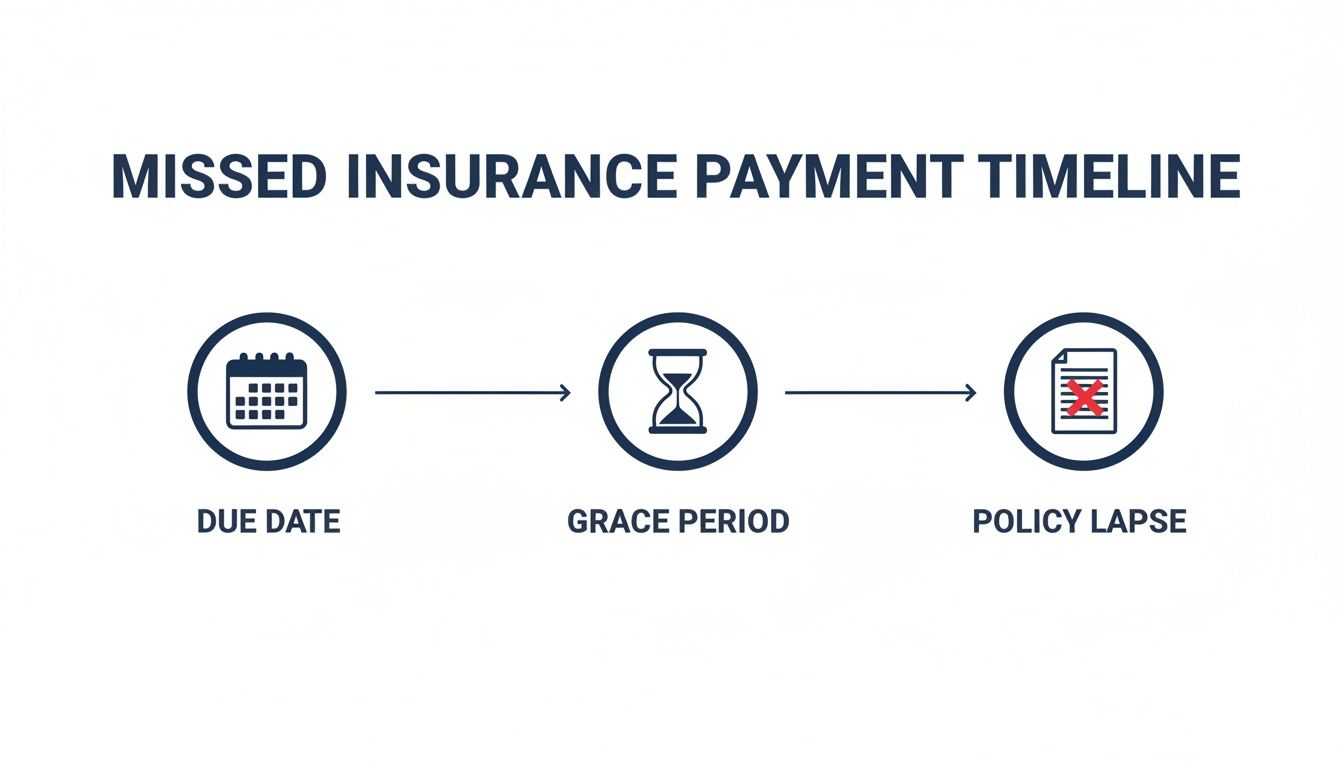
In Arizona, there is no legal grace period that allows you to drive a vehicle after your auto insurance policy has expired or been canceled. Arizona law requires continuous motor vehicle liability insurance; the moment your coverage lapses, you are in violation of state statutes and subject to immediate penalties, including registration suspension and significant fines.
Arizona is known for having some of the strictest financial responsibility laws in the United States. While many drivers assume there is a "cushion" of a few days to renew a policy or switch providers, the reality of Arizona’s regulatory environment is binary: you are either insured or you are not. Understanding the distinction between an insurance company’s internal payment grace period and the state’s legal requirements is essential for every driver in the Grand Canyon State in 2026.
The Legal Reality: Does Arizona Have a Grace Period?
To answer the question definitively: No, the State of Arizona does not provide a legal grace period for expired auto insurance.
Under Arizona Revised Statutes (A.R.S.) § 28-4135, every motor vehicle operated on Arizona roads must be covered by a liability insurance policy issued by an insurer authorized to do business in the state. This requirement is "continuous." There is no provision in the law that grants a 7-day, 10-day, or 30-day window to drive without active coverage while you search for a new provider or wait for a paycheck.
The Distinction Between State Law and Insurance Policy Terms
Confusion often arises because drivers conflate "state law" with "insurance company policy."
- Contractual Grace Periods: Some insurance carriers may offer a short window—often 7 to 30 days—during which they will accept a late payment to reinstate a policy without a lapse in coverage. However, this is a private contractual agreement. If you do not pay within that window, the cancellation is often backdated to the original due date, meaning you were legally uninsured during that entire period.
- State Enforcement: The Arizona Motor Vehicle Division (MVD) does not recognize these private "wait periods" as an excuse for a lapse. If an insurer notifies the MVD that a policy has been terminated, and no new policy is electronically reported to the state immediately, the MVD begins the process of suspending the vehicle’s registration.
How the Arizona MVD Monitors Insurance Status
In 2026, the Arizona MVD utilizes a sophisticated electronic insurance verification system. Insurance companies licensed to operate in Arizona are required by law to report all policy cancellations, non-renewals, and new issuances to the MVD database within a very short timeframe.
The Verification Process
When your insurance expires, the following sequence of events typically occurs:
- Electronic Notification: Your previous insurer sends an electronic notice to the MVD stating that policy #XXXX has been terminated.
- Database Matching: The MVD system checks for a corresponding "New Policy" notice from another insurer for that specific Vehicle Identification Number (VIN).
- The Inquiry Letter: If no new policy is found, the MVD sends an inquiry letter to the registered owner. You generally have a limited window (often 15 to 30 days) to provide proof that you were actually insured during the period in question or that the vehicle was sold/junked.
- Suspension Order: If you cannot provide proof of continuous coverage, the MVD will issue an order to suspend your vehicle registration and, in some cases, your driver’s license.
Legal Consequences of Driving Uninsured in Arizona
Driving without insurance in Arizona is a "civil traffic violation" that carries heavy financial and administrative burdens. If you are stopped by law enforcement or involved in an accident while your insurance is expired, the penalties are tiered based on your history of offenses within a 36-month period.
First Offense
For a first-time violation, the court will impose a minimum fine of $500. Additionally, the MVD will suspend your vehicle registration and plates for three months. To reinstate your driving privileges, you must pay a reinstatement fee and provide an SR-22 Certificate of Financial Responsibility for three years.
Second Offense
If you are caught driving without insurance a second time within 36 months, the minimum fine increases to $750. Your registration and driver’s license will be suspended for six months. Again, the SR-22 requirement and reinstatement fees apply.
Third and Subsequent Offenses
A third offense within 36 months results in a minimum fine of $1,000 and a one-year suspension of your registration and driver’s license. The long-term costs of being classified as a "high-risk" driver during this period can amount to thousands of dollars in increased insurance premiums.
| Violation Tier | Minimum Fine | Registration Suspension | License Suspension | SR-22 Required? |
|---|---|---|---|---|
| 1st Offense | $500 | 3 Months | No (unless accident) | Yes (3 Years) |
| 2nd Offense | $750 | 6 Months | 6 Months | Yes (3 Years) |
| 3rd+ Offense | $1,000 | 12 Months | 12 Months | Yes (3 Years) |
Note: These fines do not include additional court fees or the costs associated with the SR-22 filing.
The Role of the SR-22 in Arizona
The SR-22 is perhaps the most misunderstood consequence of an insurance lapse. It is not insurance itself; rather, it is a document filed by an insurance company with the MVD certifying that you carry at least the minimum state-required liability coverage.
In Arizona, if your insurance expires and you are cited, you must maintain an SR-22 for three consecutive years. If you allow the SR-22 policy to lapse even for one day during those three years, the insurance company is legally required to notify the MVD, which will immediately re-suspend your license and registration. Because SR-22 filings are only handled by certain "high-risk" insurance departments, your premiums will likely double or triple compared to standard rates.
Payment Grace Periods: What to Expect from Insurers
While the state does not grant a grace period, your specific insurance company might. In 2026, most major carriers have digitized their billing cycles to offer some flexibility, but this flexibility is limited.
Reinstatement vs. New Policy
- Reinstatement with a Lapse: If you pay your premium three days late, the company might reinstate your policy but record a "lapse" for those three days. During those three days, you have no coverage. If you hit someone, you are personally liable.
- Reinstatement without a Lapse: If you pay within the company’s specific "grace period" (if they offer one), they may agree to cover the gap. This is rare and usually requires a "Statement of No Losses," where you sign a legal document swearing you didn't have an accident during the unpaid period.
Why You Should Never Rely on a Payment Grace Period
Relying on a payment grace period is risky because of the Arizona Insurance Verification System. Even if your insurer reinstates you, the "cancellation" notice may have already reached the MVD. You could end up with a suspended registration even after you've paid your bill, requiring you to navigate the MVD's bureaucracy to prove you are back in compliance.
Steps to Take if Your Arizona Insurance Has Expired
If you realize your insurance has lapsed, you must act immediately to minimize the damage. Every hour you wait increases the risk of a permanent mark on your driving record.
- Stop Driving the Vehicle: This is the most critical step. Do not drive to the insurance agency or the MVD. If you are caught, "I was on my way to pay it" is not a valid legal defense in Arizona.
- Contact Your Current Insurer: Ask if the policy can be reinstated. If it is within a few days of the expiration, they may allow you to pay the premium plus a late fee.
- Shop for Immediate Coverage: If your previous insurer refuses to renew you, find a new provider immediately. Many companies offer "instant" digital proof of insurance. Ensure the new policy meets Arizona’s minimum liability limits (currently $25,000 for bodily injury per person, $50,000 per accident, and $15,000 for property damage).
- Verify with the MVD: Log into the AZ MVD Now portal to check the status of your registration. If you see a "Pending Suspension" or "Insurance Verification Required" notice, you can often upload your new proof of insurance directly through the portal.
- Pay Reinstatement Fees: If your registration was already suspended, you will need to pay a $25 reinstatement fee (subject to change) after providing proof of new insurance.
Common Mistakes and Misconceptions
"I don't drive the car, so I don't need insurance."
In Arizona, if a vehicle is registered, it must be insured, even if it is sitting in a garage or on blocks. If you plan to stop insuring a vehicle because it is inoperable, you must file a De-Insured Certificate with the MVD to avoid registration suspension.
"My insurance company has to give me 10 days' notice."
Under Arizona law, insurers are required to send a notice of cancellation at least 10 days before the policy terminates for non-payment. However, this notice is usually sent before the expiration date. By the time the actual "expiration date" on your ID card arrives, the 10-day notice period has usually already passed.
"A lapse of one day doesn't matter."
A lapse of even one day can trigger a "high-risk" classification by insurance algorithms. When you apply for a new policy, the insurer will ask if you have had a lapse in coverage within the last 12 to 36 months. Answering "yes" can disqualify you from "preferred" rates, costing you hundreds of dollars over the next several years.
Long-Term Financial Impact of an Insurance Lapse
Beyond the immediate fines, the financial tail of an insurance lapse in Arizona is long.
- Loss of "Continuous Coverage" Discounts: Most insurance companies offer significant discounts to drivers who have maintained coverage for 5+ years without a break. A single day of expiration resets this clock to zero.
- Increased Premium Rates: Statistical data shows that drivers with insurance lapses are more likely to be involved in future claims. Consequently, insurers raise rates for these individuals.
- Vehicle Impoundment: If you are stopped for a lapse and have a prior history of being uninsured, Arizona police have the authority to impound your vehicle. You would then be responsible for towing fees and daily storage fees, which often exceed $50 per day.
Frequently Asked Questions
Can I drive my car to the MVD to show proof of insurance?
No. If your insurance is expired, you cannot legally drive the vehicle anywhere. You should handle the proof of insurance through the AZ MVD Now website or by calling their customer service line. If you must go in person, have someone else drive you or use a ride-sharing service.
What if I forgot to pay because I didn't receive a bill?
Arizona law places the burden of maintaining financial responsibility on the vehicle owner. Not receiving a bill or a notice is not a valid defense against the penalties for driving without insurance. It is recommended to set up "Auto-Pay" to prevent accidental lapses.
Does the "Grace Period" apply if I just bought a new car?
When you purchase a new vehicle from a dealership, most insurance policies provide a "Newer Vehicle" grace period (typically 7 to 30 days) where your existing coverage extends to the new car. However, this only applies if you already have an active policy on another vehicle. If you do not have any active insurance, you cannot drive the new car off the lot until you purchase a policy.
How do I fix a suspended registration due to insurance?
You must obtain a new insurance policy and ensure the insurer reports it to the MVD. Then, visit the AZ MVD Now portal, pay the $25 reinstatement fee, and confirm that the registration status has returned to "Valid."
Practical Recommendation
To avoid the severe penalties associated with Arizona's lack of a grace period, you should monitor your insurance status at least 15 days before your policy renewal date. In 2026, the integration between insurers and the Arizona MVD is nearly instantaneous. If you find yourself in a position where you cannot afford your premium, it is better to downsize your coverage to the state minimum or file a De-Insured Certificate than to let the policy expire while continuing to drive.
The minimum $500 fine for a first offense is significantly more expensive than most monthly premium payments. If a lapse has already occurred, stop driving immediately and prioritize obtaining a new policy today to stop the "lapse clock" from further damaging your insurance score and driving record.