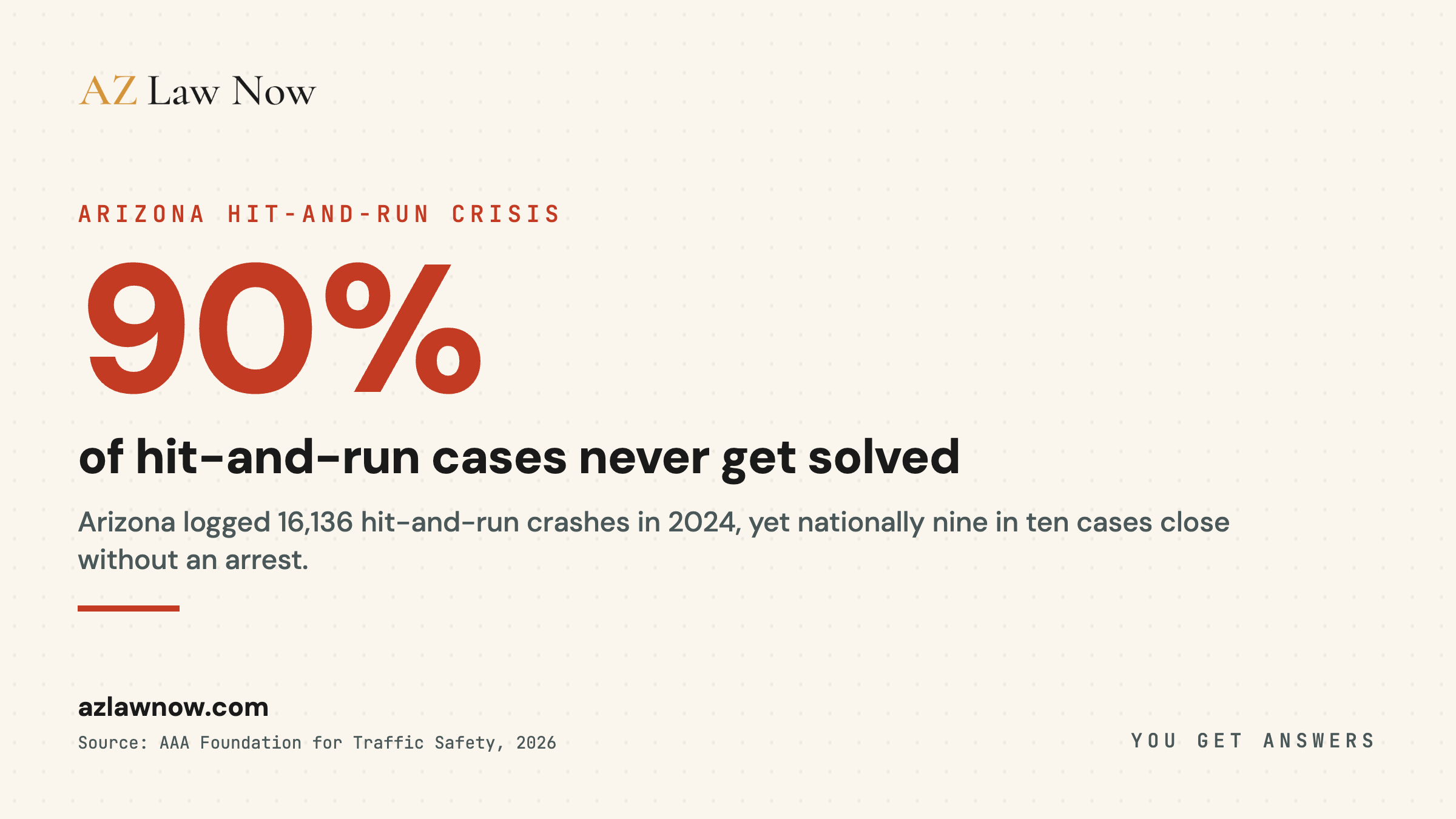
In Arizona, hit and run laws require any driver involved in a motor vehicle accident to immediately stop at the scene or as close as possible without obstructing traffic. Drivers must exchange specific information and provide "reasonable assistance" to anyone injured. Failure to fulfill these duties results in criminal charges ranging from a Class 3 misdemeanor for property damage to a Class 2 felony for accidents involving death or serious injury.
Arizona’s approach to hit and run incidents—legally referred to as "Failure to Stop" or "Leaving the Scene of an Accident"—is rooted in the principle of accountability. The law does not strictly care who caused the initial collision; the criminal act occurs the moment a driver chooses to flee rather than fulfill their statutory obligations. Whether you are a driver seeking to understand your responsibilities or a victim looking for legal clarity, navigating the complexities of the Arizona Revised Statutes (A.R.S.) is essential for protecting your rights.
The Legal Framework of Arizona Hit and Run Statutes
Arizona law categorizes hit and run offenses based on the severity of the outcome. These statutes are found within Title 28 of the Arizona Revised Statutes. To be convicted of a hit and run, the prosecution must typically prove that the driver was involved in an accident, knew (or should have known) that an accident occurred, and failed to comply with the duties outlined in the law.
A.R.S. § 28-661: Accidents Involving Death or Personal Injury
This is the most severe hit and run statute in Arizona. It applies when an accident results in injury or death to any person. Even if the driver was not at fault for the crash itself, leaving the scene elevates the incident to a felony.
- Serious Physical Injury or Death: If a driver fails to stop after an accident that results in death or "serious physical injury" (defined as an injury that creates a reasonable risk of death or causes serious/permanent disfigurement or loss of organ function), they face a Class 2 or Class 3 felony.
- Non-Serious Injury: If the injury is not "serious" but still requires medical attention, the charge is typically a Class 5 felony.
A.R.S. § 28-662: Accidents Involving Damage to a Vehicle
This statute covers "fender benders" and collisions where no one is hurt, but one or more vehicles are damaged. The driver must stop and remain at the scene until they have fulfilled their information-sharing requirements. Violating this statute is generally a Class 2 misdemeanor.
A.R.S. § 28-663: Duty to Give Information and Assistance
This section defines exactly what a driver must do after stopping. Simply pulling over is not enough. Under A.R.S. § 28-663, you must:
- Provide your name and address.
- Provide the registration number of the vehicle you are driving.
- Upon request, show your driver’s license to the other party.
- Render "reasonable assistance" to any injured person, which may include making arrangements for the person to be carried to a physician or hospital for medical treatment.
Criminal Penalties and Sentencing in 2026
The consequences for a hit and run conviction in Arizona are among the strictest in the United States. In 2026, the courts continue to prioritize victim restitution and public safety, often imposing mandatory driver’s license revocations alongside jail or prison time.
Felony Penalties (Injury or Death)
- Class 2 Felony: If the driver caused the accident and fled a scene involving death or serious injury, they can face 3 to 12.5 years in prison. If the driver did not cause the accident but still fled, the sentencing range is slightly lower but still carries significant prison time.
- Class 3 Felony: Applies to fleeing a scene with serious injury or death where the driver was not the primary cause of the collision.
- Class 5 Felony: Typically involves accidents with minor injuries. Conviction can result in 6 months to 2.5 years in prison.
Misdemeanor Penalties (Property Damage)
- Class 2 Misdemeanor: Leaving the scene of an accident involving a vehicle driven or attended by another person (damage only). This can result in up to 4 months in jail and a fine of up to $750 plus surcharges.
- Class 3 Misdemeanor: Often applies to failing to provide information or striking a fixed object (like a fence or pole) and failing to report it.
Administrative Penalties: The Arizona MVD
Beyond the criminal courtroom, the Arizona Motor Vehicle Division (MVD) imposes its own set of penalties. A conviction for a hit and run involving injury or death results in a mandatory driver's license revocation.
- For death or serious injury, the revocation period is typically three years.
- For other injuries, the revocation period is one year.
- For property damage, the MVD may assess 8 points to the driver's record, which often triggers a mandatory Traffic Survival School (TSS) requirement or a license suspension.
| Violation Type | Primary Statute | Classification | Potential Jail/Prison | License Impact |
|---|---|---|---|---|
| Death/Serious Injury (Driver at Fault) | A.R.S. § 28-661 | Class 2 Felony | 3 to 12.5 Years | 3-Year Revocation |
| Death/Serious Injury (Driver Not at Fault) | A.R.S. § 28-661 | Class 3 Felony | 2 to 8.75 Years | 3-Year Revocation |
| Injury (Non-Serious) | A.R.S. § 28-661 | Class 5 Felony | 0.5 to 2.5 Years | 1-Year Revocation |
| Damage to Occupied Vehicle | A.R.S. § 28-662 | Class 2 Misdemeanor | Up to 4 Months | 8 Points / Suspension |
| Striking Unattended Vehicle | A.R.S. § 28-664 | Class 3 Misdemeanor | Up to 30 Days | 8 Points |
| Striking Highway Fixtures | A.R.S. § 28-665 | Class 3 Misdemeanor | Up to 30 Days | Financial Liability |
Hit and Run Involving Unattended Property
Arizona law also accounts for situations where the owner of the property or vehicle is not present. This frequently occurs in parking lots or when a vehicle veers off the road into a structure.
Striking an Unattended Vehicle (A.R.S. § 28-664)
If you strike a parked car and the owner is not present, you are legally required to stop and either:
- Locate the owner and provide your name and address.
- Leave a written notice in a conspicuous place (usually under the windshield wiper) that provides your name, address, and an explanation of what happened.
Leaving a business card is generally sufficient, provided it contains the required contact information. Failure to do so is a Class 3 misdemeanor.
Striking Fixtures or Highway Landscaping (A.R.S. § 28-665)
If you crash into a "fixture" (which includes utility poles, guardrails, traffic signs, or even decorative landscaping on a highway), you must take reasonable steps to notify the person in charge of the property. You must provide your name, address, and vehicle registration. If the property belongs to the state (like a highway sign), notifying the Arizona Department of Public Safety (DPS) or local police is the standard procedure.
The Role of "Knowledge" in Hit and Run Cases
A critical element in any Arizona hit and run prosecution is the driver's knowledge. The state must prove that the driver was aware, or should have been aware, that they were involved in a collision.
In 2026, legal precedents continue to clarify that "willful blindness" is not a defense. If a driver hits something large enough that a reasonable person would conclude they struck a car or a human, they cannot claim they "didn't know" simply because they didn't look back. However, if the impact was so slight that it was imperceptible—such as a trailer hitch brushing a bumper with no vibration or sound—the lack of knowledge may serve as a valid legal defense.
Civil Consequences and Insurance Impact
While the criminal penalties focus on punishment, the civil side of a hit and run focuses on compensation. If you are the victim of a hit and run in Arizona, you face a unique set of challenges in recovering damages.
Insurance and Uninsured Motorist (UM) Coverage
If the fleeing driver is never identified, the victim’s own insurance policy usually handles the claim under Uninsured Motorist (UM) or Underinsured Motorist (UIM) coverage. In Arizona, insurance companies are required to offer UM/UIM coverage, though policyholders can opt-out in writing.
- Identification Requirement: To file a hit and run claim with your insurer, you typically need to prove that "physical contact" occurred between the vehicles.
- Deductibles: Even if you are not at fault, you may still have to pay your collision deductible if the other driver is not found.
Punitive Damages
If the hit and run driver is caught, the victim may sue for damages in civil court. Because leaving the scene of an accident is considered an egregious act of negligence and a violation of public policy, Arizona courts may allow victims to seek punitive damages. These are additional funds intended to punish the wrongdoer rather than just reimburse the victim for medical bills or car repairs.
Common Legal Defenses Against Hit and Run Charges
Facing hit and run charges in Arizona is a serious matter, but there are several recognized legal defenses. Because these cases often rely on circumstantial evidence, a skilled defense may focus on the following:
- Lack of Knowledge: As mentioned, if the driver truly did not know an accident occurred, they cannot be held criminally liable for "failing" to stop.
- Safety Concerns: In rare instances, a driver may leave the scene because they reasonably fear for their safety. For example, if a collision occurs in a high-crime area at night and the other driver brandishes a weapon, the defendant may argue that leaving the scene was a necessity. In such cases, the driver is expected to drive directly to a police station or call 911 immediately.
- The "Mistaken Identity" Defense: It is surprisingly common for a vehicle to be involved in a hit and run while the owner is not the one driving. The prosecution must prove beyond a reasonable doubt that the defendant was behind the wheel.
- No Injury or Damage: If a driver stops, checks for damage, sees none, and leaves, they might be charged if the other party later claims injury. If it can be proven that no damage or injury actually occurred at the time of the impact, the charges may be dismissed.
Frequently Asked Questions
What should I do if I accidentally leave the scene of an accident?
If you realize you left an accident scene, you should contact a legal professional immediately. Turning yourself in to the police with an attorney can often lead to a more favorable outcome than waiting for investigators to find you via traffic cameras or witness reports. Do not wait for the police to knock on your door.
Does the "Good Samaritan" law protect me if I help someone in a hit and run?
Arizona’s Good Samaritan law (A.R.S. § 32-1471) provides immunity from civil liability for those who render emergency care in good faith at the scene of an accident. However, this does not absolve a driver involved in the accident of their duty to stop and provide information under A.R.S. § 28-663.
How long does the police have to charge me for a hit and run in Arizona?
The statute of limitations for a hit and run depends on the classification of the crime. For a felony hit and run (injury or death), the state generally has seven years to file charges. For a misdemeanor (property damage), the limit is typically one year.
Can I be charged with a hit and run if I hit an animal?
While A.R.S. § 28-661 and § 28-662 specifically mention "injury to a person" or "damage to a vehicle," hitting a domestic animal (like a dog) could be considered property damage. If you hit a pet, you should make a reasonable effort to find the owner or contact local animal control/police to avoid potential civil or misdemeanor claims.
If I am hit by a driver who flees, will my insurance rates go up?
Under Arizona law (A.R.S. § 20-263), an insurer cannot increase your premium for a claim where you were not at fault. Since a hit and run victim is generally not the "at-fault" party, your rates should theoretically remain stable, though you should verify your specific policy terms.
Immediate Next Actions
If you are involved in a collision in Arizona, your immediate priority must be safety and legal compliance.
- Stop Immediately: Never "chase" a fleeing driver; instead, pull over safely and call 911.
- Document the Scene: Use your phone to take photos of vehicle damage, the surrounding area, and any skid marks. If the other driver is fleeing, try to record their license plate or the make/model of the car.
- Seek Medical Attention: Even if you feel fine, adrenaline can mask injuries like whiplash or internal bleeding. A medical record created shortly after the accident is vital for both insurance and criminal cases.
- Consult Legal Counsel: Whether you are facing charges or seeking compensation, Arizona’s hit and run laws are too complex to navigate alone. Contact a qualified attorney who specializes in Arizona transportation law to ensure your rights are protected throughout the process.