For commercial growers in 2026, New Zealand apple varieties represent the gold standard in high-value, branded cultivars, specifically optimized for high-density planting and long-distance export. Key varieties such as Envy™, Jazz™, and Dazzle™ dominate the market due to their exceptional pressure-test ratings, high Brix levels, and the "Club Variety" intellectual property model that ensures premium pricing through controlled supply.
New Zealand has transformed from a general fruit producer into a specialized global "nursery" for the world’s most successful apple genetics. Managed primarily through collaborations between Plant & Food Research, Prevar, and commercial giants like T&G Global, New Zealand’s apple pipeline focuses on three pillars: texture (extraordinary crunch), shelf life (ability to withstand 60+ days of shipping), and "snackability." For a grower, selecting a New Zealand variety is no longer just a horticultural decision; it is a strategic entry into a global supply chain.
The Intellectual Property Landscape: Understanding Club Varieties
Before a grower selects a New Zealand cultivar, they must navigate the managed variety or "Club" model. Unlike traditional varieties like Red Delicious or Granny Smith, which are "open" and can be planted by anyone, most New Zealand-origin apples are protected by Plant Variety Rights (PVR).
In this model, a grower does not simply buy a tree; they enter into a license agreement. This agreement often dictates:
- Acreage Limits: The total number of hectares allowed globally is capped to prevent oversupply.
- Quality Standards: Only fruit meeting specific color, size, and Brix (sugar) parameters can be sold under the brand name.
- Marketing Levies: A portion of the sales goes back to the IP holder to fund global marketing.
- Mandatory Packers: Growers may be required to use specific packing houses to ensure consistency.
As of 2026, the transition toward these closed loops is nearly complete for new releases. Growers looking for New Zealand genetics must evaluate whether they have the infrastructure to meet these rigorous quality standards.
Top New Zealand Varieties for Commercial Cultivation
1. Envy™ (Scilate Variety)
Envy™ remains the flagship of New Zealand’s export success. A cross between Royal Gala and Braeburn, it has become one of the most sought-after apples in the premium Asian and North American markets.
- Flavor Profile: Intensely sweet with low acidity. It features a dense, bright white flesh that is slow to brown when sliced.
- Growing Characteristics: The tree is moderately vigorous and responds well to 2D trellis systems. It has a high pack-out rate because the fruit achieves a consistent red blush even in shaded parts of the canopy.
- Grower Considerations: Envy™ requires careful crop load management. If allowed to overcrop, fruit size diminishes, and the tree may fall into a biennial bearing pattern (fruiting only every second year).
2. Jazz™ (Scifresh Variety)
The Jazz™ apple is the "workhorse" of the premium category. It was the first major success of the New Zealand breeding program to hit global scale.
- Flavor Profile: A sharp, tangy-sweet balance with an incredibly hard, crisp texture. It is marketed toward consumers who prefer a "refreshing" rather than "syrupy" apple.
- Growing Characteristics: Jazz™ is known for its high pressure-test results, often exceeding 9kg/cm² at harvest. This makes it exceptionally durable during mechanical sorting and long-term controlled atmosphere (CA) storage.
- Grower Considerations: It is susceptible to Bitter Pit, a physiological disorder related to calcium deficiency. Growers must implement a rigorous foliar calcium spray program and manage tree vigor carefully to ensure the fruit remains marketable.
3. Dazzle™ (PremA129 Variety)
Dazzle™ is a newer entry that has gained massive traction in the mid-2020s. It was specifically bred to appeal to the "sweet-tooth" markets of China and Southeast Asia.
- Flavor Profile: Very sweet, large, and remarkably red. It has a "creamy" crunch that is less dense than Jazz™ but more substantial than Gala.
- Growing Characteristics: This is a high-yielding variety. The fruit stays on the tree well without dropping, allowing for a wider harvest window.
- Grower Considerations: Because it targets the premium large-fruit market, thinning is essential. Growers must be aggressive with chemical and manual thinning to ensure the majority of the crop reaches the preferred size 40–60 range.
4. Rockit™ (PremA96 Variety)
Rockit™ redefined the apple category by creating the "miniature snack" segment. These apples are sold in plastic tubes or recyclable canisters rather than by weight.
- Flavor Profile: Sweet, thin-skinned, and crunchy.
- Growing Characteristics: The fruit is naturally small. While other growers fight for size, Rockit™ growers focus on maximizing the number of small, uniform fruits per hectare.
- Grower Considerations: The licensing for Rockit™ is highly exclusive. The business model relies on the packaging and branding rather than the commodity market. It requires specialized packing lines designed for small-diameter fruit.
Comparative Technical Specifications for Growers
The following table summarizes the operational requirements for the most prominent New Zealand varieties available to growers in 2026.
| Variety | Harvest Window (Relative to Gala) | Optimal Rootstock | Storage Potential | Key Market Strength |
|---|---|---|---|---|
| Envy™ | +20 to 25 days | M9, CG 202 | 8–10 months | High-end gift/premium retail |
| Jazz™ | +10 to 14 days | M9, M26 | 10+ months | Global supermarket staple |
| Dazzle™ | +15 to 20 days | M9, CG 41 | 7–9 months | Asian export (Sweet/Red) |
| Rockit™ | +5 to 7 days | M9 (High Density) | 6–8 months | Convenience/Snack sector |
| Smitten™ | -5 to 0 days (Early) | M9, M26 | 5–6 months | Early season premium |
| Cherish™ | +10 days | M9 | 4–6 months | Pink-skin "boutique" market |
Site Selection and Agronomic Requirements
New Zealand varieties were developed in a maritime climate with high UV light and tempered temperatures. Translating these genetics to other regions (such as Washington State, South Africa, or Europe) requires specific adjustments.
Chill Hour Requirements
Most New Zealand cultivars require between 800 and 1,100 chill hours (temperatures between 0°C and 7°C). In low-chill environments, growers may see protracted flowering, which leads to uneven fruit maturity and multiple "picks," increasing labor costs. In 2026, many growers are using dormancy-breaking agents to synchronize bloom in warmer microclimates.
Rootstock Compatibility
The modern New Zealand orchard is almost exclusively high-density (2,500 to 4,000 trees per hectare).
- M9 Nic29: Still the standard for many NZ varieties due to its dwarfing nature and precocity (early fruiting).
- Geneva (CG) Series: Increasingly popular for Envy™ and Jazz™ due to their resistance to Fire Blight and Woolly Apple Aphid, the latter being a significant pest for New Zealand genetics.
Pest and Disease Resistance
New Zealand breeding programs have historically prioritized fruit quality over broad-spectrum disease resistance. Consequently, many of these varieties are susceptible to:
- Apple Scab (Venturia inaequalis): Requires a proactive fungicide program, particularly in humid regions.
- Powdery Mildew: Jazz™ and its progeny show some sensitivity; maintaining airflow through pruning is critical.
- Neonectria Canker: A major concern for European growers of NZ varieties, requiring careful wound protection during winter pruning.
Precision Pruning and Canopy Management
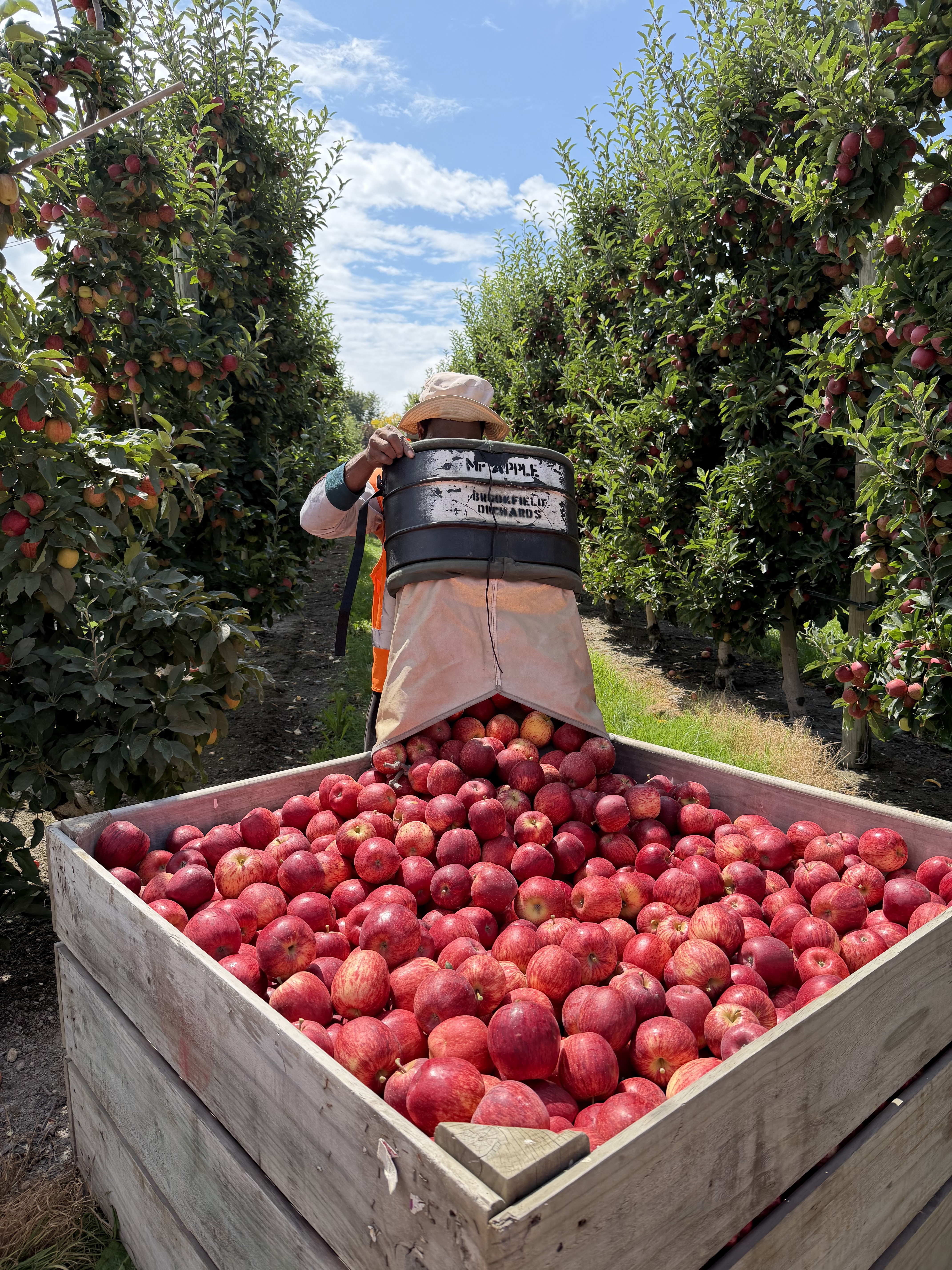
In 2026, the labor market has pushed growers toward "pedestrian orchards" or "robot-ready" canopies. New Zealand varieties are particularly well-suited for 2D Plane (Espalier) systems or Multi-leader V-trellis.
By flattening the canopy, growers ensure that every apple receives the high light interception necessary for the deep red coloration required by the "Envy" or "Dazzle" grade standards. Furthermore, these 2D systems facilitate the use of automated platforms for pruning and thinning, which reduces labor overhead—a critical factor given that these varieties often require more "touches" per season than standard Gala.
Harvest and Post-Harvest Logistics
One of the primary reasons New Zealand varieties are profitable is their harvest window. They generally fill the gap between the early Gala harvest and the late Fuji or Cripps Pink harvest.
Maturity Indices
Growers must use precision tools to determine the picking date:
- Starch Pattern Index (SPI): Critical for Jazz™ to ensure it isn't picked too early (starchy) or too late (mealiness).
- Brix Testing: Dazzle™ must hit a minimum of 13–14% Brix before it can be legally branded.
- Pressure Testing: New Zealand varieties are defined by their "crunch." Monitoring flesh firmness (kg/cm²) is the most important factor for determining long-term storage viability.
Controlled Atmosphere (CA) Storage
New Zealand varieties are "designed" for shipping. They respond exceptionally well to 1-MCP (SmartFresh™) treatments, which inhibit ethylene perception. This allows a grower in the Southern Hemisphere to deliver a "fresh" tasting Envy™ apple to a London or Shanghai supermarket six months after it was picked.
Economic Outlook: Why Plant NZ Varieties in 2026?
The global apple market in 2026 is bifurcated. Commodity apples (Red Delicious, standard Gala, Braeburn) often struggle to return the cost of production to the grower. In contrast, branded New Zealand varieties continue to command a 30% to 60% price premium at the retail level.
The "New Zealand advantage" lies in the consumer's perception of these apples as a consistent, high-quality "brand" rather than a seasonal fruit. For the grower, this means more stable pricing and a protected market share, even during years of global overproduction.
Frequently Asked Questions
Can I grow Jazz™ or Envy™ without a license?
No. These are proprietary varieties protected by Plant Variety Rights (PVR). To plant them, you must be part of a licensed grower group and pay both tree royalties and ongoing production royalties. Unauthorized planting can lead to legal action and the mandatory destruction of the orchard.
Which New Zealand variety is best for a hot climate?
Dazzle™ has shown significant resilience in warmer growing regions. Its ability to color well in higher night-time temperatures gives it an advantage over varieties like Braeburn or traditional Gala, which often struggle with "color fade" in heatwaves.
How do New Zealand varieties compare to Honeycrisp?
While Honeycrisp is famous for its "explosive" crunch, it is notoriously difficult to grow and ship, with high rates of storage disorders. New Zealand varieties like Envy™ provide a similar (though denser) crunch but are much more "grower-friendly" in terms of storage stability and pack-out consistency.
What is the average lifespan of a New Zealand variety orchard?
Because these are high-intensity investments, the economic lifespan is typically 15 to 20 years. By the end of this period, new "next-generation" genetics usually supersede the current varieties, or the tree vigor becomes difficult to manage in a high-density configuration.
Are there any organic New Zealand varieties?
Yes, but they are challenging. Because varieties like Jazz™ are susceptible to scab and mildew, organic production requires a very dry climate (like parts of Central Otago in NZ or eastern Washington in the US) to minimize fungal pressure without synthetic fungicides.
Practical Recommendation for Growers
If you are a commercial grower looking to diversify your orchard in 2026, the most balanced choice for entry into New Zealand genetics is Dazzle™ (PremA129). It offers the highest yield potential and the most straightforward agronomic management among the premium "Club" apples. However, if you have the infrastructure for high-precision calcium management and are targeting the most elite price points, Envy™ remains the highest-yielding variety in terms of pure dollar-per-hectare return, provided you can meet the strict color and size specifications of the brand.