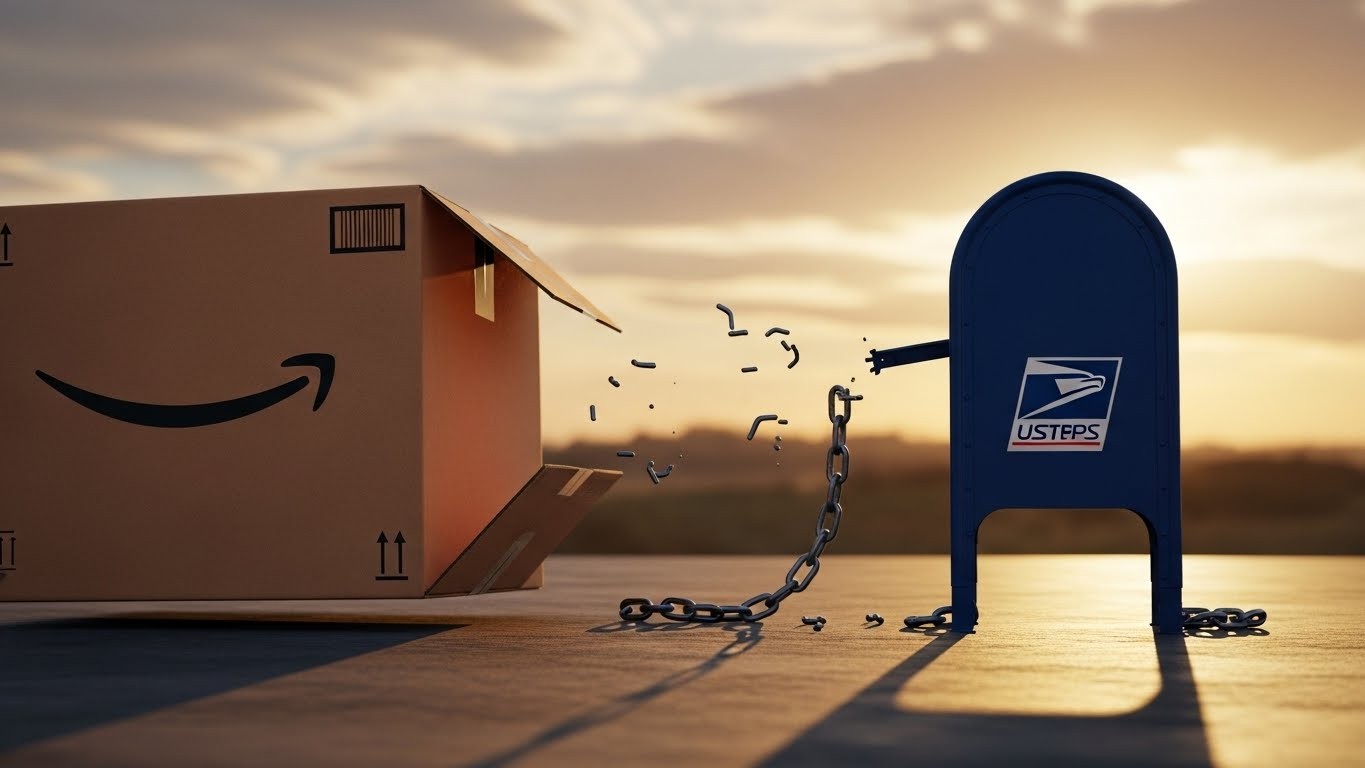
Despite recurring rumors and the visible expansion of Amazon’s own delivery fleet, Amazon is not leaving the United States Postal Service (USPS) in 2026. The partnership remains a cornerstone of the American e-commerce infrastructure, functioning as a strategic alliance where Amazon utilizes the USPS for "last mile" delivery in rural areas, P.O. Box access, and surge capacity that its private network cannot yet match.
The relationship between Amazon and the USPS has frequently been the subject of speculation, political debate, and market analysis. As we navigate the logistics landscape of 2026, it is clear that while the nature of their contract has evolved from a high-volume dependency to a specialized strategic partnership, the idea of a total "divorce" between the two entities is logistically and financially unfeasible for both parties.
The Interdependent Relationship: A 2026 Perspective
In 2026, the logistics industry operates on a hybrid model. Amazon has spent the last decade building one of the world's most sophisticated private delivery networks, featuring thousands of branded vans, long-haul trailers, and a growing fleet of cargo planes. However, this internal network is designed for density and efficiency in urban and suburban hubs. It is not, and was never intended to be, a universal service provider.
The USPS, governed by the Universal Service Obligation (USO), is legally mandated to deliver to every address in the United States, regardless of geographical difficulty or profitability. This makes the USPS an indispensable partner for Amazon. When you see an Amazon package arrive via a mail carrier, it is typically through a service known as Parcel Select. In this arrangement, Amazon handles the "middle mile" logistics—transporting goods from fulfillment centers to local post offices—and pays the USPS a negotiated rate to handle the "last mile" to the doorstep.
Why Total Separation is Logistically Impossible
The suggestion that Amazon would leave the USPS ignores several hard realities of infrastructure and geography. To replace the USPS entirely, Amazon would need to replicate a government-backed network that has been refined over two centuries.
The Rural Coverage Gap
Amazon’s internal logistics are optimized for "drop density." In a city like New York or Chicago, an Amazon driver can deliver fifty packages on a single block. In rural Wyoming or the Appalachian regions, a driver might travel ten miles between stops. For Amazon, the cost of fuel, vehicle maintenance, and driver wages for these remote deliveries is prohibitively high. The USPS, which is already visiting these addresses to deliver mail, offers a significantly lower marginal cost for these "last mile" deliveries.
P.O. Boxes and Federal Property
The USPS holds an exclusive legal right to deliver to mailboxes and P.O. Boxes. Amazon drivers cannot legally place packages inside a standard residential mailbox. For customers who rely on P.O. Boxes—including millions of rural residents and individuals in high-theft urban areas—the USPS remains the only viable delivery method. Unless federal law changes, Amazon cannot bypass the USPS for this segment of the population.
Capacity Management and Peak Season
The holiday season and "Prime Day" events create massive spikes in delivery volume. Maintaining a private fleet large enough to handle 100% of peak volume would mean having thousands of idle vans and drivers during slower months. Amazon uses the USPS as a "relief valve," shifting excess volume to the postal network when its own capacity is exceeded. This flexibility is essential for maintaining the "Prime" delivery speed promises that consumers expect in 2026.
The Evolution of the Partnership: From Volume to Strategic Utility
The reason many people believe Amazon is leaving the USPS is that the visible share of USPS-delivered Amazon packages has decreased in urban centers. This is a deliberate shift, but it does not equate to an exit.
In the early 2020s, the USPS was often the primary carrier for Amazon. Today, the relationship is defined by Strategic Utility. Amazon now prioritizes its own fleet for high-density routes where it can control the customer experience and reduce costs. It reserves the USPS for:
- Non-conforming packages: Items that don't fit well on automated belts or in standard delivery vans.
- Returns: The USPS remains the most convenient "drop-off" point for many consumers returning items via the "No Box, No Label" program.
- Sunday Deliveries: The USPS was a pioneer in Sunday package delivery for Amazon, a service that continues to be vital in many regions where private carrier Sunday operations are limited.
Analyzing the Financial Incentives for 2026
Both Amazon and the USPS have strong financial reasons to maintain their partnership, despite the friction often reported in the media.
For the USPS: Revenue and Fixed Cost Coverage
The USPS has faced significant financial head-winds due to the decline of First-Class Mail. Package delivery, driven largely by Amazon, has been the primary growth engine for the Postal Service. Under the "Delivering for America" 10-year plan, the USPS has modernized its sorting facilities to better handle e-commerce. The revenue from Amazon contributes significantly to the fixed costs of maintaining the universal delivery network. While critics argue the USPS should charge Amazon more, the current rates are designed to be competitive with private carriers like UPS and FedEx while still ensuring the USPS covers its "attributable costs" as required by the Postal Regulatory Commission (PRC).
For Amazon: Capital Expenditure vs. Operational Expense
Building a delivery network that reaches 100% of U.S. households would require hundreds of billions of dollars in additional capital expenditure (CapEx). By using the USPS for the "hardest" 10-15% of deliveries, Amazon can deploy its capital into high-return areas like AWS (Amazon Web Services) and AI-driven warehouse automation. Using the USPS converts a massive fixed cost into a variable operational expense (OpEx), which is more attractive to shareholders.
Comparison: Amazon Logistics vs. USPS (2026)
The following table outlines the roles each entity plays in the current delivery ecosystem for Amazon orders.
| Feature | Amazon Logistics (Internal) | United States Postal Service (USPS) |
|---|---|---|
| Primary Focus | High-density urban and suburban routes. | Rural, remote, and P.O. Box deliveries. |
| Delivery Mechanism | Amazon branded vans and "Flex" drivers. | Uniformed federal mail carriers. |
| Access Rights | Doorstep, porch, and Amazon Lockers. | Mailboxes, P.O. Boxes, and Doorstep. |
| Operational Goal | Maximum speed and brand control. | Universal service and cost-effective last-mile. |
| Sunday Service | Standard in most urban markets. | Contracted specifically for Amazon packages. |
| Returns Handling | Whole Foods and Kohl's drop-offs. | Local Post Office and home pickup. |
Common Misconceptions: Where the "Leaving" Rumors Come From
The myth that Amazon is leaving the USPS persists due to several observable trends that are often misinterpreted.
1. The Rise of "Amazon Hubs" and Lockers Consumers see Amazon-branded lockers and specialized delivery hubs popping up in apartment complexes and retail locations. While these reduce reliance on traditional carriers, they are designed to solve the "theft" and "re-delivery" problems, not to replace the USPS for the average suburban or rural home.
2. Changes in Tracking Information In 2026, Amazon's tracking interface has become more opaque. A package may be "Out for Delivery" with no carrier specified until it arrives. When a package is transferred from an Amazon sort center to a USPS local office, the tracking often shows a "Transfer to Carrier" status. Some customers interpret this transition as a delay or a sign of shifting away from the USPS, when in reality, it is the Parcel Select system working exactly as intended.
3. The 2024-2025 Contract Renegotiations Recent cycles of contract renewals between Amazon and the USPS involved intense negotiation over rates and service levels. Media reports of these "tense" negotiations are often framed as a "near-breakup." However, in the world of high-stakes corporate logistics, these negotiations are standard. Both parties recognize they have "no-alternative" options that are equally cost-effective.
Regulatory and Political Safeguards
The relationship is also protected by the regulatory environment. The Postal Regulatory Commission (PRC) ensures that the USPS does not price its services so low that it harms private competition (like UPS), but also that it doesn't price them so high that it stifles e-commerce.
Furthermore, the "Delivering for America" plan, which is entering its final stages in 2026, has integrated Amazon’s volume into the very design of the new Regional Processing and Distribution Centers (RPDCs). The infrastructure has been physically built to accommodate the "drop-ship" model that Amazon uses. Tearing this down would result in massive stranded assets for the USPS and a logistical nightmare for Amazon.
Future Outlook: The Partnership in 2027 and Beyond
As we look toward the late 2020s, the partnership will likely become even more integrated at the data level. We are seeing the implementation of shared AI-driven forecasting, where Amazon provides the USPS with real-time data on incoming volume weeks in advance. This allows the USPS to staff local offices more accurately.
Rather than leaving, Amazon is becoming a "sophisticated customer" of the USPS. They are moving away from being a customer that just "hands over packages" to one that integrates deeply into the postal network's workflow to ensure that the last mile remains the most efficient part of the journey.
FAQ: Frequently Asked Questions
Is Amazon still using USPS for Prime shipping?
Yes. Amazon continues to use the USPS for Prime shipping, particularly for two-day and standard delivery windows in regions where Amazon’s internal fleet does not operate. While "Same-Day" and "Next-Day" deliveries are predominantly handled by Amazon’s own drivers in cities, millions of Prime packages are still delivered by mail carriers daily.
Why do some of my Amazon packages come through USPS and others through Amazon drivers?
This is determined by Amazon’s "Transportation Management System" (TMS). The system calculates the most cost-effective and fastest route in real-time. If you live in an area with an Amazon Delivery Station nearby, an Amazon driver will likely handle it. If you live further away, or if the local Amazon station is at capacity, the package is routed to the USPS for the final leg.
Did the USPS raise prices for Amazon in 2026?
The USPS adjusts its rates annually, and these changes affect all commercial shippers, including Amazon. While specific contract rates are proprietary, the USPS has shifted toward a more "market-dominant" pricing strategy for packages to help offset the costs of its universal service mandate. Amazon pays these higher rates because the cost of building its own equivalent rural network would be significantly higher.
Can I request that Amazon only use the USPS for my deliveries?
Currently, Amazon does not allow customers to select a specific carrier for standard orders. The carrier is assigned based on logistics optimization. However, if you ship to a P.O. Box, the delivery will automatically be handled by the USPS, as they are the only carrier with legal access to those boxes.
Does the USPS still deliver Amazon packages on Sundays?
Yes, in most major markets and many suburban areas, the USPS continues to provide Sunday delivery for Amazon. This service is part of a specific negotiated agreement that helps Amazon maintain its seven-day delivery promise without having to run its own full-scale operations in every zip code on weekends.
Summary and Next Actions
The narrative that Amazon is leaving the USPS is a misunderstanding of how modern logistics functions. In 2026, the two organizations are more like two gears in a single machine than two competitors trying to put each other out of business.
Next Actions for Consumers and Businesses:
- For Consumers: Continue to provide accurate delivery instructions for both "front door" (Amazon drivers) and "mailbox/porch" (USPS) scenarios. Ensure your "Delivery Instructions" in your Amazon account are updated to help carriers from both networks find your location.
- For Small Businesses: If you sell on Amazon (FBA), understand that your products will continue to be delivered by a mix of carriers. Your shipping strategy should account for the fact that the USPS remains the primary gateway to rural America.
- For Rural Residents: Rest assured that your access to the Amazon marketplace remains secure through the USPS network, as there is no current or planned alternative that offers the same level of universal geographic reach.