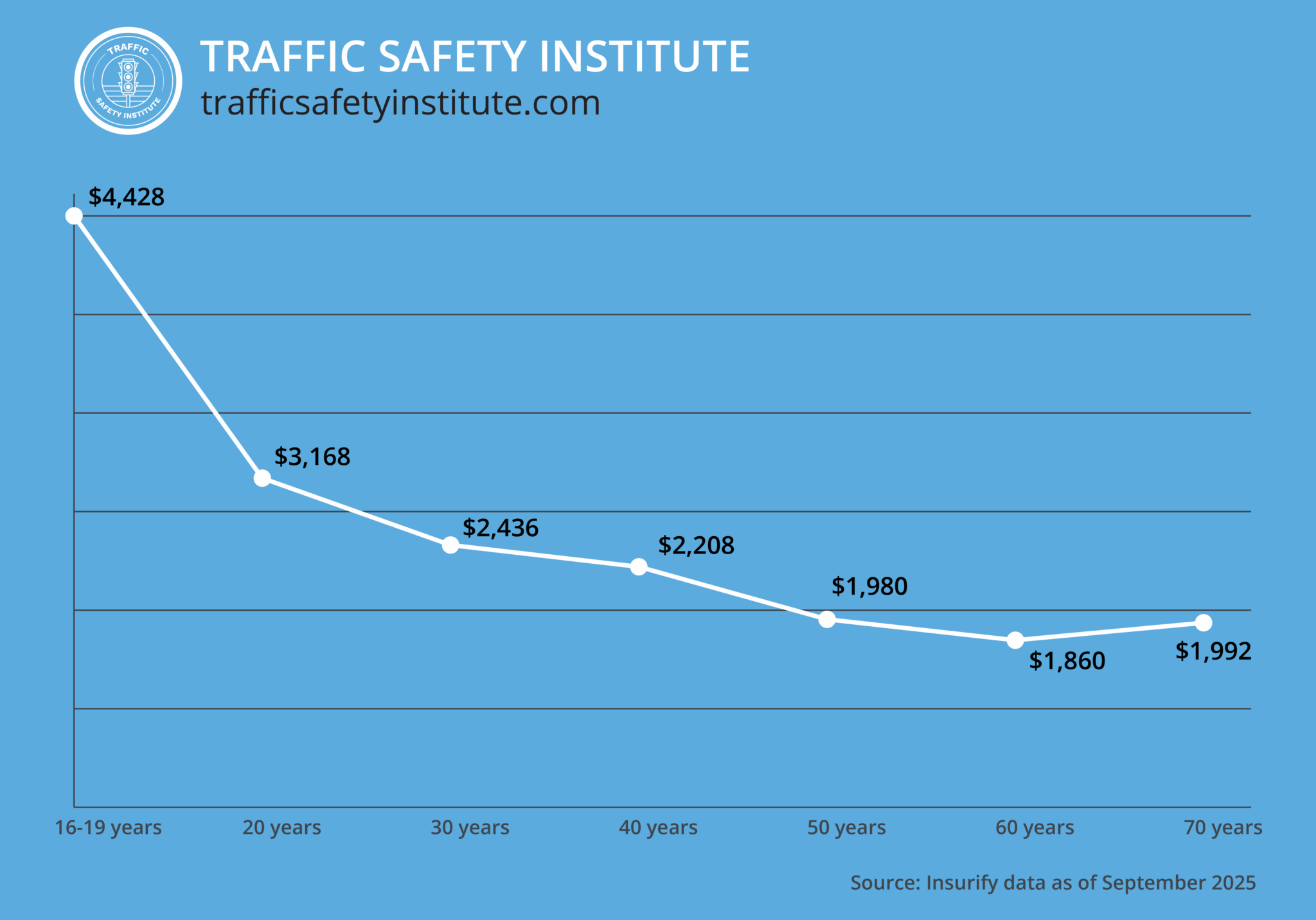
Auto insurance premiums typically see their most significant decrease when a driver reaches age 25. While smaller incremental drops often occur annually between the ages of 19 and 24, the "25-year-old milestone" remains the industry standard for transitioning out of the highest-risk demographic. Rates generally remain at their lowest and most stable through middle age before beginning to rise again after age 65.
The Actuarial Logic: Why Age Governs Your Premium
To understand why insurance rates decrease at specific ages, one must look at the actuarial science that powers the insurance industry. In 2026, despite the massive influx of AI-driven risk modeling and real-time telematics data, age remains one of the most reliable predictors of claim frequency and severity.
Insurance is essentially the "pooling" of risk. When you are a teenager or a driver in your early 20s, you belong to a risk pool that is statistically more likely to be involved in high-speed collisions, distracted driving incidents, and single-vehicle accidents. According to data from the National Highway Traffic Safety Administration (NHTSA) and the Insurance Institute for Highway Safety (IIHS), drivers under 25 have the highest rate of crashes per mile driven.
The decrease at age 25 is not arbitrary. It aligns with biological research suggesting that the prefrontal cortex—the part of the brain responsible for impulse control and complex decision-making—fully matures around the mid-20s. Insurers have translated this biological reality into financial policy. As a driver ages, they typically gain more "road years," which translates to better split-second decision-making and a more developed "muscle memory" for hazard avoidance.
The Timeline of Decreases: What to Expect at Every Stage
While age 25 is the headline-maker, the trajectory of insurance costs is a curve rather than a single step. Here is a breakdown of how age typically influences premiums across a driver's lifespan.
The Peak Years: Ages 16 to 18
These are statistically the most expensive years for any driver. Because 16-year-olds have near-zero experience, insurers charge a massive premium to offset the high probability of a claim. In 2026, adding a teenager to a family policy can increase premiums by 100% to 150%. At this stage, the primary goal for drivers is not "low rates" but rather "avoiding surcharges" by maintaining a clean record.
The Gradual Descent: Ages 19 to 24
If a driver maintains a clean record—meaning no at-fault accidents and no moving violations—rates usually begin a steady decline during these years. Each year of experience reduces the "inexperience surcharge." For example, a 21-year-old with five years of licensed experience is viewed much more favorably than a 21-year-old who just received their license. However, because these drivers are still in the "high-risk" bracket, they often pay significantly more than the national average.
The Major Milestone: Age 25
This is the "magic number" in the insurance world. Upon turning 25, most drivers see a reduction in their premiums ranging from 15% to 33%, provided their driving record is clean. This is the point where many insurers move the driver from a "youthful operator" category to a "standard" or "preferred" risk category. If your rate does not automatically drop on your 25th birthday, it is often due to the timing of your policy renewal; most companies apply the age-based discount at the first renewal following the birthday.
The Golden Era: Ages 30 to 60
During this three-decade span, drivers typically enjoy their lowest historical rates. By age 30, most drivers have at least a decade of experience. During this phase, other life factors start to lower rates even further, such as:
- Marriage: Statistically, married drivers are involved in fewer accidents than single drivers.
- Homeownership: Bundling home and auto insurance provides significant discounts.
- Credit Maturity: In states where it is legal, a more established credit history leads to lower insurance tiers.
The Senior Rebound: Age 65 and Beyond
The downward trend eventually reverses. After age 65, and more significantly after age 75, premiums begin to climb again. This is due to physical factors such as slower reflex times, changes in vision, and a higher physical fragility that makes medical claims more expensive in the event of an accident. By age 80, many drivers find their premiums returning to levels similar to what they paid in their late 20s.
Estimated Annual Premiums by Age Bracket (2026 Projections)
The following table provides a generalized comparison of how annual premiums fluctuate by age. These figures assume a clean driving record, a standard sedan, and "full coverage" (comprehensive and collision) in a medium-cost-of-living state.
| Age Bracket | Typical Risk Level | Est. Annual Premium (2026) | Change From Previous Bracket |
|---|---|---|---|
| 16 – 18 | Ultra-High | $6,200 - $8,500 | N/A (Starting Point) |
| 19 – 24 | High | $3,800 - $5,400 | Decrease of ~35% |
| 25 – 30 | Moderate | $2,100 - $2,800 | Decrease of ~45% |
| 31 – 50 | Low | $1,600 - $2,200 | Decrease of ~20% |
| 51 – 64 | Lowest | $1,450 - $1,900 | Decrease of ~10% |
| 65 – 75 | Moderate-Low | $1,800 - $2,400 | Increase of ~20% |
| 75+ | Moderate-High | $2,500 - $3,500 | Increase of ~40% |
Note: These are estimates for educational purposes. Actual rates vary significantly by state, insurer, and specific vehicle technology.
Factors That Can Override the "Age 25" Rule
It is a common misconception that turning 25 is a "get out of jail free" card for high insurance. Several factors can prevent a driver from seeing that expected decrease:
- Driving History: A single DUI or multiple speeding tickets between the ages of 21 and 24 can completely negate the age-based discount. In 2026, insurers are even more aggressive about penalizing "at-risk" behavior detected through public records.
- Insurance Gaps: If you did not have continuous insurance coverage leading up to your 25th birthday, you might still be rated as a high-risk driver. Insurers view a lapse in coverage as a sign of financial or behavioral instability.
- Location-Specific Laws: Some states prohibit or strictly limit the use of age as a primary rating factor. For instance, California, Hawaii, and Massachusetts have regulations that emphasize driving experience and records over chronological age. In these states, the "drop at 25" may be less pronounced or non-existent, replaced instead by a "drop after X years of licensed experience."
- Gender Differences: Traditionally, young men pay significantly more than young women because they are statistically more likely to engage in risky driving behaviors. While both genders see a drop at age 25, the gap between male and female rates usually narrows significantly at this point.
- Market Inflation: In 2026, the rising costs of automotive parts and specialized labor for electric vehicles (EVs) have caused general rate hikes. A driver might turn 25 and qualify for a 20% "age discount," but if the insurance company raised their base rates by 20% due to inflation, the driver's premium may stay exactly the same.
How 2026 Technology is Changing the Age Curve
As we move through 2026, the rigid link between age and insurance cost is beginning to soften due to Telematics and Usage-Based Insurance (UBI).
Most major insurers now offer programs where a device or a smartphone app tracks driving behavior in real-time. This allows a safe 20-year-old to bypass the "youthful operator" surcharge by proving they don't speed, brake harshly, or use their phone while driving. For many Gen Z and Gen Alpha drivers, these UBI programs are the fastest way to see an insurance decrease before they turn 25.
Furthermore, the prevalence of Advanced Driver Assistance Systems (ADAS)—such as automatic emergency braking and lane-keep assist—is being factored into age-based risk. A 22-year-old driving a vehicle with a 5-star safety rating and high-level autonomous features may pay less than a 22-year-old in a 15-year-old vehicle without those safety nets.
Strategies to Lower Rates Before Turning 25
If you are currently under the age of 25 and looking for relief from high premiums, you do not necessarily have to wait for your birthday. Consider the following verified methods:
- Good Student Discounts: Most insurers offer a discount (often up to 15%) for full-time students who maintain a B average or a 3.0 GPA. This is based on the actuarial finding that students who are responsible in the classroom are statistically more responsible on the road.
- The "Resident Student" Rule: If you are a student away at college (usually 100+ miles from home) without a car, your parents can often keep you on their policy at a significantly reduced rate. This maintains your "continuous coverage" history while lowering the immediate cost.
- Defensive Driving Courses: Completing a state-approved defensive driving course can provide a mandatory discount in many jurisdictions. This is particularly effective for young drivers looking to offset an initial ticket or simply lower their base rate.
- Higher Deductibles: If you have an emergency fund, increasing your deductible from $500 to $1,000 can reduce your monthly premium by 15% to 30%. However, this is a financial risk you must be prepared to handle if an accident occurs.
The Senior Shift: Navigating Higher Rates After 65
For older drivers, the goal is to delay the inevitable rise in premiums that comes with senior status. By 2026, many states have implemented laws that protect seniors, but the market still adjusts for risk.
- AARP and Senior Discounts: Organizations like AARP partner with insurers to provide specialized rates for members.
- Voluntary Self-Retraining: Just as young drivers take defensive driving courses, seniors can take "mature driver" courses. These courses focus on adapting to physical changes and navigating modern road technologies, often resulting in a 5% to 10% discount.
- Mileage-Based Policies: Many seniors drive significantly fewer miles after retirement. Switching to a "pay-per-mile" insurance model can save hundreds of dollars annually, as the risk of an accident is directly correlated with time spent on the road.
Common Questions Regarding Age and Auto Insurance
Does insurance drop exactly on my 25th birthday?
Not usually. Most insurance companies do not adjust rates mid-term. The decrease typically takes effect during the first renewal period after you turn 25. If your birthday is in July but your policy doesn't renew until October, you will likely pay the higher rate until October.
Why did my insurance go up at 25 instead of down?
This usually happens for one of three reasons: you moved to a more expensive ZIP code, you had a recent accident or ticket that just hit your record, or the insurance company implemented a general rate increase across all customers to account for rising claim costs or inflation.
Is age 25 the only major "drop" age?
No. Many insurers have smaller "step-downs" at ages 19 and 21. Age 21 is significant because it is the legal drinking age; drivers who reach this age without a history of alcohol-related incidents are often moved into a slightly lower risk tier.
Do some states ban age as a factor in insurance?
Yes. As of 2026, several states, including California, Massachusetts, and Hawaii, do not allow insurance companies to use age as a primary factor in determining premiums. Instead, these states rely heavily on "years of driving experience."
Final Recommendations for Drivers of All Ages
Regardless of your age, the most effective way to ensure your insurance decreases—and stays low—is to maintain a clean driving record. In the modern era of 2026, insurance companies have nearly instant access to telematics data and digital court records.
If you are approaching age 25, do not assume your current insurer will give you the best "post-youthful" rate. This is the ideal time to shop around. Different insurers have different "appetites" for different age groups; some specialize in young adults, while others offer much better rates for the 30-60 demographic. Comparing at least three quotes during your 25th birth month is the most reliable way to capture the full benefit of your age-based discount.