An introductory Python course provides the foundational knowledge required to write, debug, and execute code using one of the world's most versatile programming languages. These courses typically cover basic syntax, data structures, control flow, and functional programming, preparing students for specialized fields like data science, artificial intelligence, and web development in 2026.
Understanding the Role of Python in the 2026 Tech Ecosystem
As of 2026, Python maintains its position as the primary language for both entry-level developers and seasoned engineers. Its enduring popularity stems from a philosophy that prioritizes readability and developer efficiency. In an era where artificial intelligence and automated systems dominate the landscape, Python serves as the "glue language" that connects complex C++ backends with user-friendly interfaces and data processing pipelines.
An intro to Python course is no longer just for aspiring software engineers. It has become a prerequisite for data analysts, financial researchers, biologists, and even digital marketers. The ability to automate repetitive tasks—such as scraping data from the web, generating complex reports, or managing large file systems—is a high-value skill across all sectors. Modern introductory curricula have adapted to this by focusing not just on abstract logic, but on practical applications that learners can use immediately in their professional lives.
The language itself has evolved. While the core principles remain consistent with the Python 3.x lineage, 2026 standards emphasize cleaner asynchronous programming and better integration with machine learning libraries right from the start. Introductory courses now often include brief modules on how to interact with AI coding assistants responsibly, teaching students how to vet AI-generated code against standard Pythonic principles.
Core Learning Objectives of an Introductory Python Curriculum
A well-structured intro to Python course overview should highlight a logical progression from "Hello World" to building functional, multi-file applications. The goal is to move the student from a state of "syntax awareness" to "algorithmic thinking."
Module 1: Syntax, Variables, and Environmental Setup
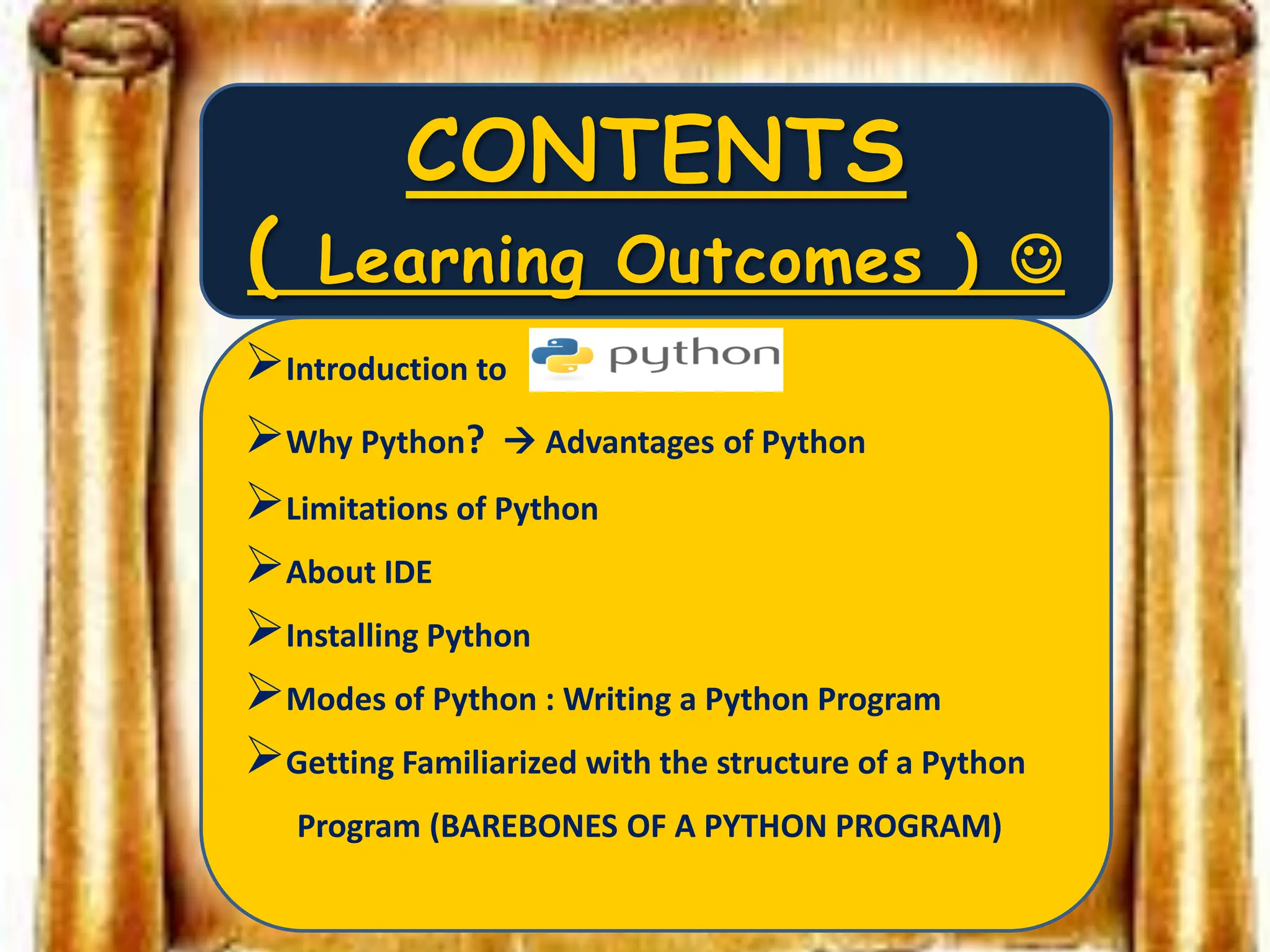
The first hurdle for any beginner is setting up the development environment. Modern courses typically guide students through the installation of the latest Python interpreter from the Official Python Website and the configuration of an Integrated Development Environment (IDE).
Key concepts in this phase include:
- The Interpreter: Understanding how Python executes code line-by-line.
- Variables and Constants: How to store data in memory using meaningful identifiers.
- Primitive Data Types: Distinguishing between Integers, Floats (decimals), Strings (text), and Booleans (True/False).
- Type Hinting: A 2026 standard practice where developers explicitly state what kind of data a variable should hold to prevent bugs.
Module 2: Complex Data Structures
Once a student understands individual pieces of data, the course moves to collections. This is where the power of Python begins to show. Beginners learn to manage groups of items using:
- Lists: Ordered, mutable collections used for sequences of data.
- Tuples: Immutable sequences often used for fixed data sets or returning multiple values from a function.
- Dictionaries: Key-value pairs that allow for rapid data retrieval, similar to a real-world directory.
- Sets: Unordered collections of unique elements, vital for membership testing and eliminating duplicates.
Module 3: Control Flow and Logic
Programs must make decisions. This module introduces the logic that governs how code branches and repeats. Students learn the if-elif-else structure to handle conditional logic. They also master loops: the for loop for iterating over a known sequence and the while loop for continuing an action until a specific condition is met. A significant portion of this module is dedicated to Indentation, which is Python’s unique way of defining code blocks.
Module 4: Functions and Modularization
To avoid writing the same code repeatedly, students are taught to wrap logic into reusable Functions. This section covers:
- Parameters and Arguments: Passing information into functions.
- Return Values: Getting data back out of a function.
- Scope: Understanding where a variable "exists" within a program.
- Modules: Learning how to import code from external files or the Python Standard Library, such as the math or datetime modules.
Technical Requirements and Software Prerequisites
Before enrolling in an introductory course, students must ensure their hardware and software meet the necessary standards. Fortunately, Python is lightweight, but the modern development stack requires specific configurations for a smooth experience.
- Hardware: A computer running Windows 10/11, macOS 12+, or a modern Linux distribution (e.g., Ubuntu 22.04+). At least 8GB of RAM is recommended to run an IDE alongside a web browser for research.
- The Python Interpreter: Most courses in 2026 utilize Python 3.12 or 3.13. It is vital to use a version that supports the latest security patches and performance improvements.
- Code Editors: While Python comes with a basic editor called IDLE, most introductory courses recommend Visual Studio Code (VS Code) or PyCharm Community Edition. These tools provide syntax highlighting, auto-completion, and debugging features that significantly flatten the learning curve.
- Terminal/Command Line: Students should have a basic comfort level with their operating system's terminal (PowerShell, Terminal.app, or Bash). An intro course usually dedicates the first few hours to teaching essential commands like cd (change directory) and python3 main.py (run script).
Pedagogical Approaches: Choosing the Right Learning Format
Not all "Intro to Python" courses are created equal. The "overview" of a course often depends on its delivery method. As we navigate the educational landscape of 2026, three primary formats have emerged as the most effective.
Self-Paced Online Platforms
Websites like Coursera, Udemy, and edX offer massive open online courses (MOOCs). These are excellent for individuals with full-time jobs. They rely heavily on recorded video lectures and automated grading systems. The primary advantage is cost and flexibility, but the downside is a lack of direct mentorship when a student hits a "logic wall."
Interactive Coding Bootcamps
Bootcamps are intensive, often lasting 12 to 24 weeks. Their intro to Python modules are fast-paced, designed to get a student to a professional level of competency in a short window. These courses are high-pressure but offer high-reward through peer networking and live instructor feedback.
Academic and University Extensions
University-led courses (like those found on Harvard CS50) focus more on the "Computer Science" aspect of Python. Instead of just teaching syntax, they explain memory management, binary logic, and computational complexity (Big O notation). This is the best route for those who want a deep theoretical understanding of how software works under the hood.
Comparison of Python Learning Paths
| Feature | Self-Paced Online | Coding Bootcamp | University Extension |
|---|---|---|---|
| Typical Duration | 2–6 Months | 3–6 Months | 1 Semester (4 Months) |
| Cost Range (2026) | $0 – $200 | $5,000 – $15,000 | $1,000 – $3,000 |
| Level of Support | Low (Forums) | High (1-on-1) | Moderate (TAs/Office Hours) |
| Primary Goal | General Literacy | Career Placement | Academic Credit/Theory |
| Project Focus | Individual/Small | Team/Portfolio-Ready | Research/Algorithmic |
Common Pitfalls and How to Overcome Them
Transitioning into programming is mentally taxing. An intro to Python course overview would be incomplete without addressing the common areas where students struggle.
1. Syntax Errors vs. Logic Errors Beginners often get frustrated by syntax errors (missing colons or mismatched parentheses). However, the real challenge lies in logic errors—where the code runs but produces the wrong result. Courses in 2026 now place a heavier emphasis on Debugging. Learning to read a "Traceback" (Python's error report) is considered as important as writing the code itself.
2. The "Tutorial Hell" Phenomenon Many students fall into the trap of watching tutorials and mimicking the instructor without understanding the underlying "Why." To combat this, the best intro courses utilize Project-Based Learning. Instead of just learning how a list works, a student might be tasked with building a "To-Do List Manager" or a "Simple Calculator" from scratch without following a step-by-step guide.
3. Mathematical Anxiety A common misconception is that you must be a math genius to learn Python. In reality, most introductory programming requires only basic algebra. The computer handles the heavy calculations; the programmer’s job is to define the logic of when and how those calculations happen.
Transitioning from Beginner to Intermediate: The Next Steps
Completing an introductory course is only the beginning. Once the fundamentals of syntax and logic are mastered, the next phase involves choosing a specialization. In 2026, these specializations usually fall into three categories:
- Data Science and AI: Moving into libraries like NumPy, Pandas, and Scikit-Learn. This path focuses on statistics, data visualization, and predictive modeling.
- Web Development: Learning frameworks like Django or FastAPI. This involves understanding how Python interacts with the internet, databases (SQL), and frontend technologies like HTML/CSS.
- Automation and Scripting: Using Python to control the operating system, interact with APIs, and automate cloud infrastructure (often paired with tools like Docker and Kubernetes).
Verification of skills is often the final step of an intro course. Many students seek certifications from recognized bodies like the Python Institute to validate their knowledge to potential employers.
Frequently Asked Questions
Is Python still the best language for beginners in 2026? Yes. Despite the emergence of newer languages, Python's ecosystem is the most mature. Its syntax remains the closest to the English language, which reduces the cognitive load on new learners. Furthermore, the massive community support means that almost any problem a beginner faces has already been solved and documented online.
How much math do I actually need for an intro Python course? For a general introduction, you only need basic arithmetic and an understanding of variables (similar to 8th-grade algebra). Unless you are diving specifically into Machine Learning or Scientific Computing, you do not need Calculus or Linear Algebra to be a highly successful Python programmer.
Can I learn Python for free? Absolutely. High-quality resources like FreeCodeCamp, Automate the Boring Stuff, and official documentation provide a complete path to proficiency without any financial investment. Paid courses generally offer more structure, curated projects, and a certificate of completion, which some learners find helpful for motivation.
Do I need a high-end computer to run Python? No. Python is very efficient. You can write and run Python code on a ten-year-old laptop, a Chromebook (via Linux mode or Google Colab), or even a Raspberry Pi. The only time you need significant power is when you move into advanced areas like Deep Learning or massive Big Data processing.
How long does it take to finish a typical intro course? For a student dedicating 5–10 hours a week, a comprehensive introductory course usually takes 8 to 12 weeks. This allows enough time for the concepts to "sink in" and for the completion of several hands-on projects.
Practical Recommendation
If you are looking to start your journey, the best first step is to download the latest version of Python and a simple text editor. Avoid getting overwhelmed by complex "Full Stack" roadmaps. Focus entirely on Logic and Syntax for the first month. Once you can write a script that takes user input, processes it, and returns a logical result without looking at a tutorial, you have successfully crossed the threshold from a spectator to a programmer.