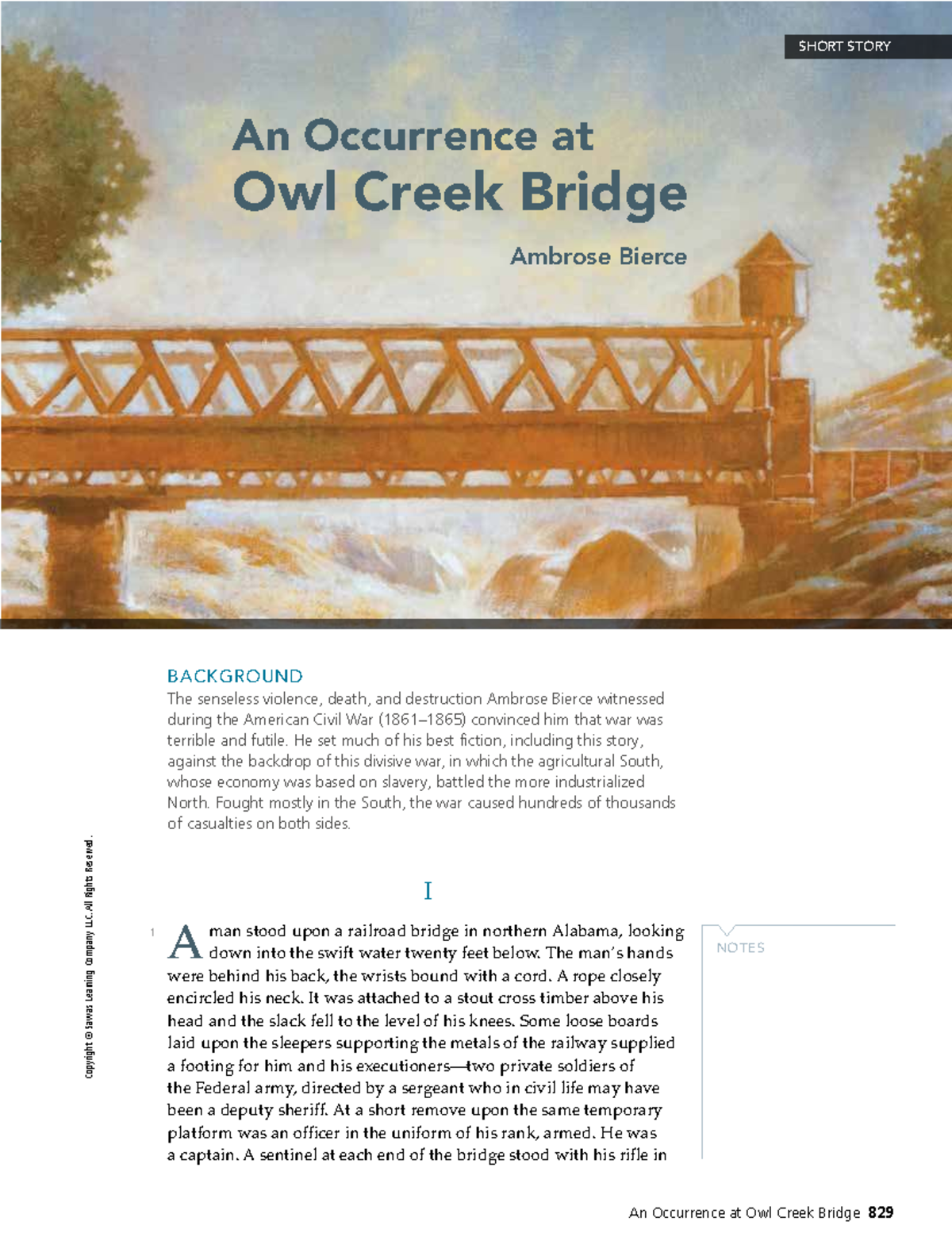
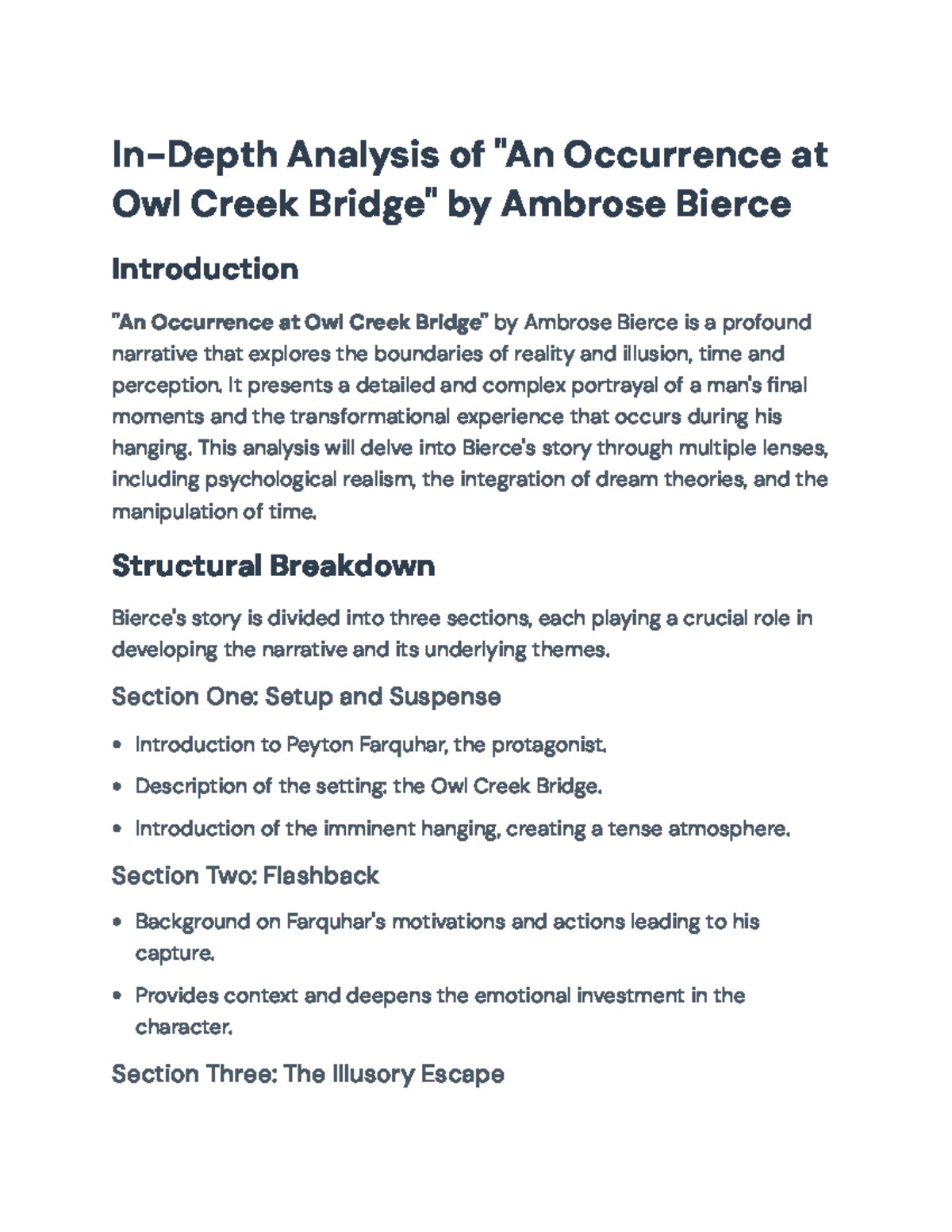
You can access an An Occurrence at Owl Creek Bridge PDF for free through public domain repositories like Project Gutenberg, the Internet Archive, or the Library of Congress. Because Ambrose Bierce’s 1890 short story is in the public domain, these digital versions provide the full, unabridged text for academic or personal use.
Understanding the Legal Status of the Digital Text
The primary reason a PDF of "An Occurrence at Owl Creek Bridge" is so widely available in 2026 is its copyright status. First published in The San Francisco Examiner in 1890 and later included in the 1891 collection Tales of Soldiers and Civilians, the work has long since entered the public domain. In the United States, works published before 1929 are free from copyright restrictions, allowing anyone to digitize, share, and format the text into PDF files without infringing on intellectual property rights.
For students and researchers, this means that any "paywall" encountered for the basic text is usually for a specific annotated edition or a proprietary platform’s interface, rather than the story itself. When searching for a high-quality PDF, it is essential to prioritize sources that offer clean, Optical Character Recognition (OCR) processed text, which allows for highlighting, searching, and screen-reading compatibility.
Top Reliable Sources for the PDF Download
When looking for a reliable version of the text, several institutional repositories stand out. These sources ensure that the text you are reading is historically accurate and free from the typographical errors often found on "free ebook" blogs or unverified document-sharing sites.
1. Project Gutenberg
Project Gutenberg is one of the oldest and most trusted sources for public domain literature. They offer "An Occurrence at Owl Creek Bridge" as part of the larger collection Tales of Soldiers and Civilians. You can download the specific story by selecting the PDF or "Portable Document" option. Their versions are meticulously proofread by volunteers.
2. The Internet Archive
The Internet Archive provides scanned copies of original first editions and early 20th-century printings. If you are looking for a PDF that preserves the original typesetting and "feel" of the 1891 publication, this is the best resource. You can view the book in a "Flip Book" format or download the full PDF scan.
3. Standard Ebooks
While technically an ebook producer, Standard Ebooks often provides high-quality downloads that can be converted or viewed as PDFs. They focus on modern typography and rigorous formatting standards, making their versions the most readable for mobile devices and tablets in 2026.
4. University Repositories (e.g., UNC or University of Virginia)
Many university English departments host clean HTML or PDF versions of classic American short stories for their coursework. These are often excellent because they may include line numbers, which are helpful for citing the text in academic papers.
| Source Name | Primary Format | Best For | Verification Status |
|---|---|---|---|
| Project Gutenberg | PDF, EPUB, Kindle | Academic citation and clean text | Highly Verified |
| Internet Archive | Scanned PDF | Historical research and original layout | Primary Source |
| Standard Ebooks | EPUB (PDF compatible) | Modern readability and formatting | Expertly Edited |
| Library of Congress | Digitized Image/PDF | Authenticating original publication | Government Official |
| CommonLit | Annotated PDF | Student assignments and literacy tools | Educator Reviewed |
Why the PDF Format is Preferred for This Story
In 2026, while many readers use e-readers, the PDF remains the standard for literary analysis for several specific reasons:
- Pagination Consistency: Unlike "reflowable" text in EPUB files, a PDF maintains the same layout regardless of the device. This is crucial when a professor says, "Look at the description of the water on page 4."
- Annotation Capabilities: Using software like Adobe Acrobat or specialized tablet apps, readers can highlight specific instances of Bierce’s sensory imagery—such as the "sharp, distinct, metallic percussion" of Farquhar’s watch—and leave notes directly in the margin.
- Offline Access: Once the PDF is downloaded, it does not require an internet connection, making it ideal for distraction-free reading or study sessions in locations with poor connectivity.
- Preservation of Structure: Bierce divided the story into three distinct, numbered sections. A PDF ensures these structural breaks, which are vital to the story's pacing and "twist," remain intact and visible.
Literary Significance and Summary of the Text
"An Occurrence at Owl Creek Bridge" is a masterpiece of American realism and an early example of the "stream of consciousness" narrative technique. Set during the American Civil War, it follows Peyton Farquhar, a Confederate sympathizer who is caught attempting to sabotage the Owl Creek Bridge.
Section I: The Execution
The story opens with Farquhar standing on a railroad bridge in northern Alabama, his neck in a noose. Bierce uses cold, clinical language to describe the military precision of the Union soldiers preparing to hang him. This section establishes the "objective" reality of the situation.
Section II: The Backstory
Bierce shifts time to explain who Farquhar is: a well-to-do planter who was unable to join the army but desperately wanted to serve the South. A federal scout, disguised as a Confederate soldier, tricked Farquhar into attempting to burn the bridge, leading to his capture.
Section III: The Illusion
The final section is the longest and most celebrated. As Farquhar falls through the bridge, the rope seemingly breaks. He plunges into the water, dodges bullets, and begins an arduous journey home. The narrative becomes increasingly surreal, with heightened sensory details that hint at the impossibility of his escape. The story concludes with one of the most famous twist endings in literature: Farquhar never escaped; the entire third section occurred in the seconds between the drop and his death.
Key Themes to Analyze in the PDF
When reviewing the PDF for a class or book club, focusing on these themes will provide a deeper understanding of Bierce’s intent.
The Distortion of Time
Bierce explores how the human mind experiences time under extreme stress. The "occurrence" at the bridge takes only a few minutes in reality, but for Farquhar, the subjective experience of his "escape" feels like an entire day and night. Look for the passage regarding the ticking of his watch, which Bierce describes as sounding like "the tolling of a death knell."
Reality vs. Illusion
The tension between what is actually happening (the execution) and what Farquhar imagines (the escape) is the core of the story. Bierce leaves "clues" throughout Section III that the escape is a hallucination. For example, Farquhar notes that the stars are grouped in strange constellations and that he can see the individual veins in the leaves of trees from a great distance—sights that are physically impossible under the circumstances.
The Brutality of War
Unlike the romanticized versions of the Civil War common in the late 19th century, Bierce—a veteran of the Battle of Shiloh—presents war as a mechanical, unfeeling process. The soldiers are described as "statues" and "silhouettes," emphasizing the dehumanization required for military execution.
Technical Tips for Managing Your PDF
To get the most out of your digital copy of "An Occurrence at Owl Creek Bridge," consider these technical recommendations:
- Check for OCR: If you cannot select individual words in the PDF, it is a "flat" scan. Use a free online OCR tool or Adobe Acrobat to recognize the text so you can use the "Find" (Ctrl+F) function.
- Use a Split-Screen Setup: When writing an essay, keep the PDF on one side of your screen and your word processor on the other. This allows for quick cross-referencing of Bierce’s specific word choices.
- Verify the Edition: Ensure your PDF includes all three numbered sections. Some abridged versions found in older anthologies might strip out the middle section, which provides the necessary context for Farquhar’s motivations.
- Metadata Check: When citing the PDF in MLA or APA format, don’t just use the file name. Look at the PDF properties or the first few pages to find the original publisher and the date the digital version was created.
Ambrose Bierce: The Man Behind the Story
Knowing the author's background adds a layer of depth to the text. Known as "Bitter Bierce," the author was famous for his cynicism and dark wit. His experiences as a Union topographical engineer gave him an intimate knowledge of the Southern landscape and the logistics of bridge-building and destruction.
Bierce’s own life ended in a mystery that rivals his fiction. In 1913, he traveled to Mexico to observe the Mexican Revolution and vanished without a trace. This enigmatic end has kept interest in his work, especially "An Occurrence at Owl Creek Bridge," alive well into 2026.
FAQs About the An Occurrence at Owl Creek Bridge PDF
Is the PDF of "An Occurrence at Owl Creek Bridge" free?
Yes, because the story was published in 1890, it is in the public domain. You can download it for free from various reputable sources like Project Gutenberg or the Internet Archive without paying a licensing fee.
How do I know if a PDF version is the "full" text?
A complete version of the story will always be divided into three numbered sections. Section I deals with the preparation for the hanging, Section II explains Farquhar's background and his meeting with the scout, and Section III describes the "escape" and the final twist. If any of these are missing, the version is abridged.
Can I use the PDF for a school project or essay?
Absolutely. Since the text is in the public domain, you can quote it freely. If you are using a PDF from a specific academic site, be sure to cite the source correctly using the formatting style required by your instructor (such as MLA, APA, or Chicago).
Are there any "clean" versions without advertisements?
Yes. Academic repositories (like those from the University of North Carolina) and non-profit sites like Standard Ebooks or Project Gutenberg provide clean PDF or text files that are free from advertisements, pop-ups, or watermarks.
Why is this story often assigned in English classes?
It is frequently assigned because it is a perfect example of structural irony and narrative pacing. It allows students to explore how an author can manipulate the reader's perception of time and reality, making it a foundational text for studying modern fiction techniques.
Does the PDF include illustrations?
Most standard PDFs are text-only. However, if you download a scanned PDF of an old magazine or the 1891 book from the Internet Archive, you may find original woodcuts or illustrations that accompanied the story in its early publications.
Final Recommendation
For the best reading and study experience, download the An Occurrence at Owl Creek Bridge PDF from Project Gutenberg or Standard Ebooks. These versions offer the most accurate text and are compatible with all modern annotation tools. Once you have the file, pay close attention to the sensory details in the third section; they are the keys to understanding how Bierce constructs one of the most famous illusions in American literature.