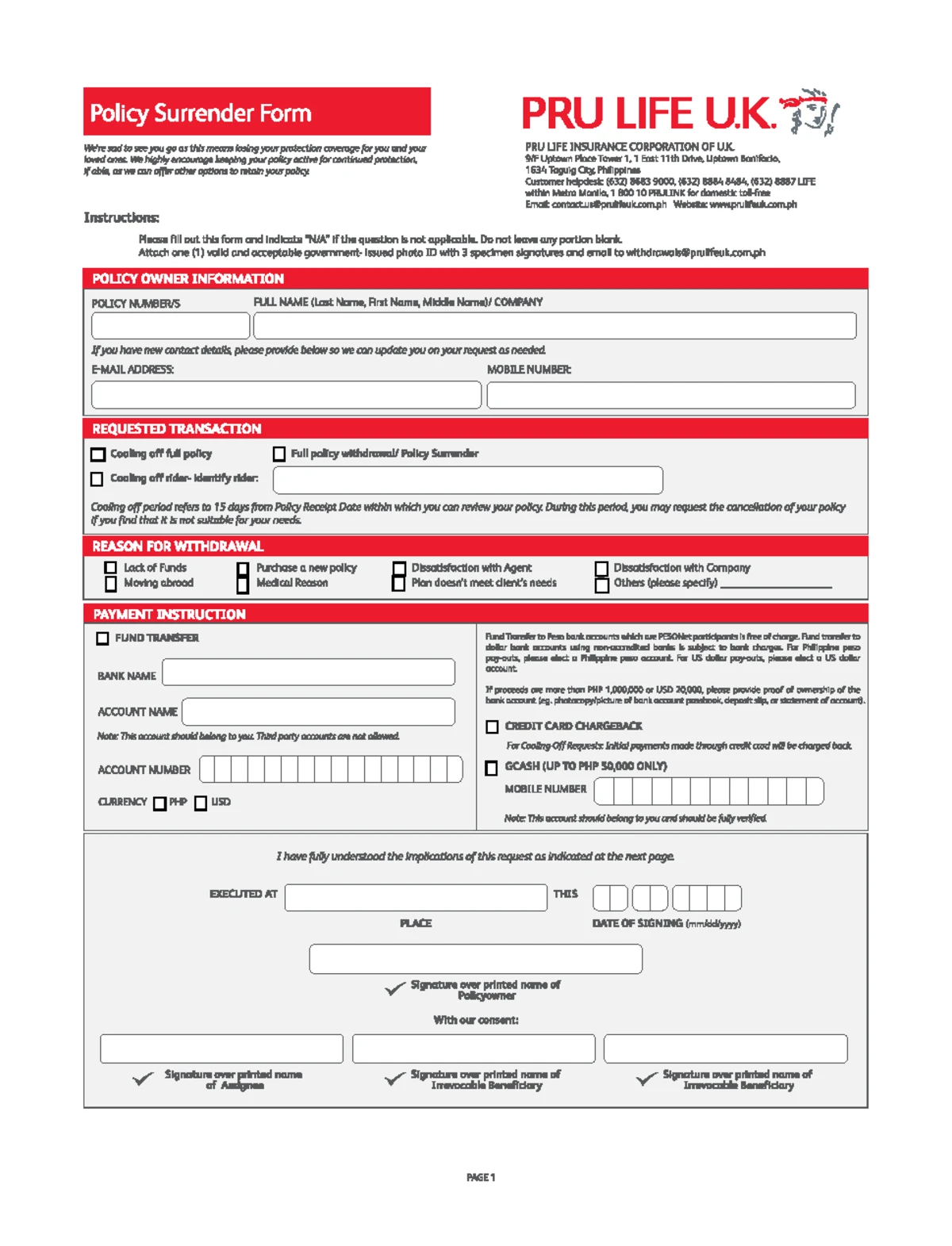
When an insured decides to surrender a whole life insurance policy, they voluntarily terminate the contract before the insured event—death—occurs. In exchange, the insurance company pays the policyholder the net cash surrender value, which is the accumulated cash value minus any outstanding loans, interest, and applicable surrender charges.
Whole life insurance is designed as a permanent financial instrument, blending a death benefit with a cash-value accumulation component. However, financial circumstances often change, leading an insured to evaluate the utility of their coverage. Surrendering a policy is a significant decision with permanent consequences, affecting not only the death benefit but also the policyholder’s tax liability and long-term financial plan. As of 2026, the complexity of these products requires a thorough understanding of the mechanics of surrender to avoid unnecessary losses.
The Mechanics of a Policy Surrender
A policy surrender is more than a simple cancellation. Unlike term life insurance, which simply ceases to exist if premiums are not paid, whole life insurance is a contract with an underlying asset. When an insured initiates a surrender, they are effectively selling the policy back to the insurance carrier.
Once the surrender process is finalized, the insurance company’s obligation to pay a death benefit ends immediately. This is the most critical trade-off: the insured receives immediate liquidity in exchange for the long-term security of the death benefit. The amount received is the "Cash Surrender Value" (CSV). This figure is rarely equal to the "Gross Cash Value" displayed on an annual statement, especially during the first 10 to 15 years of the policy’s life.
The Role of Surrender Charges
Most whole life policies include a surrender charge schedule. These charges are designed to help the insurance company recoup the high upfront costs of issuing the policy, such as underwriting expenses and agent commissions. In 2026, many older policies (those issued before 2011) may have already cleared their surrender charge period, but newer policies often feature charges that scale down over a decade or more.
If an insured surrenders a policy in its third year, the surrender charge might consume a significant portion of the cash value. By the 15th year, the charge typically drops to zero, meaning the CSV equals the full cash value. Understanding where your policy sits on this schedule is the first step in financial verification.
Calculating the Net Cash Surrender Value
To determine exactly how much an insured will receive upon surrender, several deductions must be accounted for. The formula generally follows this structure:
Net Cash Surrender Value = (Accumulated Cash Value + Earned Dividends) - (Surrender Charges + Outstanding Loans + Unpaid Loan Interest)
- Accumulated Cash Value: The portion of your premiums that has been invested by the insurer and grown at a guaranteed rate.
- Dividends: If the policy is "participating" (common with mutual insurance companies), any dividends left to accumulate at interest or used to purchase paid-up additions will be added to the value.
- Outstanding Loans: If the insured borrowed against the policy and did not repay the principal, that amount is deducted from the payout.
- Unpaid Loan Interest: Interest on policy loans accrues daily. Any outstanding interest is subtracted from the final check.
It is vital to request an "In-Force Illustration" from the carrier before surrendering. This document provides a real-time snapshot of the net value and the projected tax consequences of the action.
Tax Implications of Surrendering a Policy in 2026
The IRS treats life insurance payouts with a specific hierarchy of taxation. Generally, the cash value of a life insurance policy grows on a tax-deferred basis. When the policy is surrendered, the tax treatment depends on the "Cost Basis" of the policy.
The Cost Basis Rule
The cost basis is the total amount of premiums paid into the policy, minus any dividends received in cash or used to reduce premiums.
- No Tax Due: If the Net Cash Surrender Value is less than the cost basis, the surrender is generally a tax-free event. This is often the case in the early years of a policy when expenses are high and cash value growth is slow.
- Ordinary Income Tax: If the Net Cash Surrender Value exceeds the cost basis, the excess amount is taxed as ordinary income, not capital gains. For a policy held for 30 years, this tax bill can be substantial.
The "Phantom Gain" Trap
A common pitfall occurs when a policyholder has an outstanding loan. If the loan amount plus the cash received exceeds the cost basis, the IRS considers the "forgiven" loan as a taxable distribution. An insured might receive a small check but a large 1099-R form, leading to an unexpected tax bill.
For more information on the taxation of life insurance contracts, the Internal Revenue Service (IRS) Publication 525 provides guidance on taxable and nontaxable income.
Steps to Execute a Policy Surrender
If an insured decides to move forward, the process is relatively standardized across major carriers.
1. Request the Surrender Forms
The insured must contact the insurance company or their agent to request a "Request for Surrender" or "Policy Cancellation" form. Most companies in 2026 provide these through secure online portals, though some still require a notarized signature for high-value policies.
2. Verify Beneficiary Consent
In most cases, the policyholder (owner) can surrender the policy without the beneficiary's permission. However, if the beneficiary is designated as "irrevocable," the insurer will require that beneficiary to sign off on the surrender.
3. Choose the Payout Method
While most choose a lump-sum check or electronic transfer, some carriers offer "settlement options." This allows the insured to convert the cash value into an annuity or a stream of payments.
4. Final Processing and Delivery
Once the paperwork is submitted, the insurance company typically processes the request within 5 to 10 business days. Per the National Association of Insurance Commissioners (NAIC), carriers must adhere to state-specific timelines for payment, which are designed to protect consumers from undue delays.
Comparing Surrender to Common Alternatives
Surrendering a policy is a "nuclear option." It is permanent and often inefficient. Before proceeding, an insured should evaluate the following alternatives.
| Option | Impact on Death Benefit | Tax Treatment | Liquidity Provided |
|---|---|---|---|
| Full Surrender | Terminated completely. | Taxed on gains over basis. | High (Full net cash value). |
| Policy Loan | Reduced by loan amount. | Generally tax-free. | Medium (Varies by policy). |
| Partial Withdrawal | Reduced dollar-for-dollar. | Tax-free up to basis. | Moderate. |
| Reduced Paid-Up | Reduced but stays active. | Tax-deferred growth. | None (No immediate cash). |
| 1035 Exchange | Transferred to new policy. | Tax-free transfer. | None (Moves to new asset). |
| Life Settlement | Transferred to third party. | Capital gains treatment. | High (Often exceeds CSV). |
Why an Insured Might Decide to Surrender
There are several legitimate reasons why an insured might choose to surrender their policy in 2026:
- Eliminating Premium Payments: If the policy is no longer "self-sustaining" through dividends and the insured can no longer afford the premiums, surrendering stops the financial drain.
- Changing Beneficiary Needs: If the policy was intended to provide for children who are now independent adults with their own wealth, the death benefit may no longer be necessary.
- Opportunity Cost: If the cash value is earning a guaranteed 3-4% but the insured believes they can earn 8-10% elsewhere, they may surrender the policy to reinvest the capital.
- Emergency Liquidity: When facing medical crises or catastrophic debt, the cash value of a life insurance policy serves as a last-resort source of funds.
The Risks of Surrendering Early
Surrendering a whole life policy in its early years (usually years 1 through 7) is almost always a financial loss. During this period, the insured has paid for the cost of insurance and the agent's commission, but the cash value has not had enough time to compound.
Furthermore, once a policy is surrendered, it cannot be reinstated. If the insured’s health has declined since the policy was first issued, they may find it impossible or prohibitively expensive to obtain new coverage later. This is known as "insurability risk." Before surrendering, it is essential to confirm that no future need for life insurance exists.
Alternative: The 1035 Exchange
If the goal is not to get cash, but rather to get a better financial product, a 1035 exchange is often superior to a surrender. Named after Section 1035 of the Internal Revenue Code, this allows a policyholder to transfer the cash value of an underperforming life insurance policy into a new life insurance policy or an annuity without triggering immediate taxes on the gains.
In 2026, many consumers use 1035 exchanges to move from traditional whole life into Indexed Universal Life (IUL) or Long-Term Care (LTC) hybrid policies, which may offer more flexibility or specific benefits that match their current life stage.
Alternative: Life Settlements
For insured individuals over the age of 65, a "life settlement" may be a more lucrative option than surrendering to the carrier. In a life settlement, the policyholder sells the policy to a third-party investor for a lump sum.
The investor becomes the beneficiary and continues to pay the premiums, eventually collecting the death benefit. Historically, life settlements pay significantly more than the cash surrender value—sometimes two to three times more. However, this process involves a deep dive into the insured's medical records and a complex bidding process. The Life Insurance Settlement Association (LISA) provides resources for consumers considering this path.
Common Pitfalls to Avoid
- Forgetting the Riders: Some whole life policies have valuable riders, such as "Waiver of Premium" or "Chronic Illness" riders. Surrendering the policy kills these benefits.
- Ignoring the Dividend Option: Instead of surrendering, the insured could change the dividend option to "Pay Premiums," which might keep the policy active without out-of-pocket costs.
- Timing the Tax Year: If a surrender will result in a large taxable gain, it may be wiser to wait until a year when the insured's overall income is lower to stay in a lower tax bracket.
FAQs
Can I surrender only part of my whole life policy?
Yes, this is known as a "partial surrender" or a withdrawal. You take a portion of the cash value, which reduces the death benefit proportionally. Unlike a loan, a withdrawal does not need to be paid back, but it may be taxable if the amount withdrawn exceeds the premiums you have paid into the policy.
How long does it take to get the money after I surrender my policy?
Most insurance companies process surrender requests within 5 to 10 business days. If the policy is very old or involves complex ownership (like a trust), it may take up to 30 days. In 2026, most major insurers offer instant electronic fund transfers once the paperwork is verified.
What is the difference between cash value and surrender value?
Cash value is the total amount of equity built up within the policy. The surrender value is the amount you actually receive after the insurance company subtracts surrender charges and any outstanding loans or interest. In older policies, these two numbers are often identical.
Will surrendering my policy affect my credit score?
No. Surrendering a life insurance policy is a private contract termination and does not involve debt or credit reporting agencies. Even if you have an outstanding policy loan, it is secured by the cash value, so failing to pay it back does not result in a credit penalty; it simply reduces the payout.
Can the insurance company refuse my request to surrender?
Generally, no. As the policy owner, you have a legal right to the cash value of your contract. However, they can delay the process if the paperwork is incomplete or if there is a legal dispute over ownership (such as during a divorce or bankruptcy proceeding).
Final Recommendation
Before an insured decides to surrender a whole life insurance policy, they should perform a three-point check:
- Request an in-force illustration to see the exact net payout and tax impact.
- Evaluate the need for the death benefit, considering that health changes may make it impossible to get coverage back later.
- Explore the "Reduced Paid-Up" option, which stops premiums but keeps a smaller death benefit in place indefinitely.
If the primary goal is liquidity and the tax impact is manageable, surrendering can provide the necessary funds. However, consulting with a tax professional or a fee-only financial advisor is strongly recommended to ensure that the surrender fits into a broader 2026 financial strategy without creating unintended tax liabilities.