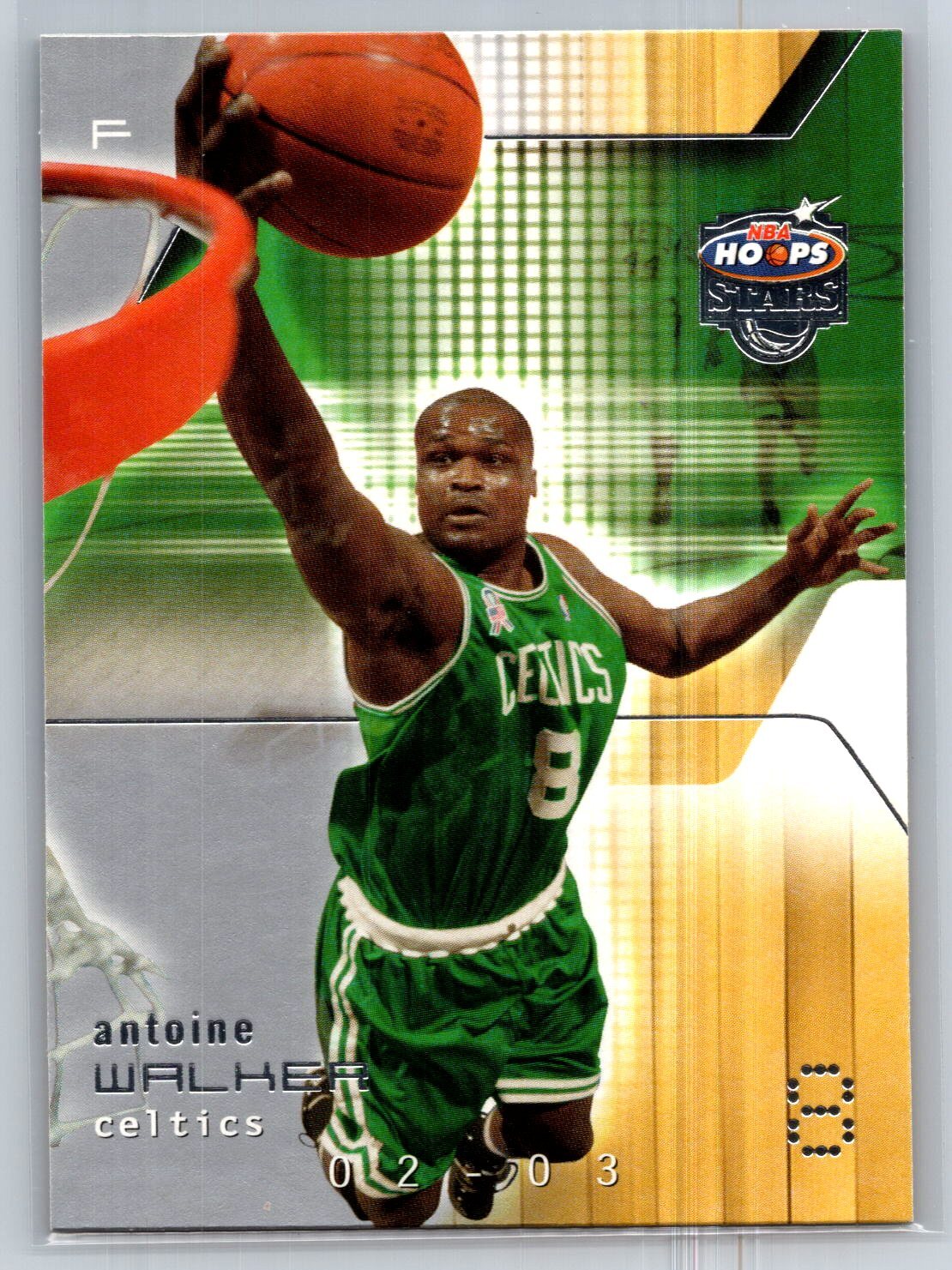
Antoine Walker’s tenure in the NBA was defined by his role as a versatile, high-scoring forward who became a cornerstone of the Boston Celtics in the late 1990s and early 2000s. Known for his signature "shimmy" and his penchant for shooting three-pointers—famously quipping he shot so many "because there are no fours"—Walker was a three-time All-Star and a 2006 NBA Champion. His career provides a fascinating case study in the evolution of the "stretch four" position and the complexities of professional athlete wealth management.
As of 2026, Antoine Walker’s legacy is viewed through two distinct lenses: his pioneering playing style that foreshadowed the modern perimeter-oriented NBA, and his highly publicized journey through financial bankruptcy and subsequent redemption as a financial literacy advocate. During his 12-season NBA career, Walker averaged 17.5 points, 7.7 rebounds, and 3.5 assists per game, marking him as one of the most statistically diverse players of his era.
The Rise of "Employee No. 8": Early Years and the 1996 Draft
Antoine Walker entered the NBA during what many historians consider the greatest draft class in league history. Selected 6th overall in 1996 by the Boston Celtics, Walker joined a cohort that included future legends like Kobe Bryant, Allen Iverson, Ray Allen, and Steve Nash. Coming off an NCAA Championship at the University of Kentucky under Rick Pitino, Walker was expected to be the face of a rebuilding Celtics franchise.
Upon his arrival in Boston, Walker immediately assumed a massive workload. During his rookie season (1996-97), he averaged 17.5 points and 9.0 rebounds, earning a spot on the All-Rookie First Team. When Rick Pitino took over as the Celtics' head coach and president in 1997, Walker became the focal point of a fast-paced, full-court pressing system. It was during this era that he adopted the moniker "Employee No. 8," a nickname derived from an Adidas marketing campaign that highlighted his status as a key worker in the Celtics' revitalization project.
The synergy between Walker’s versatile skillset and Pitino’s aggressive system allowed Walker to put up massive individual numbers. In the 1997-98 season, he averaged a career-high 22.4 points and 10.2 rebounds per game, earning his first All-Star selection. However, the team struggled for consistency, leading to significant roster turnover and eventually the arrival of the player who would define Walker's best years in Boston.
The Dynamic Duo: Antoine Walker and Paul Pierce
The trajectory of Antoine Walker’s career changed forever in 1998 when the Celtics drafted Paul Pierce. Together, Walker and Pierce formed one of the most potent scoring tandems in the Eastern Conference. During the late 90s and early 2000s, "The Dynamic Duo" carried the offensive burden for Boston, often combining for over 45 points per game.
Their peak arrived during the 2001-02 season. Under coach Jim O'Brien, the Celtics reached the Eastern Conference Finals for the first time in over a decade. Walker was instrumental in this run, averaging 22.1 points and leading the league in three-pointers attempted (645) and made (222). His ability to bring opposing power forwards out to the perimeter created driving lanes for Pierce and disrupted traditional defensive schemes.
Despite their success, the duo was often criticized for a "live by the three, die by the three" philosophy. Walker, in particular, was scrutinized for his high volume of perimeter shots despite his size (6'9") and ability to score in the post. Looking back from the perspective of 2026, these criticisms seem dated; Walker was essentially playing a style of basketball that would become the league standard fifteen years later. He was a "stretch four" before the term was widely used, possessing the ball-handling and passing skills of a guard in a power forward's body.
The Evolution of the "Stretch Four" and the Infamous Quote
To understand Antoine Walker’s impact on the game, one must analyze his shooting philosophy. At a time when power forwards were expected to be "bruisers" like Charles Oakley or Karl Malone, Walker was attempting nearly eight three-pointers per game. When asked by a reporter why he shot so many threes, Walker famously replied, "Because there are no fours."
This quote, while humorous, reflected a deeper truth about his game. Walker was a mismatch nightmare. He could beat slower big men off the dribble, pass over smaller defenders, and force centers to guard him 25 feet from the basket.
Tactical Impact of Walker's Versatility:
- Spacing: By playing on the perimeter, Walker emptied the "paint," allowing teammates to cut and drive without meeting a secondary shot-blocker.
- Playmaking: Walker was an exceptional passer for his position. He averaged over 5 assists per game in multiple seasons, often acting as a point-forward.
- Transition Offense: His ability to grab a rebound and lead the fast break himself was a rare trait in the late 1990s.
However, his efficiency was often a point of contention. Walker’s career field goal percentage was 41.4%, and his three-point percentage was 32.5%. In the context of 2026 analytics, these numbers would be viewed as the result of a high-usage player taking difficult shots to bail out a stagnant offense, though his "shot selection" remained a talking point throughout his career.
Championship Glory: The Miami Heat Era (2005-2007)
After a brief and somewhat tumultuous stint with the Dallas Mavericks and a return to Boston, Walker was traded to the Miami Heat in 2005 as part of the largest trade in NBA history (involving 13 players and five teams). In Miami, Walker’s role changed significantly. He was no longer the primary or even secondary scoring option; instead, he was a veteran "glue guy" tasked with supporting Dwyane Wade and Shaquille O'Neal.
This transition proved successful. Walker’s willingness to accept a bench role and focus on his perimeter shooting provided the Heat with the spacing necessary for Wade and O’Neal to dominate inside. During the 2006 NBA Finals against the Dallas Mavericks, Walker played a pivotal role. In the clinching Game 6, he scored 14 points and grabbed 11 rebounds, securing the only NBA Championship of his career.
The championship validated Walker's career, proving that his unique style could contribute to winning at the highest level when paired with the right personnel. It was the crowning achievement of a decade-long journey through the league.
Statistical Summary of Antoine Walker's NBA Career
The following table summarizes Walker's performance across different phases of his career, illustrating his transition from a high-volume star to a championship contributor.
| Period | Team(s) | Games | PPG | RPG | APG | Notable Achievement |
|---|---|---|---|---|---|---|
| 1996–2003 | Boston Celtics | 552 | 20.6 | 8.7 | 4.1 | 3x All-Star |
| 2003–2004 | Dallas Mavericks | 82 | 14.0 | 8.3 | 4.5 | High-efficiency role |
| 2004–2005 | ATL / BOS | 77 | 19.1 | 9.0 | 3.4 | Veteran leadership |
| 2005–2007 | Miami Heat | 138 | 10.1 | 4.4 | 1.9 | 2006 NBA Champion |
| 2007–2008 | MIN Timberwolves | 46 | 8.0 | 3.7 | 1.0 | Final NBA Season |
| Career | Total | 895 | 17.5 | 7.7 | 3.5 | 15,647 Total Pts |
Life After Basketball: Bankruptcy and Redemption
One cannot discuss Antoine Walker in the NBA without addressing his post-career financial struggles. Despite earning over $108 million in NBA salary, Walker filed for Chapter 7 bankruptcy in 2010, just two years after his final NBA game.
His story became a cautionary tale for professional athletes. Walker’s financial downfall was attributed to several factors:
- Lifestyle Spending: Maintaining a lavish lifestyle for himself and a large entourage.
- Helping Family and Friends: Walker famously supported over 70 people financially during his career.
- Real Estate Investments: A series of poorly timed and aggressive real estate ventures in Chicago during the 2008 financial crisis.
- Gambling: Losses at casinos that, while significant, were often secondary to his investment failures.
However, since 2013, Walker has transformed his narrative. He became a consultant for Morgan Stanley’s Global Sports & Entertainment division, using his personal experience to educate young athletes on "Walker’s Law"—a set of guidelines designed to prevent the financial mistakes he made. By 2026, he has established himself as a respected voice in the realm of financial literacy, often speaking at rookie symposiums and collegiate programs.
Historical Comparison: Antoine Walker vs. The Modern NBA
In the 2020s, the NBA is dominated by players who share Walker's archetypal traits. Players like Draymond Green, Kevin Love, and even Nikola Jokic utilize the "point-forward" and "stretch" capabilities that Walker pioneered.
While Walker was often criticized for his 32.5% career three-point average, modern analytics suggest that his "gravity"—the way his presence on the perimeter forced defenses to spread out—was worth more than the raw percentage suggested. He was a high-volume shooter in an era that didn't yet value volume as much as efficiency. In today's game, a player with Walker's handles, passing vision, and shooting range would likely be a perennial All-NBA candidate rather than just a three-time All-Star.
Frequently Asked Questions
Why was Antoine Walker called "Employee No. 8"?
The nickname "Employee No. 8" originated from an Adidas advertising campaign during Walker's early years with the Boston Celtics. It emphasized his hard-working nature and the idea that he was just one of many "employees" working to bring the Celtics back to their former glory, despite being the team's undisputed star at the time.
How many NBA championships did Antoine Walker win?
Antoine Walker won one NBA Championship. He earned his ring as a member of the Miami Heat in 2006, where he served as a starting forward alongside Dwyane Wade and Shaquille O'Neal. He played a crucial role in the Finals series against the Dallas Mavericks, particularly as a floor spacer.
What happened to Antoine Walker's money?
Walker lost his $108 million career earnings due to a combination of high-risk real estate investments that failed during the 2008 recession, lavish personal spending, and the financial burden of supporting a large network of friends and family members. He filed for bankruptcy in 2010 but has since rebuilt his life as a financial educator and media analyst.
Was Antoine Walker a good three-point shooter?
By the standards of the late 90s and early 2000s, Walker was considered a high-volume but inconsistent shooter. He led the league in three-point attempts several times. While his career percentage of 32.5% is modest by modern standards, his willingness to shoot from deep was revolutionary for a player of his size and position.
Did Antoine Walker play with Paul Pierce?
Yes, Walker and Paul Pierce played together on the Boston Celtics from 1998 to 2003, and again briefly in 2005. They were known as the "Dynamic Duo" and led the Celtics to the Eastern Conference Finals in 2002. They remain one of the most iconic pairings in the history of the Celtics franchise.
Final Perspective and Recommendations
Antoine Walker's career is a multi-faceted story of innovation, success, failure, and ultimate resilience. For students of the game, Walker serves as a reminder that the "modern" NBA didn't happen overnight; it was built on the backs of versatile players who were willing to step outside traditional positional roles. For professional athletes and high-net-worth individuals, his financial journey serves as the ultimate lesson in the importance of asset protection and sustainable spending.
Next Steps for Fans and Researchers:
- Watch Historical Footage: To truly appreciate the "Shimmy" and his point-forward skills, view highlights from the 2001-02 Celtics season.
- Read "Gone in a Flash": Walker’s autobiography provides a detailed, first-hand account of his financial rise and fall.
- Analyze the 1996 Draft: Compare Walker’s career arc with his peers like Allen Iverson and Ray Allen to see how different styles of play aged through the transition into the "pace and space" era.