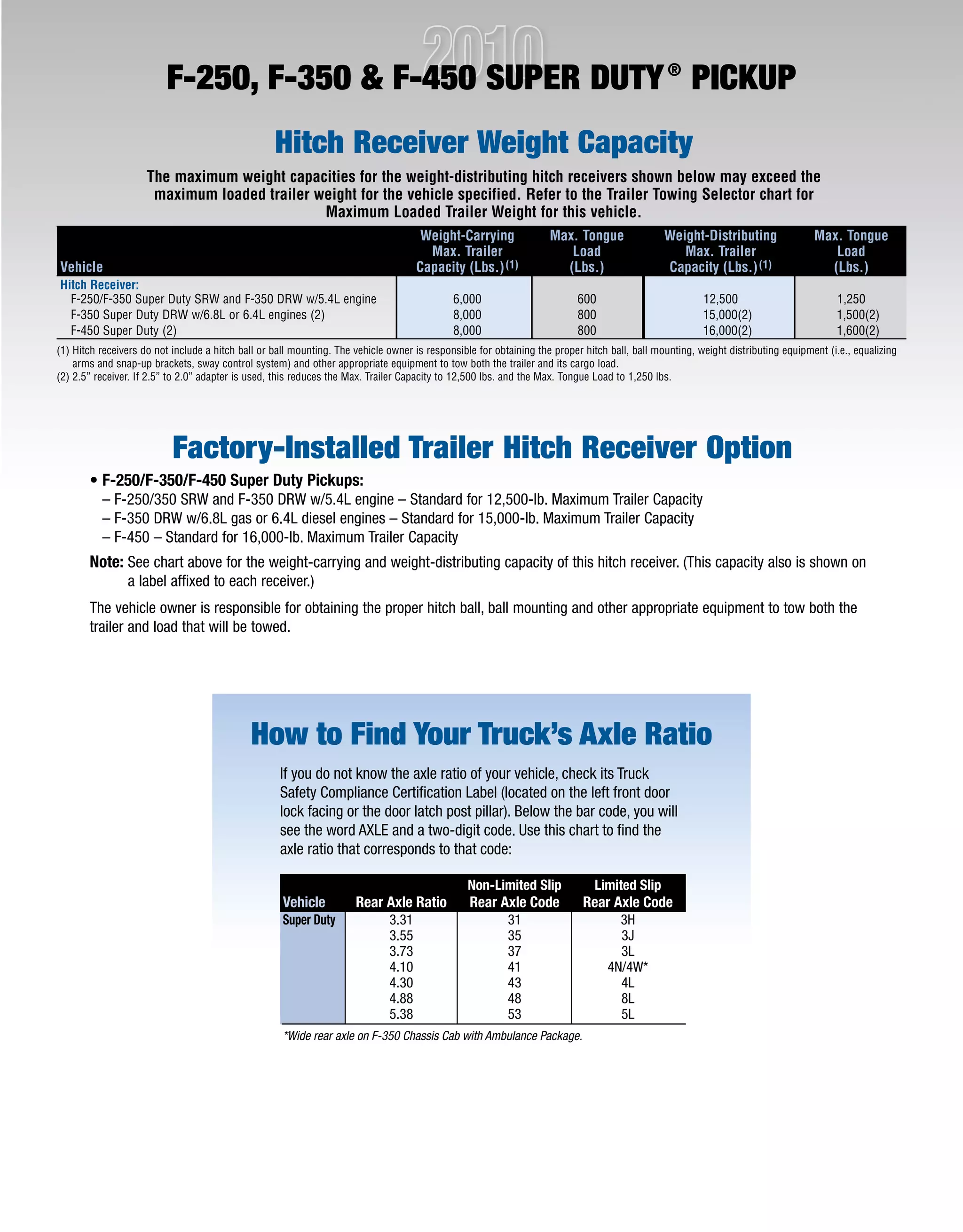
The 2015 Ford Super Duty diesel models, equipped with the 6.7-liter Power Stroke V8 Turbo Diesel engine, offer a maximum conventional towing capacity of up to 19,000 pounds and a maximum fifth-wheel/gooseneck towing capacity reaching up to 31,200 pounds when properly configured with dual rear wheels and appropriate axle ratios.
Introduction to the 2015 Ford Super Duty Diesel Lineup
The 2015 model year represents a significant milestone for the Ford Super Duty lineup, which includes the F-250, F-350, and F-450. Building upon a legacy of heavy-duty capability, Ford introduced a second-generation 6.7-liter Power Stroke V8 Turbo Diesel engine for this production year. This upgraded powerplant featured a larger, class-exclusive dual-side turbocharger mounted to the engine block's exhaust face, a redesign that boosted performance figures substantially.
Understanding the towing capacity of these trucks requires looking beyond a single maximum figure. Towing performance depends on a combination of factors, including cab configuration (Regular Cab, SuperCab, or Crew Cab), bed length, drivetrain (4x2 or 4x4), single rear wheel (SRW) versus dual rear wheel (DRW) setups, and final drive axle ratios. This overview examines how these specifications translate into real-world pulling power for commercial operators, heavy equipment haulers, and recreational towers.
The 6.7-Liter Power Stroke V8 Turbo Diesel Engine
At the heart of every 2015 Ford Super Duty diesel is the 6.7-liter Power Stroke engine. For the 2015 model year, Ford engineers re-engineered key internal components to increase output. The engine output was bumped to an impressive 440 horsepower at 2,800 RPM and a massive 860 lb-ft of torque starting at a low 1,600 RPM.
This engine is paired with the TorqShift 6-speed SelectShift automatic transmission, a heavy-duty unit designed to handle high torque loads without sacrificing shift smoothness. The transmission features a progressive range select mode, allowing the driver to manually lock out higher gears when towing heavy loads on steep grades. Additionally, an integrated exhaust brake utilizes variable turbine geometry in the turbocharger to create backpressure, helping control vehicle speed on descents and reducing wear on the factory service brakes.
Breakdown of Towing Capacities by Model
Towing limits vary significantly across the F-250, F-350, and F-450 designations. Buyers must carefully consult the official Ford towing guide for their specific vehicle identification number (VIN) to ensure safe and legal hauling.
F-250 Super Duty Diesel Towing Limits
The F-250 serves as the entry point into the Super Duty diesel range. Built primarily for single rear wheel configurations, the 2015 F-250 diesel is well-suited for medium-duty towing, such as large utility trailers, livestock trailers, and mid-sized travel trailers.
- Maximum Conventional Towing: Up to 14,000 pounds when properly equipped with a weight-distributing hitch.
- Maximum Fifth-Wheel/Gooseneck Towing: Up to 15,900 pounds, depending on cab style and axle ratio (typically utilizing 3.31 or 3.55 ratios).
F-350 Super Duty Diesel Towing Limits
The F-350 steps up capability with heavier suspension components and the option for dual rear wheels (DRW), commonly known as a dually. This configuration provides lateral stability for wider and heavier loads.
- Maximum Conventional Towing: Up to 14,000 pounds for single rear wheel models, and up to 19,000 pounds for properly equipped dual rear wheel models.
- Maximum Fifth-Wheel/Gooseneck Towing: Ranges from roughly 16,000 pounds for SRW configurations up to 26,700 pounds for DRW configurations with a 4.10 axle ratio.
F-450 Super Duty Diesel Towing Limits
For 2015, Ford re-positioned the F-450 Pickup as a consumer-available heavy-duty truck rather than strictly a chassis cab. It features commercial-grade components, including larger brakes, a wider front track for tighter turning radius, and a standard 4.30 rear axle ratio.
- Maximum Conventional Towing: 19,000 pounds.
- Maximum Fifth-Wheel/Gooseneck Towing: An industry-leading maximum of up to 31,200 pounds, making it the premier choice for massive fifth-wheel RVs and heavy commercial transport.
| Model | Drive Type | Rear Wheel Setup | Max Conventional Towing (lbs) | Max Fifth-Wheel/Gooseneck Towing (lbs) |
|---|---|---|---|---|
| F-250 | 4x2 / 4x4 | Single Rear Wheel | Up to 14,000 | Up to 15,900 |
| F-350 | 4x2 / 4x4 | Single Rear Wheel | Up to 14,000 | Up to 16,200 |
| F-350 | 4x2 / 4x4 | Dual Rear Wheel | Up to 19,000 | Up to 26,700 |
| F-450 | 4x2 / 4x4 | Dual Rear Wheel | 19,000 | Up to 31,200 |
Crucial Factors Affecting Towing Performance
Evaluating towing capacity requires understanding that gross vehicle weight rating (GVWR), gross combined weight rating (GCWR), and payload capacity interact directly with trailer weight. Exceeding any single rating compromises safety and vehicle longevity.
Payload and Tongue Weight Interaction
When hitching a heavy trailer, a portion of the trailer's weight transfers directly to the truck as tongue weight (for conventional trailers) or pin weight (for fifth-wheels and goosenecks). This weight counts against the truck’s payload capacity. Because diesel engines add significant weight over the front axle compared to gasoline engines, the available payload on a diesel Super Duty is often lower than its gas-powered counterpart. Operators must verify that the combined weight of passengers, cargo, and trailer pin weight does not exceed the truck's payload rating.
Axle Ratios and Their Impact
The 2015 Super Duty diesel was offered with several axle ratios, most notably 3.31, 3.55, 3.73, 4.10, and 4.30.
- Lower numerical ratios (e.g., 3.31): Provide better fuel economy during highway cruising and empty driving.
- Higher numerical ratios (e.g., 4.10 or 4.30): Deliver higher maximum GCWRs and greater pulling force from a dead stop, which is essential for heavy commercial loads.
Safety Features and Towing Technology
Towing heavy loads safely requires more than just engine power. The 2015 Ford Super Duty incorporates several factory technologies designed to assist drivers under heavy loads:
- Trailer Sway Control: Works in conjunction with AdvanceTrac with Roll Stability Control to sense trailer sway and apply specific vehicle brakes or reduce engine torque to bring the trailer back under control.
- Hill Start Assist: Prevents the truck from rolling backward on an incline when moving from a stop to forward motion, whether pulling a trailer or driving unladen.
- Integrated Trailer Brake Controller: Factory-installed and synchronized with the truck's anti-lock braking system to provide smooth, proportional activation of the trailer's electric or electric-over-hydraulic brakes.
- Tow/Haul Mode: Alters transmission shift points to reduce gear hunting when climbing or descending grades, utilizing engine braking to maintain optimal control.
Common Mistakes and Operational Considerations
When operating a 2015 Ford Super Duty diesel near its maximum capacity, drivers should avoid several frequent pitfalls:
- Ignoring GCWR: Focusing solely on the maximum trailer weight rating while ignoring the Gross Combined Weight Rating (the total allowable weight of the truck plus the trailer combined).
- Incorrect Hitch Selection: Using a weight-carrying hitch when a weight-distributing hitch is required for conventional loads exceeding specific tongue weight thresholds.
- Neglecting Maintenance Intervals: Heavy towing places severe thermal and mechanical stress on fluids. Diesel engine oil, transmission fluid, and differential gear oil must be changed more frequently under severe towing service schedules.
Frequently Asked Questions
What is the maximum towing capacity of a 2015 Ford F-250 Diesel?
The maximum conventional towing capacity for a 2015 Ford F-250 diesel is 14,000 pounds, while its maximum fifth-wheel or gooseneck towing capacity reaches up to 15,900 pounds. These limits depend on cab style, 4x2 or 4x4 drivetrain, and axle ratio selection.
Can a 2015 Ford F-350 Diesel tow 20,000 pounds?
Yes, but only if it is configured with dual rear wheels (DRW) and the appropriate heavy-duty axle ratio. Single rear wheel (SRW) F-350 diesel models have a lower conventional limit of 14,000 pounds and a max fifth-wheel limit around 16,200 pounds, whereas DRW models can handle significantly heavier loads.
How does the 6.7L Power Stroke diesel affect payload capacity?
The 6.7L Power Stroke V8 Turbo Diesel engine is a heavy cast-iron block component that adds substantial weight over the front axle compared to the 6.2L gas V8. This extra weight consumes a portion of the truck's total payload capacity, meaning diesel models generally offer lower payload capacities than equivalently equipped gas models.
Is an exhaust brake standard on the 2015 Ford Super Duty Diesel?
Yes. The 2015 model features an electronic exhaust brake as standard equipment on all 6.7L Power Stroke diesel models. It uses the variable-geometry turbocharger to restrict exhaust flow, creating backpressure that assists in slowing the vehicle on steep downgrades.
What is the difference between F-350 and F-450 towing capacities in 2015?
While the F-350 DRW maxes out at 19,000 pounds conventional and up to 26,700 pounds fifth-wheel/gooseneck, the 2015 F-450 pickup features heavier commercial running gear and a standard 4.30 axle ratio, allowing it to pull up to 31,200 pounds in gooseneck/fifth-wheel configurations.
Conclusion and Next Actions
Evaluating the 2015 Ford Super Duty diesel requires matching the specific configuration of the truck—whether F-250, F-350, or F-450—to the precise weight and type of trailer being pulled. Before towing, verify the exact capacities of your specific vehicle using the door jamb certification sticker and the official Ford towing guide. Always ensure that hitch equipment, weight distribution, and trailer brakes are inspected and maintained to meet safety standards.