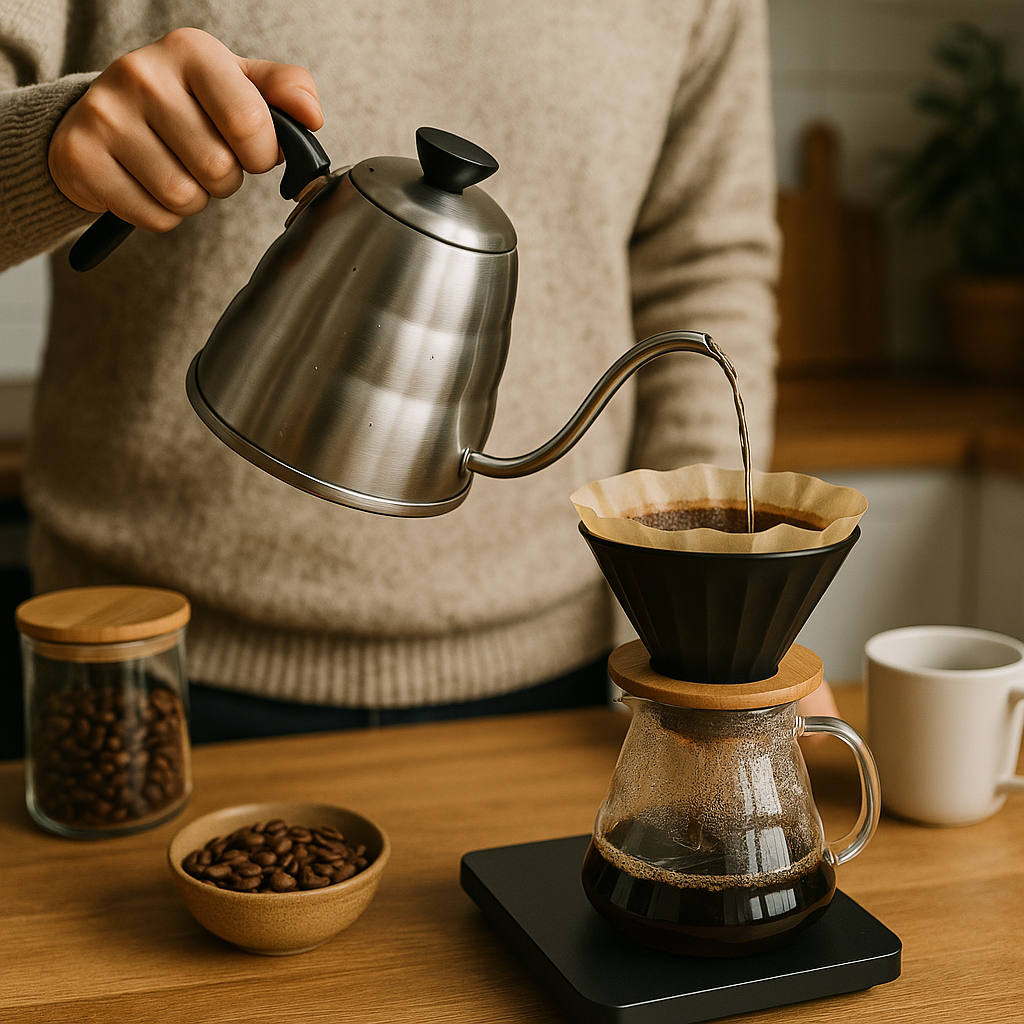
The single most effective and simple tip for consistently superior coffee is to transition from measuring by volume—using scoops or spoons—to measuring by weight using a digital scale. By weighing your coffee beans and water, you eliminate the guesswork inherent in scoop density, ensuring the correct ratio of grounds to water every time regardless of bean roast or grind size.
The Problem with Scoops and "Volume" Brewing
For decades, the standard advice for brewing coffee has involved the use of scoops, tablespoons, or "heaping" measures. While convenient, this method is fundamentally flawed due to the physics of coffee beans. Different roast levels result in beans of varying density; a light-roast bean is physically denser than a dark-roast bean, which has undergone more extensive cellular expansion during the roasting process.
When you use a scoop, you are measuring space, not mass. A tablespoon of light-roast beans will weigh significantly more than a tablespoon of dark-roast beans because the darker beans are more porous and have more air gaps between them. If you follow a "two tablespoons per cup" rule, you are likely introducing massive variability into your extraction process, which is the primary reason coffee tastes bitter one morning and sour the next. By shifting to a digital scale, you bypass the inaccuracies of volume-based measurement, creating a stable foundation for flavor consistency.
Understanding the Golden Ratio
In the world of specialty coffee, the "Golden Ratio" generally refers to the balance between coffee grounds and water. While personal preference plays a significant role, most professional baristas and organizations, such as the Specialty Coffee Association (SCA), recommend a starting point of 1:16 to 1:17. This means for every 1 gram of coffee, you use 16 to 17 grams of water.
This ratio provides a sweet spot where the water has enough solvent power to extract the desirable sugars and oils from the coffee without pulling too much of the astringent, bitter compounds that arise from over-extraction.
Implementing the Ratio
To implement this in your daily routine, follow these steps:
- Target Yield: Determine how much finished coffee you want. A standard mug is roughly 300ml (300 grams) of water.
- Calculate Grounds: Divide your water weight by 16. For 300g of water, you would need approximately 18.75g of coffee (300 / 16 = 18.75).
- Tare the Scale: Place your brewing device (e.g., a Chemex, V60, or French Press) on the scale and press "tare" to zero out the weight.
- Weigh Beans: Add your 18.75g of beans.
- Brewing: Once the coffee is ground and the water is heated, place the brewer back on the scale, tare it again, and pour your 300g of water.
Essential Gear for Precision Brewing
You do not need an expensive commercial setup to apply this tip. However, certain tools make the process more reliable and repeatable.
| Tool | Purpose | Requirement |
|---|---|---|
| Digital Kitchen Scale | Measuring mass | Accuracy to 0.1g preferred |
| Burr Grinder | Achieving uniform particle size | Essential for even extraction |
| Gooseneck Kettle | Controlling water flow | Necessary for pour-over methods |
| Filtered Water | Ensuring flavor purity | High mineral content affects taste |
A basic digital kitchen scale that can measure in grams is usually sufficient. Look for a model that has a "tare" or "zero" function and a reasonably fast refresh rate. Avoid scales that only measure in whole grams, as the decimal precision becomes important when you are scaling recipes up or down.
The Role of Water Quality
Even if you use a scale to hit the perfect ratio, your coffee will fail to shine if the water chemistry is poor. Coffee is approximately 98% to 99% water. If your tap water contains excessive chlorine, high levels of dissolved solids, or an unpleasant odor, those qualities will be amplified in your final cup.
The goal is not "pure" distilled water, as coffee requires some minerals (magnesium and calcium) to bond with the coffee compounds and extract flavor. Ideally, use filtered water—either from an under-sink filtration system or a high-quality carafe filter. If your local water is exceptionally "hard," it may cause scale buildup in your equipment and dull the bright, acidic notes of your coffee.
Common Mistakes to Avoid
Even when using a scale, beginners often encounter issues that lead to underwhelming coffee. Recognizing these pitfalls is key to mastering your daily brew.
- Neglecting the "Bloom": When you first pour hot water over fresh grounds, gases (primarily carbon dioxide) are released. This is the "bloom." If you don't allow this gas to escape, the water cannot properly penetrate the grounds, leading to uneven extraction. Pour just enough water to wet the grounds and wait 30–45 seconds before continuing.
- Ignoring Grind Size: The scale manages the amount, but the grinder manages the surface area. If your coffee is too sour, your grind is likely too coarse (the water passed through too fast). If it is too bitter or "muddy," the grind is likely too fine (the water sat too long).
- Inconsistent Temperature: While the scale ensures the ratio is correct, the temperature affects solubility. Aim for water between 90°C and 96°C (195°F to 205°F). Boiling water can scorch the grounds, while cool water will lead to flat, under-extracted flavors.
Troubleshooting Your Results
If your coffee still tastes off after you have mastered the scale, use this systematic approach to isolate the variable:
- The Sour Cup: This is usually under-extraction. Increase your contact time (grind slightly finer) or increase your water temperature.
- The Bitter Cup: This is usually over-extraction. Decrease your contact time (grind slightly coarser) or reduce your brew time.
- The Weak/Watery Cup: Your ratio might be too high. Try moving from 1:17 toward a 1:15 ratio to see if the body and intensity improve.
- The "Muddy" Cup: If using a French Press or immersion method, the "fines" (the smallest particles of ground coffee) might be causing the silt. Ensure your grinder is a burr grinder, not a blade grinder, to ensure more consistent particle size.
Frequently Asked Questions
Why does my coffee taste different if I use the same scoop every day? Even if you use the same physical scoop, the amount of coffee that fits into that volume changes based on how tightly you pack the grounds and the density of the bean. A scale measures the actual mass, which is a constant regardless of how the beans settle in the container.
Do I really need to be this precise every morning? You do not have to be a scientist, but using a scale takes less than ten seconds and removes the "luck" factor. Once you find a ratio you enjoy, keeping a digital scale on your counter ensures that your coffee is just as good on a Tuesday as it is on a Sunday.
Can I use a scale for espresso as well? Yes, and it is even more critical for espresso. Because espresso brewing uses high pressure, even a half-gram deviation in the amount of coffee used can change your brew time by several seconds, leading to either a perfectly balanced shot or a ruined one.
Does a digital scale help with batch brewing in a drip machine? Absolutely. Many people add water to the reservoir and coffee to the basket by "eyeing it." By weighing your water as you pour it into the reservoir and weighing your beans before grinding, you can ensure your 12-cup drip machine delivers the same strength every time.
Are there any exceptions to the 1:16 ratio? The 1:16 ratio is a baseline. Some brewing methods require different ratios. For example, a French Press often performs better at 1:15 for a heavier body, while a light-roast Pour-Over may shine at 1:17 to highlight subtle floral notes. Treat the scale as a tool for repeatability once you have found your preferred range.
Next Action: Your Calibration Session
To put this tip into practice, conduct a calibration session this weekend. Do not change your coffee beans or your brewing method. Instead, for three consecutive days, use your scale to maintain a strict 1:16 ratio (e.g., 20g of coffee to 320g of water). Take a moment to note the flavor profile each day. This simple exercise will teach you more about your equipment and your personal preferences than any other variable change. Once you have established this control, you will finally be able to judge the coffee beans—and the roast—rather than guessing whether your "scoop" was properly filled.