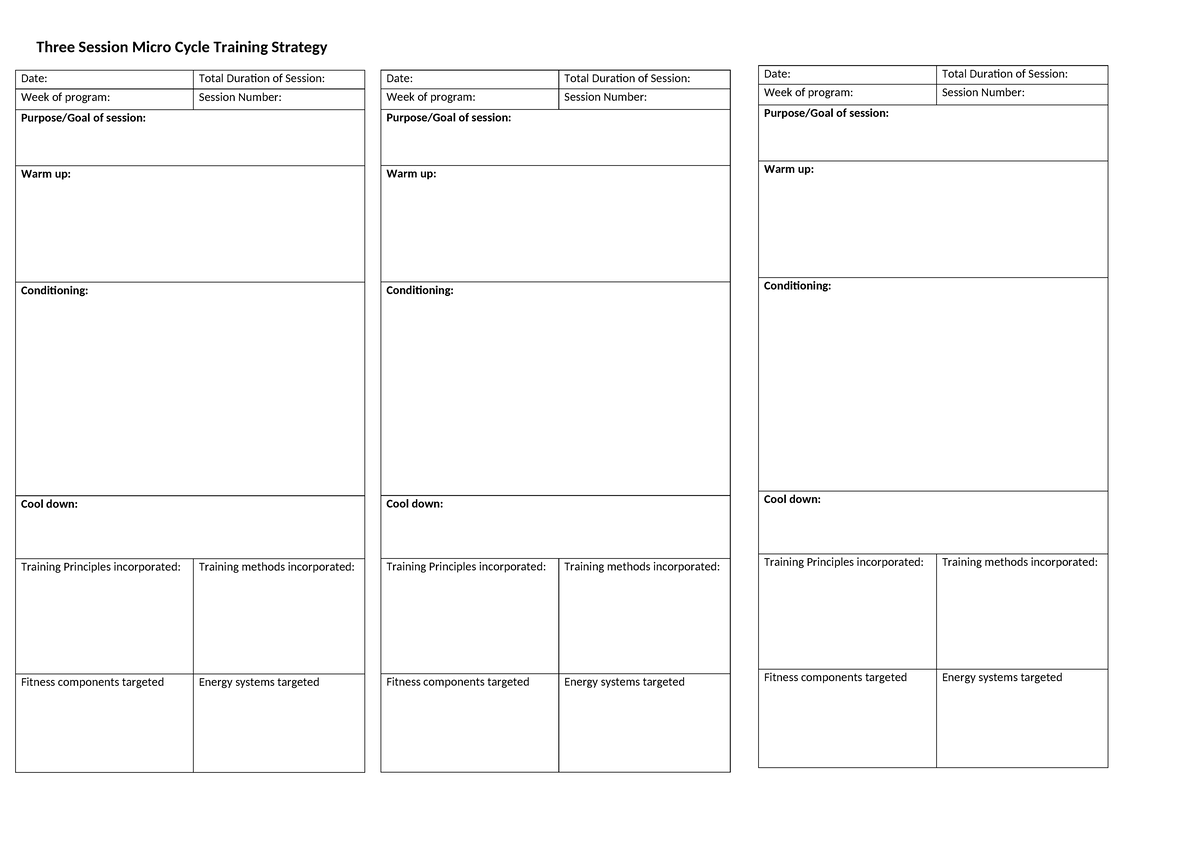
A training microcycle is the shortest functional unit within a periodized athletic program, typically spanning seven days. It organizes specific daily sessions to balance stimulus and recovery, ensuring that athletes achieve targeted adaptations—such as strength, hypertrophy, or endurance—while managing fatigue to prevent overtraining and optimize long-term performance gains.
In the landscape of modern sports science as of 2026, the microcycle serves as the bridge between daily effort and the broader goals of a mesocycle (usually 4–6 weeks) and a macrocycle (an annual or multi-month plan). While the 7-day calendar week is the most common format due to social and professional constraints, microcycles can technically range from 3 to 14 days depending on the athlete's recovery capacity and the complexity of the training goals.
The Structural Role of the Microcycle in Periodization
To understand how to build a weekly training example, one must first understand where the microcycle fits in the hierarchy of periodization. Periodization is the systematic planning of athletic or physical training. The aim is to reach the best possible performance in the most important competition of the year. It involves progressive cycling of various aspects of a training program during a specific period.
The microcycle is the "tactical" level of this planning. If the macrocycle is the map of the entire journey and the mesocycle is the current leg of that journey, the microcycle represents the daily steps taken to ensure the traveler stays on course. In 2026, advanced physiological monitoring through wearables and biochemical markers has made microcycle adjustment more dynamic than ever, allowing coaches to pivot intensity based on real-time recovery data.
The Dynamics of Load and Recovery
The primary objective of a microcycle is to apply a "training stress" that the body can adapt to. This is governed by the Principle of Supercompensation. When a training stimulus is applied, the body’s performance capacity initially dips due to fatigue. During the recovery phase, the body repairs itself and "overshoots" its previous baseline to better handle future stress.
A well-designed microcycle ensures that the hardest sessions are spaced far enough apart to allow for this supercompensation, while easier sessions or active recovery days maintain metabolic efficiency and movement quality without adding excessive systemic fatigue.
Principles of Designing an Effective Weekly Training Microcycle
Before looking at a specific example, it is essential to establish the principles that dictate the placement of exercises and intensity levels.
1. Specificity and Goal Orientation
Every microcycle must have a primary emphasis. A week designed for a marathon runner will look fundamentally different from one designed for a powerlifter. Even within a single athlete's year, a "hypertrophy microcycle" will prioritize volume (total sets and reps), while a "peaking microcycle" will prioritize intensity (weight on the bar) and specificity of movement.
2. Management of Training Volume and Intensity
Volume and intensity usually have an inverse relationship. If you are training with very high intensity (90%+ of your one-rep max), the total number of sets must be lower to prevent Central Nervous System (CNS) burnout. Conversely, during a high-volume phase, the weight must be moderate enough to allow the athlete to complete the required repetitions without mechanical failure.
3. The Alternation of Load
A common mistake in amateur programming is the "flat-load" approach, where every day is treated with equal intensity. Effective microcycles utilize "undulating" loads. This means following a high-intensity day with a low-intensity or recovery day. This prevents the accumulation of "junk volume"—work that adds fatigue without providing a significant adaptive stimulus.
A Technical Microcycle Example: The Hybrid Strength-Hypertrophy Week
The following example is a 7-day microcycle designed for an intermediate-to-advanced trainee looking to build both muscle size (hypertrophy) and maximal strength. This "Power-Building" approach is a staple in modern athletic preparation as of 2026.
This microcycle uses a 4-day training split with three days of varied recovery and metabolic conditioning.
Monday: Day 1 – Lower Body Strength (High Intensity)
- Focus: Maximal force production in the posterior chain and quads.
- Primary Lifts: Squat or Deadlift variations.
- Parameters: 3–5 sets of 3–5 repetitions at 80–85% of 1RM.
- Why: Starting the week with the most taxing session ensures the CNS is fresh after a weekend of rest.
Tuesday: Day 2 – Upper Body Strength (High Intensity)
- Focus: Maximal force production in pushing and pulling patterns.
- Primary Lifts: Bench Press, Overhead Press, Weighted Pull-ups.
- Parameters: 3–5 sets of 5 repetitions.
- Why: Allows the lower body to recover while still maintaining high neural drive for the upper body.
Wednesday: Day 3 – Active Recovery & Mobility
- Focus: Increasing blood flow and resolving tissue restrictions.
- Activities: Low-intensity steady-state (LISS) cardio (e.g., walking, light cycling) for 30 minutes, followed by a dedicated mobility flow.
- Why: Complete rest can sometimes lead to stiffness. Active recovery promotes the clearance of metabolic waste.
Thursday: Day 4 – Lower Body Hypertrophy (Moderate Intensity/High Volume)
- Focus: Metabolic stress and muscle damage for growth.
- Primary Lifts: Leg Press, Bulgarian Split Squats, Leg Curls.
- Parameters: 3–4 sets of 10–12 repetitions at 60–70% of 1RM.
- Why: Different rep ranges target different muscle fiber types (Type I vs. Type II).
Friday: Day 5 – Upper Body Hypertrophy (Moderate Intensity/High Volume)
- Focus: Sarcoplasmic hypertrophy and "the pump."
- Primary Lifts: Incline Dumbbell Press, Rows, Lateral Raises, Bicep/Tricep work.
- Parameters: 3–4 sets of 12–15 repetitions.
- Why: Closing the training week with higher volume allows for significant muscle protein synthesis stimulation heading into the weekend.
Saturday: Day 6 – GPP and Metabolic Conditioning
- Focus: General Physical Preparedness (GPP) and cardiovascular health.
- Activities: Kettlebell swings, carries, or interval training (HIIT) on a rower.
- Why: Maintaining a baseline of aerobic and anaerobic conditioning supports faster recovery between sets in the strength sessions.
Sunday: Day 7 – Full Rest
- Focus: Psychological and physiological reset.
- Activities: Zero structured exercise. Focus on nutrition and sleep hygiene.
- Why: Prevents mental burnout and allows for full systemic recovery before the next microcycle begins.
Comparison of Microcycle Variations
Not all microcycles are created equal. Depending on the phase of the mesocycle, the structure shifts.
| Microcycle Type | Primary Goal | Intensity Level | Volume Level | Recovery Demand |
|---|---|---|---|---|
| Introductory | Familiarization with movements | Low | Moderate | Low |
| Ordinary | Progressive overload | Moderate-High | Moderate | Moderate |
| Shock | Overreaching to break plateaus | Very High | High | Very High |
| Taper/Peak | Dissipating fatigue for performance | High | Low | Low |
| Recovery/Deload | Systemic restoration | Low | Low | Minimal |
The "Shock" Microcycle
The Shock Microcycle is a specialized tool used sparingly (perhaps once every 8–12 weeks). It involves a sudden, significant increase in training load—either through volume, frequency, or intensity—designed to "shock" the body out of a plateau. This must always be followed by a Recovery or Deload microcycle to prevent injury.
The Deload Microcycle
A deload is a planned reduction in training volume and intensity. In 2026, many programs incorporate a deload every 4th or 5th week. This isn't "time off," but rather a period where you perform the same movements at roughly 50–60% of the usual volume. This allows connective tissues (tendons and ligaments), which heal slower than muscle tissue, to catch up.
Managing Fatigue: The Science of Intra-Weekly Recovery
A microcycle example is only effective if the athlete can actually recover from the prescribed sessions. Fatigue is not just muscular; it is neurological, hormonal, and psychological.
Central Nervous System (CNS) Fatigue
High-intensity lifting (near-maximal weights) or explosive plyometrics tax the CNS. Unlike muscle soreness (DOMS), CNS fatigue can be subtle, manifesting as a lack of motivation, decreased grip strength, or disrupted sleep. Structuring the microcycle to avoid back-to-back high-CNS days is a hallmark of professional programming.
Nutritional Support
The microcycle should dictate the nutritional strategy. On high-volume hypertrophy days (Thursday/Friday in our example), carbohydrate intake should be higher to fuel glycogen stores and trigger insulin-mediated muscle growth. On rest or low-intensity days, a shift toward higher fats and moderate carbohydrates may support metabolic flexibility.
The Role of Sleep
Current 2026 guidelines emphasize that sleep is the most potent ergogenic aid available. A microcycle that includes five days of grueling training but only six hours of sleep per night is destined for failure. Consistency in sleep-wake cycles (circadian rhythm) is as important as the total number of hours.
Common Mistakes in Microcycle Construction
Even with a solid example, several pitfalls can undermine progress:
- Monotony: Repeating the exact same microcycle for months without any change in load or rep schemes. This leads to the Law of Diminishing Returns.
- Neglecting the "Micro-Signature": Every athlete has a unique "recovery signature." Some people can handle high volume but struggle with high intensity, while others are the opposite. A generic microcycle example should always be adjusted based on individual feedback.
- Ignoring Outside Stressors: The body does not distinguish between "gym stress" and "life stress" (work deadlines, family issues, lack of sleep). If external stress is high, the intensity of the microcycle must be adjusted downward.
- Excessive Variety: Changing exercises every single week prevents the athlete from mastering the technical skill of the movement. Consistency in exercise selection within a mesocycle is necessary for meaningful data tracking.
Frequently Asked Questions
How many days should a microcycle last?
While 7 days is the standard for most people because it aligns with the work week, professional athletes often use 3-day, 5-day, or even 10-day microcycles. The "best" length is whatever allows you to complete the necessary training volume for your goal while hitting your recovery markers.
Can I skip the rest days if I feel good?
It is generally discouraged to skip planned rest days. The goal of a microcycle is not to work until you are exhausted, but to provide a stimulus that triggers adaptation. Often, the "feeling good" is a result of the supercompensation process occurring; training during that window can actually cut the adaptation short.
What should I do if I miss a day in the microcycle?
Avoid the urge to "double up" on the following day. This often results in a session that is too long, leading to excessive cortisol release and poor technique. Instead, either pick up where you left off and shift the entire microcycle forward by one day, or skip the missed day entirely and resume the schedule if the missed session wasn't a "primary" lift day.
How often should I change my microcycle structure?
The core structure of your microcycle (the split) should typically stay the same for a full mesocycle (4–6 weeks). After that, you might change the emphasis—for example, moving from a 4-day hypertrophy focus to a 3-day strength/power focus—to provide a new stimulus.
Is cardio necessary in a strength-based microcycle?
Yes. Cardiovascular health supports the "aerobic base," which is what allows your body to recover between sets of heavy lifting. In 2026, the consensus among elite strength coaches is that some form of LISS (Low-Intensity Steady State) or GPP should be included in every microcycle to support longevity and work capacity.
Practical Recommendation for Next Steps
To implement a microcycle effectively, start by tracking your RPE (Rate of Perceived Exertion) for every session. Using a scale of 1–10, rate how difficult the session was. If you find that every day in your microcycle is a 9 or 10, you are likely overreaching and will burn out before the mesocycle ends. Aim for a mix: perhaps two "9" days, two "7" days, and one "5" day.
Begin with the 4-day hybrid example provided above. Document your performance for three weeks. On the fourth week, perform a "Deload Microcycle" by cutting your total sets in half while keeping the weights moderate. This cycle of three weeks on, one week off, is a proven method for sustainable, long-term athletic development.