ARMO Cloud Security, primarily delivered through the ARMO Platform and its open-source foundation, Kubescape, provides a comprehensive Cloud-Native Application Protection Platform (CNAPP) designed specifically for Kubernetes environments. It enables organizations to identify misconfigurations, manage vulnerabilities based on actual risk, and ensure continuous compliance across the entire software development lifecycle.
The shift toward containerized workloads and microservices architecture has rendered traditional perimeter-based security models insufficient. In 2026, the complexity of managing large-scale Kubernetes clusters requires a specialized approach that bridges the gap between development, security, and operations (DevSecOps). ARMO addresses this by offering deep visibility into the internal workings of clusters, utilizing advanced technologies like eBPF (Extended Berkeley Packet Filter) to provide context-aware security that minimizes "alert fatigue."
The Core Philosophy: Why ARMO Focuses on Kubernetes
To understand ARMO, one must first understand the unique security challenges of Kubernetes (K8s). Kubernetes is an orchestration engine that manages highly dynamic, ephemeral workloads. Traditional security scanners often struggle with the "reachability" problem—identifying thousands of vulnerabilities but failing to distinguish which ones are actually exploitable in a specific runtime environment.
ARMO was built on the premise that security should be "open-source first" and deeply integrated into the CI/CD pipeline. By leveraging Kubescape, which was the first tool to automate the testing of the NSA-CISA Kubernetes Hardening Guidance, ARMO provides a framework that is both community-validated and enterprise-ready. Its primary goal is to move beyond simple "point-in-time" scanning toward continuous, automated remediation.
Key Capabilities of the ARMO Platform
The ARMO Platform has evolved into a multi-faceted security suite. As of 2026, its feature set covers the entire spectrum of the CNAPP definition, focusing on three main pillars: Posture Management, Vulnerability Management, and Runtime Protection.
Kubernetes Security Posture Management (KSPM)
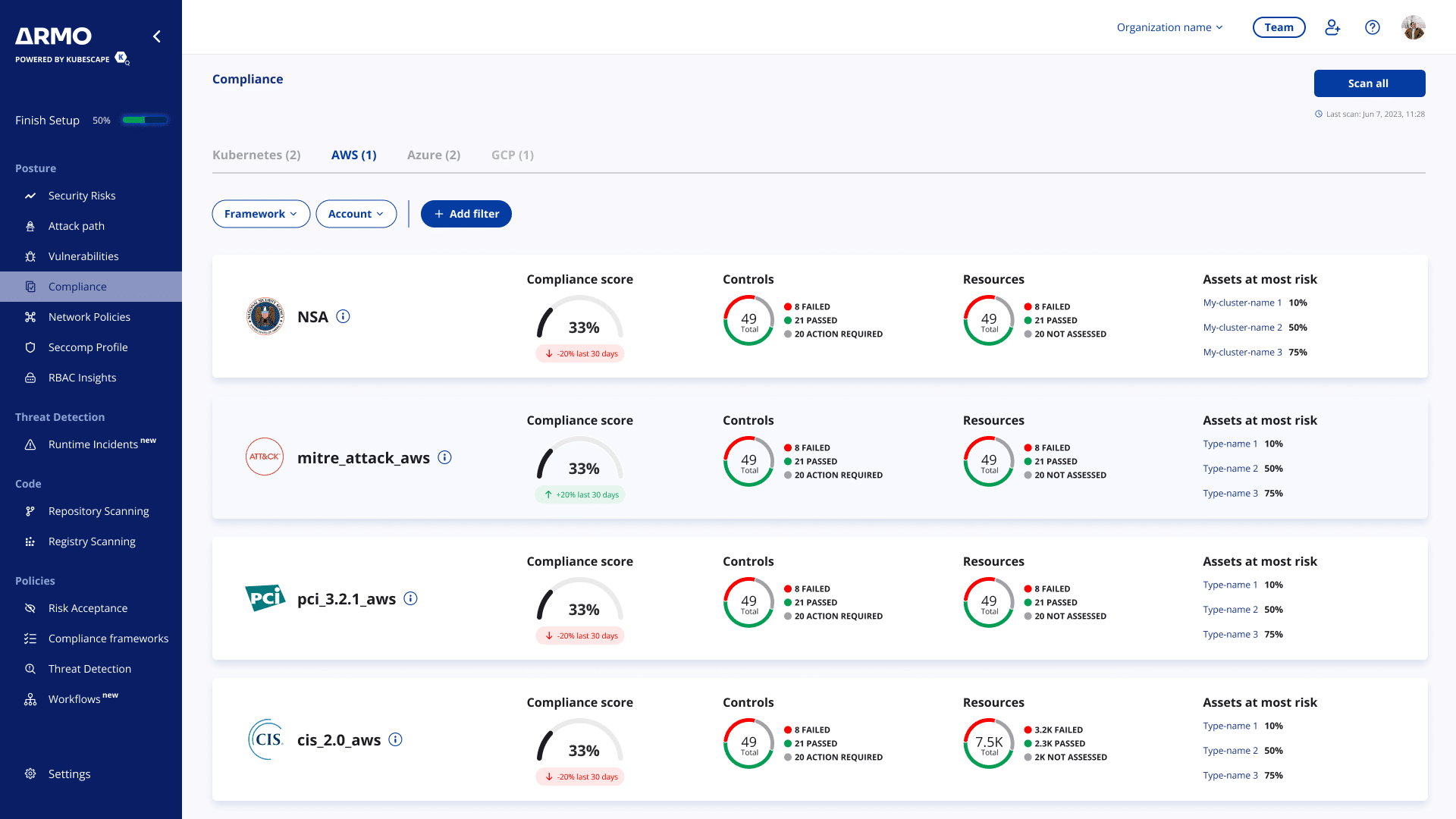
KSPM is the process of continuously monitoring a cluster for misconfigurations that could lead to a breach. ARMO scans your clusters against industry benchmarks such as CIS (Center for Internet Security), MITRE ATT&CK®, and the NSA-CISA hardening guide.
Unlike basic scanners, ARMO provides automated remediation advice. It doesn't just tell you that a Pod is running with privileged access; it provides the specific YAML snippet or Pull Request (PR) needed to fix the issue. This reduces the friction between security teams who find problems and developers who are tasked with fixing them.
Risk-Based Vulnerability Management
Vulnerability management is often the most overwhelming part of cloud security. A single container image might contain hundreds of Common Vulnerabilities and Exposures (CVEs). ARMO utilizes eBPF-based reachability analysis to filter the noise.
By observing the application at runtime, ARMO determines which vulnerable libraries are actually loaded into memory and executed. If a "Critical" CVE exists in a library that the application never uses, ARMO de-prioritizes it. This allows security teams to focus on the 5-10% of vulnerabilities that actually pose a real-world risk, significantly improving the efficiency of the remediation process.
CI/CD and GitOps Integration
Security must start before a single line of code reaches production. ARMO integrates directly into the DevOps toolchain, including:
- IDE Plugins: Developers receive real-time feedback in VS Code or JetBrains IDEs.
- CLI Tools: Kubescape can be run locally to test manifests before they are committed.
- Pipeline Gates: ARMO can be configured to "break the build" if a new deployment introduces a critical misconfiguration or a high-risk vulnerability.
- GitOps Sync: For organizations using ArgoCD or Flux, ARMO monitors the desired state in Git and compares it to the actual state in the cluster, identifying "drift" that could indicate unauthorized changes.
Understanding the Architecture: How ARMO Operates
ARMO’s architecture is designed to be lightweight and non-intrusive, ensuring that security monitoring does not degrade cluster performance.
- The In-Cluster Component: ARMO deploys a set of micro-agents (often via Helm charts) into the Kubernetes cluster. These agents include the Kubescape operator and eBPF sensors.
- eBPF Sensors: These sensors sit at the kernel level. They observe system calls, network traffic, and file access. Because eBPF is highly efficient, it provides deep visibility without the overhead associated with traditional sidecar proxies.
- The Cloud Backend (SaaS): While the data collection happens locally, the analysis, historical logging, and dashboarding are typically handled in the ARMO Cloud backend. This provides a single pane of glass for managing security across multiple clusters (on-prem, EKS, GKE, or AKS).
- The Registry Scanner: ARMO can connect to private container registries (like JFrog Artifactory, AWS ECR, or Docker Hub) to scan images for vulnerabilities before they are even pulled into a cluster.
Comparison of ARMO Security Features
The following table illustrates how ARMO compares to standard security approaches in several critical categories of cloud-native protection.
| Feature Category | Traditional Security Approach | ARMO Platform Approach (2026) |
|---|---|---|
| Scanning Depth | Static manifest analysis only. | Full stack: YAML, Helm, K8s API, and Runtime. |
| Vulnerability Priority | Based solely on CVSS scores. | Based on Runtime Reachability and exploitability. |
| Compliance | Manual audits and spreadsheets. | Continuous mapping to CIS, SOC2, and HIPAA. |
| Remediation | Alerting only; developers must find fixes. | Actionable fixes and automated Pull Requests. |
| Runtime Visibility | Log-based analysis (reactive). | eBPF-based real-time observation (proactive). |
| Performance Impact | Heavy agents or sidecars. | Lightweight kernel-level eBPF monitoring. |
Implementation and Prerequisites
Deploying ARMO Cloud Security is a straightforward process, but it requires specific administrative access to your infrastructure.
System Requirements
- Kubernetes Version: A supported version of Kubernetes (typically 1.25+ as of 2026).
- Permissions: Cluster-admin rights are required to install the Helm chart and deploy the necessary Custom Resource Definitions (CRDs).
- Network Access: The cluster must be able to communicate with ARMO's SaaS endpoints (unless using the Air-Gapped/On-Premise enterprise version).
Deployment Steps
- Account Setup: Create an account on the ARMO Platform console.
- Cluster Connection: Use the provided Helm command to install the ARMO operator. This usually looks like:
helm install armo armo/armo-cluster-components -n armo-system --create-namespace - Initial Scan: Once deployed, ARMO automatically triggers a full scan of the cluster configuration and all running container images.
- RBAC Analysis: ARMO will examine your Role-Based Access Control settings to identify users or service accounts with excessive permissions (e.g., "cluster-admin" roles assigned unnecessarily).
Compliance and Regulatory Frameworks
For many organizations, the primary driver for adopting ARMO is the need to satisfy auditors. Kubernetes environments are notoriously difficult to map to traditional compliance frameworks like PCI-DSS or SOC2.
ARMO simplifies this by providing pre-built Compliance Frameworks. Within the dashboard, you can select a specific regulation, and the platform will generate a report showing exactly where your cluster passes or fails. This is not a one-time report; it is a live compliance score that fluctuates as your environment changes.
Supported Frameworks in 2026:
- SOC2 Type II: Focuses on security, availability, and processing integrity.
- HIPAA: Essential for healthcare providers running patient data in the cloud.
- PCI-DSS 4.0: Updated requirements for protecting payment card data in containerized environments.
- MITRE ATT&CK: Mapping cluster vulnerabilities to known adversary tactics and techniques.
Future-Proofing with ARMO: The Role of AI and Automation
By 2026, ARMO has integrated advanced AI capabilities to assist in "Security Contextualization." Standard security tools often generate false positives because they don't understand the specific intent of a workload. ARMO’s AI engine analyzes the behavior of applications over time to create a "baseline" of normal activity.
If a workload suddenly starts communicating with an external IP address it has never contacted before, or starts executing shell commands it shouldn't, ARMO can automatically isolate that Pod. This moves the platform from a tool that just "finds" problems to one that actively "defends" the cluster.
Furthermore, ARMO’s support for VEX (Vulnerability Exploitability eXchange) and SBOMs (Software Bill of Materials) allows organizations to maintain a transparent supply chain. You can export an SBOM for any running container, proving to customers and regulators exactly what software components are inside your production environment.
Common Pitfalls and Troubleshooting
While ARMO is designed to be user-friendly, users may encounter challenges during large-scale rollouts:
- Resource Quotas: In highly restricted clusters, the ARMO agent might be throttled by CPU or memory limits. Ensure your namespace has adequate quotas for the security components.
- eBPF Compatibility: While most modern Linux kernels support eBPF, some older or highly customized kernels may lack the specific features required for deep runtime analysis. Always verify kernel versions (typically 5.4+) on your worker nodes.
- Network Policies: If you have strict egress rules, you must whitelist ARMO’s backend URLs to allow the agents to send telemetry and receive configuration updates.
FAQ
Is ARMO Cloud Security the same as Kubescape?
No, but they are deeply linked. Kubescape is the open-source security engine that performs scanning and tests. The ARMO Platform is the enterprise SaaS offering that adds a centralized management console, long-term data retention, advanced RBAC analysis, eBPF-based runtime security, and dedicated support.
How does ARMO impact cluster performance?
Because ARMO uses eBPF for runtime monitoring, the performance impact is minimal. Unlike traditional security tools that intercept every network packet or use heavy sidecar containers, eBPF runs sandboxed programs within the Linux kernel, which is significantly more efficient.
Can ARMO scan private registries?
Yes. ARMO supports integration with all major container registries. It can scan images stored in private repositories using credentials securely stored in your environment or via cloud-native IAM roles (like AWS IAM Roles for Service Accounts).
Does ARMO support multi-cloud environments?
Yes. The ARMO Platform is designed to provide a unified security view across multiple providers. You can manage EKS, GKE, AKS, and on-premises OpenShift clusters within a single dashboard, allowing for consistent security policies across your entire infrastructure.
What is "Reachability" in the context of ARMO?
Reachability refers to whether a specific vulnerability in a software library is actually "reachable" by the running application. If a container has a vulnerable library but that library is never called or executed, ARMO marks it as "non-reachable," helping teams prioritize the vulnerabilities that pose the greatest actual risk.
Final Recommendation
For organizations running production workloads on Kubernetes in 2026, the ARMO Platform represents a critical investment in operational stability and security. Its ability to provide a high "Signal-to-Noise" ratio through eBPF reachability analysis is its greatest asset, preventing developer burnout and ensuring that security teams focus on genuine threats.
If you are currently managing more than two or three clusters, the manual effort of tracking compliance and vulnerabilities becomes unsustainable. Your next step should be to deploy the Kubescape CLI for an initial local scan of your manifests, followed by a trial of the ARMO Platform to experience the benefits of continuous runtime visibility and automated remediation.