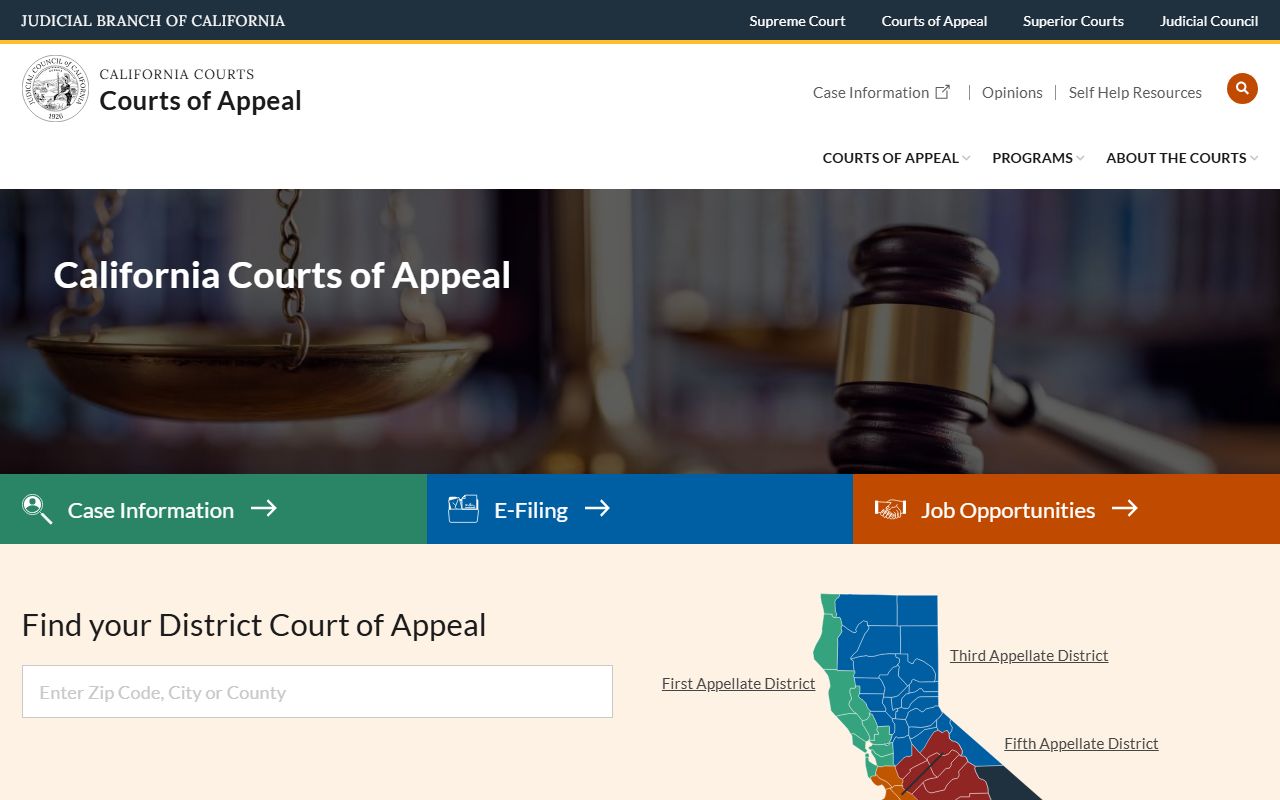
The California Courts of Appeal serve as the state's intermediate appellate courts, reviewing decisions made by Superior Courts to ensure trial judges correctly interpreted and applied California law. Consisting of six geographic districts, these courts evaluate trial court records, transcripts, and written legal briefs rather than retrying cases or considering new evidence.
Legal Disclaimer
This article provides general educational information regarding the structure, rules, and procedures of the California Courts of Appeal. It does not constitute formal legal advice. Appellate rules and deadlines are strictly enforced, and individuals seeking to file or defend an appeal should consult a licensed attorney admitted to practice in California.
Understanding the Structure of the California Appellate System
California operates a three-tiered judicial system designed to balance trial-level resolution with appellate oversight. At the base are the 58 Superior Courts (one in each county), which act as trial courts handling civil disputes, criminal prosecutions, family law matters, probate, and juvenile proceedings. At the top sits the Supreme Court of California, which retains discretionary review over appellate decisions and handles cases of critical statewide importance.
Positioned between the trial courts and the Supreme Court are the California Courts of Appeal. As the intermediate appellate courts, their primary function is to resolve appeals taken from final judgments and appealable orders originating in the Superior Courts.
- Supreme Court of California
- Discretionary Review / Writs
- California Courts of Appeal (6 Districts)
- Appeals of Right / Writs
- Superior Courts of California (58 Counties)
The Six Appellate Districts
The Courts of Appeal are geographically organized into six distinct Appellate Districts. Each district handles cases arising from specific county Superior Courts, though some larger districts are divided into sub-divisions:
- First Appellate District (San Francisco): Covers 12 Northern California coastal and Bay Area counties, including Alameda, Contra Costa, Marin, San Francisco, San Mateo, and Sonoma.
- Second Appellate District (Los Angeles and Ventura): Divided into eight divisions. Divisions 1 through 5, 7, and 8 sit in Los Angeles, while Division 6 sits in Ventura (handling Ventura, Santa Barbara, and San Luis Obispo counties).
- Third Appellate District (Sacramento): Serves 23 Northern and Central Valley counties stretching from Sacramento north to the Oregon border.
- Fourth Appellate District (San Diego, Riverside, Santa Ana): Divided into three geographic divisions: Division 1 (San Diego), Division 2 (Riverside), and Division 3 (Santa Ana).
- Fifth Appellate District (Fresno): Covers 9 Central Valley counties, including Fresno, Kern, Merced, and Stanislaus.
- Sixth Appellate District (San Jose): Covers four South Bay and Central Coast counties: Santa Clara, Santa Cruz, Monterey, and San Benito.
Panels of three appellate justices consider each appeal. To secure a ruling, an opinion must receive the concurrence of at least two justices on the panel. Official operational outlines and justice rosters are maintained directly on the California Courts Official Appellate Directory.
What the California Court of Appeal Does (and What It Doesn't)
A common misconception among self-represented litigants is that an appeal is a "redo" or a second trial. The Court of Appeal does not operate as a trial court, and its operational principles differ significantly from Superior Court proceedings.
Key Differences Between Trial Courts and Appellate Courts
- No New Evidence or Witnesses: The Court of Appeal will not accept new evidence, hear witness testimony, or re-evaluate the credibility of witnesses who testified at trial. The court’s analysis is strictly limited to the official Record on Appeal created in the trial court.
- Focus on Legal Error: An appeal is not a vehicle to re-argue facts simply because a party is unhappy with the verdict. The party appealing (the appellant) must demonstrate that the trial court made a significant legal error that caused prejudiced harm to their case.
- Presumption of Correctness: Under California law, a Superior Court judgment is presumed correct. The burden rests entirely on the appellant to overcome this presumption by pointing to explicit errors in the record and citing supporting legal authority.
Legal Standards of Review
When reviewing a case, appellate justices apply specific legal frameworks known as standards of review. The standard of review determines how much deference the appellate court gives to the trial judge's decisions:
- De Novo Review: Applied to pure questions of law, such as statutory interpretation or the construction of a contract. Under de novo review, the appellate court gives no deference to the trial judge’s decision and analyzes the issue independently.
- Substantial Evidence Review: Applied to factual findings made by a judge or jury. The appellate court reviews the record to determine whether there is reasonable, credible evidence supporting the verdict. The appellate court will not weigh conflicting evidence or judge witness credibility; if substantial evidence exists, the trial court's factual finding will be upheld.
- Abuse of Discretion Review: Applied to discretionary trial court rulings, such as evidentiary objections, request for continuances, or discovery sanctions. The appellate court will reverse only if the trial court’s ruling exceeded the bounds of reason or violated established legal principles.
Step-by-Step California Civil Appeal Process
Filing an appeal in California requires strict adherence to the procedural steps governed by Title 8 of the California Rules of Court. Failing to comply with these rules can result in fine penalties or immediate dismissal of the appeal.
- 1. NOTICE OF APPEAL: Must be filed in Superior Court within strict jurisdictional time limits (typically 60 days after Notice of Entry of Judgment).
- 2. RECORD DESIGNATION & PREPARATION: Parties designate the Clerk's Transcript (written documents) and Reporter's Transcript (verbatim oral proceedings).
- 3. BRIEFING PHASE:
- Appellant's Opening Brief (AOB)
- Respondent's Brief (RB)
- Appellant's Reply Brief (ARB - optional)
- 4. ORAL ARGUMENT & JUDICIAL OPINION: 30-minute oral argument (optional), followed by a written opinion issued within 90 days of submission.
- 5. REMITTITUR & ISSUANCE: Final jurisdiction transfers back to Superior Court to enforce or execute the appellate ruling.
Step 1: Filing the Notice of Appeal
The appeal process formally begins when the appellant files a Notice of Appeal in the Superior Court where the judgment was rendered (not in the Court of Appeal).
- Civil Deadline: Under California Rules of Court, Rule 8.104, a Notice of Appeal in a unlimited civil case must generally be filed on or before the earliest of:
- 60 days after the Superior Court clerk mails a document entitled "Notice of Entry" of judgment or a file-stamped copy of the judgment;
- 60 days after the party filing the appeal serves or is served with a "Notice of Entry" of judgment or a file-stamped copy of the judgment; or
- 180 days after entry of the judgment.
- Jurisdictional Nature: This deadline is strictly jurisdictional. If a Notice of Appeal is filed even one day late, the Court of Appeal has no legal authority to hear the case and must dismiss the appeal.
Step 2: Designation and Preparation of the Record
Within 10 days after filing the Notice of Appeal, the appellant must file a notice in the Superior Court designating the Record on Appeal. The record consists of two main components:
- Clerk's Transcript (or Joint Appendix): Written documents filed in the trial court, including pleadings, motions, court orders, and the final judgment. Litigants frequently elect to prepare an Appendix under Rule 8.124 to save time and administrative costs.
- Reporter's Transcript: The verbatim transcript created by the court reporter during oral hearings and trials. The appellant must pay a deposit to cover the cost of transcribing the oral proceedings designated for inclusion.
Step 3: Appellate Briefing
Once the record is certified and served, the Court of Appeal sets a briefing schedule. Briefs are written legal arguments detailing why the trial court was correct or incorrect.
- Appellant's Opening Brief (AOB): Filed within 40 days after the record is filed. The appellant must articulate the legal errors made by the trial court, cite supporting statutory and case law, and explain how the error affected the trial outcome (prejudicial error).
- Respondent's Brief (RB): Filed within 30 days after the appellant files their opening brief. The respondent defends the trial court's judgment, arguing that no legal error occurred or that any error was harmless.
- Appellant's Reply Brief (ARB): Filed within 20 days after the respondent's brief. This brief allows the appellant to address points raised in the respondent's brief. New legal theories or arguments cannot be raised for the first time in a reply brief.
Step 4: Oral Argument
After briefing concludes, the court notifies the parties of their right to present an oral argument. Each side is typically allocated 15 to 30 minutes to present their case directly to the three-justice panel.
Oral argument gives justices the opportunity to ask targeted questions about the briefs, transcript details, or legal precedents. Parties may waive oral argument, in which case the panel will decide the appeal based entirely on the written briefs and the appellate record.
Step 5: Decision, Opinion, and Remittitur
Under the California Constitution, the Court of Appeal must render a decision within 90 days after a case is submitted (either after oral argument or upon waiver of argument).
The court issues a written opinion that may:
- Affirm: Uphold the trial court’s judgment.
- Reverse: Overturn the trial court’s judgment entirely or in part.
- Modify: Change a specific portion of the judgment (e.g., correct a damages calculation).
- Remand: Send the case back to the Superior Court with instructions for further proceedings or a new trial.
Approximately 61 days after issuing an opinion (allowing time for potential Supreme Court review), the Court of Appeal clerk issues a document called a Remittitur. The remittitur officially transfers jurisdiction back to the trial court so the appellate decision can be executed.
District Court Locations and Jurisdictions
California’s six appellate districts are structured geographically to process trial court challenges efficiently across all 58 counties.
| Appellate District | Main Headquarters | Divisions / Sub-Offices | Primary Counties Served |
|---|---|---|---|
| 1st District | San Francisco | Divisions 1–5 (San Francisco) | Alameda, Contra Costa, Marin, Napa, San Francisco, San Mateo, Solano, Sonoma, Humboldt, Lake, Mendocino, Del Norte |
| 2nd District | Los Angeles | Divisions 1–5, 7, 8 (Los Angeles)Division 6 (Ventura) | Los Angeles, San Luis Obispo, Santa Barbara, Ventura |
| 3rd District | Sacramento | Single Division | Sacramento, El Dorado, Placer, Yolo, Shasta, Butte, Sutter, Yuba, Tehama, Nevada, plus 13 rural northern counties |
| 4th District | San Diego | Division 1 (San Diego)Division 2 (Riverside)Division 3 (Santa Ana) | Imperial, Inyo, Orange, Riverside, San Bernardino, San Diego |
| 5th District | Fresno | Single Division | Fresno, Kern, Kings, Madera, Mariposa, Merced, Stanislaus, Tulare, Tuolumne |
| 6th District | San Jose | Single Division | Monterey, San Benito, Santa Clara, Santa Cruz |
Costs and Financial Considerations in Appellate Practice
Appellate litigation carries significant financial costs, distinct from the expenses incurred during the initial trial phase. Understanding fee structures and bond requirements is vital when assessing whether to initiate an appeal.
| Expense | Estimated Appellate Expenses |
|---|---|
| Court Filing Fees | ~$775 (Filing fee plus Judicial Council deposit) |
| Transcript Deposits | $1,000 to $10,000+ (Based on daily reporter rate) |
| Record Preparation | Variable (Copying, indexing, binding, appendix) |
| Appeal Bond (CCP 917.1) | 1.5x to 2x judgment amount (to stay execution) |
| Attorney Fees | Typically billed hourly; variable by complexity |
Court Filing Fees and Indigent Fee Waivers
To file a Notice of Appeal in a civil case, the appellant must pay statutory filing fees totaling approximately $775 (payable to both the Court of Appeal and the Superior Court). Litigants facing financial hardship can request an indigent fee waiver under California Rules of Court, Rule 8.26. If approved, filing fees and court record administrative costs are waived.
Transcript Preparation Expenses
The most variable expense in an appeal involves preparing the official court transcripts. Court reporters charge per page for converting raw shorthand notes into a certified Reporter’s Transcript.
- A single full day of trial testimony can generate transcription costs ranging from $1,000 to $3,000+.
- If a trial lasted multiple weeks, transcript preparation costs can easily exceed $10,000.
- Appellants are required to deposit estimated transcript costs with the court clerk before transcription begins.
Appeal Bonds and Stays of Execution
Filing a Notice of Appeal does not automatically stop (stay) the enforcement of a money judgment. Under California Code of Civil Procedure Section 917.1, if a trial court enters a monetary judgment against a defendant, the winning party can attempt to collect or seize assets while the appeal is pending.
To obtain an automatic stay of execution, the appellant must file an Appeal Bond or undertaking issued by an approved corporate surety. Under California law, an appeal bond must typically equal:
- 1.5 times the judgment amount if secured by an approved surety company, or
- 2 times the judgment amount if provided via personal sureties or cash deposits.
Common Pitfalls in California Appellate Litigation
Appellate judges strictly apply rules of court, evidence standards, and waiver principles. Unrepresented litigants and inexperienced practitioners often undermine otherwise valid cases due to common procedural mistakes.
1. Failing to Preserve Errors at Trial (Waiver/Forfeiture)
An appellate court will generally not consider arguments or evidentiary objections raised for the first time on appeal. If an attorney failed to object to improper evidence or failed to request a specific jury instruction during trial, the issue is considered waived (or forfeited). Appellate courts rely on the principle that trial judges must be given an immediate opportunity to correct mistakes while the trial is occurring.
2. Missing Strict Jurisdictional Deadlines
Unlike trial courts, which can frequently excuse missed motion dates or grant continuances for good cause, the Court of Appeal cannot extend the jurisdictional deadline to file a Notice of Appeal. Missing the 60-day window under Rule 8.104 leads to mandatory dismissal of the appeal, regardless of the merits of the underlying legal claims.
3. Relying on Evidence Outside the Record
Appellate briefs must cite specific volume and page numbers from the certified Clerk's Transcript or Reporter's Transcript. Attempting to introduce new affidavits, documentary evidence, or personal declarations in an appellate brief violates Rule 8.204. The appellate court will strike non-conforming briefs or ignore references to outside evidence.
4. Ignoring the Applicable Standard of Review
An opening brief that simply re-argues the facts without framing the issues around the correct standard of review is generally ineffective. For instance, if an appellant challenges a jury verdict, they must show that there was no substantial evidence supporting the jury's conclusion—a high legal bar—rather than merely claiming their own witnesses were more believable.
Post-Appellate Steps and Supreme Court Review
Once the Court of Appeal issues its opinion, the losing party has limited administrative and judicial avenues remaining to challenge the outcome.
- ISSUANCE OF COURT OF APPEAL OPINION
- PETITION FOR REHEARING: Filed in Court of Appeal within 15 days of opinion date. Directs court to omitted facts or misapplied law.
- PETITION FOR REVIEW: Filed in Supreme Court of Cal. within 10 days of finality. Focuses on statewide importance, conflicting appellate precedents.
1. Petition for Rehearing
A party can file a Petition for Rehearing directly in the Court of Appeal within 15 days after the court issues its opinion. A rehearing is not meant to re-hash previous arguments; it is designed to alert the appellate panel to specific material facts or legal arguments that were omitted, misunderstood, or misstated in the court's opinion.
2. Petition for Review in the California Supreme Court
If the Court of Appeal affirms an unfavorable judgment, the losing party may file a Petition for Review with the California Supreme Court.
- Filing Window: The petition must be filed within 10 days after the Court of Appeal decision becomes final (which generally occurs 30 days after the opinion is issued).
- Discretionary Jurisdiction: Unlike the Court of Appeal, the Supreme Court is not required to hear every case. It accepts only a tiny fraction of petitions—typically those resolving serious splits of authority between appellate districts or addressing novel issues of constitutional and statewide significance.
Frequently Asked Questions
How long does an appeal take in the California Court of Appeal?
A civil appeal in California typically takes between 12 to 24 months from the time the Notice of Appeal is filed to the issuance of a final written opinion. The record preparation phase and complex extension requests during briefing represent the most common operational delays.
Can I file new evidence with the appellate court?
No. The Court of Appeal evaluates only the evidence, pleadings, and transcripts that were officially part of the Superior Court record at the time the trial judge rendered a decision. With extremely rare exceptions under Code of Civil Procedure Section 909, appellate courts will not take new evidence.
What happens if I miss the Notice of Appeal deadline?
If you miss the statutory deadline under California Rules of Court, Rule 8.104, the Court of Appeal lacks legal jurisdiction to hear your case. The court will dismiss the appeal automatically, and the trial court's judgment will remain final and enforceable.
What is the difference between a published and an unpublished appellate opinion?
Under California Rules of Court, Rule 8.1115, an appellate opinion is published only if it establishes a new rule of law, addresses an issue of continuing public interest, or alters existing legal precedent. Published opinions can be cited as binding legal precedent in California courts. Unpublished opinions apply solely to the specific parties in that lawsuit and cannot be cited or relied upon in future legal actions.
Do I need a specialized attorney to handle an appeal?
While self-represented litigants are permitted to file appeals, appellate practice relies on complex formatting, strict citation rules, and specialized standards of review. Working with a dedicated appellate attorney who understands the nuances of Title 8 of the Rules of Court significantly improves procedural compliance and legal precision.
Practical Actionable Steps for Litigants
If you are considering an appeal or defending against one in California, take the following concrete steps immediately:
- Calculate Deadlines Promptly: Locate the document titled "Notice of Entry of Judgment" or the file-stamped copy of the final order. Calculate the 60-day calendar window immediately to ensure you do not forfeit your appeal rights.
- Order Official Transcripts Early: Contact the court reporter who covered your Superior Court proceedings right away to request estimated costs for transcribing the record.
- Evaluate Enforceability Concerns: If a money judgment was entered against you, confer with legal counsel regarding the cost of an Appeal Bond under CCP 917.1 to prevent the prevailing party from seizing assets during the appellate window.
- Review the Record for Preserved Objections: Work with counsel to examine court transcripts and written motions to confirm that your primary legal issues were formally raised and preserved in the trial court record.