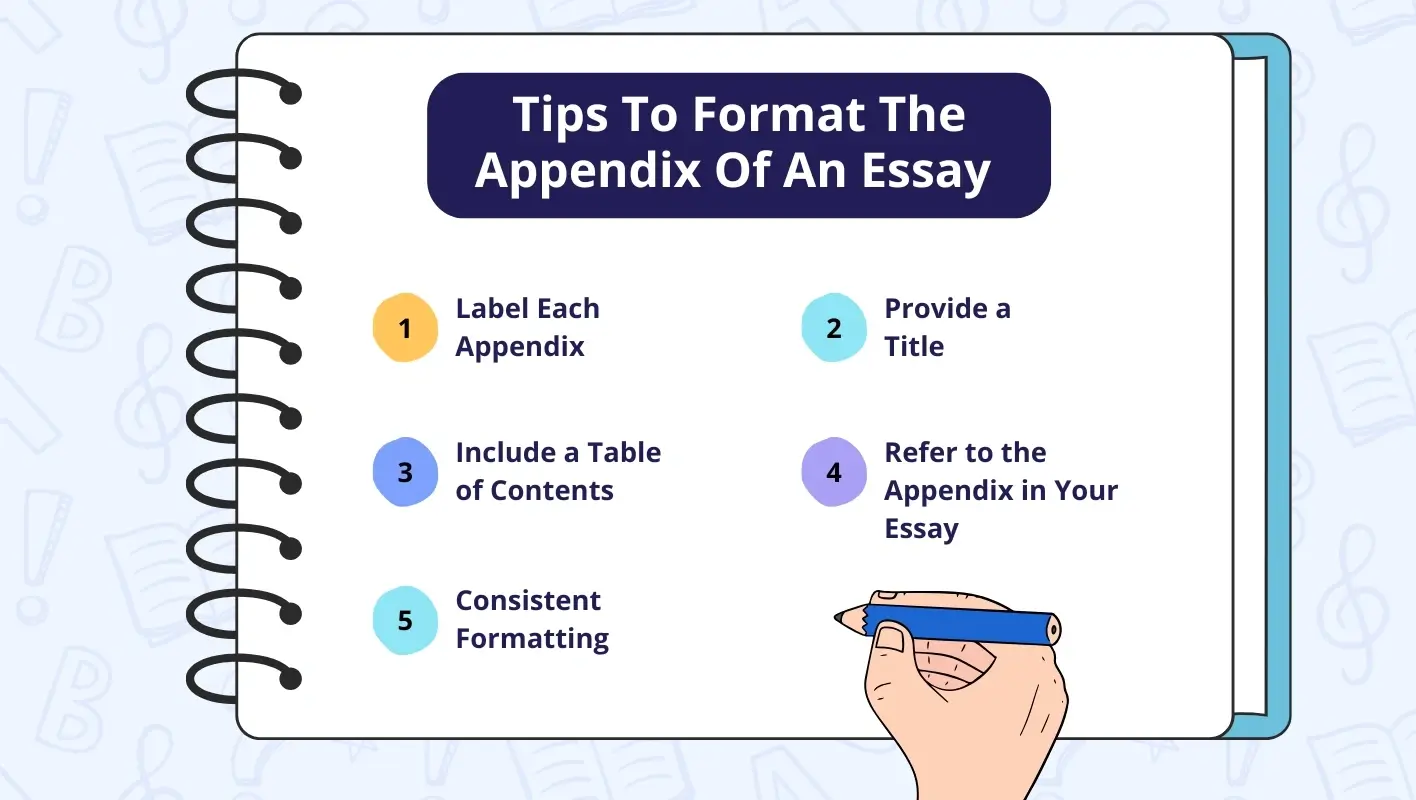
An appendix in an essay is a supplementary section placed at the end of a paper to provide detailed supporting material that is too long or intricate for the main body. It contains supplementary evidence—such as raw data, survey questionnaires, full interview transcripts, complex tables, or technical diagrams—that validates your research without disrupting the flow of your core argument.
What Is an Appendix in an Academic Essay?
An appendix (plural: appendices or appendixes) serves as a storage location for supporting information that reinforces your research findings. When writing an academic essay, research paper, or dissertation, maintaining logical narrative flow and concise structure is vital. Inserting lengthy raw datasets, multi-page questionnaires, or high-resolution technical diagrams directly into your primary text disrupts the reader's focus and weakens the clarity of your core arguments.
The primary function of an appendix is to offer complete transparency and depth for interested readers, evaluators, or peer reviewers without cluttering the main body. Everything included in an appendix must directly relate to your paper's research question, even though it remains non-essential to the immediate comprehension of your primary text. If a piece of information is critical to understanding your main thesis, it belongs within the main text of the essay. If it provides secondary proof, context, background details, or reproducible instruments, it belongs in an appendix.
Academic writing standards established by organizations such as the American Psychological Association (APA Style Guidelines) and the Modern Language Association (MLA Style Center) mandate specific structural and formatting rules for appendices. Regardless of the style guide used, every appendix must be explicitly cited within the body of your paper so readers know when and why to consult it.
When Should You Include an Appendix?
Deciding whether to place content in the main body or an appendix depends on how central the information is to your narrative argument and how much space it requires. You should consider creating an appendix whenever including detailed material in the body text would interrupt your narrative flow or exceed word count constraints.
- Does the material directly sustain your main thesis?
- YES: Is it concise and essential for logical flow?
- YES: Place in Essay Body
- NO: Move to Appendix
- NO: Is it supporting data or a reproducible tool?
- YES: Place in Appendix
- NO: Omit Material
- YES: Is it concise and essential for logical flow?
Common Types of Supplementary Materials
- Raw Data and Statistical Outputs: Extensive numerical tables, statistical software output logs (e.g., SPSS or R code outputs), raw survey tallies, or detailed financial ledgers that substantiate summary statistics provided in the essay body.
- Research Instruments: Copies of questionnaires, survey forms, evaluation rubrics, standardized test items, or structured interview protocols used during primary data collection.
- Transcripts and Field Notes: Complete or semi-redacted transcripts of qualitative interviews, focus group recordings, or detailed observation logs from field research.
- Visual Aids and Complex Graphics: High-resolution maps, detailed architectural blueprints, organizational charts, complex schematic diagrams, or extensive photographic evidence.
- Correspondence and Legal Documents: Copies of official letters, permission slips, participant consent forms, ethics board approval notices, historical letters, or primary legal statutes.
- Computer Code and Algorithms: Full source code listings, custom scripts, mathematical proofs, or detailed algorithmic workflows central to computational research.
Style-Specific Formatting Guidelines
Formatting requirements for an appendix vary depending on the citation style prescribed by your institution or publication target. The three primary style systems—APA, MLA, and the Chicago Manual of Style—each possess distinct conventions regarding placement, labeling, page numbering, and typography.
APA 7th Edition Appendix Rules
The American Psychological Association (7th edition) maintains strict formatting standards for academic paper appendices:
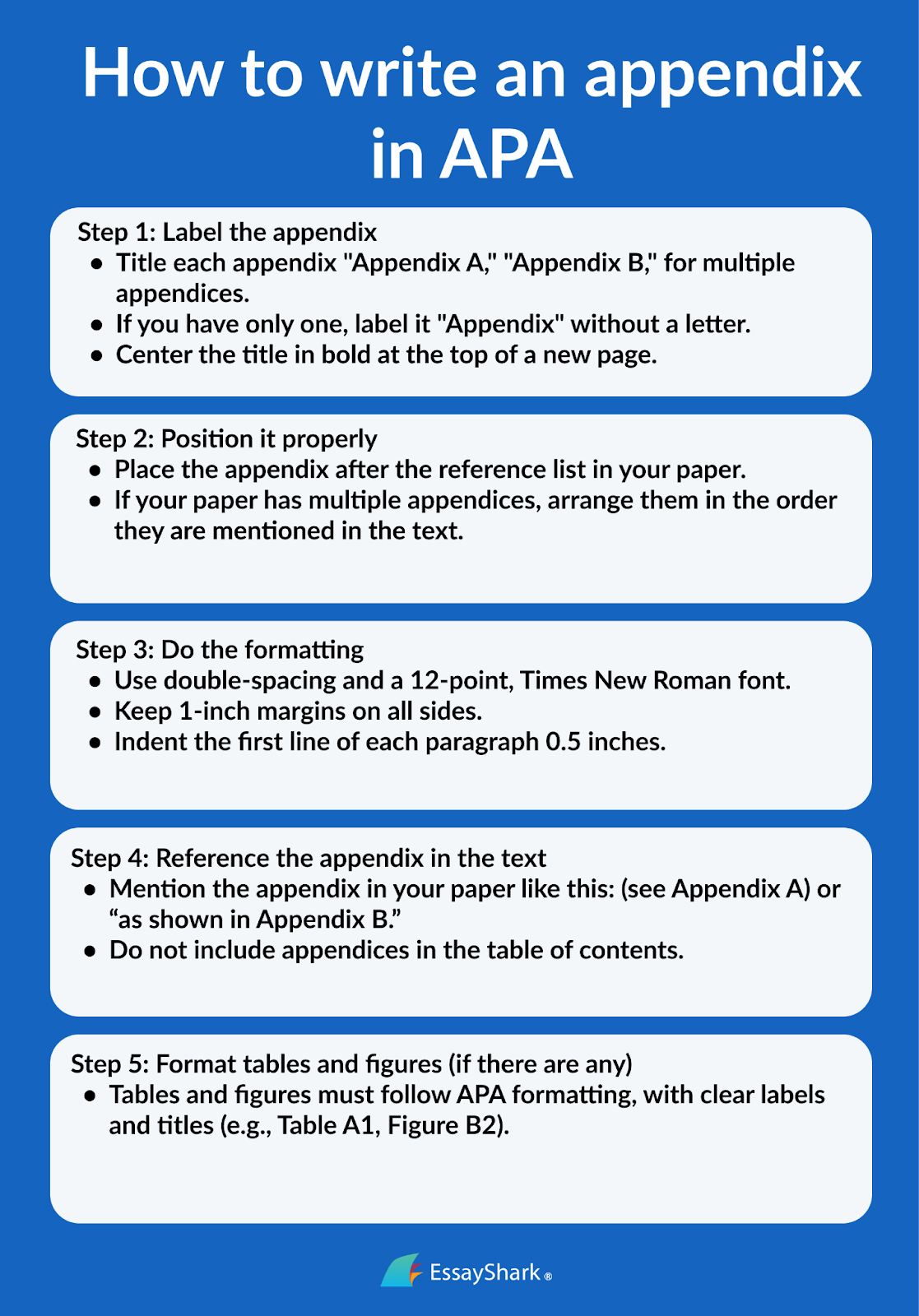
- Placement: Appendices appear after the References list, footnotes, and any main-body tables/figures, starting on a brand-new page.
- Labeling: If your essay has only one appendix, label it Appendix (bold and centered). If it contains multiple appendices, label them Appendix A, Appendix B, Appendix C, and so on, in the order they are first mentioned in your text.
- Title: Each appendix must have a descriptive title placed one double-spaced line below the appendix label. Center the title, use title case capitalization, and format it in bold font.
- Page Numbers: Continue the header page numbering sequence uninterrupted from the main text into the appendices.
- Tables and Figures: Tables and figures inside an appendix are labeled according to the letter of that specific appendix. For example, the first table in Appendix A is Table A1, the second is Table A2, and the first figure in Appendix B is Figure B1.
Page 14 (Header)
Appendix A
Participant Demographic Survey
Instructions: Please complete all sections below...
[Survey Content / Questionnaire Form]
MLA 9th Edition Appendix Rules
The Modern Language Association (9th edition) formats appendices with a focus on humanities disciplines:
- Placement: Place the appendix section immediately after the main body of the essay and before the Works Cited page.
- Labeling: Centered or left-aligned depending on institutional guidelines, labeled as Appendix (for a single entry) or Appendix 1, Appendix 2 (or Appendix A, Appendix B).
- Title: Place a descriptive title directly beside or below the heading label. MLA style typically uses standard formatting without bolding the title, using title case capitalization.
- Page Numbers: Main body page numbering continues consecutively through the appendices into the Works Cited page.
- Integration: Appendices in MLA papers are typically double-spaced, maintaining standard 1-inch margins throughout.
Student 12
Appendix 1: Full Transcript of Interview with Dr. Jane Doe
Interviewer: Can you explain the archival process... Respondent: The collection was cataloged in 1994...
Chicago Manual of Style (17th & 18th Editions)
The Chicago Manual of Style (CMS) provides rules used frequently in history, business, and fine arts:
- Placement: In notes-and-bibliography or author-date formats, appendices are positioned after the main text but before the endnotes section and Bibliography.
- Labeling: Labeled as Appendix or numbered as Appendix A, Appendix B (or Appendix 1, Appendix 2).
- Title: Placed at the top of the page, centered, usually preceded by the heading.
- Page Numbers: Pagination continues sequentially from the main essay text.
- Format: Double-spacing applies to explanatory text, while tables, data lists, or single-spaced original documents can retain single-spacing if necessary for layout integrity.
How to Reference Appendices Within Your Main Text
An appendix must never exist as an unreferenced addition to your document. Every appendix included in your essay must be explicitly cited inside the body paragraphs. This informs the reader when relevant supplementary data is available for examination.
Cross-Referencing Rules
- Introduce context before referencing: Do not mention an appendix without first providing narrative context in the main paragraph.
- Use direct parenthetical citations or narrative integration: Refer to appendices using uppercase labels that match the appendix title.
- Sequential order: The order in which appendices are listed at the back of the paper must match the order in which they are first cited in the main text.
In-Text Citation Examples
- Parenthetical Citation (APA):
Participants completed a 15-item questionnaire regarding digital privacy preferences (see Appendix A for full survey items).
- Narrative Integration (APA):
As shown in the full interview transcript in Appendix B, thematic analysis revealed recurring concerns regarding data storage security.
- MLA Citation Example:
The architectural floor plans retrieved from the municipal archives reveal structural modifications made in 1928 (see App. 1).
- Chicago Citation Example:
The raw financial statements for the fiscal years 2020–2025 are detailed in Appendix 2.
Appendix Formatting Style Comparison
The following table summarizes key formatting variations across major citation standards:
| Feature | APA 7th Edition | MLA 9th Edition | Chicago Manual of Style |
|---|---|---|---|
| Placement | After References list | After main text, before Works Cited | After main text, before Notes/Bibliography |
| Header Label Format | Appendix A (Bold, Centered) | Appendix 1 or Appendix A (Centered/Left) | Appendix A or Appendix 1 (Centered) |
| Title Format | Descriptive Title (Bold, Centered, Title Case) | Descriptive Title (Standard font, Title Case) | Descriptive Title (Standard/Bold, Title Case) |
| Page Numbering | Continues consecutively from References | Continues consecutively into Works Cited | Continues consecutively from main body |
| Table/Figure Labels | Labeled Table A1, Figure A1 | Labeled Fig. 1 in Appendix, or Appendix Fig. 1 | Labeled Table A.1 or Figure A.1 |
| Line Spacing | Double-spaced throughout | Double-spaced throughout | Double-spaced (Single-spaced for complex tables) |
Concrete Examples of Essay Appendices
To clarify structure, below are visual formatting templates showing how appendices appear in academic papers across different citation styles.
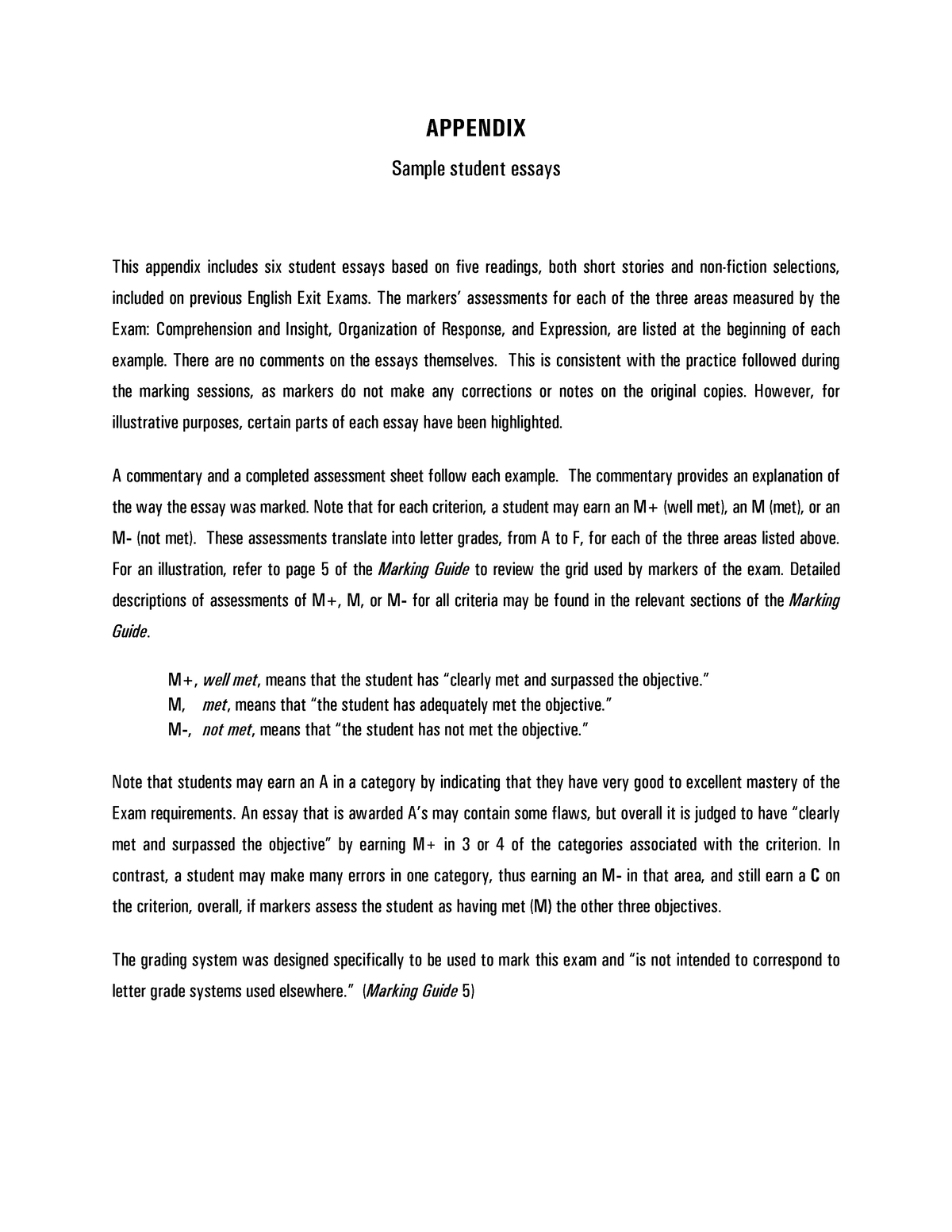
Example 1: APA 7th Edition Appendix Layout
Page 18
Appendix A
Participant Consent and Survey Instrument
Section 1: Demographic Information
What is your current age group? [ ] 18–24 [ ] 25–34 [ ] 35–44 [ ] 45+
How many hours per day do you utilize remote collaboration software? [ ] Less than 1 hour [ ] 1–3 hours [ ] 4–6 hours [ ] 7+ hours
Section 2: Likert Scale Ratings Please rate your level of agreement with the following statements from 1 (Strongly Disagree) to 5 (Strongly Agree).
Statement A: Digital communication tools increase overall daily productivity. 1 2 3 4 5
Statement B: Asynchronous communication reduces workplace stress. 1 2 3 4 5
Example 2: APA 7th Edition Appendix with Embedded Table
Page 19
Appendix B
Raw Regression Analysis Data Outputs
Table B1 Linear Regression Predicting Employee Retention Rates
| Variable | B | SE B | β | t | p |
|---|---|---|---|---|---|
| Work Flexibility | .42 | .08 | .38 | 5.25 | <.001 |
| Salary Benchmark | .28 | .11 | .21 | 2.54 | .012 |
| Team Autonomy | .15 | .07 | .14 | 2.14 | .034 |
Note. R² = .41 (N = 250). Significance evaluated at the p < .05 level.
Example 3: MLA 9th Edition Appendix Layout
Smith 14
Appendix 1: Textual Comparison of Archival Letters (1914–1918)
Letter A: Sent from Private Thomas Edward to Mary Edward, June 12, 1915. "The weather remains damp across the northern sector, yet spirits within the regiment remain steady despite supply delays..."
Letter B: Sent from Private Thomas Edward to Mary Edward, August 4, 1915. "Artillery bombardment resumed early Tuesday morning. Supplies arrived late yesterday evening following heavy rainfall..."
Common Errors to Avoid When Writing Essay Appendices
When constructing appendices, students and researchers frequently make structural and editorial mistakes. Avoiding these errors ensures your paper remains professional and compliant with style guidelines.
1. Including Essential Main-Body Arguments
An appendix is meant solely for supplementary material. If an evaluator cannot understand your thesis or core evidence without reading the appendix, that content belongs in your body text. Placing vital arguments in an appendix to bypass word count limits is a common error that penalizes scoring.
2. Failing to Reference the Appendix in Body Text
Every appendix must be introduced in the main body. An appendix that is not referenced anywhere in your essay text is considered orphaned data and should be removed.
3. Mislabeling Multiple Appendices
When using more than one appendix, maintain consistent labeling (e.g., Appendix A, Appendix B) throughout the text and headers. Never switch between numbers (Appendix 1) and letters (Appendix A) within the same paper.
4. Poor Formatting and Page Organization
Each separate appendix must start on a brand-new page. Combining multiple distinct appendices onto a single page creates visual confusion. Furthermore, scans of survey forms or low-resolution images must remain clear, legible, and oriented correctly (portrait vs. landscape).
Frequently Asked Questions
Does an appendix count toward the essay word count?
In most academic institutions, appendices do not count toward the main essay word count limits. However, policies vary between university departments and journal publishers. Always review your specific course syllabus or author submission guidelines to verify word count boundaries.
How do I order multiple appendices?
Order multiple appendices sequentially based on the order in which they are first cited in your essay's main body. The first appendix mentioned in your text becomes Appendix A (or Appendix 1), the second mentioned becomes Appendix B (or Appendix 2), and so on.
Where exactly does the appendix go in an essay?
Placement depends on the required citation style. Under APA 7th edition, appendices are placed after the References page. In MLA 9th edition, appendices appear after the main text and before the Works Cited page. Under the Chicago Manual of Style, appendices are placed after the main body text but before the Notes and Bibliography sections.
Can an appendix contain images, graphics, and charts?
Yes. Appendices frequently store supplementary figures, high-resolution photographs, maps, architectural drawings, and charts. Each figure placed inside an appendix must feature a clear number and descriptive title (e.g., Figure A1 in APA style) and be explicitly referenced within your body text.
How do you format single versus multiple appendices?
If your paper contains only one appendix, label it simply as Appendix without any accompanying letter or number. If your paper contains two or more appendices, label them using letters (Appendix A, Appendix B) or numbers (Appendix 1, Appendix 2), adhering strictly to the guidelines of your chosen style guide.
Practical Next Steps for Writing Your Appendix
To correctly organize and finalize the appendices for your academic paper:
- Audit Your Main Essay Text: Identify all secondary data, large tables, raw interview transcripts, or survey forms currently embedded in your body paragraphs that interrupt narrative flow.
- Extract and Group Supplementary Items: Separate your supplementary materials into logical, distinct units. Group related items together (e.g., keep all survey questions in one appendix and raw statistical outputs in another).
- Format According to Style Guide: Set up page breaks and apply the exact heading, labeling, and numbering conventions required by your assigned style (APA, MLA, or Chicago).
- Insert In-Text References: Reread your essay body to ensure every appendix (Appendix A, Appendix B, etc.) is explicitly cited in narrative or parenthetical form.
- Verify Page Numbers and Formatting: Ensure page numbers continue seamlessly from your main essay or references section and that all table titles, figure captions, and scanned documents are legible.