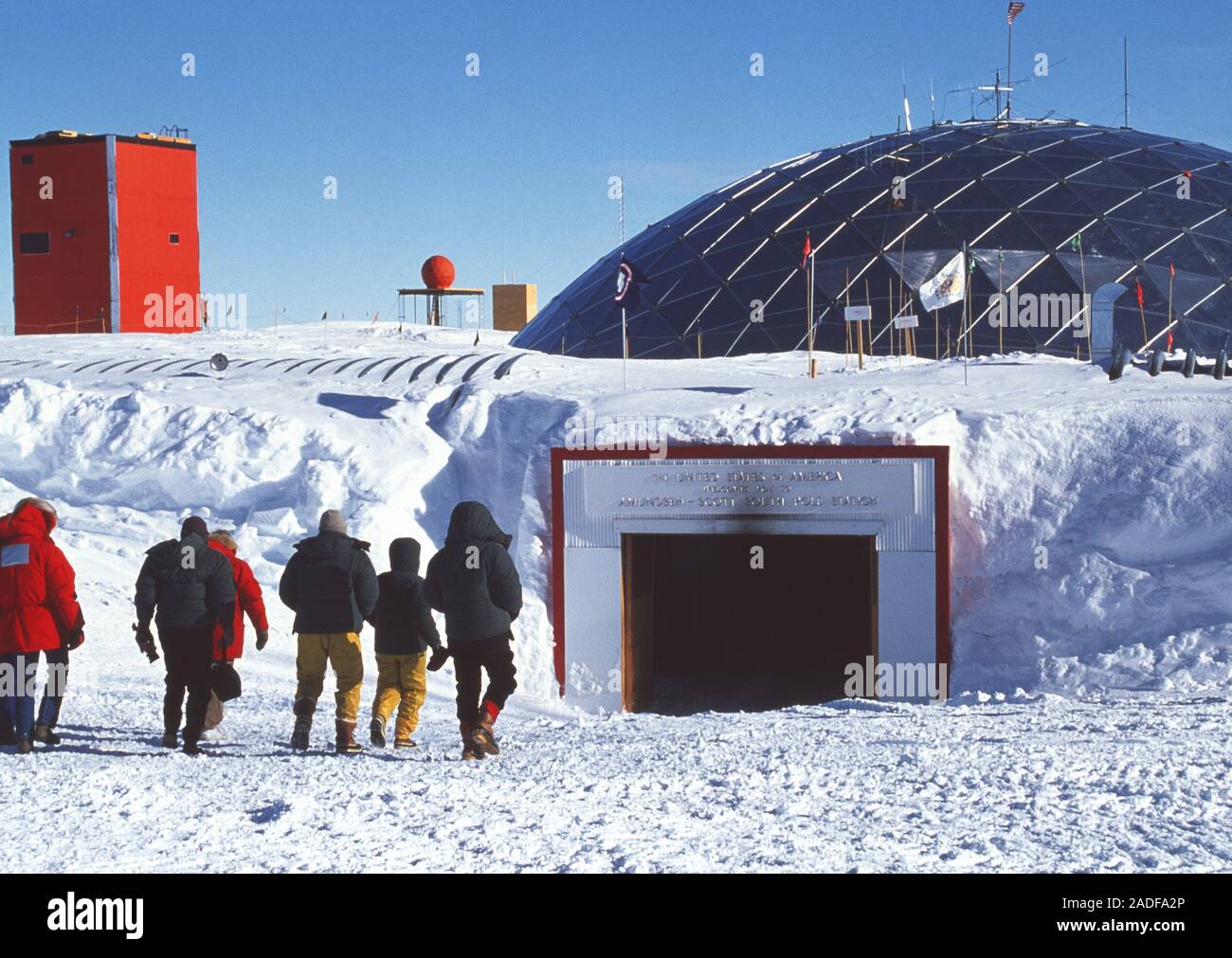
The Amundsen-Scott South Pole Station is a United States scientific research facility situated at the geographic South Pole in Antarctica, operated by the National Science Foundation. It serves as a premier year-round hub for astrophysics, glaciology, and climatology, functioning under extreme environmental conditions that require specialized logistics, advanced architectural engineering, and strict personnel protocols.
Introduction to the Amundsen-Scott South Pole Station
The Amundsen-Scott South Pole Station is one of the most remote and hostile inhabited locations on Earth. Established in 1956 by the United States Navy to support the International Geophysical Year, the station has evolved from a small cluster of canvas tents and snow-tunnel complexes into a modern, highly sophisticated scientific outpost. Named in honor of polar explorers Roald Amundsen and Robert Falcon Scott—who led competing expeditions to the geographic South Pole in 1911 and 1912, respectively—the facility represents a monumental achievement in human engineering and international scientific cooperation.
Administered by the Office of Polar Programs within the National Science Foundation (NSF), the station supports continuous, long-term observations of the Earth's atmosphere, interior, and the distant universe. Because of its unique geographic position, sitting atop an ice sheet nearly 2,835 meters (9,301 feet) above sea level, the station experiences six months of continuous sunlight followed by six months of continuous darkness. This environment presents unique operational challenges that dictate every aspect of life, work, and scientific inquiry at the facility.
Geographic, Climatological, and Environmental Parameters
Understanding the Amundsen-Scott South Pole Station requires examining the extreme physical parameters of the Antarctic plateau. The station sits on a slowly moving sheet of ice that drifts approximately 10 meters each year toward the Weddell Sea. Consequently, the geographic South Pole marker—a physical stake in the ice surrounded by flags of the Antarctic Treaty signatories—must be relocated annually on New Year's Day to maintain precise alignment with the true axis of Earth's rotation.
The climate at the South Pole is classified as an ice-cap climate, characterized by negligible precipitation, extreme cold, and high winds. However, because the air is exceptionally dry and clear, the station serves as an ideal location for astronomical observation, particularly in the microwave and infrared spectra.
Key Environmental Metrics
- Elevation: Approximately 2,835 meters (9,301 feet) above mean sea level. Due to atmospheric compression at the poles, the barometric pressure is often equivalent to an altitude of 3,300 meters or higher, causing significant physiological challenges related to hypoxia.
- Temperature Range: Average summer temperatures hover around -28°C (-18°F), while winter temperatures frequently drop below -60°C (-76°F). The lowest recorded temperature at the station is -82.8°C (-117°0F).
- Wind and Weather: While catastrophic storms with high winds are less frequent than on the Antarctic coast, blowing snow and low-pressure systems can drastically reduce visibility, creating whiteout conditions.
- Solar Cycle: The year is divided into roughly equal halves: six months of continuous daylight (September to March) and six months of continuous darkness (March to September), punctuated by single annual sunrise and sunset events.
Architectural Evolution and Station Design
The current physical infrastructure of the Amundsen-Scott South Pole Station represents the third major iteration of facilities built at the site. The original 1957 station, constructed primarily of wood and steel arches, eventually succumbed to the immense weight and shifting of accumulating snow, becoming deeply buried. A second station, known as the Dome, was completed in 1975. This iconic geodesic structure protected buildings inside from wind and drifting snow, but it too faced structural limitations and ultimately exceeded its operational lifespan.
Design and construction of the current facility, known officially as the Elevated Station, began in the late 1990s and was dedicated in 2008. Engineered by the firm Perkins+Will and constructed under the management of the National Science Foundation and various contractors, the modern station incorporates innovative design principles to withstand the polar environment.
Engineering Features of the Elevated Station
- Aerodynamic Wing Shape: The primary building is elevated on adjustable stilt-like columns and features a curved, aerodynamic profile underneath. This design encourages Antarctic winds to sweep underneath the structure, scouring away drifting snow rather than allowing it to pile up and bury the facility.
- Modular Pod System: The station consists of interlocking pavilions or pods that house living quarters, galley spaces, medical facilities, and administrative offices. This modular approach allows for structural expansion and maintenance access.
- Wastewater and Utility Management: Water is generated by melting compressed snow in a deep trench utility arch, known as the "A-Arch," where fuel storage, electrical generation, and water purification systems are housed. Wastewater is treated and reinjected into deep firn layers via specialized boreholes, adhering to strict environmental protocols mandated by the Antarctic Treaty System.
| Station Generation | Operational Years | Primary Structural Type | Main Vulnerability |
|---|---|---|---|
| First Station | 1957–1975 | Wood and steel Quonset huts inside snow trenches | Snow accumulation pressure and structural collapse |
| The Dome | 1975–2010 | Aluminum geodesic dome over modular buildings | Snow drift accumulation and interior corrosion |
| Elevated Station | 2008–Present | Elevated modular pods on hydraulic, adjustable columns | Extreme thermal contraction and mechanical wear |
Scientific Research and Observational Facilities
The primary justification for maintaining a permanent station at the geographic South Pole is its unparalleled suitability for cutting-edge scientific research. The combination of high altitude, extremely dry air, minimal atmospheric pollution, and the unique rotational perspective of the Earth creates an environment unobtainable anywhere else in the populated world.
Research conducted at Amundsen-Scott is broadly categorized into several core disciplines:
Astrophysics and Cosmology
The thin, dry atmosphere allows cosmic microwave background radiation—echoes from the Big Bang—to reach instruments with minimal atmospheric distortion.
- The South Pole Telescope (SPT): A 10-meter telescope designed to map the cosmic microwave background and detect distant galaxy clusters using the Sunyaev-Zel'dovich effect.
- IceCube Neutrino Observatory: A massive particle detector embedded deep within a cubic kilometer of clear glacial ice. It uses thousands of digital optical modules to detect high-energy neutrinos originating from cataclysmic astrophysical sources such as black holes and supernovae.
Climatology and Atmospheric Science
Because the South Pole is isolated from major industrial pollution sources and continental landmass disruptions, it serves as a baseline monitoring site for global atmospheric chemistry.
- Researchers track long-term trends in carbon dioxide, methane, and ozone depletion. The continuous atmospheric data collected here forms a cornerstone of modern climate change models and international environmental policy assessments.
Glaciology and Seismology
- Seismographs buried deep in the ice sheet monitor global seismic activity free from the background noise of ocean waves and human infrastructure.
- Glaciologists drill deep ice cores to reconstruct historical climate records spanning hundreds of thousands of years, analyzing trapped air bubbles to determine past atmospheric composition.
Logistics, Supply Chain, and Operational Constraints
Operating a high-altitude polar station requires a massive, highly coordinated logistical effort. Because the station is entirely inaccessible by land vehicles for most of the year, supply chains rely heavily on seasonal aviation managed by the United States military and contracted civilian operators.
Operation Deep Freeze and Air Logistics
The logistical backbone supporting the station is Operation Deep Freeze, a joint military service operation led by the United States Indo-Pacific Command, with primary airlift provided by the New York Air National Guard's 109th Airlift Wing.
- Aircraft Utilization: The 109th Airlift Wing operates Lockheed LC-130 Hercules aircraft equipped with ski-wheels, enabling them to land on prepared snow runways known as the Pegasus Blue Ice Runway and the South Pole station skiway.
- Seasonal Windows: The main resupply and personnel rotation window, known colloquially as "mainbody" or the summer season, runs from October through February. During this period, cargo flights deliver heavy machinery, fuel, scientific equipment, and fresh food.
The Overland Traverse
In addition to air transport, the NSF utilizes the South Pole Traverse—a specialized tractor train traveling over 1,600 kilometers across the polar ice sheet from McMurdo Station. This heavy-haul overland route transports bulk fuel and massive cargo items that are too heavy or voluminous for efficient airlift, significantly reducing reliance on air operations.
Personnel, Demographics, and Life at the Station
The population of the Amundsen-Scott South Pole Station fluctuates dramatically between seasons. During the austral summer (November to January), the population peaks at approximately 150 to 200 personnel, comprising scientists, support staff, tradespeople, and military support crew.
However, once the resupply flights cease in mid-February, the station enters the austral winter phase, isolating a small crew known as the "winter-overs."
The Winter-Over Experience
Typically consisting of 40 to 60 individuals, the winter-over crew is entirely cut off from the outside world from mid-February until late October. During this period of total darkness and extreme cold, no aircraft can safely land or take off due to the risk of hydraulic fluid freezing and fuel gelling.
- Medical Self-Sufficiency: The winter-over crew includes a small medical staff (usually a physician and a medic or physician assistant). Evacuations during the winter are virtually impossible except under catastrophic, life-threatening circumstances, and even then, historical winter medical evacuations have required high-risk, specially planned twilight flights.
- Community and Maintenance: Life during the winter requires maintaining a functioning micro-society. Personnel share community responsibilities, maintain the station's vital life support systems, and engage in recreational activities to sustain mental health during months of isolation and perpetual night.
Frequently Asked Questions
What is the primary purpose of the Amundsen-Scott South Pole Station?
The station serves as a United States scientific research facility dedicated to advanced studies in astrophysics, cosmology, glaciology, meteorology, and climatology. Its unique geographical and environmental conditions make it ideal for observing cosmic phenomena and tracking global atmospheric baseline data without interference from industrial pollution.
How do people get to the South Pole Station during the winter?
Personnel generally do not travel to or from the South Pole Station during the winter months. Due to extreme cold—often dropping below -60°C—and total darkness, aircraft operations are suspended. The station operates in complete isolation for approximately eight months of the year until the return of light and warmer temperatures in October.
Who owns and operates the Amundsen-Scott South Pole Station?
The station is owned by the United States government and managed through the National Science Foundation's Office of Polar Programs. Operational and logistical support is coordinated with the United States military, various academic institutions, and private contractors specializing in polar logistics.
Can tourists visit the Amundsen-Scott South Pole Station?
Independent tourism to the station is strictly limited. While specialized private expedition companies occasionally bring travelers to the geographic South Pole via overland or permitted aircraft routes, visitors are not permitted inside the operational station facilities or science areas without prior authorization from the National Science Foundation due to security, safety, and operational constraints.
How cold does it get at the Amundsen-Scott South Pole Station?
Summer temperatures typically average around -28°C (-18°F), while winter temperatures frequently fall below -60°C (-76°F). The lowest recorded temperature at the station is -82.8°C (-117°0F). Combined with high altitude and wind chill, these temperatures require specialized extreme-weather gear and strict safety protocols to prevent frostbite and hypothermia.
Conclusion and Operational Summary
The Amundsen-Scott South Pole Station stands as a testament to international scientific ambition and engineering resilience. By overcoming extreme environmental parameters—ranging from hypoxic elevations and perpetual darkness to paralyzing temperatures—the facility enables critical research that shapes our understanding of the universe and our own changing planet. Maintaining this outpost requires rigorous adherence to safety protocols, sophisticated architectural engineering, and precise logistical coordination, ensuring that scientific exploration at the bottom of the world continues uninterrupted.