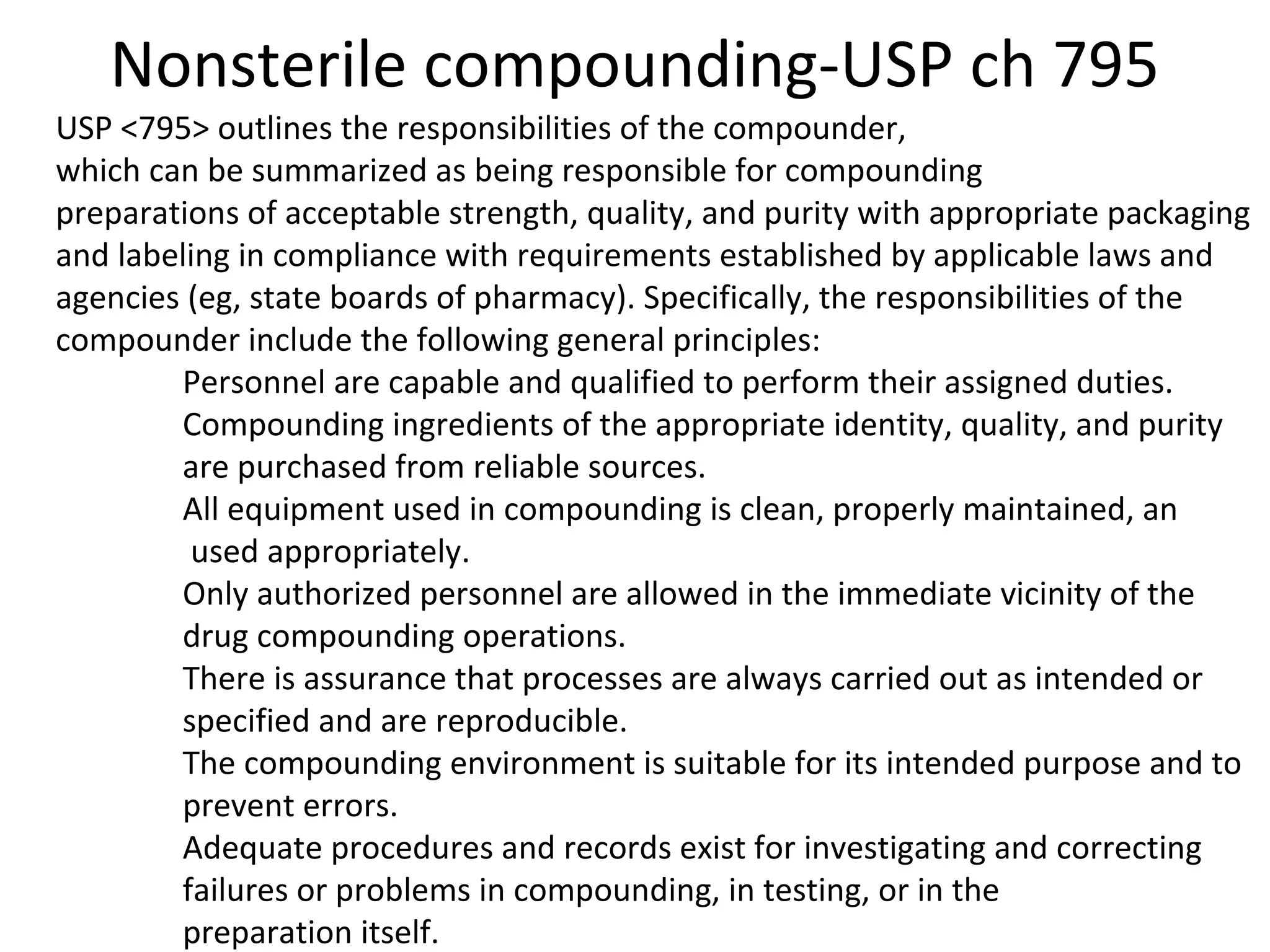
A USP 795 compliance checklist for nonsterile pharmaceutical compounding must focus on five core essentials: personnel training and competency, facility design and environmental monitoring, equipment calibration and maintenance, standard operating procedures with rigorous documentation, and quality assurance incorporating correct Beyond-Use Date (BUD) assignments. Together, these pillars ensure compounding safety, quality, and regulatory compliance.
Understanding USP <795>: Scope and Regulatory Context
United States Pharmacopeia General Chapter <795> (Pharmaceutical Compounding – Nonsterile Preparations) sets the standards for compounding nonsterile preparations (CNSPs) across health system pharmacies, independent community pharmacies, veterinary practices, and outpatient clinics. Updated standards that became officially enforceable establish strict mandates designed to minimize preparation errors, prevent microbial or chemical contamination, and ensure consistent potency and identity in nonsterile medications.
In pharmacy practice, maintaining full compliance with USP <795> is not merely a recommendation; it is an enforceable regulatory standard monitored by state boards of pharmacy, accreditation organizations like The Joint Commission, and the U.S. Food and Drug Administration (FDA). Non-compliance can result in regulatory warnings, operational suspensions, or adverse patient outcomes.
To help pharmacy leaders, quality officers, and compounding staff systematically evaluate their workflows, a robust compliance framework rests upon five essential operational pillars. This guide details each pillar, provides concrete operational parameters, and outlines how to structure a audit-ready checklist.
Essential 1: Personnel Training, Qualification, and Hygiene Protocols
Compounding quality begins with the individual preparing the formulation. Human error and poor technique remain the primary vectors for contamination and dosing variances in nonsterile compounding. USP <795> mandates that every facility designate one or more individuals responsible for oversight, while enforcing strict initial and ongoing training standards for all compounding staff.
- Designated Person(s) Oversight & Quality
- Qualification & Core Testing
- Hand Hygiene & Garbing
- Health Status Evaluations
The Designated Person Requirement
Facilities must officially assign one or more qualified individuals—often referred to as the Designated Person(s)—who possess the authority and responsibility to oversee all nonsterile compounding operations. The Designated Person is tasked with:
- Managing personnel training and core competency evaluations.
- Reviewing and approving all Master Formulation Records (MFRs) and Compounding Records (CRs).
- Monitoring facility cleanliness, environmental controls, and equipment calibration.
- Investigating quality deviations, handling complaint logs, and managing recalls.
Training and Competency Frequency
Personnel involved in compounding, evaluating, or packing nonsterile preparations must demonstrate competency prior to working independently and undergo routine re-evaluations at least once every 12 months. Training must cover:
- Standard Operating Procedures (SOPs) specific to the facility's nonsterile workflow.
- Proper hand hygiene and garbing procedures.
- Master Formulation Record comprehension and calculations.
- Correct use of compounding equipment (e.g., balances, ointment mills, electronic mortars and pestles).
- Quality control testing, packaging, and labeling standards.
Hand Hygiene and Garbing Standards
USP <795> outlines strict hygiene and garbing steps designed to reduce particulate shedding and cross-contamination:
- Hand Washing: Staff must wash hands and arms up to the elbows with soap and water for at least 30 seconds before beginning compounding tasks. Clean, lint-free towels or single-use towels must be used for drying.
- Garbing Requirements: At a minimum, staff must wear clean clothing and gloves. Additional personal protective equipment (PPE)—such as hair covers, shoe covers, masks, or aprons—must be worn depending on the hazard profile of the chemical components and local facility SOPs.
- Health Exclusions: Personnel with open wounds, active skin infections, or communicable respiratory illnesses must be excluded from direct compounding duties until fully recovered.
Essential 2: Facility Design, Environmental Controls, and Designated Compounding Spaces
The physical environment where compounding takes place directly impacts product safety. USP <795> requires a dedicated, well-controlled space isolated from traffic, draft sources, and routine retail or hospital operations.
Designated Compounding Area
The nonsterile compounding area must be strictly controlled and distinct from standard operational areas. Key physical requirements include:
- Spatial Separation: Space must be adequate to prevent mix-ups between ingredients, packaging, and finished compounds.
- Smooth and Washable Surfaces: Counters, walls, floors, and equipment surfaces must be smooth, impervious, non-porous, and free of cracks to allow thorough cleaning and disinfection.
- Draft Prevention: The designated area must not be placed directly under air supply vents, next to active doorways, or in high-traffic corridors where air currents can disrupt balance readings or scatter fine powders.
Environmental Monitoring: Temperature and Water Quality
Environmental controls ensure that raw ingredients and finished preparations maintain their chemical stability throughout their lifecycle.
- Temperature Control: Storage areas and designated compounding spaces must be monitored and recorded daily. Controlled room temperature must be maintained between 20°C and 25°C (68°F to 77°F). Cold storage (refrigeration) must remain between 2°C and 8°C (36°F to 46°F), and freezer storage must stay between -25°C and -10°C (-13°F to 14°F).
- Water Source Integrity: Water used in compounding nonsterile preparations where water is an ingredient must be Purified Water USP (or higher quality such as Water for Injection USP). Tap water is strictly prohibited as a compounding component and may only be used for initial equipment washing, followed immediately by a final rinse with Purified Water.
Integration with Hazardous Nonsterile Compounding
When handling hazardous drugs (HDs) in nonsterile compounding, facilities must integrate USP <795> with the containment standards specified in USP General Chapter <800>. Nonsterile hazardous compounding requires external venting or redundant HEPA filtration inside a Containment Ventilated Enclosure (CVE) or Containment Primary Engineering Control (C-PEC) maintained under negative pressure.
Essential 3: Equipment Calibration, Cleaning, and Material Handling
Equipment accuracy and ingredient purity are foundational to reliable compounding. Using uncalibrated balances or substandard raw ingredients introduces unacceptable risk to patient care.
Equipment Selection and Calibration
All equipment—including prescription balances, volumetric glass, pH meters, thermal devices, and mechanical mixers—must be suitable for its intended purpose and properly sized for the task.
- Balancing and Weighing: Electronic balances must be leveled, placed on stable, vibration-free surfaces, and calibrated periodically according to manufacturer instructions using certified weight sets. Daily operational checks must be documented in a calibration log.
- Maintenance Logs: Equipment requiring periodic servicing (such as ointment mills or homogenizers) must have written maintenance and inspection schedules, with all service events recorded.
- Raw Material Arrival
- Verify Certificate of Analysis (CoA)
- Inspect Packaging Integrity
- Assign Internal Lot & Expiry
- Store under Controlled Conditions
Raw Material Quality and Component Verification
The selection of active pharmaceutical ingredients (APIs) and excipients is governed by safety and purity metrics:
- Compendial Standards: Active ingredients should ideally be sourced from FDA-registered facilities and conform to official USP or National Formulary (NF) monographs.
- Certificates of Analysis (CoA): A valid CoA must be obtained and reviewed for every lot of API used in nonsterile compounding.
- Expiration and Receipt Dates: If a component arrives without a manufacturer-assigned expiration date, the Designated Person must assign a conservative date not to exceed 3 years from receipt, backed by supplier stability literature.
Essential 4: Standard Operating Procedures (SOPs), Master Formulation Records, and Documentation
Comprehensive documentation forms the backbone of regulatory verification. In nonsterile compounding, if a step is not documented, regulatory inspectors view it as not completed. USP <795> mandates two primary operational records: the Master Formulation Record (MFR) and the Compounding Record (CR).
Master Formulation Record (MFR)
The MFR serves as the master recipe for any compounded nonsterile preparation made for more than one patient, or for a single preparation compounded for the first time. An MFR must contain:
- Name, strength, and dosage form of the preparation.
- Exact quantities and physical descriptions of all ingredients.
- Detailed step-by-step compounding instructions, including mixing speeds, temperatures, and order of addition.
- Assigned Beyond-Use Date (BUD) and backing rationale.
- Packaging specifications and storage requirements.
- Quality control procedures (e.g., pH checking, visual clarity, weight verification).
Compounding Record (CR)
The CR is the individual execution log completed every time a preparation is compounded. It documents the real-time creation of a specific batch and must include:
- Name, strength, and dosage form referencing the corresponding MFR.
- Internal lot numbers, manufacturer lot numbers, and expiration dates of all components.
- Exact quantities weighed and measured.
- Total yield produced.
- Names/signatures of the person who compounded the preparation and the Designated Person who performed the final verification.
- Date and time of compounding.
- Assigned internal lot number, assigned BUD, and final quality control sign-off.
Retention and SOP Maintenance
Standard Operating Procedures must cover every phase of compounding operations, including garb sequence, surface sanitization, equipment cleaning, waste disposal, and recall management. All SOPs, MFRs, and CRs must be retained in accordance with state pharmacy board requirements—typically a minimum of 2 years, though many health systems mandate 5 to 7 years for liability protection.
Essential 5: Quality Assurance, Beyond-Use Date (BUD) Assignment, and Quality Control
The final essential pillar involves evaluating the finished preparation, assigning appropriate shelf-life limits, and implementing systematic quality assurance to capture trends and operational deviations.
Assigning Beyond-Use Dates (BUDs) Under USP <795>
Unlike commercial pharmaceutical expiration dates (which are established via long-term analytical testing by drug manufacturers), a BUD represents the date after which a compounded nonsterile preparation must not be used or stored.
Under USP <795>, default BUDs are calculated based on water activity ($a_w$), formulation type, presence of preservatives, and storage conditions, provided no published stability data indicates a shorter or longer shelf life.
| Formulation Category | Water Presence | Storage Temperature | Maximum Default BUD (Without Stability Data) | Operational & Technical Notes |
|---|---|---|---|---|
| Non-Aqueous Dosage Forms | No added water ($a_w < 0.60$) | Controlled Room Temp (20°C to 25°C) | 180 days | Applies to non-aqueous liquids, capsules, powders, and ointments without water. Cannot exceed expiration date of any individual component. |
| Oral Formulations Containing Water | Contains water ($a_w \ge 0.60$) | Refrigerated (2°C to 8°C) | 14 days | Applies to oral solutions, suspensions, and gels. Must use Purified Water USP. Storage must remain strictly cold. |
| Dermal/Topical Liquids & Semisolids | Contains water ($a_w \ge 0.60$) | Controlled Room Temp (20°C to 25°C) | 30 days | Applies to water-containing creams, lotions, and mucosal gels. Preservative efficacy must be verified if extending BUD beyond default. |
| Formulations with Tested Stability Data | Variable | Specified by study | Up to 180 days maximum | Can only extend beyond defaults if backed by a valid, stability-indicating analytical assay matching the exact formulation and container closure system. |
Quality Control Inspection Procedures
Before releasing any CNSP to a patient or clinic, the Designated Person must complete a physical inspection of the preparation:
- Visual Checks: Check for clarity, particulate matter, color uniformity, emulsion separation, or phase division.
- Weight and Volume Verification: Confirm that final weight or volume matches the target yield documented on the MFR and CR.
- Packaging Integrity: Ensure the container-closure system is light-resistant, child-resistant (where applicable), airtight, and non-reactive with the compounded drug.
Complaint Handling and Recall Management
A continuous quality assurance (QA) program requires logging patient or prescriber complaints, investigating physical or therapeutic anomalies, and keeping a formal recall workflow. If a quality defect poses a health risk, state pharmacy boards and federal agencies must be notified according to jurisdictional laws.
Step-by-Step USP <795> Compliance Checklist
Pharmacy operators can use this practical checklist during internal audits to confirm alignment with USP <795> standards.
Section 1: Personnel & Administration
- Has a Designated Person been formally appointed with documented authority over compounding operations?
- Are initial competency evaluations completed and logged for all compounding personnel?
- Are annual re-evaluations (every 12 months) scheduled and enforced?
- Is hand hygiene (30-second wash) and required garbing strictly practiced and monitored?
Section 2: Facilities & Controls
- Is nonsterile compounding conducted in a dedicated, isolated area free from drafts and heavy foot traffic?
- Are temperature logs for room, refrigerator, and freezer storage recorded daily?
- Is Purified Water USP used for all water-containing nonsterile preparations?
- Are surface cleaning and sanitization schedules maintained with compliant germicidal agents?
Section 3: Equipment & Ingredients
- Are balances leveled, checked daily with certified weights, and recalibrated annually?
- Are Certificates of Analysis (CoA) on file for every API and key excipients?
- Are raw materials inspected for package integrity and assigned receipt/expiration dates?
- Are non-reactive, non-additive mixing containers and instruments utilized?
Section 4: Documentation & Process Rules
- Is a validated Master Formulation Record (MFR) established for every recurring preparation?
- Is a complete Compounding Record (CR) generated, signed, and retained for every batch?
- Are all calculations, weights, and lot numbers double-checked and verified by the Designated Person?
- Are SOPs reviewed at least annually and accessible in the compounding area?
Section 5: Quality Assurance & BUD Assignment
- Are default BUDs calculated correctly based on formulation water activity ($a_w$) and storage temp?
- Are physical quality control checks (clarity, color, weight) documented prior to product release?
- Are finished CNSPs packaged in appropriate, light-resistant, airtight containers?
- Is a formal complaint log and recall plan active and operational?
Common USP <795> Audit Pitfalls and Prevention Strategies
Internal and external inspections frequently reveal recurring operational errors. Understanding these vulnerabilities allows compounding teams to proactively adjust workflows.
| Common Failure Points | Proactive Prevention |
|---|---|
| Improper BUD Calculation (Ignoring Water Activity) | Use water activity ($a_w$) matrix decision trees in SOPs |
| Missing Daily Temperature Logs or Excursion Actions | Install digital continuous monitoring with alerting |
| Incomplete Compounding Records (Signatures or Lots Omitted) | Require mandatory fields in software or CR hard copies |
- Incorrect BUD Assignment on Oral Liquids: A frequent infraction occurs when compounders assign a 30-day room-temperature BUD to aqueous oral suspensions. Under revised USP <795>, aqueous oral formulations default to a 14-day BUD under refrigeration, unless published stability-indicating assay data explicitly justifies an extension.
- Failure to Track Excursion Events: Simply logging a temperature deviation (e.g., a refrigerator reaching 12°C) is insufficient. Facilities must document the corrective action taken, such as quarantine of affected ingredients and stability evaluation before release.
- Inadequate Balance Verification: Checking an electronic analytical balance without certified class-standard check weights invalidates weighing records. Check weights must be calibrated and handled with forceps to prevent oil transfer from skin.
- Using Tap Water for Final Equipment Rinsing: Routine municipal tap water contains dissolved minerals and microbial contaminants. Rinsing equipment with tap water without a final rinse of Purified Water USP introduces chemical impurities into future compounding batches.
Frequently Asked Questions
What is the main difference between USP <795> and USP <797>?
USP <795> governs nonsterile pharmaceutical compounding (such as oral liquids, ointments, creams, capsules, and suppositories). In contrast, USP General Chapter <797> governs sterile compounding (such as intravenous injections, ophthalmic drops, and irrigations) which requires ISO-classified cleanrooms, aseptic technique, and sterility testing.
How often must personnel complete USP 795 re-evaluations?
Compounding personnel must undergo refresher training and practical competency re-evaluations at least once every 12 months. If a compounder fails a competency assessment or if significant changes occur in facility SOPs, retraining and re-evaluation must occur immediately before that individual resumes compounding.
Can tap water ever be used in nonsterile compounding?
Tap water can only be used for the initial washing and cleaning of utensils and equipment. It can never be used as a formulation ingredient, nor can it be used as the final rinse water for compounding tools. The final rinse and all formulation steps requiring water must use Purified Water USP or higher quality water.
What is water activity ($a_w$) and why does it matter for BUDs?
Water activity ($a_w$) measures the vapor pressure of water in a formulation compared to pure water. It indicates how much "free" water is available to support microbial growth or chemical hydrolysis. Formulations with $a_w < 0.60$ (such as non-aqueous ointments or powders) carry a lower microbial risk and qualify for longer default BUDs (up to 180 days) than formulations with high water activity (such as oral liquids).
How can a pharmacy extend a BUD beyond the default USP <795> limits?
To extend a BUD past standard limits (e.g., extending an aqueous oral liquid past 14 days), the pharmacy must rely on valid stability-indicating analytical assay testing published in peer-reviewed literature or performed by a qualified laboratory. The study must evaluate the exact formulation, concentration, storage temperature, and container-closure system used by the compounding facility. In all cases, BUDs cannot exceed the earliest expiration date of any component ingredient.
Next Actions for Pharmacy Operations
To ensure immediate and sustained alignment with USP <795> standards, pharmacy leadership should complete the following actions:
- Designate Leadership: Formally document the appointment of your facility's Designated Person(s) in writing within your master SOP file.
- Conduct a Gap Analysis: Run the step-by-step checklist above against current facility practices, equipment logs, and Master Formulation Records.
- Audit Water Systems and Supplies: Confirm that all compounding water supplies consist of Purified Water USP, and replace tap-water rinsing protocols with dedicated purification protocols.
- Standardize MFRs and CRs: Transition informal compounding logs into standardized, audit-proof templates capturing all required parameters, signatures, and batch yields.
- Schedule Annual Staff Assessments: Calendar mandatory 12-month competency re-evaluations and garbing assessments for every member of the compounding team.