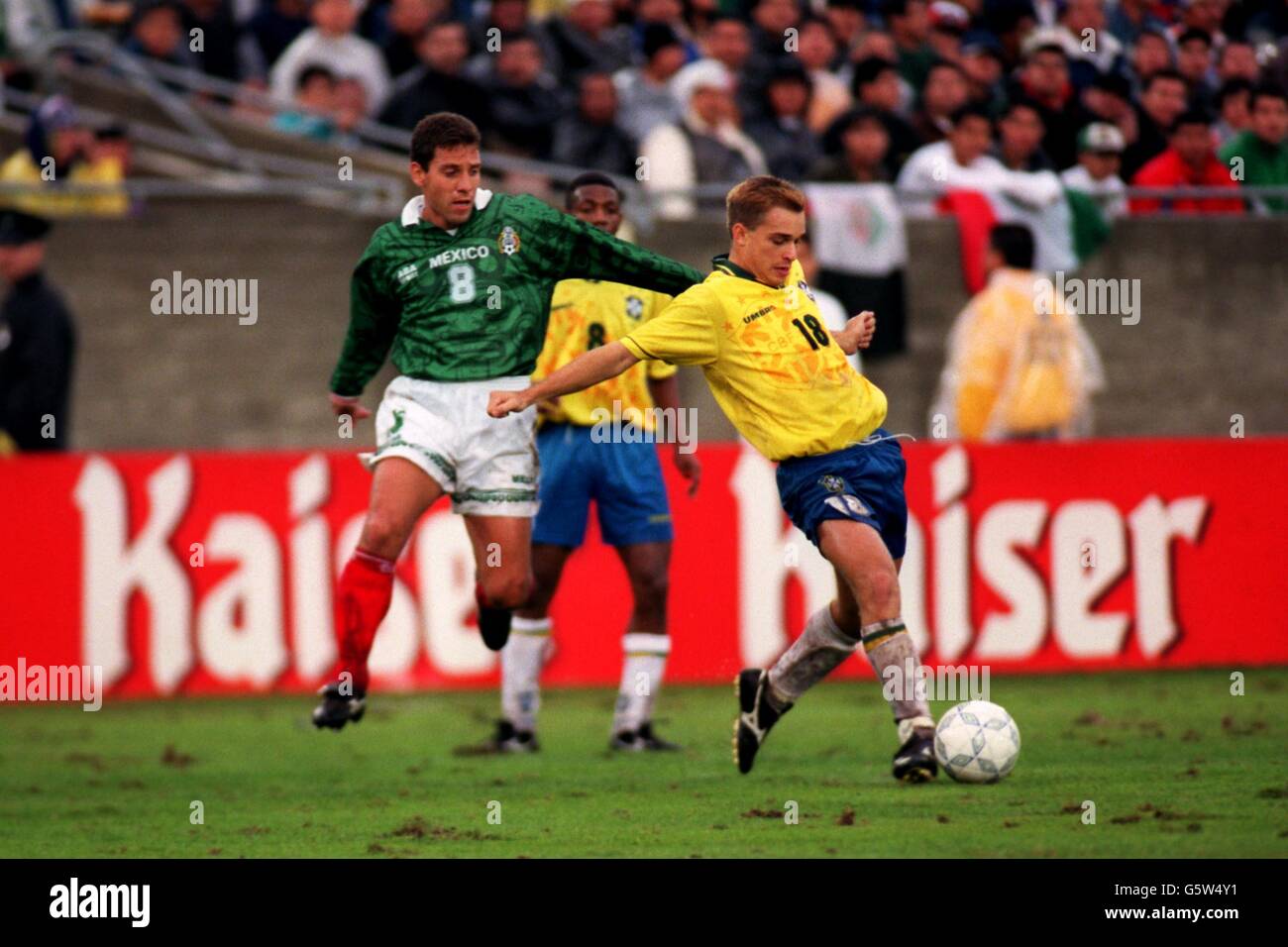
Alberto García Aspe remains one of the most influential figures in Mexican soccer history, serving as the quintessential "Number 8" who bridged the gap between amateur-leaning structures and the professionalized modern era. As of 2026, his legacy is defined by his leadership, three World Cup appearances, and his status as one of the greatest penalty takers the sport has ever seen.
The Formative Years: Pumas UNAM and the Birth of a Leader
The trajectory of Alberto García Aspe began in the mid-1980s within the prestigious youth academy of Pumas UNAM, an institution renowned for producing tactically disciplined and intellectually sharp footballers. Debuting in 1984, Aspe quickly distinguished himself not just through physical stamina, but through a precocious understanding of midfield geometry. During this era, Mexican soccer was undergoing a transition, moving away from a reliance on foreign veterans toward cultivating domestic talent that could compete on the global stage.
At Pumas, Aspe was part of a golden generation. His tenure culminated in the 1990-1991 season, where he helped lead the team to a league title against arch-rivals Club América. This period was critical because it established Aspe's "garra" (tenacity). He wasn't merely a creative playmaker; he was a combative presence who demanded excellence from his teammates. His ability to strike the ball with immense power from distance became his trademark, forcing opposing defenses to press him higher up the pitch, which in turn created space for strikers like Luis García Postigo.
The tactical significance of Aspe at Pumas cannot be overstated. He played as a "volante mixto" (box-to-box midfielder) before the term was widely popularized in Mexican media. His defensive contributions were as vital as his offensive output, setting a blueprint for the modern Mexican midfielder that emphasizes versatility over specialization.
The Necaxa Dynasty: Defining an Era of Dominance
While Pumas provided the foundation, Alberto García Aspe’s peak years are inextricably linked to Club Necaxa during the 1990s. This period saw Necaxa transform from a perennial underdog into the "Team of the Decade." Under the tactical guidance of Manuel Lapuente, Aspe became the emotional and technical heartbeat of a side that prioritized efficiency and psychological warfare.
Aspe’s partnership with Ecuadorian legend Álex Aguinaga is often cited by historians as one of the most balanced midfields in the history of the Liga MX. While Aguinaga provided the flair and rhythmic dribbling, Aspe provided the structural integrity and the "long-ball" threat. Together, they led Necaxa to back-to-back championships in the 1994-1995 and 1995-1996 seasons.
During these years, Aspe’s role evolved into that of a field general. He was the primary executor of Lapuente’s "system," which relied on absorbing pressure and launching lethal counter-attacks. Aspe’s precision in long-range passing allowed Necaxa to bypass the midfield congestion that characterized Mexican soccer at the time. Furthermore, his leadership during high-stakes liguilla (playoff) matches earned him a reputation for being "un frío" (cold-blooded) under pressure, a trait that would define his international career.
The International Gamble: Alberto García Aspe at River Plate
In 1995, Alberto García Aspe took a step that few Mexican players of his generation dared to take: moving to the Argentine Primera División to play for River Plate. At the time, the Argentine league was considered significantly more physical and competitive than the Mexican league. For Aspe, this was a move to prove that Mexican talent could thrive in the "Cradle of Football."
His stint at River Plate was relatively brief and is often debated by critics. While he did not become a long-term fixture in the starting lineup, the experience was transformative for his character. He played alongside future icons like Enzo Francescoli and Ariel Ortega. The tactical rigor and the intense pressure from the Argentine "barras bravas" (supporters) sharpened his mental fortitude.
When he returned to Mexico, he was a more cynical, experienced player. He had learned the "South American way" of managing the tempo of a game—knowing when to foul, when to slow down the play, and how to manipulate the referee's perception. This "dark arts" knowledge was something the Mexican National Team lacked, and Aspe brought it back to the "El Tri" locker room, significantly improving the team's competitiveness in tournaments like the Copa América.
National Team Pillar: World Cups and Continental Glory
Alberto García Aspe’s contribution to the Mexican National Team (Selección Mexicana) is the cornerstone of his historical standing. Representing Mexico in three FIFA World Cups (USA 1994, France 1998, and Korea-Japan 2002), he became the face of a generation that demanded respect on the international stage.
The 1993 Copa América Turning Point
Before 1993, Mexico was often viewed as a regional power that struggled against elite South American and European opposition. The 1993 Copa América changed everything. As an invited guest, Mexico reached the final, narrowly losing to Argentina. Aspe was the engine room of that team. His performance in the semi-final against Colombia demonstrated that he could out-duel world-class midfielders. This tournament proved that Mexico belonged among the world's top 15 teams, and Aspe was the captain who led that psychological breakthrough.
The 1994 and 1998 World Cup Campaigns
In the 1994 World Cup, Aspe scored a crucial penalty against Bulgaria in the Round of 16. Although Mexico was eliminated in a heartbreaking penalty shootout—where Aspe, ironically, missed his second attempt—his leadership throughout the group stage was flawless.
Four years later, in France 1998, Aspe remained a vital veteran. In the famous 2-2 comeback draw against Belgium, Aspe scored a penalty with such velocity and precision that it remains a highlight-reel staple in 2026. He provided the veteran presence that allowed younger stars like Cuauhtémoc Blanco and Luis Hernández to flourish. He was the bridge between the "old guard" and the "new idols."
The 1999 Confederations Cup
The pinnacle of Aspe's international trophy cabinet is the 1999 FIFA Confederations Cup. Playing at the Estadio Azteca, Mexico defeated a star-studded Brazilian side 4-3 in the final. While Aspe was reaching the twilight of his career, his presence in the locker room and his tactical discipline on the pitch were essential for coach Manuel Lapuente. This remains Mexico’s only official FIFA senior-level trophy, and Aspe’s role as the elder statesman was a key ingredient in that success.
Technical Anatomy: The Penalty Specialist and Tactician
To understand Alberto García Aspe’s place in history, one must analyze his technical specificities. He was not a traditional "10" who danced around defenders. Instead, he was a "power player."
- The Left Foot: Aspe possessed one of the most powerful left-footed strikes in CONCACAF history. His ability to score from 30 yards out meant that teams could never sit deep against his clubs.
- Penalty Technique: Aspe’s approach to penalties was unique. He did not use the modern "stutter-step" or wait for the goalkeeper to move. He relied on a short, aggressive run-up and sheer ball speed. Most of his penalties were aimed toward the upper corners, making them mathematically impossible to save if the strike was true.
- Positioning: In his later years at Puebla and América, he transitioned into a deeper "regista" role. He used his vision to dictate the game's rhythm, often dropping between the center-backs to start the buildup. This longevity—transitioning from a dynamic box-to-box player to a deep-lying playmaker—showcased his high soccer IQ.
Alberto García Aspe: Career Statistics and Honors
The following table summarizes the professional milestones of Alberto García Aspe across his club and international career.
| Category | Details / Statistics | Impact Level |
|---|---|---|
| Professional Debut | 1984 (Pumas UNAM) | High (Youth Academy Graduate) |
| Total International Caps | 109 | Elite (Centurion Status) |
| International Goals | 21 | High (Excellent for a Midfielder) |
| World Cup Appearances | 1994, 1998, 2002 | Historic (3-Tournament Veteran) |
| Major Club Titles | 3 Liga MX Titles (Pumas, Necaxa x2) | Consistent Champion |
| Key International Title | 1999 FIFA Confederations Cup | Pinnacle Achievement |
| Primary Position | Central Midfielder / Captain | Leadership Core |
| Notable Club Stint | River Plate (Argentina) | Pioneer for Mexicans Abroad |
Life after Retirement and Influence in 2026
Since retiring in 2002 after the World Cup in Korea-Japan, Alberto García Aspe has remained a prominent voice in the Mexican soccer landscape. By 2026, he has solidified his reputation as a respected analyst and commentator. Unlike many former players who shy away from critical discourse, Aspe is known for his blunt, no-nonsense evaluation of the current state of the Mexican National Team.
His influence is seen in the "Aspe Standard"—a benchmark used by scouts and coaches to evaluate the character of midfield prospects. When a young Mexican player shows both technical skill and aggressive leadership, they are often compared to "El Beto." He has also been involved in various administrative and advisory roles, advocating for better youth development and more opportunities for Mexican players in European and South American leagues.
In the context of the 2026 World Cup cycle, Aspe’s historical performances serve as a reminder of the "identity" Mexico often struggles to maintain. He represents a time when the team played with a distinct lack of fear against the world's giants, a quality that modern fans and pundits continuously urge the current generation to reclaim.
Comparison with Modern Midfielders
How does Aspe compare to the midfielders of the 2010s and 2020s? While players like Andrés Guardado and Héctor Herrera have surpassed him in total caps and European longevity, many argue that Aspe possessed a higher "clutch factor" in do-or-die moments.
- Leadership Style: Guardado leads through example and longevity; Aspe led through vocal command and intimidation.
- Tactical Role: Modern midfielders are often more specialized (either a pure "6" or a "10"). Aspe was a hybrid who could do both at an elite level, a rarity in today’s more rigid tactical systems.
- Goal Scoring: It is rare for a modern Mexican central midfielder to consistently hit the 10-goal mark in a season, a feat Aspe achieved multiple times due to his set-piece mastery.
Frequently Asked Questions
Why was Alberto García Aspe called the "Eternal Captain"?
While many players have worn the armband, Aspe earned this moniker because of his consistent leadership across three different coaching eras in the National Team. His teammates frequently noted that even when he wasn't officially the captain, he was the voice everyone followed in the locker room.
How many goals did Alberto García Aspe score in World Cups?
Aspe scored two World Cup goals, both from the penalty spot. The first was against Bulgaria in 1994, and the second was against Belgium in 1998. His ability to convert under the highest possible pressure solidified his status as a big-game player.
Did he have a successful career in Europe?
Alberto García Aspe never played for a European club. During his prime in the 1990s, the financial incentives and domestic prestige of the Liga MX were very high, and fewer Mexican players sought moves to Europe compared to the post-2010 era. His primary international experience was with River Plate in Argentina.
What was Aspe's last professional match?
His final match for the Mexican National Team was the Round of 16 loss against the United States in the 2002 World Cup. It was a bittersweet end, as he came on as a substitute but received a red card late in the game, marking the end of a legendary international career.
Which club defines Aspe's career the most: Pumas or Necaxa?
This is a point of debate. Pumas fans see him as a product of their "Cantera" (academy) and a champion. However, soccer historians generally associate his peak "prime" years and tactical dominance with the Necaxa dynasty of the 90s, where he won two league titles and became a global household name.
Recommendations for Further Study
To fully appreciate the impact of Alberto García Aspe, fans and students of the game should seek out full-match replays of the 1993 Copa América semi-finals and the 1998 World Cup group stage matches. Observing his off-the-ball positioning and how he organized the defensive line from a midfield position provides a masterclass in tactical leadership.
For those interested in the psychological aspect of soccer, studying Aspe’s penalty-taking routine offers insight into high-performance mental health and focus. His legacy is not just in the goals he scored, but in the standard of professionalism and "Mexican pride" he demanded every time he stepped onto the pitch. In 2026, he remains the gold standard for what it means to lead "El Tri."