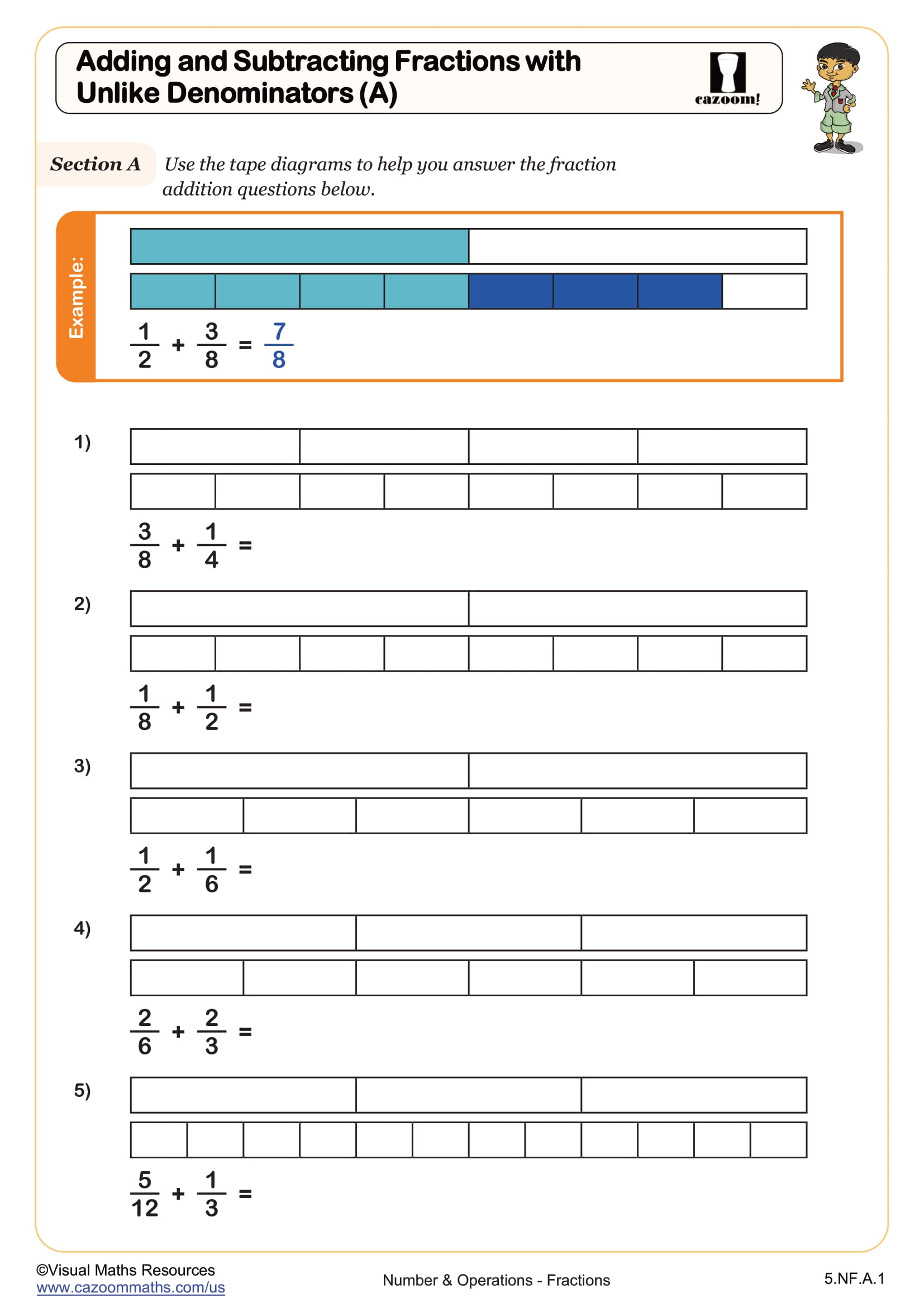
Adding and subtracting fractions with unlike denominators is a foundational mathematical skill that requires converting fractions into equivalent forms using a common denominator. By utilizing structured worksheets, students can practice finding the Least Common Multiple (LCM), performing precise conversions, and simplifying final results to ensure accuracy in multi-step arithmetic problems.
The Foundation: Understanding Denominators and Equivalency
Before diving into complex worksheets, it is essential to grasp why fractions with different denominators cannot be added or subtracted directly. A denominator represents the total number of equal parts into which a whole is divided. If you have one-third of a pizza and one-fourth of another, you are dealing with different "sized" slices. To perform addition or subtraction, these slices must be converted into a common unit of measure.
The goal of any worksheet focusing on this topic is to guide the learner through the process of finding a common denominator. This is the smallest number that is a multiple of both original denominators, often referred to as the Least Common Multiple (LCM). For example, to add 1/4 and 1/6, one must identify that 12 is the smallest number divisible by both 4 and 6. By converting both fractions into twelfths (3/12 and 2/12), the addition becomes straightforward: 3/12 + 2/12 = 5/12.
Essential Components of an Effective Worksheet
An effective worksheet designed for this skill is not merely a list of problems; it is a pedagogical tool that scaffolds learning. When selecting or designing a worksheet, look for the following structural elements that promote deep understanding rather than rote memorization:
- Step-by-Step Prompts: The best worksheets provide space for students to list multiples of each denominator, identify the LCM, and write out the new equivalent fractions before calculating the sum or difference.
- Visual Aids: Inclusion of fraction circles, bars, or number lines can help younger students visualize how the conversion to a common denominator maintains the actual value of the fraction.
- Progression of Difficulty: A well-designed worksheet begins with problems that have denominators that are multiples of one another (e.g., halves and quarters) before moving to prime numbers or larger, more complex denominators (e.g., sevenths and ninths).
- Simplification Requirements: The final stage of any fraction operation is ensuring the answer is in its simplest form. Worksheets should explicitly remind students to divide the numerator and denominator by their Greatest Common Factor (GCF).
Step-by-Step Methodology for Solving Problems
When approaching a worksheet on adding and subtracting fractions with unlike denominators, consistency in methodology is key to avoiding errors. Use the following sequence to approach any problem:
- Find the Common Denominator: List the multiples of each denominator or use prime factorization to determine the LCM.
- Convert to Equivalent Fractions: Multiply the numerator and denominator of each fraction by the factor needed to reach the common denominator. If the denominator of 1/3 is multiplied by 4 to become 12, the numerator must also be multiplied by 4 to result in 4/12.
- Perform the Operation: Add or subtract only the numerators. The denominator remains constant throughout this specific part of the calculation.
- Simplify the Result: Check if the numerator and denominator share any common factors. If they do, divide both by the GCF to reach the irreducible fraction.
- Convert to Mixed Numbers (If Applicable): If the result is an improper fraction (where the numerator is greater than or equal to the denominator), convert it into a mixed number to provide the most standard mathematical answer.
Common Pitfalls and Troubleshooting
Even advanced students often encounter friction when working through these problems. Recognizing these patterns can significantly improve accuracy:
- The "Add Across" Error: The most common mistake is adding or subtracting both the numerators and the denominators (e.g., 1/4 + 1/3 = 2/7). This is mathematically incorrect because it ignores the size of the fractional parts. Emphasize that the denominator represents the "label" or "size" of the slice and must remain common.
- Incorrect LCM Identification: Sometimes, students find a common multiple that is not the Least common multiple. While this still leads to the correct answer, it creates much larger numbers that are significantly harder to simplify later. Encourage students to spend the extra seconds finding the lowest possible number.
- Neglecting the Numerator: During the conversion process, students often remember to multiply the denominator to reach the new value but forget to multiply the numerator by that same factor. Using a "balancing" mindset—what you do to the bottom, you must do to the top—is the best way to correct this.
Comparative Methods for Finding Denominators
| Method | Best Use Case | Pros | Cons |
|---|---|---|---|
| Listing Multiples | Small denominators (2-12) | Easy to visualize and explain. | Can be tedious for larger numbers. |
| Prime Factorization | Larger or complex denominators | Highly accurate and systematic. | Requires knowledge of prime numbers. |
| Cross-Multiplication | Quick operations with two fractions | Extremely fast for simple addition. | Often results in larger fractions requiring heavy simplification. |
Designing Practice Schedules
To gain proficiency, consistency is more effective than volume. A student should aim to complete a worksheet that covers a specific sub-niche of the topic every two to three days. For instance, spend one session focusing exclusively on subtraction problems with unlike denominators, as the "borrowing" process in mixed number subtraction often causes more confusion than simple addition.
In 2026, many educational platforms offer digital, interactive versions of these worksheets. While these provide immediate feedback, paper-and-pencil practice remains superior for developing the fine motor skills and spatial organization required to track the multi-step nature of fraction arithmetic. Ensure that the practice environment is distraction-free, as the cognitive load required to hold several numbers in the "working memory" during these calculations is higher than in basic multiplication or division.
When to Seek Further Assistance
If a student consistently struggles despite following these steps, there may be a gap in prerequisite knowledge. Adding and subtracting fractions with unlike denominators requires a solid grasp of:
- Greatest Common Factor (GCF) and Least Common Multiple (LCM): If a student cannot identify these, the actual fraction operations will remain inaccessible.
- Equivalent Fractions: The ability to understand that 1/2 is the same as 2/4, 4/8, and 50/100 is foundational.
- Basic Multiplication Facts: Since finding the LCM and creating equivalent fractions requires frequent multiplication, weak fact fluency can turn a simple fraction problem into a tedious chore.
If these areas are the source of the struggle, shift the focus of the practice sessions back to these foundational topics before returning to the worksheets.
Frequently Asked Questions
Why do we have to change the denominator? You must change the denominator because you cannot combine parts of different sizes. Just as you cannot easily add apples to oranges without defining them as "pieces of fruit," you cannot add fourths to sixths without defining them both as "twelfths."
Is it better to use the Least Common Multiple or just any common multiple? Always use the Least Common Multiple. Using the smallest possible number keeps your numerators and denominators smaller, which makes the final step of simplifying your fraction much easier and less prone to calculation errors.
Should I simplify the fraction before or after adding/subtracting? Always simplify after you have completed the addition or subtraction. While you can simplify the individual fractions before starting the problem, it is generally safer to perform the operations first and simplify the final result to ensure you haven't changed the denominator to something that is no longer common.
What happens if I get a negative result? In subtraction, if the first fraction is smaller than the second, you will end up with a negative result. The steps remain exactly the same: find the common denominator, subtract the numerators, and keep the sign.
Are these worksheets appropriate for all grade levels? While the core concept is typically introduced in 4th or 5th grade, these worksheets are frequently used as review material for middle and high school students who need to brush up on their foundational arithmetic to succeed in algebra or geometry.
Final Recommendation
To master this skill, select a worksheet that features a "guided" section for the first five problems. This forces the learner to write out the common denominator and the equivalent fractions explicitly. Once the learner can consistently reach the correct answer without the prompt, transition to "independent" worksheets. Focus on quality of work—showing all steps—rather than the total number of problems completed.