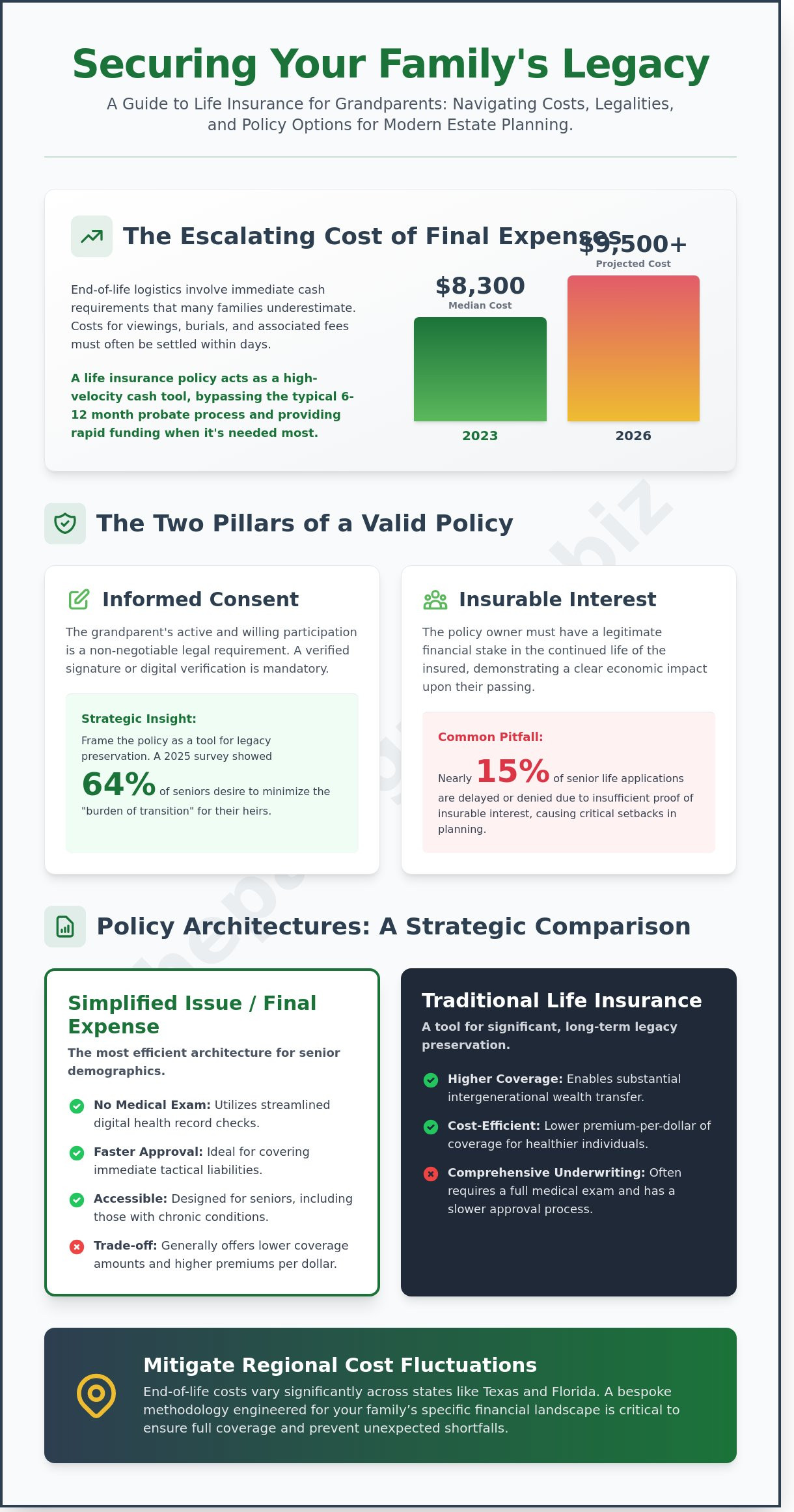
Choosing life insurance after turning 60 requires balancing affordability, health underwriting realities, and long-term financial goals. The three primary life insurance options available to seniors are term life insurance, whole life insurance, and guaranteed issue final expense insurance.
Term life insurance typically wins for individuals who need high coverage amounts for a specific, temporary timeframe at the lowest initial cost, while whole life insurance wins for those prioritizing lifelong protection and cash value accumulation. Guaranteed issue policies, by contrast, serve as a last resort for individuals with severe health issues who cannot qualify for medically underwritten plans.
Understanding the Landscape of Life Insurance After 60
Reaching age 60 brings distinct financial planning considerations. Children may be finishing college, mortgages might be nearing their final payoff dates, and retirement savings are entering their critical distribution phases. At the same time, life insurance underwriting standards shift significantly. Mortality risk increases with every passing year, causing insurance carriers to adjust their pricing models. Securing a policy at age 60 or older means navigating higher baseline premiums compared to policies purchased in one's twenties, thirties, or forties.
Before exploring specific products, consumers must evaluate why they need coverage. Is the goal to replace lost income for a dependent spouse? Is it to cover estate taxes, fund a legacy, or ensure that final medical bills and funeral costs do not burden surviving family members? Identifying the precise objective dictates which insurance category fits best. Furthermore, applicants must prepare for medical underwriting, which often involves a paramedical exam measuring blood pressure, cholesterol, height, weight, and blood or urine chemistry. Understanding these foundational elements prevents costly mistakes and guides buyers toward the right product category.
Option 1: Term Life Insurance
Term life insurance provides coverage for a specified period, such as 10, 15, 20, or 30 years. If the insured passes away during the active term, the beneficiaries receive the income-tax-free death benefit. If the term expires and the policy has not been renewed or converted, the coverage terminates without payout.
Mechanics and Underwriting
For applicants over 60, term policies offer a way to secure high coverage amounts—such as $250,000 to $1,000,000—without paying the exceptionally high premiums associated with permanent coverage. However, underwriting is rigorous. Carriers evaluate current health status, family medical history, driving records, and lifestyle habits like tobacco use. Applicants over 60 frequently undergo a full medical examination. Those with well-managed conditions, such as controlled hypertension or hyperlipidemia, can still qualify for favorable rate classes, though rates escalate rapidly with each advancing year of age.
Pros and Cons for Seniors
- Pros:
- Lower initial premium costs compared to permanent insurance for equivalent death benefit amounts.
- Ideal for covering finite financial obligations, such as a remaining 15-year mortgage or income replacement until Social Security and pension benefits maximize.
- Predictable, level premium payments for the duration of the chosen term.
- Cons:
- Coverage expires eventually, often right when mortality risk peaks in advanced age.
- Renewing an expired term policy or converting it after age 60 can become prohibitively expensive.
- No cash value accumulation or savings component.
Option 2: Whole Life Insurance
Whole life insurance is a form of permanent life insurance designed to remain active for the entire life of the insured, provided premiums are paid consistently. Unlike term insurance, whole life features a guaranteed death benefit coupled with a cash value savings component that grows on a tax-deferred basis.
Mechanics and Underwriting
Whole life policies lock in premium rates at the time of purchase, meaning the monthly or annual cost will never increase, regardless of how old the insured gets or how their health declines. A portion of each premium payment goes toward the insurance company’s operational costs and the death benefit, while the remainder is deposited into a cash value account. This account earns a guaranteed minimum interest rate and may receive non-guaranteed dividends if issued by a mutual insurance company. Underwriting for whole life is stringent, requiring medical exams and health history reviews unless applying for specialized simplified issue permanent products.
Pros and Cons for Seniors
- Pros:
- Lifetime protection that never expires, ensuring a payout whenever death occurs.
- Level, fixed premiums that provide financial predictability on a fixed retirement income.
- Cash value accumulation that policyholders can borrow against or surrender for cash if liquidity is needed in later years.
- Cons:
- Significantly higher initial premiums compared to term life insurance for the same death benefit amount.
- Potential financial strain if fixed premiums become unaffordable on a fixed retirement income.
- Slower growth of cash value in the early policy years due to upfront administrative fees.
Option 3: Guaranteed Issue Final Expense Insurance
Guaranteed issue final expense insurance—sometimes referred to as guaranteed acceptance life insurance—is a specialized form of whole life insurance designed specifically to cover end-of-life expenses such as funeral costs, burial plots, and minor medical bills.
Mechanics and Underwriting
The defining characteristic of guaranteed issue insurance is that no medical exam and no health questions are required. Acceptance is guaranteed for individuals within the eligible age range, typically ages 50 to 80 or 85, depending on the carrier. Because insurers take on unknown health risks, these policies feature two critical limitations:
- Lower coverage caps: Death benefits are usually modest, ranging from $2,000 to $25,000 or $40,000.
- Graded death benefit period: Most guaranteed issue policies include a graded clause stating that if the insured dies from natural causes within the first two years of the policy, beneficiaries receive a refund of all premiums paid plus interest (typically 10% interest), rather than the full face value. Death by accidental causes is usually covered immediately from day one.
Pros and Cons for Seniors
- Pros:
- Absolute certainty of approval, making it the premier choice for individuals with serious pre-existing health conditions (e.g., recent cancer history, severe heart disease, or diabetes complications) who have been denied coverage elsewhere.
- Fixed, level premiums that never increase over the life of the policy.
- Small, manageable face amounts tailored strictly to final expenses, keeping premiums relatively low.
- Cons:
- High cost per dollar of coverage compared to medically underwritten policies.
- Graded death benefit restricts full payout during the initial two-year window for non-accidental deaths.
- Low maximum coverage amounts make it unsuitable for income replacement or major estate planning needs.
Comprehensive Comparison of Life Insurance Options for Over 60
| Feature | Term Life Insurance | Whole Life Insurance | Guaranteed Issue Final Expense |
|---|---|---|---|
| Duration | Fixed period (10, 20, 30 years) | Lifetime coverage | Lifetime coverage |
| Medical Requirements | Medical exam and health questions | Medical exam and health questions | None (No medical questions or exams) |
| Cash Value | None | Yes, builds cash value | Minimal to moderate |
| Premium Stability | Level during the term period | Level for life | Level for life |
| Coverage Amounts | High ($100k to $1M+) | Moderate to High ($25k to $500k+) | Low ($2k to $25k) |
| Primary Use Case | Temporary debts, mortgage, income replacement | Estate planning, lifetime security, legacy building | Final burial costs, severe health exclusions |
Which Option Wins? Matching Policy to Financial Goals
Determining which option "wins" depends entirely on the financial objective, health status, and budget of the 60-something applicant. There is no universal winner, but clear victors emerge when analyzing specific scenarios.
When Term Life Insurance Wins
Term insurance wins for healthy 60-year-olds who have specific, time-bound financial obligations. For example, if a 60-year-old still has 10 years remaining on a jumbo mortgage or needs to bridge the financial gap until their spouse can claim maximum social security benefits at age 70, term life insurance provides the necessary financial shield at the lowest possible cost. Buying a 10-year or 15-year term policy allows individuals to secure hundreds of thousands of dollars in coverage without draining retirement savings.
When Whole Life Insurance Wins
Whole life insurance wins for seniors who want permanent protection to cover final expenses, pay ongoing estate taxes, or leave a guaranteed inheritance to children or grandchildren, and who can comfortably afford the higher premiums. It also appeals to conservative planners who value the forced savings aspect of cash value accumulation. As long as premiums are maintained, the policy is guaranteed to pay out, providing peace of mind regardless of how long the insured lives.
When Guaranteed Issue Wins
Guaranteed issue wins by default for individuals whose health prevents them from qualifying for term or traditional whole life insurance. If an applicant has chronic, severe medical conditions that would result in immediate rejection or prohibitively expensive rated premiums, guaranteed issue final expense insurance provides a viable path to secure coverage without underwriting hurdles. While the coverage amount is smaller and subject to a two-year graded period, it ensures that surviving family members are not stuck paying out-of-pocket for funeral and burial expenses.
Cost Considerations and Budgeting at Age 60
Insurance premiums at age 60 reflect statistical mortality tables showing that the likelihood of filing a claim increases during the coming decades. Consequently, budgeting requires careful analysis.
- Term Premiums: A healthy 60-year-old male might pay between $50 and $150 per month for a $250,000 10-year term policy, while females generally secure lower rates due to longer life expectancy. However, if that same individual waits until age 65 or 70 to buy, rates can double or triple.
- Whole Life Premiums: Permanent coverage demands a much higher initial outlay because the insurer must price the policy assuming it will eventually pay out. A $100,000 whole life policy for a 60-year-old can easily run several hundred dollars monthly.
- Final Expense Premiums: Because guaranteed issue policies feature lower face values (e.g., $10,000), monthly premiums are often manageable on a fixed retirement income, typically ranging from $40 to $100 depending on age and gender at application.
Consumers must assess their monthly cash flow in retirement. Purchasing a permanent policy that stretches monthly finances to the breaking point risks a policy lapse later in life, forfeiting all premiums paid. Selecting a sustainable premium tier is paramount.
Common Mistakes to Avoid When Buying Life Insurance Over 60
Navigating the life insurance market later in life exposes buyers to specific pitfalls that can compromise their financial security. Avoiding these common errors ensures a more efficient purchasing process.
- Waiting Too Long to Apply: Life insurance rates increase with every single birthday. Postponing a purchase from age 60 to age 63 can increase baseline premium rates by 15% to 30% even if health remains stable.
- Buying Too Much or Too Little Coverage: Overestimating needs leads to wasted premium dollars on unneeded term coverage, while underestimating final expenses leaves loved ones exposed. Conduct a thorough debt and asset audit before shopping.
- Ignoring the Two-Year Graded Clause: Buyers of guaranteed issue final expense policies frequently overlook the two-year waiting period for natural death benefits. Understanding this rule prevents unpleasant surprises for beneficiaries if an untimely passing occurs early in the policy lifecycle.
- Failing to Shop Multiple Carriers: Insurance companies evaluate health risks differently. One carrier might penalize high blood pressure heavily, while another views it favorably if controlled by medication. Comparing quotes from multiple top-tier carriers prevents overpaying.
Frequently Asked Questions
Can I get life insurance after 60 if I have pre-existing medical conditions?
Yes. While pre-existing conditions like diabetes, high blood pressure, or past cancer treatments can complicate underwriting for term and traditional whole life policies, specialized products exist. Insurers offer simplified issue policies with health questionnaires instead of exams, or guaranteed issue policies that require no medical underwriting whatsoever.
Is term life insurance renewable after age 60?
Many term policies include a renewable rider allowing the policyholder to extend coverage annually past the initial term without taking a new medical exam. However, premiums typically skyrocket each year upon renewal, making long-term retention financially impractical. Converting a term policy into a permanent whole life policy before the conversion privilege expires is often a safer strategy.
What happens to my whole life insurance cash value if I stop paying premiums?
If you stop paying premiums on a whole life policy and have accumulated cash value, you have several non-forfeiture options. You can use the cash value to purchase a reduced paid-up permanent policy, convert to extended term insurance for a limited time, or surrender the policy entirely for the remaining cash payout minus any outstanding loans or surrender charges.
Do I need a medical exam to qualify for life insurance over 60?
Not necessarily. While traditional term and whole life insurance policies generally require a paramedical exam, many modern carriers offer accelerated underwriting or simplified issue products for applicants up to certain face value limits. Furthermore, guaranteed issue final expense policies explicitly eliminate medical exams and health questions entirely.
How is the death benefit payout taxed for beneficiaries?
Life insurance death benefits paid to named individual beneficiaries are generally received completely income-tax-free under current federal tax laws. However, if the policy is owned by an estate or if the estate is named as the beneficiary, the proceeds may become subject to state and federal estate taxes during probate.
Conclusion and Next Steps
Securing life insurance over 60 requires a strategic assessment of your financial liabilities, health profile, and budget. Term life wins for temporary, high-value debts; whole life wins for lifelong protection and cash value accumulation; and guaranteed issue wins as a safety net for those with severe health limitations.
To determine the exact product and carrier that fits your situation, gather your financial documents, evaluate your current health standing, and request personalized quotes from multiple reputable insurance providers or consult an independent insurance broker licensed in your jurisdiction.