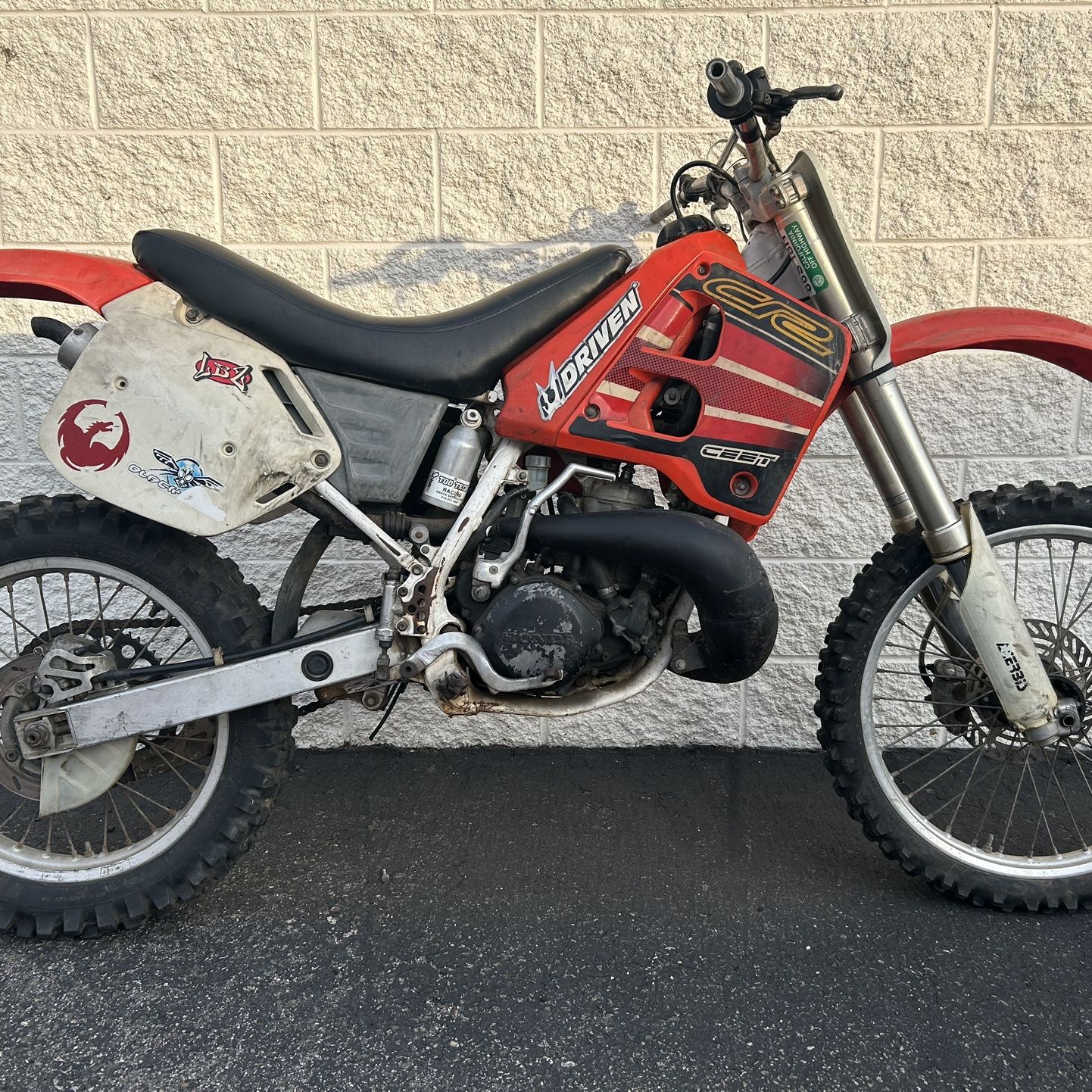
The 1990 Honda CR250R remains a benchmark in motocross history, featuring a 249cc liquid-cooled two-stroke engine, the innovative Honda Power Port (HPP) system, and refined Showa 45mm inverted forks. Renowned for its aggressive power delivery and "Great White" aesthetic, it is a primary target for vintage restoration and competitive Evo-class racing.
The Legacy of the 1990 Honda CR250R
By the time 1990 arrived, Honda had established a dominant position in the global motocross market. The CR250R was the flagship of their two-stroke line, a machine that benefited directly from the "works bike" era of the 1980s. While the 1989 model had introduced the controversial inverted forks to the mass market, the 1990 version was the refinement that enthusiasts had been waiting for.
In the context of 2026, the 1990 CR250R is no longer just a used dirt bike; it is a highly sought-after vintage racing machine. It sits in the "Sweet Spot" of motocross evolution—modern enough to feature disc brakes and liquid cooling, yet simple enough for a dedicated hobbyist to maintain in a home garage. This technical snapshot explores the mechanical nuances that defined this era of Honda engineering.
Engine and Powertrain Specifications
The heart of the 1990 CR250R is its 249.3cc single-cylinder two-stroke engine. This powerplant was designed during a period when "hit" was more important than "tractability." Honda engineers focused on maximizing the volumetric efficiency of the engine through a combination of precise porting and the sophisticated HPP system.
The Honda Power Port (HPP) System
Unlike Yamaha’s rotary valve (YPVS) or Suzuki’s guillotine valves, the Honda HPP system utilized two sliding valves that moved horizontally across the exhaust port. These valves changed the height and shape of the exhaust port based on engine RPM. At low speeds, the valves remained closed to increase back pressure and bottom-end torque. As RPMs climbed, a centrifugal governor on the right side of the engine opened the valves, allowing the engine to breathe freely and produce its legendary top-end rush.
For restorers in 2026, the HPP system is often the most critical area of focus. These valves are prone to carbon buildup, which can cause them to stick. If the valves do not open in sync, the engine loses its predictable power delivery. Maintenance requires meticulous cleaning of the sliding mechanisms and ensuring the linkage rods are correctly timed.
Carburetion and Induction
Fuel delivery was handled by a 38mm Keihin PJ "choke-knob" carburetor. This design was unique because the idle adjustment was integrated into the choke knob itself. While innovative, it often confused riders accustomed to a traditional idle screw. The induction system featured a six-petal reed valve, which, in 1990, provided a significant leap in throttle response compared to older piston-port designs.
Chassis, Geometry, and Ergonomics
The 1990 model utilized a semi-double-cradle frame made of high-tensile steel. While manufacturers were beginning to experiment with aluminum in other sectors, steel remained the choice for motocross due to its predictable flex characteristics and durability under extreme jump loads.
Frame Geometry
The 1990 frame featured a 27.5-degree rake and 4.5 inches of trail. These figures were aggressive for the time, contributing to Honda’s reputation for having the fastest-turning bikes on the track. However, this agility came at the cost of high-speed stability, a phenomenon often referred to as "headshake." Riders in the 1990s often added aftermarket steering stabilizers or dropped the forks in the triple clamps to mitigate this.
Bodywork and Aesthetics
Known as part of the "Great White" generation, the 1990 CR250 featured white plastics with "Fighting Red" (a vibrant orange-red) accents and a red frame. The seat was relatively flat, allowing the rider to slide forward for cornering weight or backward for traction. In 2026, finding original OEM plastics is nearly impossible, though high-quality reproductions from companies like UFO and Acerbis continue to support the vintage community.
Suspension: The Evolution of Inverted Forks
The 1990 CR250R was the second year Honda utilized inverted (upside-down or USD) forks. The primary advantage of the inverted design is rigidity. By placing the larger-diameter outer tubes in the triple clamps, engineers reduced fork flex during heavy braking and landing.
Showa 45mm USD Forks
The 45mm Showa units on the 1990 model were a significant improvement over the 1989 version, which many riders found overly harsh. The 1990 internals featured revised valving and spring rates intended to provide a more "plush" feel through the initial stroke. These forks offer 12.0 inches of travel and are fully adjustable for compression and rebound damping.
Pro-Link Rear Suspension
At the rear, Honda utilized its signature Pro-Link system. This setup used a rising-rate linkage connected to a single Showa shock. The system was designed to provide a soft feel over small bumps while rapidly increasing resistance as the shock compressed further, preventing bottoming on large jumps. The 1990 shock provided 12.6 inches of wheel travel and featured a remote reservoir to help dissipate heat and prevent damping fade during long motos.
Technical Specifications Table
The following data summarizes the factory specifications for the 1990 Honda CR250R. These figures are essential for verification during restoration or when sourcing parts.
| Feature | Specification |
|---|---|
| Engine Type | 249.3cc liquid-cooled single-cylinder two-stroke |
| Bore x Stroke | 66.4mm x 72.0mm |
| Compression Ratio | 8.5:1 |
| Induction | Crankcase reed valve / 38mm Keihin PJ Carburetor |
| Transmission | 5-speed, constant mesh, wet multi-plate clutch |
| Final Drive | #520 Chain; 13T Front / 49T Rear Sprockets |
| Front Suspension | 45mm Showa Inverted telescopic fork; 12.0-in travel |
| Rear Suspension | Pro-Link Showa single shock; 12.6-in travel |
| Front Brake | Single 240mm disc with twin-piston Nissin caliper |
| Rear Brake | Single 220mm disc with single-piston Nissin caliper |
| Dry Weight | 216 lbs (98 kg) |
| Fuel Capacity | 2.1 Gallons (8.0 Liters) |
| Wheelbase | 58.7 inches |
Critical Maintenance Issues for Modern Collectors
Owning a 1990 CR250 in 2026 requires an understanding of aging mechanical components. Even a low-hour "survivor" bike will likely face specific issues related to the materials used in that era.
Magnesium Water Pump Corrosion
Perhaps the most notorious issue with late-80s and early-90s Hondas is the magnesium water pump cover. Over time, the coolant reacts with the magnesium, leading to severe pitting and eventual perforation. This allows coolant to leak into the transmission oil, turning it milky.
- The Solution: Many owners now replace the magnesium covers with aluminum versions from later models or aftermarket reproductions. If using the original cover, it is vital to use high-quality, silicate-free coolant.
Crankshaft Seals
Two-stroke engines rely on an airtight crankcase to function. After 35+ years, the rubber crankshaft seals often become brittle. A failed right-side seal will allow the engine to suck in transmission oil, causing excessive smoke. A failed left-side seal creates a "lean" condition by sucking in air, which can lead to a catastrophic engine seizure. Replacing these seals is a mandatory step in any 1990 CR250 restoration.
Nikasil Cylinder Plating
Honda used a Nikasil (nickel silicon carbide) coating on the cylinder bore. This coating is extremely durable but cannot be "bored out" like a traditional cast-iron sleeve. If the cylinder is damaged, it must be stripped and replated by a specialist. When inspecting a bike, always look through the exhaust port for signs of peeling or deep scratches in the plating.
Comparison: 1990 vs. Adjacent Models
The 1990 model occupies a middle ground in the CR250 lineage. Understanding the differences between it and the 1989 or 1991 models can help buyers make an informed decision.
- 1989 vs. 1990: The 1989 was the "first" of the white-plastic, USD-fork era. However, the 1990 is generally preferred because the fork valving and HPP power valve settings were refined for better rideability.
- 1990 vs. 1991: The 1991 model introduced further changes to the bodywork and a move toward a more "slim" ergonomic feel. While the 1991 is objectively more "modern," many collectors prefer the 1990 for its specific aesthetic and the "aggressive" feel of the 1990 engine tune.
Operational Limitations and Safety
As a machine designed for professional closed-course competition, the 1990 CR250R has several limitations when viewed through a modern lens. It lacks a kickstand, lights, or an electric start. Furthermore, the power delivery is non-linear; it has very little power at low RPMs before "pipe-ing" into a violent surge of acceleration. This makes it unsuitable for beginners or casual trail riding without significant modifications to the flywheels and gearing.
Safety in 2026 also involves inspecting the structural integrity of the aging frame. Steel frames of this era can develop hairline cracks around the footpeg mounts and the lower cradle rails. A thorough inspection and possible localized welding are often necessary before subjecting the bike to modern motocross track jumps.
FAQs
What is the correct premix ratio for a 1990 CR250R?
The original factory recommendation was 32:1 using a high-quality two-stroke oil. In 2026, with modern synthetic oils, many riders safely run 40:1. However, running a slightly "richer" oil ratio (like 32:1) provides extra protection for the crank bearings during high-RPM use, which is critical for vintage engines.
Where can I find parts for a 1990 Honda CR250R in 2026?
Many engine internals, such as pistons, rings, and gaskets, are still available through aftermarket companies like Wiseco, ProX, and Cometic. Specialized chassis parts or OEM-specific bolts are harder to find and often require searching auction sites or vintage motocross forums. Companies like VMX Racing specialize in reproduction plastics and seat covers for this specific year.
Can the 1990 CR250R run on modern pump gas?
The 1990 CR250 was designed for high-octane leaded fuel. When using modern unleaded pump gas, it is highly recommended to use 91 octane or higher (Premium). If the engine exhibits "pinging" or detonation under load, you may need to mix in a percentage of race fuel or use a thicker head gasket to slightly lower the compression.
How much is a 1990 Honda CR250R worth today?
In 2026, values vary wildly based on condition. A basket case (incomplete bike) might sell for $1,500–$2,000. A clean, running "rider" typically fetches $3,500–$5,000. A professionally restored, museum-quality example can exceed $8,000, particularly if it features period-correct performance parts from companies like Pro Circuit or FMF.
Are the 1990 forks interchangeable with other years?
The 1990 forks share the same 45mm diameter as the 1989 and 1991 models. While they can be swapped as a complete unit (including the triple clamps), internal components like shims and springs differ between years. If you are performing a swap, it is best to keep the triple clamps and front wheel assembly consistent with the fork year to ensure proper alignment.
Recommended Next Actions
If you are looking to acquire or restore a 1990 Honda CR250R, your first priority should be a comprehensive mechanical audit. Before attempting to start a bike that has sat for years, remove the expansion chamber (exhaust pipe) and look into the cylinder for signs of rust or seizing. Pressure-test the cooling system to ensure the water pump housing is intact.
For those planning to race, consider upgrading the front brake line to a modern braided steel version; the original rubber lines from 1990 often expand under pressure, leading to a "mushy" feel. Finally, join a dedicated vintage Honda motocross community to stay updated on the availability of NOS (New Old Stock) parts, which are the gold standard for high-end restorations.