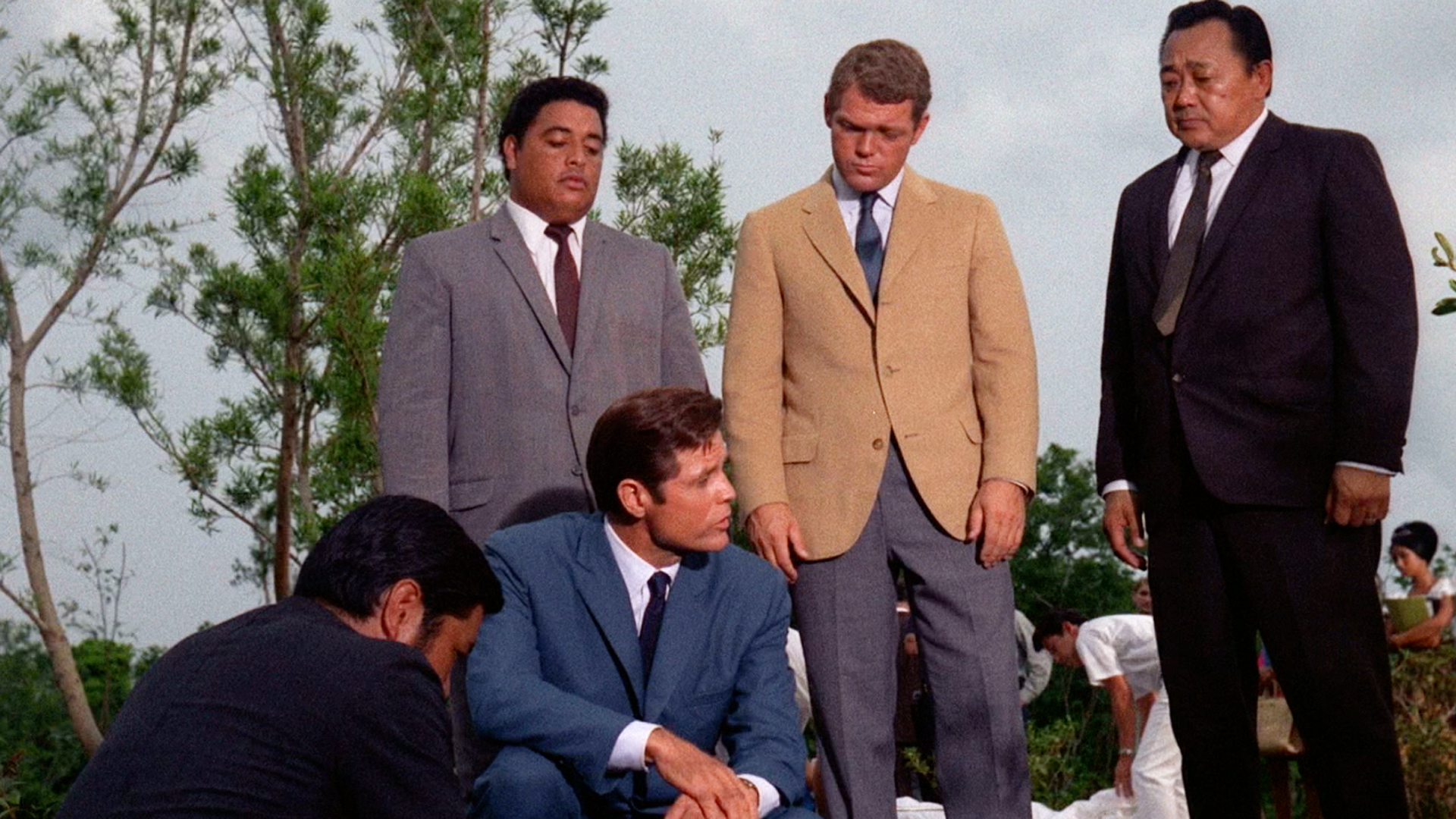
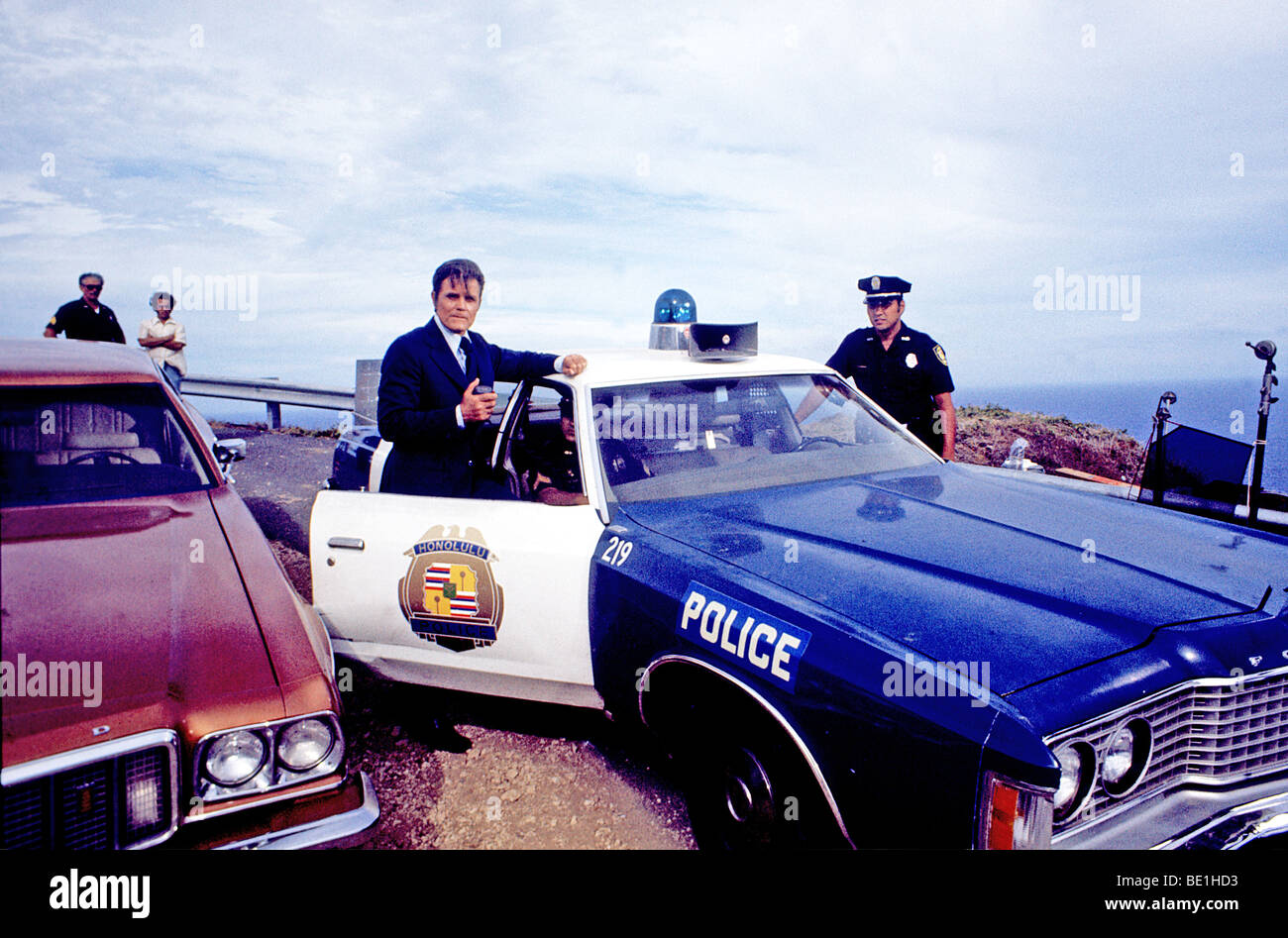
Jack Lord anchors twelve seasons of Hawaii Five-O as Steve McGarrett, leading an elite state police unit across 279 episodes of classic television. This landmark procedural defined police dramas through its picturesque Hawaiian location shooting, iconic theme music, and McGarrett’s unyielding pursuit of criminal syndicates, culminating in a historic television run that stretched from 1968 to 1980.
The Genesis of Hawaii Five-O and the Casting of Jack Lord
The creation of Hawaii Five-O in 1968 marked a significant departure from standard television production paradigms of the era. Most television series produced in the United States during the late 1960s relied heavily on backlot sets, soundstages in Los Angeles or New York, and artificial lighting to simulate exotic locales. Creator Leonard Freeman envisioned a series shot entirely on location in the newly minted 50th U.S. state, leveraging the unique cultural landscape, geography, and distinct architecture of Oahu.
At the center of this vision stood John Joseph Patrick Ryan, known professionally as Jack Lord. Lord was a classically trained actor with a commanding physical presence, intense gaze, and a reputation for meticulous preparation. Before securing the role of Steve McGarrett, Lord had starred in the television series Stoney Burke and appeared in numerous film and stage productions, including playing the CIA contact Felix Leiter in the first James Bond film, Dr. No (1962). Lord’s involvement in Hawaii Five-O went far beyond acting. As the series progressed, he exerted significant creative control over scripts, character development, and directorial choices, ensuring that Steve McGarrett remained an uncompromising, incorruptible force for law and order.
McGarrett was not merely a standard television detective; he was a brooding, highly dedicated state law enforcement officer answerable only to the Governor of Hawaii. Operating out of a sleek, modern headquarters decorated with native art and high-end audio equipment, McGarrett led a specialized four-man unit designed to handle organized crime, international espionage, political corruption, and high-stakes homicide cases that fell outside the jurisdiction of local municipal police departments.
Structural Evolution Across 12 Seasons
The longevity of Hawaii Five-O, spanning twelve consecutive seasons and 279 episodes, required constant narrative adaptation while maintaining the core formulas that viewers expected. The series structure evolved across distinct eras, shaped by changes in supporting casts, shifts in network scheduling, and the evolving political and social climate of the United States during the late 1960s and 1970s.
The Early Years: Establishing the Formula (Seasons 1–4)
The first four seasons established the definitive aesthetic and narrative rhythm of the series. Alongside Jack Lord as Steve McGarrett, the original core team featured James MacArthur as Danny "Danno" Williams, Zulu as Kono Kalakaua, and Kam Fong as Chin Ho Kelly. This lineup provided a balanced dynamic: McGarrett served as the cerebral, intense commander; Danno acted as the reliable second-in-command; and Kono and Chin Ho utilized their deep local connections, linguistic skills, and street-level intelligence to crack cases.
During this foundational period, storylines frequently touched upon Cold War espionage, remnants of World War II mysteries, and the modernizing pressures facing traditional Hawaiian society. Episodes like the feature-length pilot "Cocoon" set a high standard for cinematic production values on a weekly television budget. The pacing was deliberate, emphasizing suspense, procedural investigation, and the picturesque contrast between tropical paradise and urban crime.
The Middle Years: Personnel Changes and Expanding Scope (Seasons 5–8)
As the series entered the mid-1970s, it maintained dominant ratings while undergoing gradual personnel transitions. Zulu departed the series after Season 4 and was replaced by Al Harrington as Ben Kokua for Seasons 5 through 7. Later, Herman Wedemeyer joined the regular cast as Duke Lukela, a veteran Honolulu Police Department officer who frequently assisted the Five-O unit.
Narratively, these seasons expanded into more complex psychological profiles, intricate syndicate operations involving the local underworld (often referred to generically or via fictional syndicates, mirroring real-world organized crime patterns), and international drug trafficking networks stretching across the Pacific Rim. Despite these changes, the central anchor remained Jack Lord’s intense portrayal of McGarrett, whose catchphrase "Book 'em, Danno" became a fixture of American popular culture.
The Final Stretch: Concluding the Run (Seasons 9–12)
The final four seasons presented unique challenges for the production team. Kam Fong departed the series at the end of Season 10, resulting in the dramatic death of Chin Ho Kelly, a milestone that signaled the closing of an era for longtime fans. New characters, including Truck Kealoha (played by Moe Keale) and a rotating series of younger detectives, were introduced to refresh the unit's dynamics.
By the late 1970s, television production styles were shifting rapidly toward faster-paced, more kinetic action formats. Hawaii Five-O maintained its traditional procedural framework, relying heavily on guest stars, complex plotting, and location shooting across Oahu. However, fatigue among the cast and crew, coupled with rising production costs and declining ratings against newer prime-time competitors, led to the cancellation of the series in 1980. Jack Lord chose to retire from acting following the series finale, sealing his legacy with the character of Steve McGarrett.
Key Cast Members and Production Personnel
The success of Hawaii Five-O depended on a tight-knit ensemble cast and a dedicated behind-the-scenes crew who navigated the logistical hurdles of shooting on location in the Pacific Ocean.
| Character Name | Actor Name | Seasons Active | Primary Role & Significance |
|---|---|---|---|
| Steve McGarrett | Jack Lord | Seasons 1–12 | Head of the Five-O unit; unyielding, dedicated, and authoritative leader. |
| Danny "Danno" Williams | James MacArthur | Seasons 1–11 | Second-in-command; foil to McGarrett, executor of "Book 'em, Danno." |
| Chin Ho Kelly | Kam Fong | Seasons 1–10 | Veteran detective; deeply connected to local communities and history. |
| Kono Kalakaua | Zulu | Seasons 1–4 | Enforcer and investigator; utilized physical strength and local insights. |
| Ben Kokua | Al Harrington | Seasons 5–7 | Field detective who stepped into the team following Zulu's departure. |
| Duke Lukela | Herman Wedemeyer | Seasons 3–12 | HPD officer bridging local police operations and the state-level Five-O unit. |
Behind the camera, Leonard Freeman’s vision was sustained by veteran television directors and writers who understood the distinct logistical constraints of shooting outside of California. Transporting equipment, coordinating with local authorities, and managing island weather patterns required meticulous planning. Furthermore, the iconic musical score composed by Morton Stevens provided an unforgettable sonic identity. Featuring blazing horns, driving percussion, and a high-energy surf-rock arrangement, the theme song remains one of the most recognizable pieces of television music in history.
Major Themes and Cultural Impact
Hawaii Five-O explored a wide array of themes that reflected the geopolitical and social realities of the era. Positioned geographically between the United States mainland and Asia, Hawaii served as a natural crossroads for international intrigue. The series frequently incorporated storylines involving Soviet agents, Asian intelligence networks, cross-border smuggling, and maritime law enforcement.
At the same time, the show engaged with the rapid modernization and urbanization of Hawaii during the post-statehood decades. Scripts often balanced picturesque tourism imagery with gritty depictions of real-world crime, land development disputes, and cultural preservation. Jack Lord insisted on maintaining authentic representation where possible, frequently advocating for the casting of local Hawaiian actors, musicians, and crew members, which helped foster a burgeoning local film and television industry in the islands.
Frequently Asked Questions
How many episodes of Hawaii Five-O did Jack Lord star in?
Jack Lord starred in 279 episodes across all twelve seasons of Hawaii Five-O, maintaining continuous lead billing as Steve McGarrett from the pilot episode in 1968 until the series finale in 1980.
Why did Hawaii Five-O end after its twelfth season?
The series concluded in 1980 due to a combination of declining ratings in its final time slots, rising production expenses associated with permanent on-location shooting in Hawaii, and natural fatigue among the principal cast and crew after twelve years of continuous production.
Did Jack Lord have creative control over the series?
Yes. Jack Lord exercised substantial creative influence over script development, character portrayals, and directorial choices, ensuring that Steve McGarrett maintained a consistent, uncompromising heroic archetype throughout the show's run.
Who composed the iconic Hawaii Five-O theme song?
The famous theme song was composed by Morton Stevens. It won a Grammy Award for Best Instrumental Theme and remains celebrated for its energetic brass arrangement and driving percussion.
What happened to the original cast members in later seasons?
The core cast evolved over twelve years. Zulu departed after Season 4, James MacArthur left near the end of Season 11, and Kam Fong departed after Season 10, leading to the introduction of new supporting characters to fill out the Five-O unit.
Conclusion and Legacy
The twelve seasons of Jack Lord’s Hawaii Five-O established a high watermark for location-based television production and procedural drama. By embedding a dedicated law enforcement unit within the culturally rich and visually stunning environment of Oahu, the series delivered an enduring television legacy. For viewers examining classic television history, the 279 episodes anchored by Jack Lord offer an extraordinary look at an uncompromising television hero and a pivotal era in American entertainment.