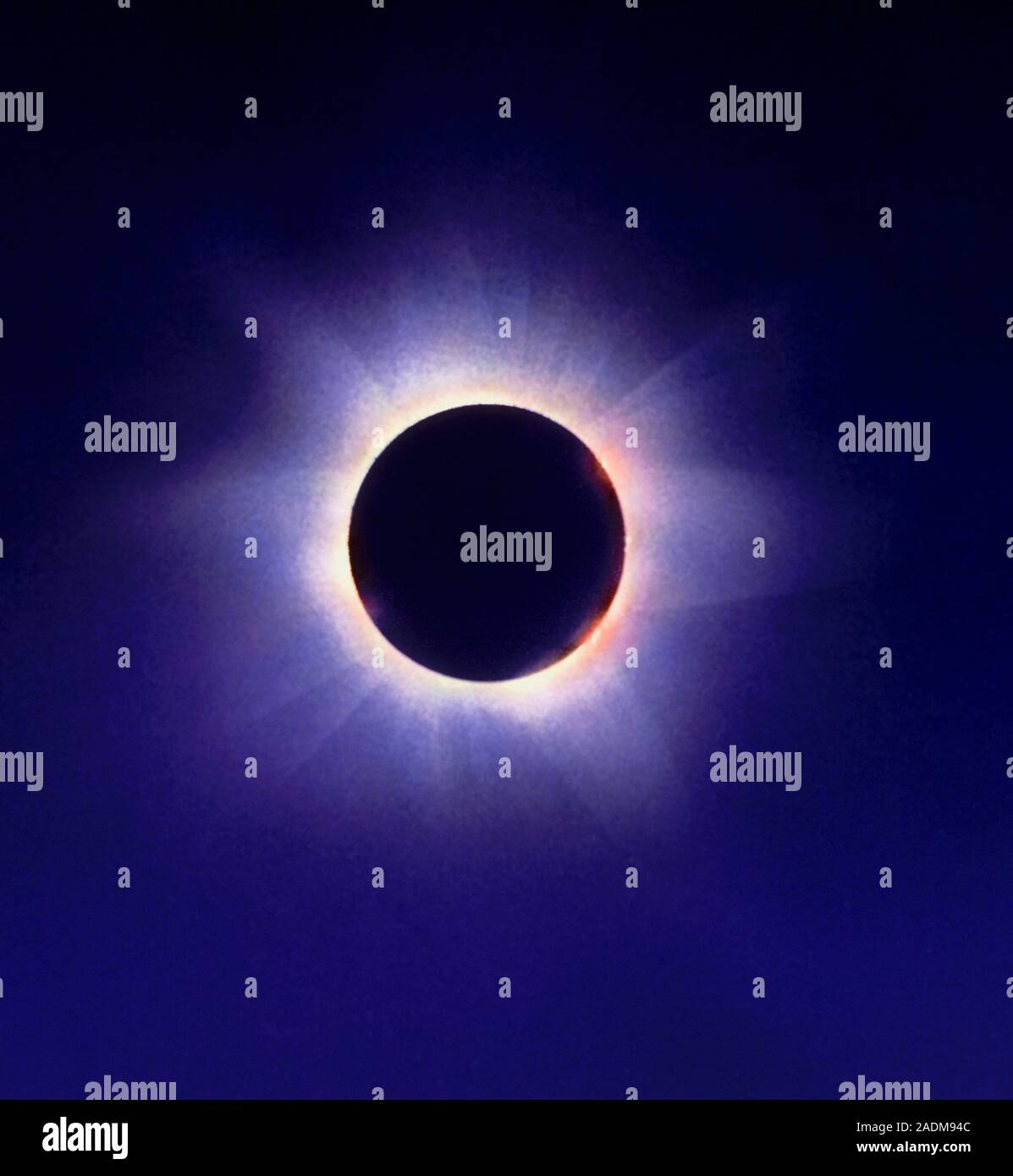
A total solar eclipse occurs when the Moon passes directly between the Sun and Earth, completely obscuring the solar disk from view. This alignment, known as syzygy, happens only during a new moon when the Moon is at its perigee and crosses the ecliptic plane at specific points called lunar nodes.
The phenomenon of a total solar eclipse is often described as one of nature’s most awe-inspiring sights. While partial and annular eclipses are more frequent, a total solar eclipse is a rare event for any specific geographic location. To understand why and how this occurs, we must look at the intricate dance of orbital mechanics, the specific geometry of our solar system, and the timing of lunar cycles. As of 2026, our understanding of these events has reached a pinnacle of precision, allowing us to predict the path of the Moon's shadow within meters and seconds.
The Three Requirements for Totality
A total solar eclipse does not happen every time the Moon passes between the Earth and the Sun. If it did, we would witness an eclipse every month during the new moon phase. Instead, three specific conditions must be met simultaneously for a total solar eclipse to occur.
1. The Lunar Phase: New Moon
The first requirement is that the Moon must be in its new moon phase. During this time, the Moon is positioned on the same side of the Earth as the Sun. From our perspective, the side of the Moon facing Earth is not illuminated, making it nearly invisible against the brightness of the sky. However, because the Moon’s orbit is tilted relative to Earth’s orbit around the Sun, the Moon usually passes "above" or "below" the Sun from our vantage point.
2. Orbital Node Alignment
The second requirement involves the lunar nodes. The Moon's orbit is tilted at an angle of approximately 5 degrees relative to the ecliptic (the plane of Earth's orbit around the Sun). The two points where the Moon's tilted orbit crosses the ecliptic are called nodes. A total solar eclipse can only happen when a new moon occurs at or very near one of these nodes. This alignment ensures that the Sun, Moon, and Earth are on the same horizontal plane, allowing the Moon's shadow to actually fall upon the Earth's surface.
3. Perigee and Apparent Diameter
The third requirement is related to distance. Because the Moon’s orbit is elliptical rather than perfectly circular, its distance from Earth varies. When the Moon is at its closest point to Earth, it is at perigee. When it is at its farthest, it is at apogee. For a total solar eclipse to occur, the Moon must be close enough to Earth (at or near perigee) so that its apparent size in the sky is equal to or larger than the apparent size of the Sun. If the Moon is too far away (near apogee), it cannot cover the Sun entirely, resulting in an annular eclipse, where a "ring of fire" remains visible.
The Physics of the Shadow: Umbra vs. Penumbra
When the Moon blocks the Sun, it casts a two-part shadow onto the Earth. Understanding the difference between these shadow types is crucial for anyone planning to witness the event.
- The Umbra: This is the darkest, central part of the Moon's shadow. Within the umbra, the Sun’s light is completely blocked. If you are standing within the path of the umbra—known as the path of totality—you will experience a total solar eclipse. The umbra is relatively narrow, typically only 60 to 150 miles wide, depending on the specific geometry of the eclipse.
- The Penumbra: This is the lighter, outer part of the shadow. In the penumbra, the Moon blocks only a portion of the Sun. Observers in this region experience a partial solar eclipse. The penumbra covers a much larger geographic area, often spanning thousands of miles.
The speed at which the umbra moves across the Earth's surface is staggering. Depending on the latitude and the Earth's rotational speed, the shadow can travel at speeds ranging from 1,000 miles per hour at the equator to over 5,000 miles per hour near the poles. This is why totality usually lasts only a few minutes at any given spot.
The Path of Totality in 2026 and Beyond
As we move through 2026, the global scientific community is focused on the upcoming total solar eclipse on August 12, 2026. This event is particularly significant as it will be the first total solar eclipse visible from continental Europe in several decades. The path of totality will sweep across the Arctic, Greenland, Iceland, the Atlantic Ocean, and Northern Spain.
| Aspect | Total Solar Eclipse | Annular Solar Eclipse | Partial Solar Eclipse |
|---|---|---|---|
| Lunar Phase | New Moon | New Moon | New Moon |
| Moon's Distance | Near Perigee (Close) | Near Apogee (Far) | Varies |
| Visual Effect | Sun completely covered; Corona visible | "Ring of Fire" visible | Sun looks like a "crescent" |
| Sky Brightness | Twilight-like darkness | Dimmed, but not dark | Slightly dimmed |
| Safety Gear | Required except during totality | Required at all times | Required at all times |
Key Phenomena Observed During Totality
When a total solar eclipse occurs, several unique physical phenomena become visible that cannot be seen at any other time.
The Solar Corona
The most striking feature of totality is the solar corona. This is the Sun’s outer atmosphere, consisting of plasma that extends millions of kilometers into space. It is normally invisible because the Sun’s photosphere (the bright surface) is too overwhelming. During the few minutes of totality, the corona appears as a ghostly, white halo surrounding the black disk of the Moon.
Baily's Beads
Just seconds before and after totality, observers may see a series of bright spots around the edge of the Moon. Known as Baily's Beads, these are caused by sunlight peeking through the valleys and craters on the Moon’s rugged horizon.
The Diamond Ring Effect
As the final bead of light disappears (or the first one reappears), it creates a brilliant flash of light that looks like a diamond set on a glowing ring. This "Diamond Ring" is the signal to observers that totality is either beginning or ending.
Chromosphere and Prominences
During totality, you may see a thin, reddish-pink layer around the edge of the Sun. This is the chromosphere. You might also see solar prominences—looping structures of solar material—extending from the Sun's surface into the corona.
Scientific Importance of Total Solar Eclipses
Beyond their visual splendor, total solar eclipses are vital for scientific research. Historically, they provided the first evidence for Albert Einstein’s General Theory of Relativity. During the eclipse of 1919, Sir Arthur Eddington observed stars near the eclipsed Sun and confirmed that the Sun's gravity bent the starlight, exactly as Einstein had predicted.
Even in 2026, with advanced satellites like the Solar and Heliospheric Observatory (SOHO), ground-based observations during an eclipse remain valuable. They allow scientists to study the lower corona, a region difficult to observe with artificial coronagraphs due to light scattering. These studies help us understand solar wind and coronal mass ejections (CMEs), which can impact Earth’s satellite communications and power grids.
Observation Safety and Requirements
It is a common misconception that you can look at a solar eclipse with the naked eye. This is only true during the brief period of totality when the Sun is 100% obscured. At all other times—during the partial phases before and after—you must use specialized eye protection.
- ISO 12312-2 Standard: Solar viewing glasses must meet this international safety standard. Regular sunglasses, even very dark ones, are insufficient because they do not filter out harmful infrared and ultraviolet radiation.
- Solar Filters for Optics: If using a telescope, binoculars, or a camera, a professional-grade solar filter must be placed on the front of the lens. Looking through an unfiltered optic at the Sun can cause instant and permanent blindness.
- Indirect Viewing: If you do not have solar glasses, you can use a pinhole projector to view the Sun's silhouette on the ground or a piece of paper.
For more detailed safety guidelines, the American Astronomical Society (AAS) provides a comprehensive list of reputable vendors and safety procedures.
Why Totality is a Geographic Lottery
The Moon's umbra is tiny compared to the size of the Earth. Consequently, any single point on Earth will only experience a total solar eclipse once every 375 years on average. This rarity is why "eclipse chasing" has become a global phenomenon.
The NASA Eclipse Website provides historical data and future predictions that show how the path of totality changes with each event. Because the Earth is rotating as the Moon's shadow moves across it, the path forms a long, thin curve. If the eclipse occurs near the poles, the path is more distorted and wider; near the equator, it tends to be narrower and moves more slowly.
Frequently Asked Questions
How long does a total solar eclipse last?
The duration of totality depends on the relative distances of the Earth, Moon, and Sun. The maximum theoretical duration for a total solar eclipse is approximately 7 minutes and 32 seconds. However, most events last between 2 and 5 minutes. The 2026 eclipse will offer roughly 2 minutes and 18 seconds of totality at its point of maximum duration.
Why doesn't a solar eclipse happen every month?
An eclipse doesn't happen every month because the Moon’s orbit is tilted about 5 degrees relative to the Earth’s orbit around the Sun. Most of the time, the Moon's shadow passes above or below the Earth. An eclipse can only occur during "eclipse seasons," which happen twice a year when the Moon's nodes align with the Sun.
Can you see stars during a total solar eclipse?
Yes. When the Moon completely blocks the Sun, the sky darkens to a deep twilight. Bright planets like Venus and Jupiter, as well as several prominent stars, often become visible to the naked eye. This drop in light also triggers a drop in temperature, sometimes by as much as 10 to 15 degrees Fahrenheit.
Do animals react to total solar eclipses?
Wildlife often exhibits confused behavior during totality. Birds may stop singing and return to their nests, thinking it is nightfall. Nocturnal animals like crickets or owls may become active. In 2026, citizen science projects continue to study these behavioral changes to better understand animal circadian rhythms.
What is the Saros Cycle?
The Saros Cycle is a period of approximately 18 years, 11 days, and 8 hours that can be used to predict eclipses. Eclipses separated by one Saros period share very similar geometries and occur at the same node, with the Moon at nearly the same distance from Earth. However, because of the extra 8 hours, the Earth rotates about one-third of the way further, so the eclipse occurs in a different geographic region.
Summary and Next Steps
A total solar eclipse occurs when the Moon, Earth, and Sun align with such precision that the Moon’s shadow falls directly upon our planet. This requires the Moon to be in its new phase, positioned at an orbital node, and close enough to Earth to cover the Sun entirely.
If you are planning to witness the next great event on August 12, 2026, or any future eclipse, your first step should be to verify your location relative to the path of totality. Use tools like Time and Date to check the exact start times for your coordinates. Secure your ISO-certified solar glasses early, as demand often outstrips supply in the months leading up to a major celestial event.