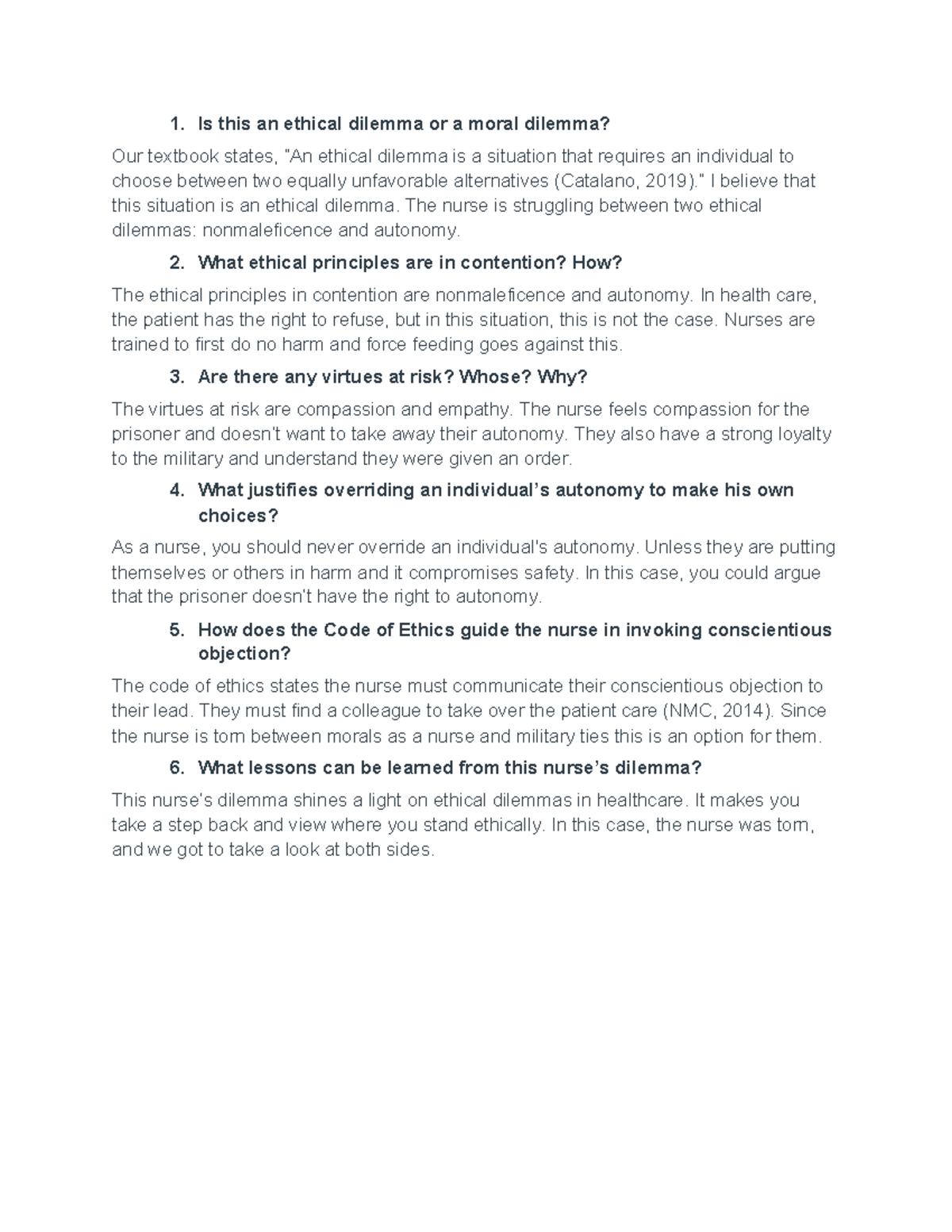
An ethical dilemma in nursing occurs when professional values, such as patient autonomy and the duty to do good, come into direct conflict. A prominent example involves a terminal patient refusing life-prolonging treatment against the family's wishes. In this scenario, the nurse must navigate the tension between respecting the patient’s right to self-determination and the family’s demand for continued intervention.
The profession of nursing is grounded in a commitment to provide care that is both technically proficient and ethically sound. As we move through 2026, the complexity of the healthcare environment—driven by advanced medical technologies and diverse cultural perspectives—continues to present nurses with profound moral challenges. These dilemmas are rarely simple "right vs. wrong" scenarios; instead, they are "right vs. right" conflicts where two or more valid ethical principles point toward different courses of action.
A Detailed Example of an Ethical Dilemma: The Case of Mr. Thompson
To understand how an ethical dilemma manifests in clinical practice, let us examine a specific, frequent scenario involving end-of-life care and patient self-determination.
The Context: Mr. Thompson is a 78-year-old patient diagnosed with Stage IV metastatic lung cancer. He has undergone several rounds of chemotherapy, but the disease has progressed. He is currently hospitalized with severe pneumonia and respiratory failure. Mr. Thompson is conscious and cognitively intact. He has expressed to his primary nurse, Sarah, that he is tired of fighting, in significant pain, and does not want to be intubated or placed on a ventilator if his condition worsens. He wishes to receive comfort care only.
The Conflict: Mr. Thompson’s daughter, who holds Durable Power of Attorney (DPOA) for healthcare, arrives at the hospital. She is distraught and insists that the medical team do "everything possible" to save her father, including intubation and aggressive resuscitation. She argues that her father is depressed and not thinking clearly.
The Nurse’s Dilemma: Sarah, the nurse, faces a classic ethical dilemma. On one hand, the principle of autonomy dictates that she must respect Mr. Thompson’s stated wishes, as he is currently capable of making his own decisions. On the other hand, the principle of beneficence (acting in the patient’s best interest) and the emotional pressure from the family create a situation where the "correct" path is obscured by conflicting obligations. Sarah also faces moral distress because she knows that intubating Mr. Thompson against his will would violate his bodily integrity and cause the very suffering he seeks to avoid.
Deconstructing the Ethical Pillars Involved
In nursing, dilemmas are analyzed using the four-pillar framework of bioethics. In Mr. Thompson’s case, these pillars are in direct opposition.
Autonomy: The Right to Self-Determination
Autonomy is the cornerstone of modern medical ethics. In 2026, the American Nurses Association (ANA) Code of Ethics continues to emphasize that the patient is the primary decision-maker in their care. Because Mr. Thompson is alert and oriented, his refusal of treatment is legally and ethically binding. However, the nurse must ensure that the patient’s decision is "informed"—meaning he understands the consequences of refusing the ventilator (i.e., that he will likely die).
Beneficence: The Duty to Do Good
Beneficence requires nurses to take positive actions to help others. The daughter believes that "doing good" means extending her father’s life. From a clinical perspective, a nurse might also struggle with whether they are giving up too soon. The dilemma arises when the patient’s definition of "good" (peaceful death) differs from the family’s or the clinician’s definition (biological survival).
Non-Maleficence: The Duty to Do No Harm
The principle of non-maleficence is often summarized as "first, do no harm." In this ethical dilemma, the definition of "harm" is subjective. To the daughter, allowing her father to die is the ultimate harm. To Mr. Thompson, being kept alive by a machine, experiencing the discomfort of an endotracheal tube, and suffering through a prolonged dying process is the greater harm.
Justice: Fairness and Resource Allocation
While less prominent in this individual case, justice involves the fair distribution of healthcare resources. In a broader sense, nurses must consider whether aggressive, non-beneficial treatments for terminal patients utilize resources (ICU beds, nursing hours, equipment) that could be used for patients with a higher probability of recovery.
The Role of the Nurse as a Patient Advocate
A primary responsibility of the nurse in an ethical dilemma is advocacy. Advocacy does not mean making decisions for the patient; rather, it means ensuring the patient’s voice is heard and their rights are protected.
In the case of Mr. Thompson, Sarah’s role involves:
- Verification of Competency: Ensuring that Mr. Thompson’s decision is not a result of temporary delirium or untreated clinical depression.
- Facilitation of Communication: Sarah must act as a bridge between the patient, the family, and the medical team. This involves organized family meetings where the patient’s goals of care are clearly stated.
- Clarifying Legal Standing: Even though the daughter has DPOA, Sarah must help the team understand that a DPOA only "activates" when the patient loses the capacity to speak for themselves. As long as Mr. Thompson is competent, his voice supersedes the daughter’s.
Analyzing Ethical Conflicts in 2026 Clinical Settings
The table below summarizes the common ethical dilemmas nurses encounter and the conflicting principles at play.
| Dilemma Type | Primary Conflict | Example Scenario |
|---|---|---|
| End-of-Life Refusal | Autonomy vs. Beneficence | A terminal patient refuses a life-saving blood transfusion due to personal or religious beliefs. |
| Truth-Telling | Veracity vs. Non-Maleficence | A family asks the nurse to hide a terminal diagnosis from a patient to "protect" their emotional state. |
| Resource Allocation | Justice vs. Beneficence | A nurse must decide which patient receives limited specialized wound care supplies during a shortage. |
| Informed Consent | Autonomy vs. Paternalism | A surgeon pressures a patient into a procedure they don't fully understand, and the nurse must intervene. |
| Staffing & Safety | Fidelity vs. Non-Maleficence | A nurse is asked to take an unsafe patient load, balancing duty to the employer against patient safety. |
The Impact of Moral Distress on the Nursing Workforce
Ethical dilemmas are not just academic exercises; they have a significant psychological impact on nurses. Moral distress occurs when a nurse knows the ethically correct action to take but feels powerless to take it due to institutional constraints, legal fears, or pressure from others.
In Mr. Thompson’s case, if the medical team ignores his wishes and intubates him to appease the daughter, Sarah may experience moral distress. Over time, repeated exposure to these dilemmas without resolution can lead to burnout, compassion fatigue, and nurses leaving the profession. In 2026, healthcare institutions have increasingly recognized this, implementing "Ethics Rounds" and debriefing sessions to help staff process the emotional weight of these decisions.
Frameworks for Resolving Nursing Ethical Dilemmas
Nurses do not have to solve these problems in isolation. Several structured approaches exist to help navigate the "gray areas" of clinical practice.
The Nursing Process for Ethics
Nurses can apply the standard nursing process (ADPIE) to ethical issues:
- Assessment: Gather all facts. Is the patient competent? What are the family's concerns? What is the medical prognosis?
- Diagnosis (Identification): Clearly state the ethical conflict (e.g., "Autonomy vs. Beneficence").
- Planning: Consult with the Ethics Committee, social workers, and chaplains.
- Implementation: Hold a family conference to align goals of care.
- Evaluation: Reflect on the outcome. Was the patient's dignity preserved?
Institutional Ethics Committees (IECs)
Most hospitals in 2026 have multidisciplinary ethics committees. These bodies provide a forum for all parties—nurses, physicians, patients, and families—to discuss the dilemma in a non-adversarial environment. They do not usually "dictate" a solution but offer recommendations based on ethical theory and hospital policy.
Legal Considerations and Professional Guidelines
It is essential to distinguish between what is legal and what is ethical. While they often overlap, they are not identical.
- Advance Directives: In Mr. Thompson’s case, if he had a written Living Will or a Physician Orders for Life-Sustaining Treatment (POLST) form, the ethical dilemma would be significantly mitigated. These documents provide legal evidence of the patient's wishes.
- The ANA Code of Ethics: This remains the gold standard for nursing conduct. Provision 1.4 specifically addresses the right to self-determination, stating that nurses must respect the values and choices of the patients they serve.
- State Statutes: Nurses must be aware of their specific jurisdictional laws regarding the "right to die" and the hierarchy of surrogate decision-makers.
Frequently Asked Questions
What is the most common ethical dilemma in nursing?
The most frequent dilemma involves end-of-life care and the conflict between the patient's wishes and the family’s expectations. This often manifests as a struggle over "Full Code" status vs. "Do Not Resuscitate" (DNR) orders. Nurses are often caught in the middle, trying to honor the patient's dignity while managing the family's grief and guilt.
How should a nurse handle a family that wants to withhold a diagnosis?
This is a conflict of veracity (truth-telling). Ethically, the patient has a right to know their own medical status. The nurse should explore the family's fears, but ultimately advocate for the patient's right to information. Hiding a diagnosis often leads to a breakdown in trust and prevents the patient from making necessary end-of-life arrangements.
What should I do if I disagree with a physician's ethical decision?
First, ensure you have all the facts. If a conflict remains, follow the chain of command. Start by discussing it with the physician directly, then involve your nurse manager or nursing supervisor. If the issue remains unresolved, request a formal consultation with the hospital’s Ethics Committee.
Can a nurse refuse an assignment based on ethical or religious grounds?
Yes, but with caveats. Most institutions allow nurses to "opt out" of specific procedures (like certain reproductive health services or end-of-life withdrawals) if they have a documented conscientious objection. However, the nurse cannot abandon the patient; they must ensure that care is seamlessly transferred to another qualified professional.
What is the difference between an ethical dilemma and a moral problem?
A moral problem is usually a situation where the right course of action is known, but there are barriers to doing it (e.g., a nurse seeing a colleague steal medication). An ethical dilemma is a situation where there is no clearly "right" or "wrong" answer because two different ethical principles are in conflict, and both have valid arguments.
Professional Recommendations for Ethical Navigation
When faced with a complex ethical dilemma such as the refusal of life-sustaining treatment, nurses should prioritize clear communication and documentation. The following steps are recommended for any nurse in 2026:
- Document Everything: Record the patient's specific statements regarding their care wishes in the medical record. Use direct quotes whenever possible to ensure their voice is preserved.
- Engage Support Early: Do not wait for a crisis. If you sense a conflict between a patient and their family, involve palliative care specialists or social workers immediately to facilitate "Goals of Care" conversations.
- Know the Hierarchy: Familiarize yourself with your state's laws regarding surrogate decision-making. Understand that a competent patient always has the final say over their own body, regardless of what family members or DPOAs desire.
- Practice Self-Care: Ethical dilemmas are emotionally draining. Utilize your institution's employee assistance programs (EAP) or peer support groups to process moral distress and prevent long-term burnout.
By adhering to the core principles of nursing ethics—autonomy, beneficence, non-maleficence, and justice—nurses can navigate even the most challenging dilemmas with integrity and compassion, ensuring that the patient remains the center of all care decisions.