In Alabama, an 18-year-old is legally considered an adult and can generally receive life insurance death benefits directly without the appointment of a court-supervised conservator, provided they are named as the primary beneficiary and the insurance company has verified their identity, completed a standard claim packet, and cleared all underwriting stipulations.
Navigating the financial and legal landscape of life insurance claims can be a challenging endeavor, particularly when the beneficiaries are young adults transitioning into financial independence. When a policyholder passes away, surviving family members and designated beneficiaries must untangle a series of administrative, legal, and operational requirements to collect the proceeds. For an 18-year-old beneficiary in Alabama, the process involves distinct legal thresholds defined by state law, contract provisions mandated by insurance carriers, and the specific mechanics of the policy in question.
While many jurisdictions maintain the age of majority at 18, various financial institutions and insurance corporations historically implemented internal rules requiring beneficiaries to be older, or requiring a minor's trust or conservator for anyone under 21. Understanding how Alabama statutory law intersects with insurance policy contracts is essential for ensuring a smooth, timely, and lawful payout of death benefits. This guide explores the legal status of 18-year-olds in Alabama regarding insurance claims, the step-by-step claims process, documentation requirements, potential complications, and practical strategies for managing the inherited funds.
The Legal Age of Majority in Alabama
To understand how an 18-year-old interacts with a life insurance contract, one must first examine the legal definition of majority within the state of Alabama. Under the Alabama Code Section 26-1-1, the age of majority for all persons in the state is set at 19 years old for many contractual and property-related purposes, yet specific exceptions exist for civil rights, criminal liability, and certain financial transactions. However, with respect to receiving and discharging financial obligations such as insurance proceeds, statutory provisions and modern insurance practices generally recognize 18 as the age where an individual possesses the legal capacity to enter into binding receipts and releases.
In practical terms, this means that when an insured individual passes away, an 18-year-old beneficiary does not automatically require a court-appointed conservator or a formal legal guardianship to claim proceeds, provided the policy terms do not dictate a higher age threshold. Insurance companies operating within Alabama evaluate claims based on the policy contract language and state insurance regulations enforced by the Alabama Department of Insurance. If the policy names the 18-year-old directly by name and Social Security number, the insurer treats the claimant as a legal adult capable of signing the release of claims.
Nevertheless, some older policies or specific group life insurance plans governed by employer contracts or federal regulations (such as ERISA) may contain legacy language referencing ages of majority up to 21. When examining these older documents, family members must look closely at the beneficiary designation form rather than assuming state law overrides private contract stipulations. If a contract explicitly states that funds cannot be distributed until age 21 without a guardian, the insurer may adhere to that contract constraint until legal counsel reviews the wording.
Prerequisites for Claiming Life Insurance Benefits at Age 18
Before an 18-year-old beneficiary can receive a payout from a life insurance policy in Alabama, several operational and evidentiary prerequisites must be met. Insurance companies require definitive proof that the insured has passed away, that the policy is active and in good standing, and that the claimant is indeed the rightful individual designated on the policy file.
1. Verification of Policy Status and Identification
The claimant must verify that the policy was active at the time of death. This involves locating the original policy document or securing the policy number through the deceased person's financial records, employer HR department, or independent insurance agent. The 18-year-old must also provide government-issued photo identification—such as an Alabama driver's license, a state identification card, or a valid passport—along with their Social Security card to satisfy federal Know Your Customer (KYC) and anti-money laundering regulations.
2. Certified Copies of the Death Certificate
Insurance carriers will not process a death benefit claim based on verbal notice or a funeral home program. The claimant must obtain at least one, and preferably several, certified copies of the death certificate issued by the Alabama Department of Public Health’s Center for Health Statistics or the local county health department where the death occurred. These certified copies feature a raised or colored seal and are required by virtually all financial institutions to release assets.
3. Completion of the Claimant’s Statement
Every insurance provider supplies a standardized claim packet that includes a "Claimant’s Statement" or "Proof of Loss" form. For an 18-year-old, this form must be filled out completely and accurately. It asks for basic information regarding the deceased, the cause of death, the claimant's contact details, and the preferred payout method (such as a lump-sum check or a retained asset account). Any discrepancies between the name on the policy and the name on the beneficiary’s identification require legal affidavits of identity.
Step-by-Step Claims Process for Young Beneficiaries
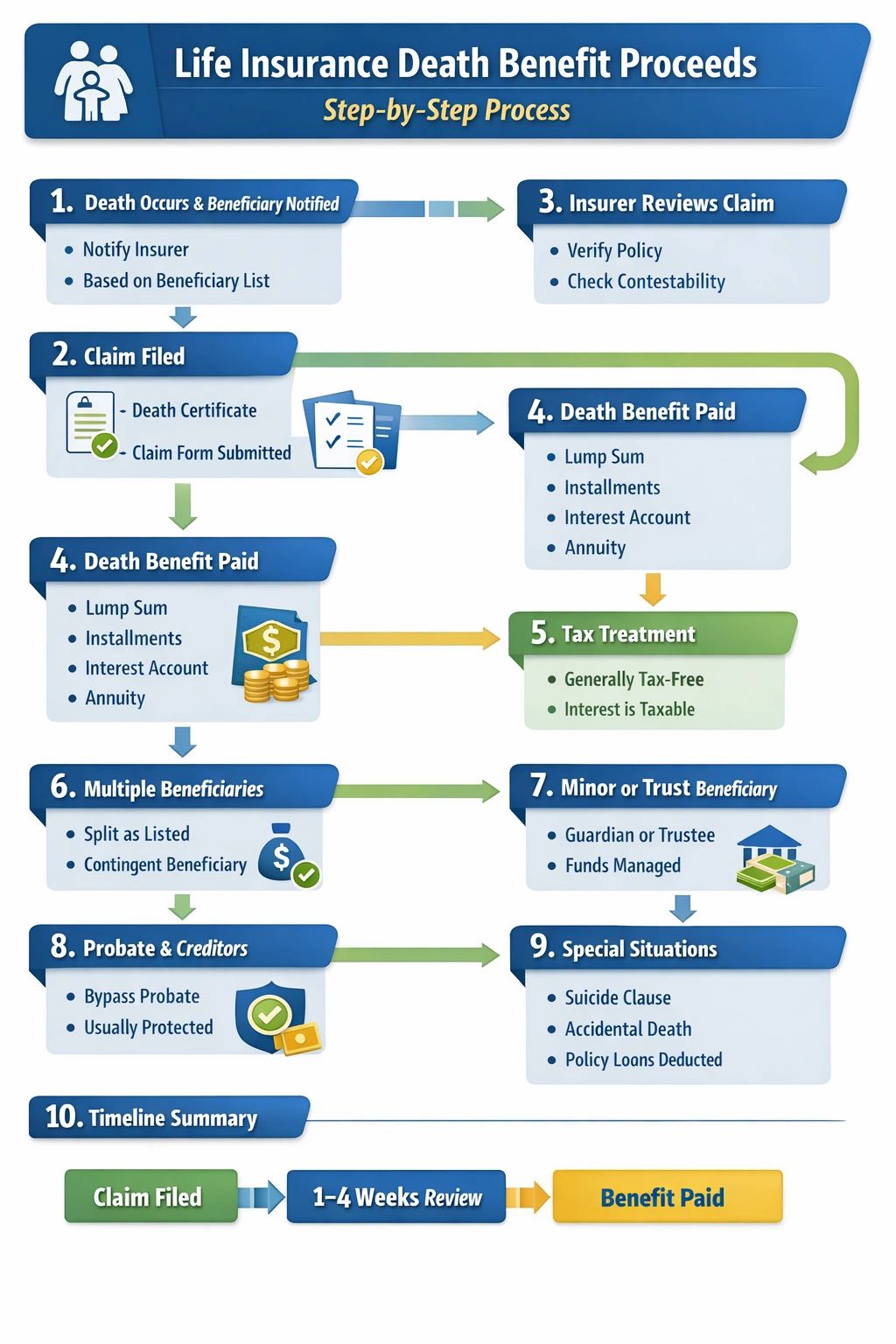
Once the prerequisites are gathered, the actual process of filing and collecting the death benefit follows a structured pathway. Following these sequential steps helps prevent administrative delays and ensures the claim is processed efficiently by the insurance carrier's claims department.
Locate Policy & Death Certificate
Contact Insurance Carrier to Open Claim
Submit Claimant Statement & ID
Underwriter Review & Claims Validation
Disbursement of Funds to 18-Year-Old
Notify the Insurer: Contact the insurance company's customer service or claims division to report the death. Inform them that the primary beneficiary is an 18-year-old adult.
Request the Claim Packet: The insurer will mail or digitally transmit the required claim forms. Review every page carefully to ensure all required fields are understood.
Assemble Supporting Documents: Gather the certified death certificate, completed claimant statement, policy documents (if available), and verification of the beneficiary's Social Security number and photo ID.
Submit the Package: Mail the complete documentation via certified mail with a return receipt requested, or submit via the insurer's secure online portal if available. Keeping a complete photocopy of all submitted materials is highly recommended.
Await Processing and Investigation: Standard claims are typically processed within 14 to 30 days of receiving all required documents, assuming the death did not occur within the policy's two-year contestability period or involve suspicious circumstances.
Receive Disbursement: Upon approval, the insurer issues payment according to the beneficiary's instructions.
Common Complications and How to Resolve Them
Even when an 18-year-old meets the state criteria for adulthood, various complications can stall or complicate the release of life insurance proceeds in Alabama. Anticipating these hurdles allows beneficiaries to resolve them proactively.
Contested Beneficiary Designations and Minor Trusts
If an individual was designated as a beneficiary when they were a minor (e.g., under 19 or 18 depending on past guidelines), the insured parent or guardian may have set up a contingent minor trust or a Uniform Transfers to Minors Act (UTMA) account. If a UTMA custodian was named on the policy documents, the funds must be paid to that custodian for the benefit of the 18-year-old, rather than directly to the individual, until the custodianship terminates according to state statute.
Contestability Periods and Suicides
If the insured passed away within two years of the policy’s issue date, the insurance company has the legal right to conduct a full investigation into the deceased's medical history to check for material misrepresentations on the original application. Furthermore, if the cause of death is ruled a suicide within the contestability window, policies typically pay out only the premiums paid rather than the full face value. These investigations can extend the waiting period for an 18-year-old beneficiary from weeks to several months.
Missing or Incomplete Documentation
Insurers frequently reject or suspend claims due to simple clerical errors, such as a mismatch between the middle initial on the death certificate and the policy record, or an unsigned claimant statement. Beneficiaries should double-check all forms before submission and ensure that certified copies of the death certificate are pristine.
Financial Considerations and Payout Options
Receiving a substantial life insurance payout at age 18 represents a pivotal financial turning point. Insurance companies offer several distribution methods, and understanding the tax implications is vital for long-term financial security.
| Payout Method | Description | Key Advantage | Potential Risk |
|---|---|---|---|
| Lump-Sum Cash Payment | The entire death benefit is paid out in a single check or direct deposit. | Complete immediate liquidity and control over funds. | Risk of impulsive spending or poor financial management by young adults. |
| Retained Asset Account | Funds are held in a draft-accessible account managed by the insurer, earning interest. | Immediate check-writing access while funds remain secured with the carrier. | Yields on these accounts may be lower than alternative investments. |
| Structured Settlement / Installments | Payouts are distributed in scheduled installments over a set number of years. | Provides steady, predictable income and prevents rapid depletion of funds. | Reduces immediate access to cash if large, unforeseen expenses arise. |
Tax Implications of Life Insurance Proceeds
Generally, life insurance death benefits paid to a beneficiary in a lump sum are income tax-free under federal law and Alabama state tax code. However, if the beneficiary chooses a payout option that accumulates interest over time (such as installment payments or holding funds in a retained asset account), any interest earned on the principal amount is subject to ordinary income tax. The insurance carrier will issue a Form 1099-INT for any taxable interest generated.
Frequently Asked Questions
Do I need a lawyer in Alabama to claim life insurance benefits at 18?
No, legal representation is generally not required to file a standard, uncontested life insurance claim. If the paperwork is complete and the beneficiary is clearly designated, the insurance company processes the claim directly. A lawyer is only necessary if the claim is wrongfully denied, contested by other family members, or tied up in complex trust or estate disputes.
Are life insurance proceeds considered taxable income in Alabama?
Lump-sum death benefits are generally free from federal and state income taxes. Taxes only apply to the interest earned if the beneficiary chooses to receive the payout in installments or leaves the money in an interest-bearing account provided by the insurer.
What happens if the insured did not update their beneficiary designation?
If the insured passed away without updating a beneficiary form—for instance, if an ex-spouse or a deceased relative remains listed—the insurance company is legally bound to pay the person explicitly named on the official policy file on record, regardless of verbal wishes or a will, unless a court order intervenes.
Can an insurance company delay payment to an 18-year-old?
Yes, insurers can delay payment if the claim falls within the two-year contestability period, if there is a dispute over who the rightful beneficiary is, if documents are missing, or if the policy requires verification that no court-appointed guardian or trustee holds legal control over the minor's assets.
What should an 18-year-old do immediately after receiving a life insurance payout?
An 18-year-old receiving a large financial windfall should avoid making immediate, high-value purchases. Consulting a fee-only fiduciary financial advisor or a certified public accountant in Alabama can help establish a sound savings plan, address tax questions regarding interest, and secure long-term financial stability.
Next Actions and Expert Guidance
For an 18-year-old beneficiary in Alabama, the path to receiving life insurance death benefits requires careful organization, adherence to policy guidelines, and patient communication with the insurance provider. The first step is to request the official claim packet directly from the insurance carrier and gather certified copies of the death certificate. Because managing a significant financial asset at a young age carries long-term consequences, seeking guidance from trusted, licensed financial professionals before spending or investing the proceeds is strongly recommended.