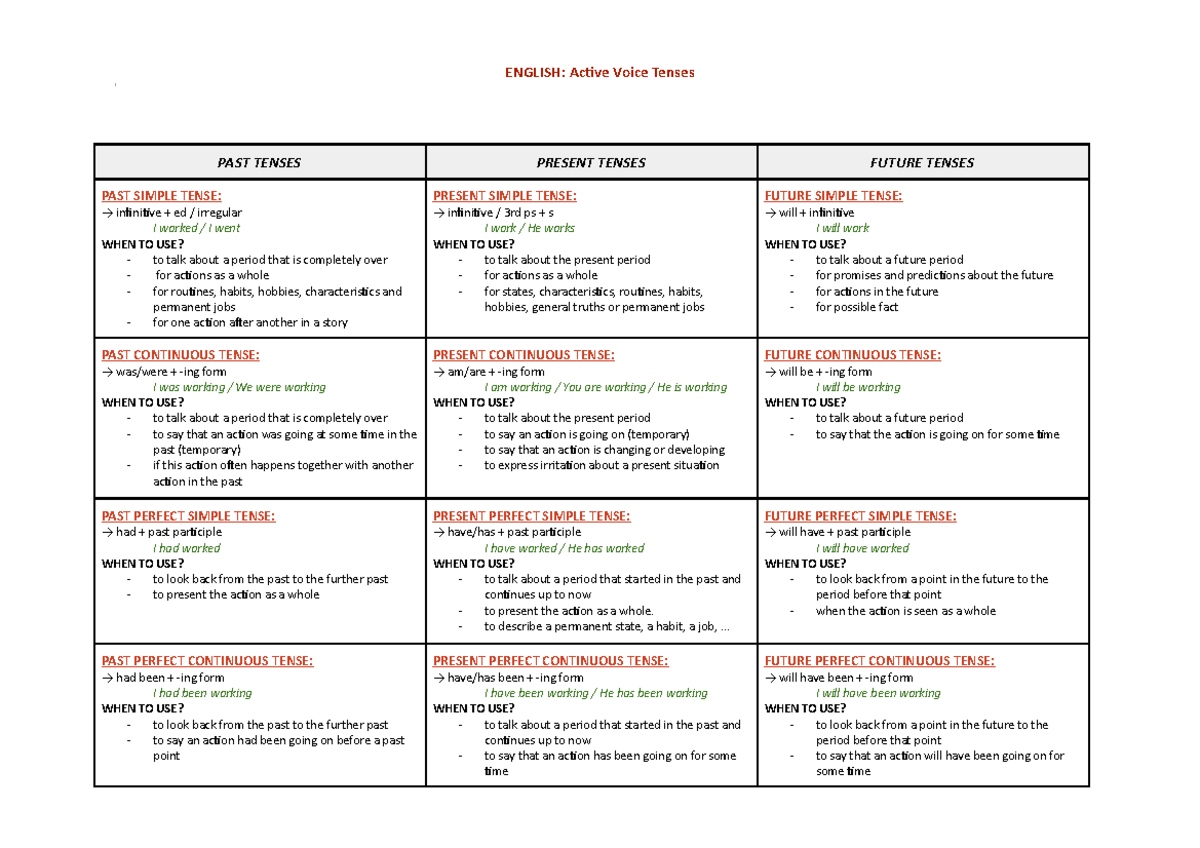
The active past tense is a grammatical construction where the subject of a sentence performs a specific action that concluded in the past. By prioritizing the agent of the action over the object, writers create sentences that are direct, dynamic, and easy to follow. This structure serves as the foundation for effective storytelling, historical documentation, and professional reporting by removing ambiguity and emphasizing accountability.
Understanding the Mechanics of Active Past Tense
To understand the active past tense, one must first identify the two core components: the actor (subject) and the completed action (past tense verb). In an active voice construction, the subject performs the verb. When that verb is conjugated in the past tense, it indicates that the event has already transpired.
Consider the difference between active and passive voice:
- Active Past Tense: "The architect designed the blueprints."
- Passive Past Tense: "The blueprints were designed by the architect."
In the first example, the actor—the architect—is front and center. The sentence moves logically from the person who acted to the object that was created. The passive alternative shifts the focus to the object and introduces a "to be" auxiliary verb ("were") and a prepositional phrase, which often slows the reader's pace and obscures the actor's role. Using the active past tense is not merely a stylistic choice; it is a structural commitment to clarity.
When to Utilize Active Past Tense
The active past tense is the standard for most forms of nonfiction, technical writing, and narrative prose. Because it clarifies "who did what," it is the preferred choice in any document where accountability or sequence of events is paramount.
Technical and Project Reporting
In technical environments, engineers and project managers often document milestones. Writing "The team completed the integration phase on Tuesday" is significantly more precise than "The integration phase was completed by the team." The former provides an immediate record of responsibility and timeline, which is crucial for auditing or project review.
Historical and Biographical Documentation
When recounting historical events, the active voice provides a sense of immediacy. Even though the events occurred in the past, the active construction forces the reader to visualize the historical figures in motion. It transforms a list of occurrences into a coherent narrative of cause and effect.
Journalistic and Business Communication
Professional emails, reports, and news articles rely on brevity. The active past tense uses fewer words than passive structures, allowing for tighter editing and faster comprehension. In 2026, where the volume of digital content continues to rise, the ability to convey information efficiently is a primary skill for effective communication.
Comparative Analysis: Active vs. Passive Structures
To effectively master this tense, it is helpful to compare how different sentence types function under the active voice versus their passive counterparts.
| Sentence Focus | Active Past Tense Example | Passive Past Tense Example | Impact on Reader |
|---|---|---|---|
| Responsibility | The manager approved the budget. | The budget was approved by the manager. | Active highlights the authority. |
| Speed | She finished the report early. | The report was finished by her early. | Active feels more concise. |
| Discovery | Scientists identified the new strain. | The new strain was identified by scientists. | Active emphasizes the breakthrough. |
| Sequence | The system triggered the alarm. | The alarm was triggered by the system. | Active clarifies the cause. |
Constructing Effective Active Past Tense Sentences
Building a strong active past tense sentence requires more than just verb conjugation; it requires careful selection of strong, evocative verbs. Weak verbs often lead writers to rely on passive voice or unnecessary descriptors.
Selecting Strong Verbs
Instead of using phrases like "made an investigation into," use the verb "investigated." Instead of "gave a description of," use "described." By using precise verbs, you eliminate the need for extra words and maintain the focus on the subject.
Maintaining Subject-Verb Proximity
One common error that breaks the impact of the active past tense is separating the subject from the verb with long, sprawling clauses.
- Cluttered: The technician, after inspecting the circuit boards and ensuring all safety protocols were followed, replaced the fuse.
- Focused: The technician replaced the fuse after inspecting the circuit boards and ensuring safety protocols.
By placing the actor near the action, the sentence remains punchy and impactful.
Common Mistakes and How to Avoid Them
Even experienced writers sometimes slip into passive patterns. Recognizing these tendencies is the first step toward better writing.
The Over-Reliance on "To Be" Verbs
The most common obstacle to using the active past tense is an over-dependence on "was" and "were." These verbs describe states of being rather than actions. If your writing is filled with "was" or "were," scan your document to see if you can replace them with an action verb that expresses what the subject actually did.
The "Hidden Subject" Problem
Sometimes writers omit the subject entirely, creating an implied passive structure. For example, "The files were moved to the archive" leaves the reader wondering who moved them. If you cannot identify who performed the action, ask yourself if the missing information is vital. If it is, explicitly state the actor to maintain the strength of the active voice.
Confusion Between Past Tense and Past Participle
A common technical error is confusing the simple past tense (e.g., "The manager decided") with the past participle used in passive constructions (e.g., "The decision was decided"). Ensure your verb reflects the simple past to keep the sentence in the active voice.
The Role of Active Voice in Professional Development
In 2026, communication standards in the workplace emphasize transparency and agility. Using the active past tense is a mark of professional maturity. It suggests that the writer understands the value of their audience’s time and is confident enough to assign ownership to actions. Whether you are writing a performance review, a project summary, or a technical manual, the clarity offered by active past tense structures reduces the likelihood of misinterpretation and increases the authority of your writing.
Frequently Asked Questions
Is it ever appropriate to use passive voice? Yes. Passive voice is useful when the actor is unknown, unimportant, or when the focus needs to remain entirely on the object (e.g., "The package was lost in transit" is often better than "Someone lost the package"). Use it sparingly and intentionally.
Does the active past tense make my writing sound too aggressive? No. It creates a direct tone that fosters trust. When you clearly state who performed an action, it demonstrates transparency rather than aggression.
How do I identify passive voice in my existing drafts? Search your document for "was," "were," "by," and "been." If you find these, check if you can rewrite the sentence to place the actor at the beginning.
Can active past tense be used in creative writing? It is essential in creative writing. Active verbs create a "showing" effect, which is more immersive for readers than the "telling" effect often produced by passive or static descriptions.
Does active past tense work for all verb types? It works for transitive verbs (actions performed on an object). For intransitive verbs (actions that do not take an object, like "slept" or "ran"), the active voice is the only option, as passive voice cannot be formed.
Next Steps for Improving Your Writing
To integrate these principles into your daily work, start by reviewing your last three emails or reports. Identify every instance of the passive voice and rewrite it into the active past tense. You will likely find that your sentences become shorter, your meaning clearer, and your professional authority more apparent. Practice this until it becomes a natural part of your drafting process.