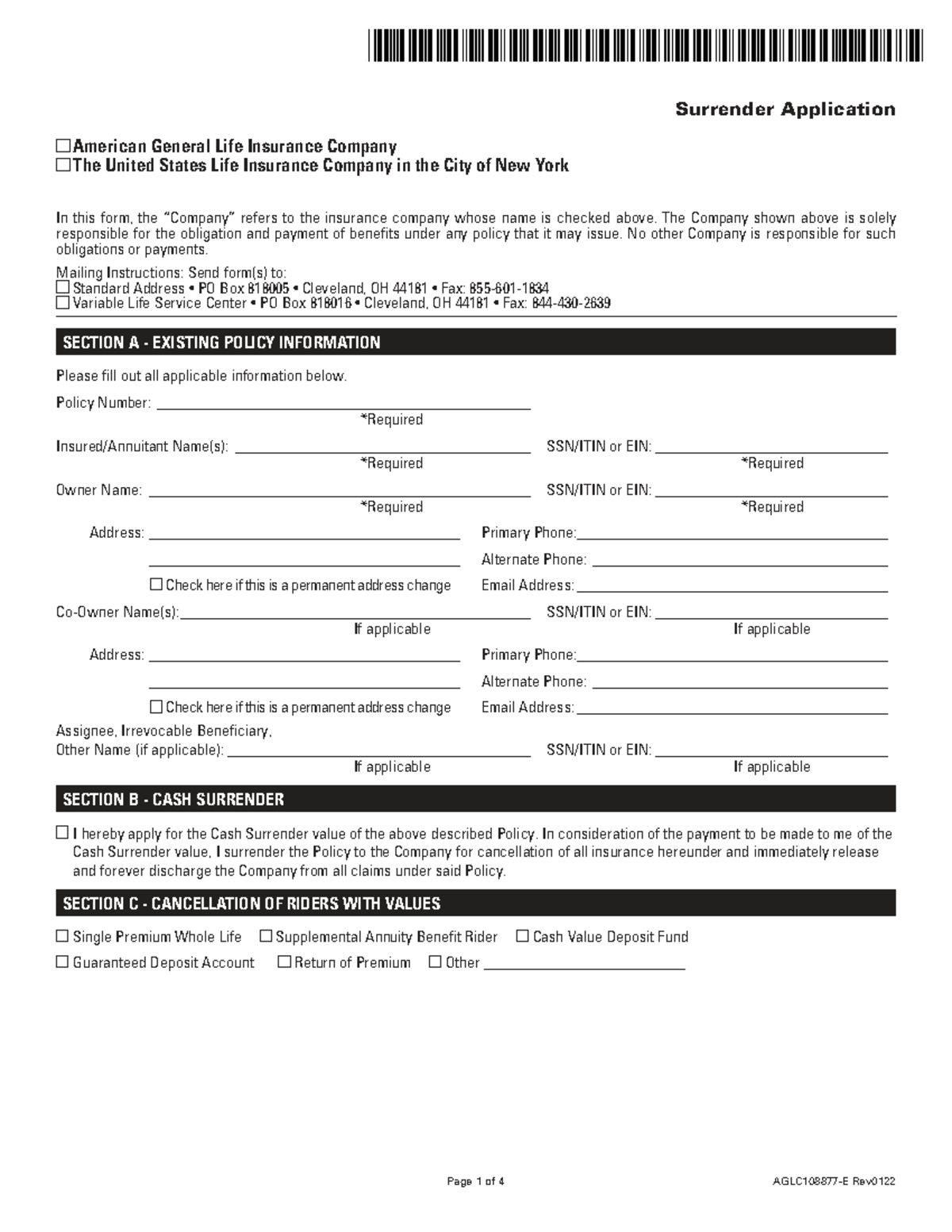
If you are looking to access funds from your American General Life Insurance (AGL) policy, the systematic withdrawal request form is the formal document required to initiate recurring, automated distributions from your cash value. This process allows policyholders to receive regular payments directly from their account’s accumulated value, provided the policy type and current status permit such withdrawals.
The Role of Systematic Withdrawals in Life Insurance
Systematic withdrawals are a common feature found in certain types of life insurance policies that accumulate cash value, such as Universal Life or Variable Universal Life. Unlike a lump-sum surrender, which can terminate the policy entirely, a systematic withdrawal program is designed to provide the policyholder with a predictable income stream while keeping the insurance contract active.
For many policyholders, this mechanism serves as a way to supplement retirement income or manage liquidity needs without triggering the immediate, total loss of death benefit protection. However, the mechanism is highly sensitive to the internal health of your policy. Because you are withdrawing from the cash value—which is the "engine" that covers the cost of insurance and administrative fees—reducing that balance through systematic withdrawals can lead to unforeseen consequences, including policy lapse if the remaining cash value is insufficient to cover future premium requirements.
Prerequisites for Initiating a Withdrawal
Before you can successfully submit a systematic withdrawal request form, you must verify that your specific policy contract allows for this feature. Not every American General Life Insurance policy is structured to support systematic distributions.
- Policy Type Verification: Ensure your policy is a permanent insurance product with a cash value component. Term life insurance policies, by definition, do not have cash value and therefore do not support systematic withdrawals.
- Current Cash Value Sufficiency: You must have sufficient "net surrender value" in your account. The insurance company will typically conduct a calculation to ensure that after your withdrawal, the remaining balance is enough to keep the policy in force under the current fee structure.
- No Active Loans: Many policies have restrictions regarding withdrawals if there are outstanding policy loans. You may be required to repay or reduce existing debt against the policy before the system will allow for a recurring withdrawal schedule.
- Beneficiary and Ownership Status: If the policy is owned by a trust or has irrevocable beneficiaries, additional documentation or signatures may be required.
Navigating the Request Form
The American General Life Insurance systematic withdrawal request form is a technical document that requires precision. Errors in completing this form can lead to processing delays or the rejection of your request. In 2026, most major insurers have streamlined their digital submission processes, but the core requirements for the data remain consistent.
When you obtain the form, you will generally be asked to provide:
- Policy Identification: Your full policy number. It is critical that this matches your records exactly to ensure the withdrawal is processed against the correct account.
- Withdrawal Frequency: You must specify the interval at which you wish to receive funds. Standard options typically include monthly, quarterly, semi-annual, or annual distributions.
- Tax Withholding Elections: This is arguably the most important section. Because life insurance withdrawals may have tax implications, the form will ask you to elect how much—if any—federal and state income tax should be withheld from each payment.
- Direct Deposit Information: For security and speed, most policyholders opt for electronic fund transfer (EFT). You will need to provide your bank routing number and account number, often accompanied by a voided check or a letter from your financial institution confirming the account details.
Comparing Withdrawal Methods
It is important to understand how systematic withdrawals compare to other ways of accessing the cash value in your AGL policy.
| Method | Access Type | Potential Impact on Policy | Tax Implications |
|---|---|---|---|
| Systematic Withdrawal | Recurring | Decreases Cash Value/Death Benefit | Potentially taxable (LIFO) |
| Policy Loan | One-time/Recurring | Requires Interest Payments | Generally non-taxable |
| Full Surrender | One-time (Total) | Terminates Policy | Taxable on gain |
| Partial Surrender | One-time | Decreases Cash Value/Death Benefit | Potentially taxable |
Note: The Last-In, First-Out (LIFO) tax rule typically applies to life insurance withdrawals, meaning any gain in the policy is generally considered withdrawn first for tax purposes.
Financial and Tax Implications
Before finalizing your request, consult with a tax professional or financial advisor. Withdrawing funds from a life insurance policy is a financial transaction that carries specific tax consequences under the Internal Revenue Code.
When you withdraw funds, the amount received is often treated first as a recovery of your "cost basis" (the premiums you have paid). Once you have recovered your basis, any further withdrawals are typically treated as taxable income. Furthermore, if your policy is classified as a Modified Endowment Contract (MEC), withdrawals are taxed on a gain-first basis and may be subject to a 10% penalty if the policyholder is under age 59½.
Because American General Life Insurance is a division of AIG (now operating as Corebridge Financial), administrative procedures regarding tax reporting, such as the issuance of 1099-R forms, are handled through their corporate financial infrastructure. Ensure your contact information is up to date to receive these tax documents accurately at the end of the calendar year.
Troubleshooting Common Issues
If your systematic withdrawal request is delayed or rejected, the issue is often related to one of the following common administrative hurdles:
- Incomplete Banking Information: If the account verification fails, the insurer cannot release funds. Always verify that the bank account name matches the policy owner's name.
- Signature Mismatches: For policies with multiple owners or corporate/trust ownership, every required party must sign the form. A missing signature is the most frequent cause for returned paperwork.
- Policy Under Review: If your policy is currently undergoing a "re-illustration" or is subject to a pending transaction (such as a death benefit claim or a recent address change), the system may freeze new withdrawal requests until those processes are completed.
- Exceeding the Limit: Every policy has a maximum allowable withdrawal percentage or amount to prevent the policy from lapsing. If your request exceeds this, you will receive a notification of rejection or a proposal for a lower, sustainable amount.
The Role of the Financial Professional
While many policyholders manage their accounts via digital portals in 2026, the guidance of a financial representative remains highly recommended for complex permanent life insurance products. A licensed representative can run a "pro-forma" illustration for you. This projection demonstrates how your proposed systematic withdrawal schedule will impact the long-term viability of your policy, accounting for future interest rate fluctuations and cost-of-insurance charges.
Relying solely on the form without viewing a current projection can be risky. If the cash value drops too low, the policy may enter a "lapse state," requiring a significant infusion of cash to keep the coverage active. A financial representative can help you set up an automatic payment plan that minimizes the risk of unintentional policy termination.
Next Actions for Policyholders
To proceed with your request, follow these structured steps:
- Access Official Documentation: Log in to your secure client portal via the official Corebridge Financial or American General website to download the most current version of the request form. Avoid third-party websites that may provide outdated or incorrect forms.
- Review Policy Health: Request an "in-force illustration" from your representative to see exactly how your proposed withdrawals will affect the policy's maturity date and death benefit over the next ten years.
- Complete the Form Carefully: Ensure all fields are filled. If you are uncertain about the tax withholding section, speak with a tax accountant before signing.
- Submit via Secure Channel: Use the secure messaging center on the AGL website or the official mailing address provided on the document. Avoid sending sensitive financial documents via unencrypted email.
- Monitor Confirmation: Once submitted, monitor your account status through the online portal. You should receive a confirmation notice once the systematic withdrawal schedule is active.
By following these procedures, you ensure that your access to your policy’s cash value is handled correctly, maintaining the integrity of your insurance protection while meeting your financial goals.