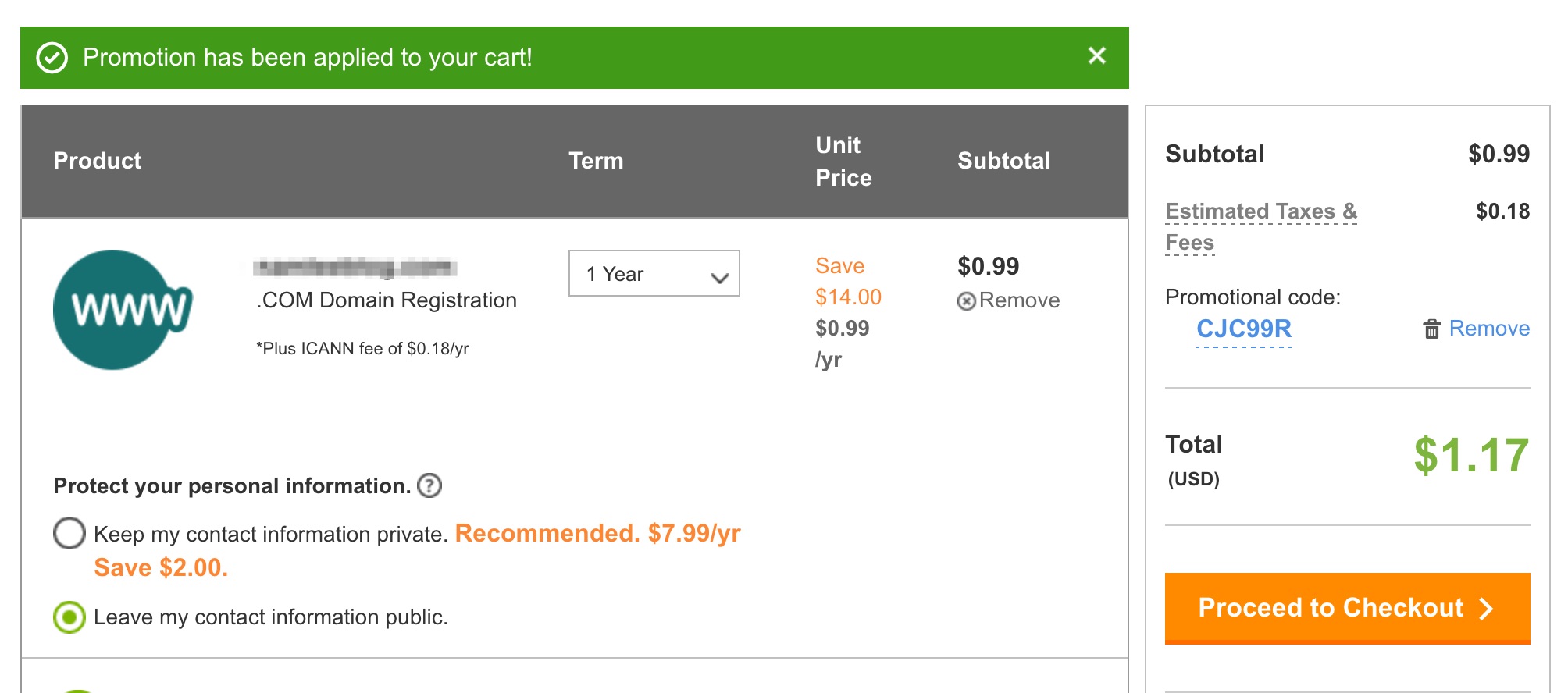
A 99-cent .com domain is a promotional introductory offer provided by domain registrars to attract new customers, allowing them to register a top-level domain for less than a dollar for the first year. This pricing strategy serves as a loss leader, lowering the entry barrier for new digital projects while requiring awareness of higher subsequent renewal rates.
The landscape of web ownership has shifted significantly by 2026, yet the allure of the "99-cent .com" remains a cornerstone of digital marketing for major registrars. While the underlying costs of maintaining the internet's infrastructure have risen, these promotional windows offer a unique, albeit temporary, financial advantage for entrepreneurs, developers, and hobbyists. To navigate these offers effectively, one must understand the mechanics of domain registration, the hidden economics of the registrar business model, and the long-term implications of "cheap" digital real estate.
The Anatomy of a 99-Cent Domain Offer
To understand what a 99-cent domain is, we must first distinguish between the various entities involved in your website's address. The Registry (for .com, this is Verisign) owns the rights to the extension and sets a wholesale price. The Registrar (such as GoDaddy, Namecheap, or IONOS) is the retail outlet where you buy the name. Finally, ICANN (the Internet Corporation for Assigned Names and Numbers) levies a small mandatory fee on every transaction.
In 2026, the wholesale price for a .com domain is significantly higher than 99 cents. Due to scheduled price increases permitted by historical agreements, the base cost for a registrar to "buy" a .com name for a user is well above $10. When a registrar offers a domain for 99 cents, they are operating at a net loss of approximately $9 to $11 per registration.
This offer is almost always restricted to:
- New Customers Only: Registrars use these deals to build their database.
- The First Year: The 99-cent price applies only to the initial 12-month term.
- One Per Account: To prevent bulk buyers (domainers) from exploiting the loss-leader pricing.
- Specific Extensions: While the .com is the most popular, occasionally .net or .org names feature similar promos.
The Economics: Why Registrars Offer Loss Leaders
It may seem counterintuitive for a business to lose money on every sale, but the 99-cent domain is a classic example of Customer Acquisition Cost (CAC). In the highly competitive world of web services, the initial domain registration is merely the "hook."
Lifetime Value (LTV)
The primary reason these offers matter to registrars is the Lifetime Value of a customer. Once a user registers a domain, they are statistically likely to keep it for several years. Since moving a domain to another provider involves a technical process (transferring) and often a fee, most users stay put. The registrar recoup their initial $10 loss during the second year when the domain renews at the standard retail rate, which in 2026 typically ranges between $18.99 and $24.99.
Ecosystem Upselling
A domain name is a "dormant" asset; it does nothing on its own. To make it functional, a user needs hosting, email services, SSL certificates, and security features. Registrars use the 99-cent domain to get the user into their ecosystem, where they can sell high-margin services:
- Web Hosting: Monthly fees that far exceed the annual cost of a domain.
- Professional Email: Branded email addresses (you@yourdomain.com).
- Privacy Protection: Shielding personal contact info from the WHOIS database.
- Website Builders: Drag-and-drop tools with recurring subscription fees.
Why the 99-Cent .com Matters for Your Strategy
For a business owner or developer in 2026, these offers are more than just a discount; they are a strategic tool for testing and deployment. However, they come with caveats that can affect the long-term health of a digital project.
1. Lowering the Barrier for MVPs
Minimum Viable Products (MVPs) are essential for modern entrepreneurship. If you have an idea for a niche tool or a local service, a 99-cent domain allows you to "land grab" the brand name and set up a landing page for less than the price of a cup of coffee. This encourages experimentation without the "sunk cost" fallacy that comes with expensive annual commitments.
2. Brand Protection and Squatting
Large organizations often buy variations of their primary domain to prevent brand dilution or phishing. While "domain squatting" for profit is increasingly regulated, buying "yourbrand-sale.com" or "yourbrand-app.com" for 99 cents is a cost-effective way to secure your intellectual property perimeter for at least a year.
3. The Renewal Cliff
The most significant reason the 99-cent domain matters is the renewal cliff. Users often forget that the second year will cost 20 times more than the first. In a portfolio of 50 or 100 "test" domains, a 99-cent entry point can lead to a multi-thousand dollar bill 12 months later. Strategic users must set audits for their domain portfolios to ensure they aren't auto-renewing low-value assets at premium prices.
Comparing Domain Registration Models in 2026
Not all "cheap" domains are created equal. When evaluating a 99-cent offer, it is vital to compare it against the "Transparent Pricing" models that have gained popularity among developers and tech-savvy users.
| Feature | 99-Cent Promotional Model | Transparent/Flat-Fee Model |
|---|---|---|
| Year 1 Cost | $0.99 | $11.00 – $14.00 |
| Year 2+ Cost | $19.99 – $29.99 | $11.00 – $14.00 |
| WHOIS Privacy | Often an Add-on ($10-$15) | Usually Included Free |
| ICANN Fee | Usually excluded (Add $0.18) | Usually Included |
| Best For | One-off projects, MVPs, Short-term sites | Long-term brands, Professional portfolios |
| Ease of Transfer | May have "lock-in" hurdles | Standard 60-day ICANN lock |
Technical Considerations and "The Fine Print"
When you see a 99-cent advertisement, the technical and legal "fine print" determines the true value of the deal. In 2026, several factors have become standard in these agreements that users must verify.
WHOIS Privacy and Data Protection
In the past, WHOIS privacy (which replaces your home address and phone number in the public registry with proxy info) was an optional luxury. In the current regulatory environment, privacy is a necessity to avoid spam and identity theft. Many 99-cent offers omit this, charging an extra $10 to $15. If the privacy isn't included, your "99-cent" domain actually costs $11.00 or more on day one.
The 60-Day Transfer Lock
ICANN mandates a 60-day lock on all new domain registrations. This means you cannot register a domain for 99 cents at "Registrar A" and immediately move it to "Registrar B" to avoid their high renewal fees. You are effectively committed to that registrar for the first two months, and practically speaking, most users find it easier to just stay for the full year.
DNS Management Limitations
Some ultra-low-cost registrars limit your ability to manage DNS records (A, CNAME, MX) unless you upgrade to a "pro" tier. For a 99-cent domain to "matter" and be useful, you must have full control over where the domain points so you can use third-party hosting or email providers. Always verify that Full DNS Control is included in the promotional price.
Common Pitfalls to Avoid
The 99-cent domain market is a minefield for the unwary. To ensure these offers serve your interests rather than just the registrar's bottom line, avoid these common mistakes:
- Ignoring Auto-Renew: Most registrars enable auto-renew by default. If you register a domain for a "joke" or a weekend project and forget about it, you will be billed the full retail price (e.g., $24.99) a year later.
- Using Fake Information: Because these deals are for "New Customers Only," some users try to create multiple accounts with fake names. This violates the registrar's Terms of Service and ICANN's accuracy requirements, leading to the immediate suspension of the domain without a refund.
- Overlooking the ICANN Fee: The $0.18 ICANN fee is a mandatory pass-through cost. A "99-cent" domain is almost always $1.17 at checkout. While a few cents won't break the bank, it's a sign of a transparent registrar if they disclose this upfront.
- Bundled "Free" Trials: Often, the 99-cent domain comes with a "Free 30-Day Trial" of a website builder or email marketing tool. These trials frequently have "gotcha" clauses where they automatically convert to paid subscriptions ($20+/month) unless manually canceled.
How to Secure a 99-Cent Domain Safely
If you have a specific project in mind and want to take advantage of these rates in 2026, follow this sequence to ensure a smooth experience:
- Step 1: Research the Registrar's Reputation. Use resources like the Better Business Bureau or Trustpilot to ensure the registrar doesn't have a history of "hostage-taking" (making it impossible to transfer out).
- Step 2: Check the Renewal Rate. Before clicking "Buy," look for the small text that says "Renews at $XX.XX." If that number is above $25 for a .com, the initial 99-cent saving may not be worth the long-term cost.
- Step 3: Verify Privacy Inclusion. Check if "WHOIS Privacy" or "Domain Privacy" is listed as $0.00. If it's a paid add-on, factor that into your initial cost.
- Step 4: Use a Dedicated Email for the Account. Since these are "New Customer" deals, ensure your account information is accurate but organized so you can track renewal notices.
- Step 5: Disable Auto-Renew Immediately. Once the purchase is complete, go into your dashboard and toggle off auto-renew. This forces you to make a conscious decision in 11 months whether the project is worth the $20+ renewal fee.
Frequently Asked Questions
Is a 99-cent domain as good as a regular-priced domain?
Yes, from a technical standpoint. A .com domain registered for 99 cents functions exactly like one registered for $50. It lives on the same DNS servers and is recognized by all browsers. The only difference is the contractual price you pay the registrar and the specific terms regarding renewals and transfers.
Can I buy 100 domains for 99 cents each?
Generally, no. Registrars lose money on these sales and strictly limit them to one per customer. Attempting to bypass this with multiple accounts often results in all domains being revoked. If you need bulk domains, you should look for "Bulk Pricing" tiers, which usually hover around the $10-$12 mark.
Why does the price jump so much after the first year?
The 99-cent price is a marketing expense for the registrar. They are paying the difference to the Registry (Verisign) out of their own pocket. The second-year price is the "real" price, which includes the Registry cost, the ICANN fee, and the registrar’s profit margin.
Can I transfer my 99-cent domain to another registrar before it expires?
You can transfer the domain after the initial 60-day ICANN lock period has passed. However, most registrars require you to pay for an additional year of registration at the new registrar when you transfer. Therefore, you cannot simply hop from one 99-cent deal to another every year without eventually paying standard rates.
What happens if I let my 99-cent domain expire?
If you don't renew, the domain will go through a "Grace Period" (usually 30 days) where you can still reclaim it for the standard renewal fee. After that, it enters a "Redemption Period" where the cost to get it back can exceed $100. Finally, it is released back to the public, where someone else can buy it.
Final Recommendation
In 2026, the 99-cent .com domain remains a powerful tool for entry-level digital presence. It is best used for short-term projects, testing marketing ideas, or securing a brand name while you decide on a business direction. However, for long-term professional websites, the initial savings of $10 are negligible compared to the importance of a registrar with transparent pricing, excellent support, and bundled privacy. Use the 99-cent offer to get started, but always have a budget plan for the "Year 2" price increase to ensure your digital assets remain secure and online.