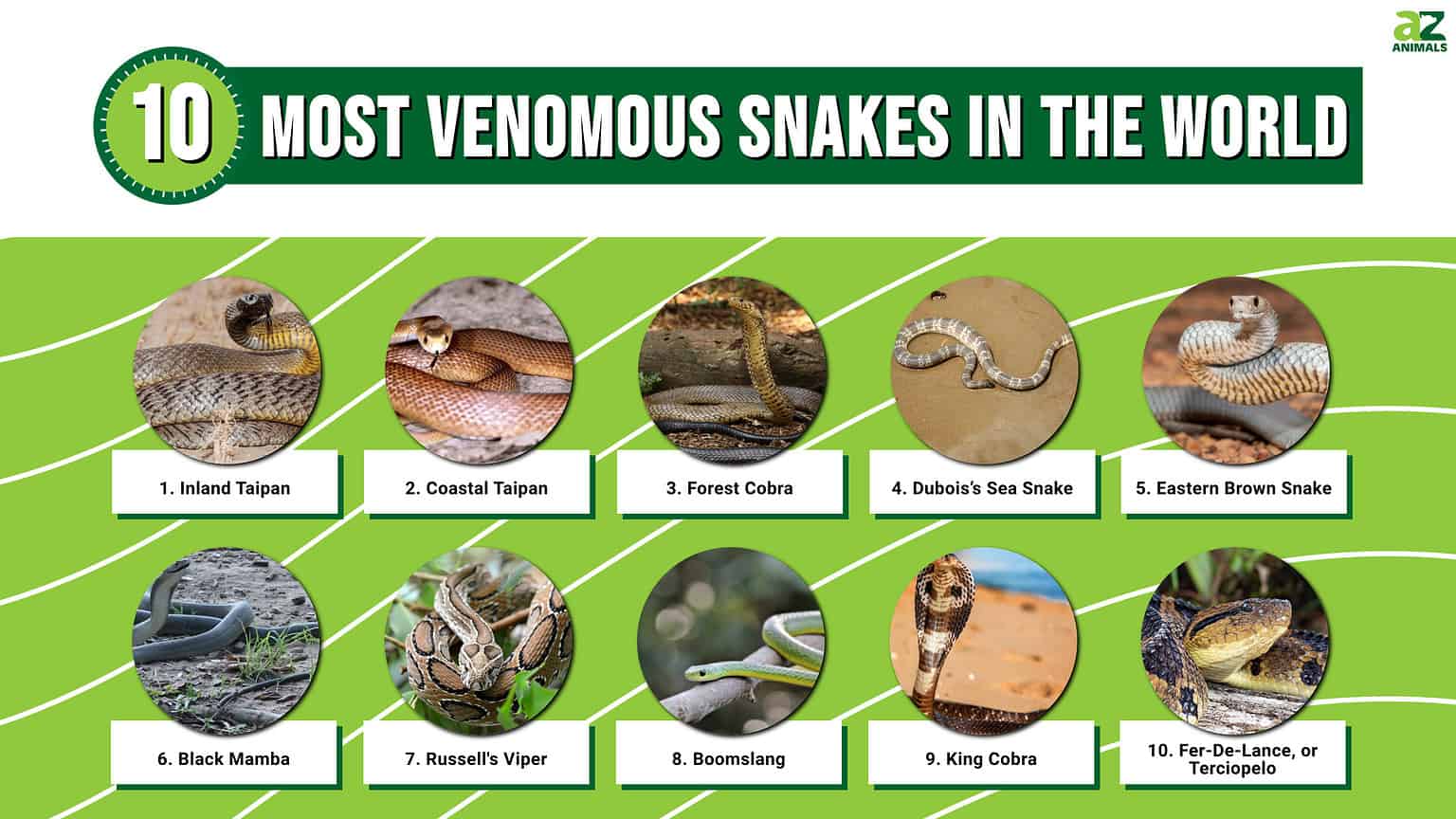
Assessing the most dangerous snakes on earth requires examining a combination of toxicity (measured by median lethal dose, or LD50), venom yield, defensive disposition, and the availability of antivenom within their native ranges. While species like the Inland Taipan possess the most potent venom by laboratory metrics, others like the Saw-scaled Viper are responsible for more human fatalities annually due to their aggressive nature and proximity to human settlements.
Understanding Snake Venom and Toxicity Metrics
To evaluate snake danger accurately, herpetologists and toxicologists rely on specific scientific metrics. The most common baseline for venom potency is the median lethal dose, or LD50, typically measured in milligrams of venom per kilogram of body weight ($\text{mg/kg}$). A lower LD50 value indicates a more potent venom, as a smaller quantity is required to prove fatal in laboratory testing models (usually mice). However, laboratory toxicity does not always translate to human risk in the wild.
Several additional ecological and biological factors dictate how dangerous a snake is to humans:
- Venom Yield: The average volume of venom a snake can deliver in a single strike. A species with moderately toxic venom that delivers a massive dose can be far more lethal than one with highly toxic venom but a low delivery capacity.
- Delivery Mechanism: The length and structure of the fangs. Proteroglyphous snakes (fixed front fangs) and solenoglyphous snakes (hinged, hollow fangs) inject venom much more efficiently than opisthoglyphous (rear-fanged) species.
- Behavioral Disposition: How easily a snake is provoked, its warning behaviors, and its tendency to flee versus strike. Cryptic coloration also plays a role in how often humans accidentally step on or disturb them.
- Geographic Proximity: Snakes living in densely populated agricultural or urban fringes encounter humans far more frequently than remote desert or rainforest dwellers, drastically altering regional bite statistics.
The Top 10 Most Dangerous Snakes
1. Inland Taipan (Oxyuranus microlepidotus)
Found in the semi-arid cracking clay soils of central Australia, the Inland Taipan is widely recognized as having the most toxic venom of any land snake on earth. Its venom is a complex cocktail containing neurotoxins, myotoxins, and procoagulants. A single bite can paralyze the nervous system, disrupt blood clotting, and cause rapid tissue breakdown. Despite its extreme toxicity, the Inland Taipan is exceptionally shy, rarely encountered by humans, and docile when handled. No fatalities have been recorded in the modern era due to the swift and widespread availability of effective antivenom.
2. Common Krait (Bungarus caeruleus)
Native to the Indian subcontinent, the Common Krait is a nocturnal predator whose danger is amplified by its stealthy habits. Krait venom consists primarily of powerful presynaptic neurotoxins that block chemical transmission at nerve-muscle junctions. Bites are notoriously painless—often occurring while a person is sleeping indoors—meaning victims may not realize they have been envenomated until systemic paralysis sets in hours later. Without prompt mechanical ventilation and antivenom, mortality rates are extremely high.
3. Eastern Brown Snake (Pseudonaja textilis)
Inhabiting eastern and central Australia, the Eastern Brown Snake is responsible for more snakebite fatalities in Australia than any other species. It possesses highly potent neurotoxic and procoagulant venoms that rapidly induce progressive paralysis and coagulopathy, preventing the blood from clotting. This species is fast-moving, easily agitated, and quick to defend itself when cornered, frequently lifting its body into an 'S' shape and striking with speed.
4. Black Mamba (Dendroaspis polylepis)
Endemic to sub-Saharan Africa, the Black Mamba is feared for its speed, size, and potent neurotoxic venom. Capable of slithering at speeds up to 16-20 kilometers per hour over short distances, it is the fastest land snake in the world. Its venom contains dendrotoxins that disrupt nerve impulses, causing respiratory failure and cardiovascular collapse within minutes. The Black Mamba has a reputation for being defensive when cornered, raising its head, gaping to display a black mouth lining, and delivering multiple strikes.
5. Saw-Scaled Viper (Echis carinatus)
While not possessing the most toxic venom on this list, the Saw-scaled Viper—found across parts of the Middle East, Central Asia, and the Indian subcontinent—is widely considered one of the deadliest snakes to humans globally. It causes more human deaths annually than almost any other snake species. This is due to its wide distribution, aggressive temperament, tendency to inhabit agricultural areas, and potent hemotoxic venom that causes severe internal hemorrhaging and coagulopathy. When threatened, it rubs its specialized scales together to produce a loud, rasping warning sound.
6. Russell’s Viper (Daboia russelii)
Another member of the "Big Four" responsible for the majority of snakebite casualties in South Asia, Russell’s Viper is a heavy-bodied, nocturnal ambush predator. Its venom is a complex mixture affecting multiple physiological systems, causing severe pain, local necrosis, disseminated intravascular coagulation (DIC), acute kidney injury, and pituitary infarction. Its long fangs and high venom yield make untreated bites frequently fatal or permanently debilitating.
7. Fer-de-Lance (Bothrops asper)
Ranging from southern Mexico through Central America and into northern South America, the Fer-de-Lance is a large, highly adaptable pit viper responsible for a significant percentage of snakebites within its range. Females are large and produce large litters, increasing local population densities near plantations and rural dwellings. The hemotoxic venom causes massive local tissue destruction, blistering, necrosis, and systemic bleeding disorders. Their cryptic coloration makes them difficult to spot among leaf litter.
8. Coastal Taipan (Oxyuranus scutellatus)
Larger and more frequently encountered than its inland cousin, the Coastal Taipan is found across northern and eastern Australia as well as parts of New Guinea. It is a large, alert, and formidable predator with specialized venom that attacks the nervous system and impairs the blood's ability to clot. Unlike the reclusive Inland Taipan, the Coastal Taipan will aggressively defend itself when cornered, striking with blinding speed and injecting large quantities of venom.
9. King Cobra (Ophiophagus hannah)
As the world's longest venomous snake, reaching lengths of up to 5.5 meters, the King Cobra commands respect across Southeast Asia and the Indian subcontinent. It feeds primarily on other snakes. Its venom is less toxic by volume than that of some elapids, but the sheer quantity delivered in a single bite—up to several milliliters—is enough to kill an adult human or even an adult elephant within hours. King Cobras are intelligent, capable of lifting a third of their body off the ground to eye level, and can deliver multiple strikes in succession.
10. Blue Krait (Bungarus candidus)
Found in Southeast Asia, the Blue Krait (or Malayan Krait) features a venom that is roughly 16 times more toxic than that of a cobra. Its venom attacks the central nervous system, inducing severe muscle cramps, spasms, and eventual total paralysis. Though nocturnal and generally docile during daylight hours, bites sustained at night carry an exceptionally high mortality rate, even with the administration of specialized antivenom, due to rapid respiratory paralysis.
Comparison of Dangerous Snake Characteristics
| Common Name | Primary Geographic Region | Main Venom Type | Typical Behavioral Response | Antivenom Availability |
|---|---|---|---|---|
| Inland Taipan | Australia | Neurotoxin / Myotoxin | Shy, flees if possible | High (Australia) |
| Common Krait | South Asia | Neurotoxin | Nocturnal, defensive if touched | Moderate (Regional) |
| Eastern Brown Snake | Australia | Procoagulant / Neurotoxin | Aggressive when cornered | High (Australia) |
| Black Mamba | Sub-Saharan Africa | Neurotoxin / Cardiotoxin | Highly defensive when cornered | Moderate |
| Saw-scaled Viper | Middle East, South Asia | Hemotoxin | Readily strikes when approached | Moderate |
| Russell’s Viper | South Asia | Hemotoxin / Cytotoxin | Sluggish until disturbed, then aggressive | Moderate |
| Fer-de-Lance | Central and South America | Hemotoxin | Camouflaged, strikes defensively | Moderate |
| Coastal Taipan | Australia, New Guinea | Neurotoxin / Procoagulant | Alert, defends vigorously | High / Moderate |
| King Cobra | South Asia, Southeast Asia | Neurotoxin | Erect posture, forward strikes | Moderate |
| Blue Krait | Southeast Asia | Neurotoxin | Sluggish by day, active at night | Limited / Moderate |
Prevention and Emergency Response Guidelines
Encountering dangerous snakes in their natural habitats requires strict adherence to safety protocols to prevent envenomation. Most bites occur when a snake is accidentally stepped on, deliberately handled, or cornered.
- Personal Protective Equipment: Always wear sturdy leather boots, heavy trousers, and thick socks when walking through tall grass, dense brush, or rocky terrain within known venomous snake ranges.
- Visual Awareness: Never reach blindly into hollow logs, under rocks, or into piles of brush. Use a long stick or tool to inspect areas before placing hands near them.
- Lighting: Use a bright flashlight when walking outdoors at night in tropical or subtropical regions, as many dangerous species (such as kraits and vipers) are strictly nocturnal.
- First Aid Protocols: If a bite occurs, keep the victim calm and still to slow the spread of venom through the lymphatic system. Immobilize the bitten limb with a splint if possible. Do not attempt to cut the wound, suck out the venom, apply tourniquets, or use ice. Transport the victim to the nearest medical facility equipped with mechanical ventilation and appropriate antivenom immediately.
Frequently Asked Questions
Which snake has the most toxic venom in the world?
The Inland Taipan (Oxyuranus microlepidotus) holds the record for the most toxic land snake venom based on median lethal dose ($\text{LD50}$) testing in laboratory models. A single drop of its venom is theoretically potent enough to kill up to 100 human adults, though effective antivenom prevents fatalities in modern clinical settings.
Do all snakebites inject venom?
No. Venomous snakes can deliver what is known as a "dry bite," where they strike without injecting venom or release only a fraction of their total reserve. Up to 50% of bites from certain species may be dry bites, though any suspected envenomation must be treated immediately as a medical emergency until proven otherwise by clinical observation.
What should I do immediately if someone is bitten by a venomous snake?
Call emergency services immediately. Keep the victim calm and immobile to slow venom circulation. Remove rings, watches, or tight clothing near the bite area before swelling begins. Do not cut, suck, ice, or apply tourniquets to the wound. Rapid transport to a hospital is the single most critical intervention.
Are sea snakes more dangerous than land snakes?
Many sea snakes (such as the Belcher's sea snake or Dubois' seasnake) possess extremely potent neurotoxic venoms that exceed those of most land snakes. However, they rarely bite humans unless heavily provoked, such as when accidentally caught in fishing nets, and human encounters are statistically rare compared to terrestrial species.
How does antivenom work?
Antivenom is manufactured by immunizing horses or sheep with small, sublethal doses of specific snake venoms. The animal's immune system produces antibodies against the toxins, which are then harvested, purified, and refined into clinical antivenom. When administered to a human patient, these antibodies bind to the venom molecules and neutralize their harmful effects in the bloodstream.
Practical Next Actions
If you live, work, or travel in regions inhabited by dangerous snakes, prioritize proactive environmental management. Clear tall grass, brush, and woodpiles away from residential buildings to eliminate rodent populations that attract predatory snakes. Maintain heavy-duty door seals and secure window screens to prevent nocturnal species from entering living spaces. In the event of an outdoor excursion, carry a fully charged communication device, study local medical facilities that stock polyvalent or monovalent antivenoms, and always prioritize professional emergency evacuation procedures over unverified traditional remedies.