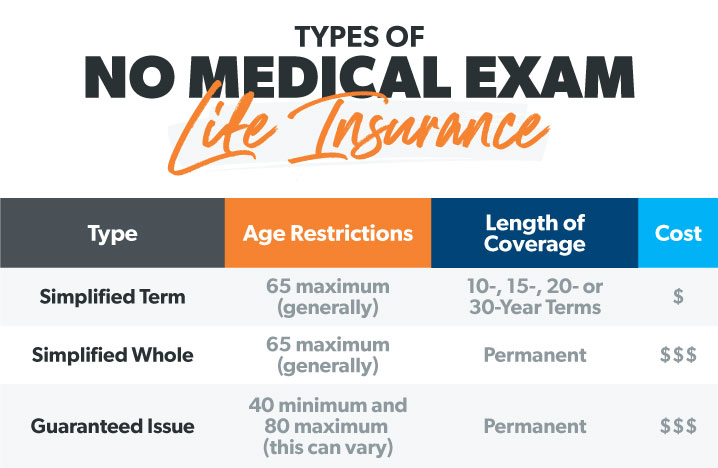
Life insurance options for individuals aged 50 and older that do not require a medical exam include simplified issue term life, guaranteed issue whole life, final expense insurance, and group life through an employer. These policies utilize "no-exam" underwriting, which leverages digital medical records and health questionnaires instead of physical examinations, blood tests, or physician statements to determine eligibility.
For many individuals entering their 50s and 60s, the prospect of a medical exam can be a significant barrier to securing life insurance. Whether due to a history of chronic conditions like hypertension or diabetes, or simply a desire for a faster application process, "no medical exam" policies have become a cornerstone of the 2026 insurance market. As of 2026, the technology behind accelerated underwriting has matured, allowing carriers to offer substantial coverage amounts without the traditional "needle and cup" requirements.
Understanding the Landscape of No-Exam Underwriting
Before exploring specific policy options, it is essential to understand how insurance companies assess risk without a physical exam. In 2026, the industry relies heavily on Big Data and predictive modeling. When you apply for a no-exam policy, the carrier typically checks several databases:
- MIB Group (formerly Medical Information Bureau): A central database that tracks previous insurance applications and disclosed medical conditions.
- Prescription History Reports: Specialized reports (such as Milliman IntelliScript) that show medications prescribed to you over the last 5–10 years.
- Motor Vehicle Records (MVR): Your driving history, which insurers use to gauge lifestyle risk.
- Digital Health Records: In many jurisdictions, insurers can now access electronic health records (EHR) with your consent to verify health history instantly.
By aggregating this data, insurers can offer policies that are issued in days—or even minutes—rather than weeks. However, because the insurer takes on more "unknown" risk by skipping the exam, these policies often carry higher premiums or lower coverage caps compared to fully underwritten policies.
1. Simplified Issue Term Life Insurance
Simplified issue term life insurance is designed for those who are in relatively good health but want to skip the inconvenience of a medical exam. Unlike traditional term life, which can take 4–8 weeks for approval, simplified issue policies are often approved within 24 to 72 hours.
How It Works
Applicants must complete a detailed health questionnaire. Questions usually cover major health events, such as heart attacks, cancer, or strokes, as well as chronic conditions like COPD or kidney disease. In 2026, many carriers have streamlined these questionnaires to focus on the "last 10 years" of health history.
Coverage and Costs
- Death Benefit: Usually ranges from $50,000 to $500,000, though some "accelerated" programs now offer up to $1 million for applicants under age 60.
- Term Lengths: Available in 10, 15, 20, or 30-year increments.
- Suitability: This is best for 50-year-olds who have minor health issues (like controlled high blood pressure) but generally lead a healthy lifestyle and need significant coverage for a mortgage or income replacement.
2. Guaranteed Issue Whole Life Insurance (GIWL)
Guaranteed issue whole life is the most accessible form of life insurance. As the name suggests, acceptance is guaranteed regardless of health status. There are no medical exams and no health questions.
The Graded Death Benefit
The most critical feature of a guaranteed issue policy is the Graded Death Benefit. Because the insurer is taking on individuals who may be terminally ill, they protect themselves with a waiting period—usually the first two years of the policy. If the insured dies of natural causes during this period, the beneficiary does not receive the full death benefit. Instead, they receive a refund of all premiums paid plus interest (typically 10%). If death occurs by accident during the waiting period, the full benefit is usually paid.
Coverage and Costs
- Death Benefit: Typically capped at $25,000 or $30,000.
- Premiums: These are the most expensive policies per dollar of coverage.
- Suitability: Reserved for those with serious health conditions (such as active cancer, congestive heart failure, or dementia) who cannot qualify for any other type of coverage.
3. Final Expense or Burial Insurance
Final expense insurance is a specialized type of simplified issue whole life insurance. Its primary purpose is to cover the costs associated with end-of-life expenses, such as funeral services, cremations, and small outstanding debts.
Characteristics
Final expense policies are "permanent" insurance, meaning they do not expire as long as premiums are paid. They also build a small amount of cash value over time. Unlike guaranteed issue policies, final expense insurance usually requires you to answer a few health questions. If you can answer "no" to the major health questions, you can avoid the 2-year waiting period found in guaranteed issue plans.
Coverage and Costs
- Death Benefit: Generally $5,000 to $50,000.
- Suitability: Ideal for seniors over 60 or 70 who do not need a large policy but want to ensure their family is not burdened by funeral costs.
4. Group Life Insurance via Employer
Many people over 50 are still in the workforce. One of the most overlooked "no-exam" options is the group life insurance provided by an employer. Most companies offer a basic benefit (often 1x or 2x your annual salary) for free or at a very low cost.
Guaranteed Issue Limits
Group plans often have a "guaranteed issue limit." This is the amount of coverage you can purchase without providing evidence of insurability (EOI). For example, a company might allow employees to buy up to $150,000 in coverage without a medical exam, regardless of their health history.
Limitations
- Portability: The biggest drawback is that the coverage usually ends when you leave the job. While some policies are "portable" or "convertible" to individual plans, the premiums often spike significantly once you are no longer part of the group.
- Control: You do not own the policy; the employer does. They can change carriers or cancel the benefit at any time.
5. Accelerated Underwriting (Instant-Decision Term)
In 2026, the line between "simplified issue" and "traditional term" has blurred due to Accelerated Underwriting (AU). This is a process where high-tech algorithms analyze your application data in real-time to offer an "instant" decision.
How It Differs
Unlike simplified issue, which is a specific product, accelerated underwriting is a process applied to standard term policies. If the algorithm determines you are a low risk based on your data footprints, the medical exam is waived entirely. If the algorithm sees "red flags," you may be asked to complete a traditional exam.
Coverage and Costs
- Death Benefit: Can exceed $1 million.
- Pricing: You get "fully underwritten" rates, which are significantly lower than simplified issue rates.
- Suitability: Best for those over 50 who are in excellent health and want the lowest possible price without the hassle of a medical exam.
6. Accidental Death and Dismemberment (AD&D)
While technically not "life insurance" in the traditional sense, AD&D is often marketed as a no-exam alternative. It pays a benefit only if the cause of death is a covered accident (e.g., a car crash or a fall).
Crucial Caveat
AD&D does not pay out if the insured dies of natural causes, such as a heart attack, stroke, or cancer. Since the vast majority of deaths for those over 50 are caused by illness, AD&D should generally be viewed as a supplement to, rather than a replacement for, life insurance.
Suitability
- Acceptance: 100% guaranteed, usually with no health questions.
- Cost: Very inexpensive compared to life insurance.
- Best For: Individuals who are completely uninsurable for life insurance and want at least some protection against accidental loss.
7. Guaranteed Universal Life (GUL)
Guaranteed Universal Life (GUL) functions like a hybrid between term and whole life. It is often available with a "no-exam" rider for applicants in their 50s. GUL allows you to choose a "lapse protection" age, such as age 90, 95, or 121.
The Advantage of GUL
Unlike term insurance, which might expire when you are 70 or 75, a GUL policy stays in force as long as you pay the level premium. It is much cheaper than traditional whole life because it does not focus on building cash value; it focuses purely on the death benefit.
Coverage and Costs
- Death Benefit: Usually starts at $25,000 and goes up to $250,000 for no-exam versions.
- Suitability: Excellent for those who want permanent coverage to leave a specific legacy or cover estate taxes but don't want to pay the high costs of whole life.
Comparison of No-Medical-Exam Options for Seniors (2026 Data)
| Policy Type | Typical Max Benefit | Medical Questions? | Waiting Period? | Best For |
|---|---|---|---|---|
| Simplified Issue Term | $500,000+ | Yes (Detailed) | No | Income replacement / Mortgage |
| Guaranteed Issue Whole Life | $25,000 | No | Yes (2 Years) | Serious health conditions |
| Final Expense | $50,000 | Yes (Simple) | Usually No | Funeral / Burial costs |
| Group Life (Employer) | Varies by salary | No (up to limit) | No | Working professionals |
| Accelerated Underwriting | $1M+ | Yes (Extensive) | No | Healthy 50+ looking for value |
| Accidental Death (AD&D) | $500,000+ | No | No | Supplemental "accident only" |
| Guaranteed Universal Life | $250,000 | Yes (Varies) | No | Permanent low-cost coverage |
Critical Factors for the 50+ Applicant
When navigating these seven options, three factors will dictate your success and your monthly budget: the contestability period, the cost of waiting, and the impact of inflation.
The Contestability Period
Every life insurance policy has a Contestability Period, typically the first two years. If you die within this window, the insurance company has the legal right to review your original application for accuracy. If you failed to disclose a medical condition that would have caused them to deny the policy, they can deny the claim and simply refund the premiums. In the "no-exam" world, honesty on the health questionnaire is paramount because the insurer has fewer data points to begin with.
The Cost of Waiting
In your 50s, life insurance premiums increase by roughly 8% to 12% for every year you age. Furthermore, health conditions that are manageable today could become "uninsurable" tomorrow. If you are considering a no-exam policy because you are currently managing a condition like Type 2 diabetes, it is often better to lock in a rate now than to wait.
Inflationary Considerations in 2026
With the rising costs of medical care and funeral services, a $10,000 burial policy purchased in 2010 might no longer cover a standard service in 2026. When selecting a death benefit, it is wise to factor in a 3-4% annual increase in costs to ensure the policy remains sufficient for its intended purpose.
Frequently Asked Questions
Can I get no-exam life insurance if I have a pre-existing condition?
Yes. Depending on the severity of the condition, you would look at either Simplified Issue (for mild to moderate conditions like controlled high blood pressure) or Guaranteed Issue (for severe conditions like recent heart surgery or terminal illness). Guaranteed issue policies do not ask any health questions, making them the default choice for those with significant medical histories.
Why is no-medical-exam insurance more expensive?
Insurers use a concept called "adverse selection." They assume that people who actively seek out no-exam policies may be hiding health issues. To offset this "unknown risk," they charge higher premiums than they would for a policy where they have full access to your bloodwork and physical stats. By skipping the exam, you are essentially paying for the convenience and the lack of medical scrutiny.
Is there an age limit for these policies?
Most no-exam term policies are available up to age 70 or 75. Final expense and guaranteed issue whole life policies are often available to applicants as old as 80 or 85. However, as you cross the age 75 threshold, the options become significantly more limited and the premiums rise sharply.
What happens if I lie on the health questionnaire?
Lying on a life insurance application is considered material misrepresentation (insurance fraud). If the insurer discovers the lie during the two-year contestability period, they can void the policy. If the lie is discovered after the insured dies, the company may refuse to pay the death benefit to the beneficiaries, only returning the premiums paid.
Does "No Medical Exam" mean "No Health Questions"?
No. This is a common misconception. "No medical exam" simply means no needles, no physical exams by a nurse, and no fluid samples. Most of these policies (except for Guaranteed Issue) still require you to answer health questions and grant the insurer access to your digital medical and prescription records.
Final Recommendation: How to Choose
Choosing the right life insurance in your 50s depends entirely on your Health and your Need.
- If you are healthy: Pursue Accelerated Underwriting or Simplified Issue Term. You will get much higher coverage amounts for a lower monthly cost.
- If you have manageable health issues: Look into Final Expense or Guaranteed Universal Life. These provide permanent peace of mind without the rigors of a physical.
- If you have been declined elsewhere: Your only viable option is Guaranteed Issue Whole Life. While expensive and subject to a 2-year waiting period, it ensures that you have at least some coverage for your loved ones.
Before applying, consult with an independent insurance broker who has access to multiple carriers. In 2026, many carriers specialize in specific niches—such as "diabetic-friendly" or "smoker-friendly" no-exam policies—and a specialist can help you navigate to the carrier most likely to offer an instant approval at the best rate.
Disclaimer: This information is for educational purposes and does not constitute financial or legal advice. Insurance regulations vary by jurisdiction. Consult with a licensed insurance professional before making a purchase.