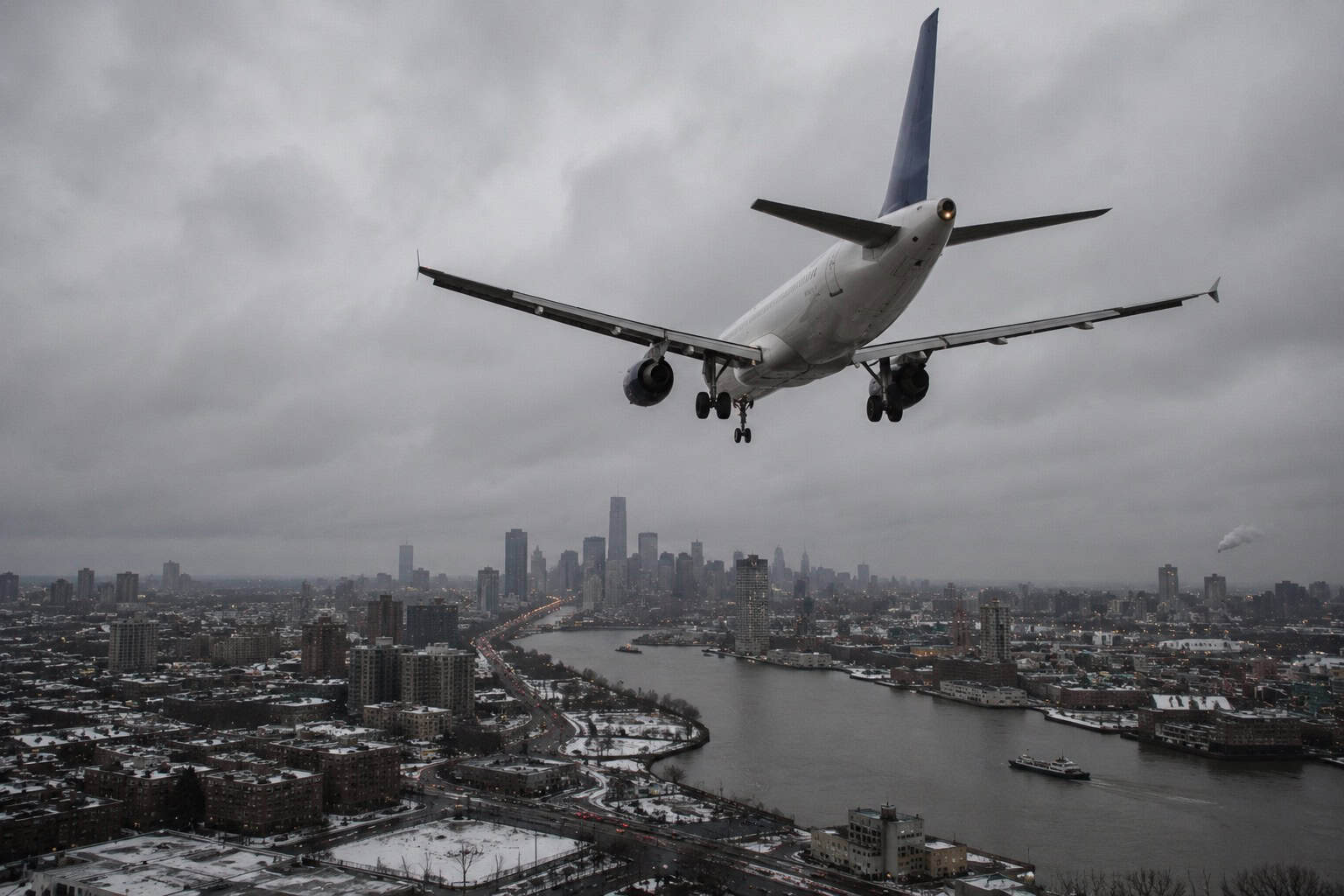
On January 15, 2009, US Airways Flight 1549 performed an emergency landing on the Hudson River after a catastrophic bird strike disabled both engines shortly after takeoff from LaGuardia Airport. The flight path was defined by a rapid, controlled descent from an altitude of approximately 3,000 feet, prioritizing a water landing over an impossible attempt to reach nearby runways.
The Sequence of Events: Departure and Immediate Crisis
US Airways Flight 1549, an Airbus A320-214 piloted by Captain Chesley "Sully" Sullenberger and First Officer Jeffrey Skiles, departed LaGuardia Airport (LGA) in New York City at 3:25 PM Eastern Standard Time. The flight was bound for Charlotte Douglas International Airport (CLT). The initial phase of the flight path followed standard departure procedures, climbing out toward the north over the Bronx.
Approximately 90 seconds into the flight, while the aircraft was climbing through 2,800 feet, the plane encountered a flock of Canada geese. The ingestion of these birds into both CFM56-5B4/P turbofan engines resulted in an immediate and near-total loss of thrust. At this precise moment, the flight path transitioned from a scheduled commercial departure to an emergency glide.
Navigating the Hudson: The Decision-Making Process
Once it became clear that the engines could not be restarted, the cockpit crew had to make split-second decisions regarding the aircraft's trajectory. The National Transportation Safety Board (NTSB) investigation later verified that the pilots evaluated two immediate options: attempting to return to LaGuardia or attempting to land at Teterboro Airport (TEB) in New Jersey.
Evaluating the Return to LaGuardia
The flight path back to LaGuardia would have required a 180-degree turn. Given the altitude and the speed of the aircraft, the crew determined that they did not possess the necessary energy—a combination of airspeed and altitude—to clear the urban landscape and make a safe landing on a runway.
Considering Teterboro Airport
Teterboro was also considered, but Captain Sullenberger concluded that the distance and the nature of the turn would prevent the aircraft from reaching the tarmac safely. Instead, Sullenberger identified a clear stretch of the Hudson River as the only viable surface for a forced landing. The resulting flight path became a southward glide toward the river, keeping the aircraft over the water to avoid densely populated residential and commercial zones.
Technical Analysis of the Glide Profile
The Airbus A320 is equipped with fly-by-wire technology, which proved critical during the descent. When the engines failed, the aircraft automatically entered "alternate law" mode. The flight path was no longer governed by standard climb thrust but by the laws of aerodynamics acting upon a heavy glider.
The crew maintained a "best glide" speed, which is the specific airspeed that maximizes the distance an aircraft can travel for every foot of altitude lost. By keeping the nose pointed toward the river and managing the pitch to maintain this optimal speed, the pilots were able to control the energy of the aircraft until the final moments before impact.
Summary of Key Performance Parameters
| Parameter | Value (Approximate) | Significance |
|---|---|---|
| Initial Altitude at Impact | 2,800–3,000 ft | Available potential energy for glide |
| Time to Impact | ~208 seconds | Limited window for critical decisions |
| Speed at Water Touchdown | 125 knots (144 mph) | Required for stable flare |
| Pitch Angle at Impact | 11 degrees | Maintained to keep tail clear of water |
The Mechanics of the Water Landing
The flight path culminated in a controlled landing on the Hudson River, specifically near 48th Street in Manhattan. This was not a crash in the traditional sense, but a "ditching." A successful ditching requires the aircraft to strike the water in a nose-high attitude. If the nose had struck the water first, the plane likely would have broken apart. If the speed had been too high, the structural integrity of the fuselage might have failed.
The flight path maintained a shallow descent angle, allowing the pilots to judge the height above the water accurately. By keeping the wings level, they ensured that the landing gear—which was retracted—would not cause the plane to flip or experience sudden deceleration that could have been fatal.
Post-Impact: Managing the Drift and Rescue
Once the aircraft touched down on the water, the flight path transitioned from an airborne trajectory to a floating one. The Hudson River's current immediately began to pull the aircraft southward. The crew successfully executed emergency procedures, including opening the over-wing exits and the forward doors to facilitate the deployment of evacuation slides, which doubled as life rafts.
Because the landing occurred in a major urban waterway, the response from local ferries, the Coast Guard, and police boats was rapid. The flight path of the rescue vessels was facilitated by the fact that the plane remained buoyant, largely due to the integrity of the pressurized fuselage and the lack of structural breaches below the waterline.
Lessons Learned from the Flight 1549 Path
The investigation into the flight path of Flight 1549 led to significant changes in aviation safety, particularly regarding bird strike mitigation and engine reliability.
- Bird Strike Awareness: Airlines and airports implemented more rigorous wildlife management programs to disperse bird populations near flight paths.
- Pilot Training: Simulators were updated to include scenarios involving dual-engine failure at low altitudes, emphasizing the need for quick decision-making rather than relying on standard checklists.
- Cockpit Resource Management (CRM): The successful coordination between Sullenberger and Skiles underscored the importance of defined roles during a crisis, where one pilot manages the trajectory while the other manages the radio and checklists.
Frequently Asked Questions
Could the plane have reached any other airport?
The NTSB study performed subsequent test flights in simulators. While some pilots in these simulations could occasionally reach a runway, the study concluded that these results relied on "instantaneous" decisions. In reality, the time required to assess the failure and decide on a course of action made a safe runway landing statistically improbable.
Did the flight path avoid residential areas?
Yes. The path was intentionally steered toward the Hudson River to avoid the heavily populated neighborhoods of the Bronx, Manhattan, and Weehawken. The pilots prioritized the water to minimize risk to people on the ground.
How did the plane stay afloat?
The Airbus A320 is designed with sealed fuselage sections. As long as the integrity of the pressure vessel is not compromised during the landing, the aircraft can float for a significant duration. The flight path and landing technique were specifically designed to minimize the stress on the hull upon impact.
Was the flight path affected by weather conditions?
On January 15, 2009, the weather was clear and cold with excellent visibility. This was a critical factor; had there been low cloud ceilings or poor visibility, it is unlikely the pilots would have been able to spot the Hudson River or judge their altitude and speed for a successful ditching.
Are all flight paths in New York City over the water?
While many departure paths from LaGuardia lead over the water, they vary based on wind direction, air traffic control requirements, and noise abatement procedures. Flight 1549 happened to be on a path that provided an emergency exit route over the river, which proved fortuitous.
Recommendation for Further Exploration
To gain a deeper understanding of the flight path, interested readers should consult the NTSB Aircraft Accident Report AAR-10/03. This document provides the official transcript of the flight data recorder and the detailed simulation results used to evaluate the pilots' decisions. For those interested in the technical engineering of the aircraft's survival, the Airbus incident reviews provide insight into why the airframe remained stable throughout the ditching process.