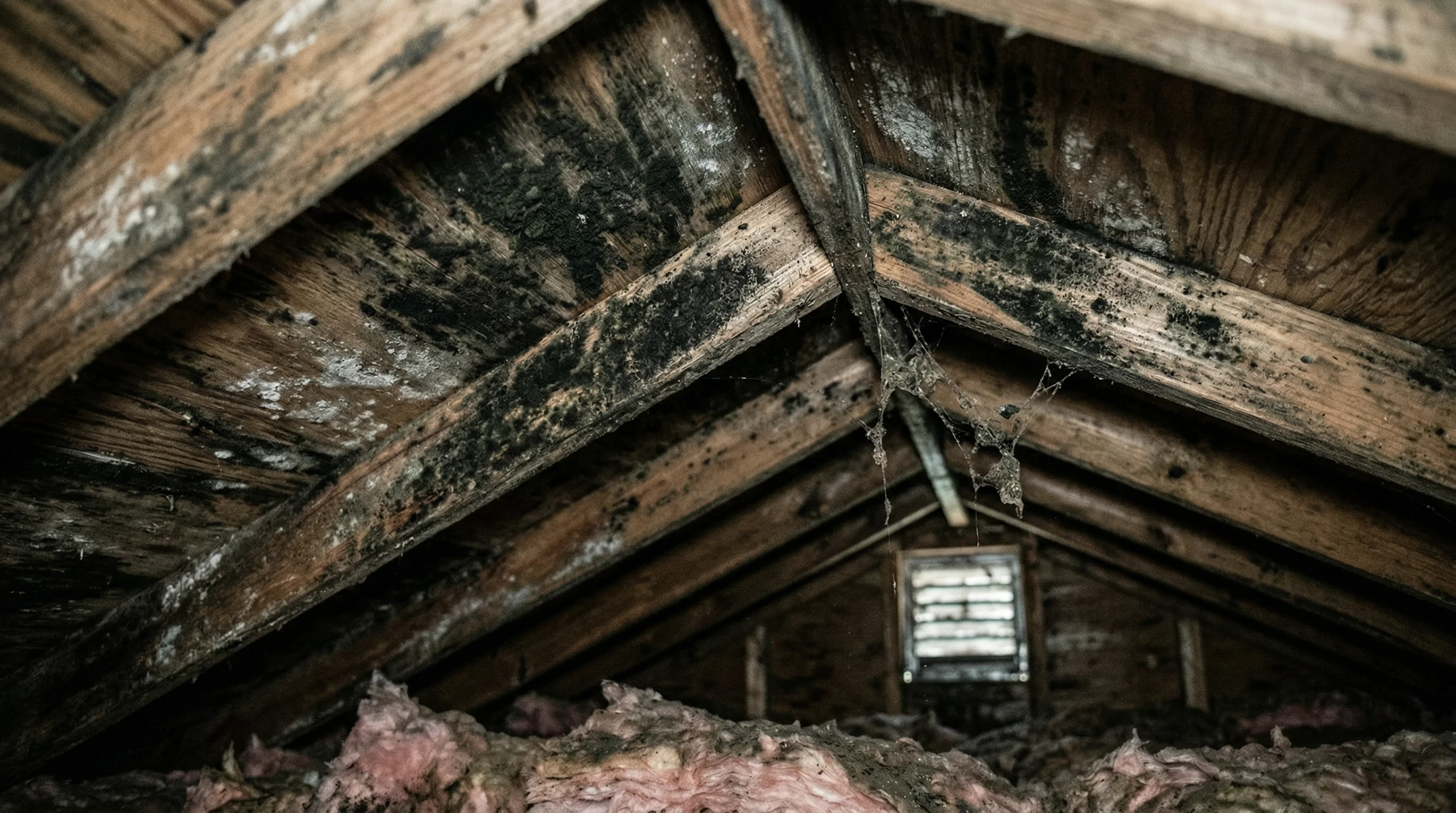
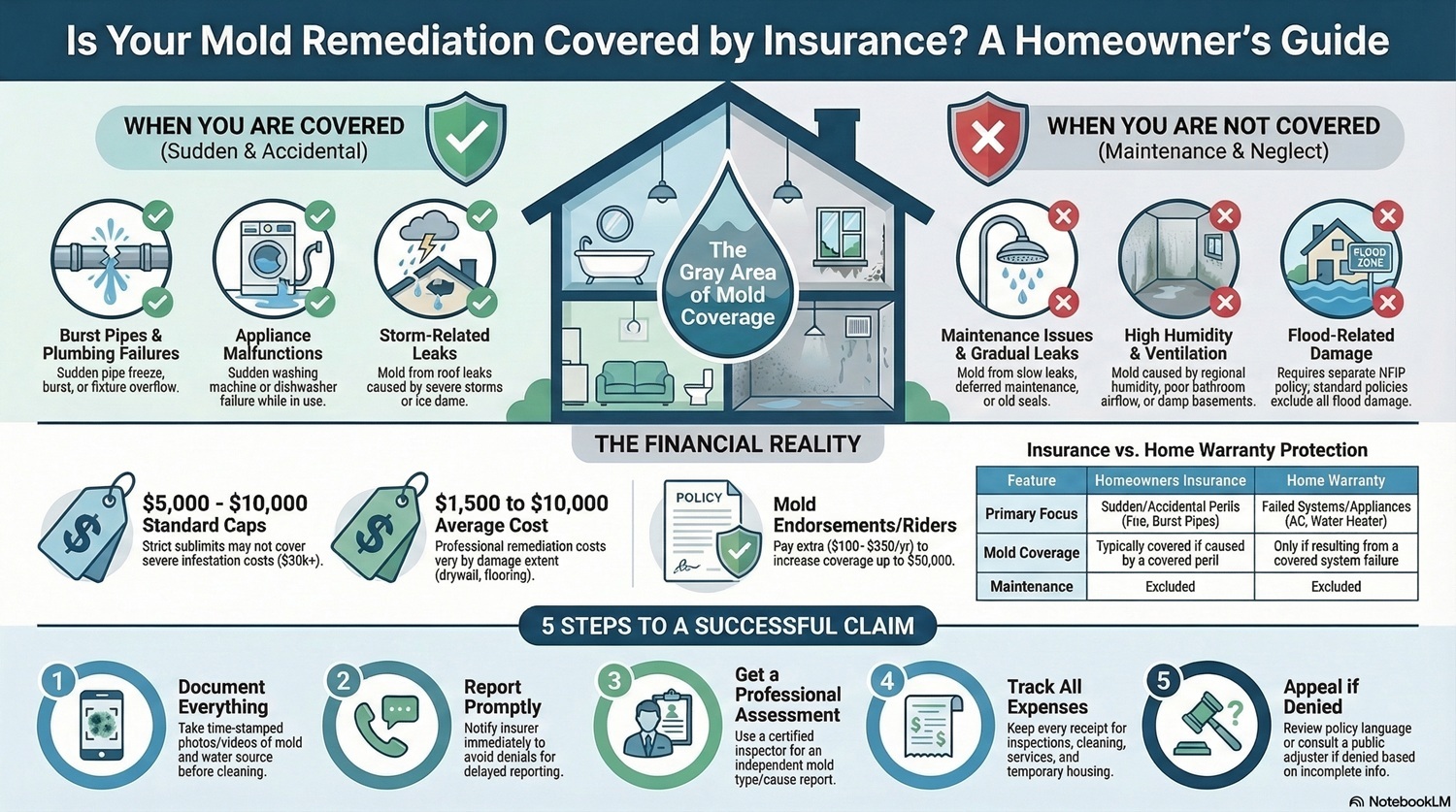
Homeowners insurance generally covers attic mold remediation only if the mold is a direct result of a "covered peril," such as a sudden pipe burst or storm-related roof damage. Most policies exclude mold resulting from high humidity, poor ventilation, or lack of maintenance, which are considered the homeowner's responsibility to prevent.
Understanding the "Covered Peril" Requirement
In the landscape of 2026 property insurance, the distinction between a "covered peril" and a "maintenance issue" remains the primary factor in claim approval. For insurance to pay for attic mold remediation, the mold must be the secondary consequence of an event that the policy already covers. In insurance terminology, this is often referred to as the "proximate cause."
If a sudden and accidental event occurs—for example, a tree limb punctures your roof during a localized windstorm, allowing rainwater to saturate your attic insulation—the resulting mold growth is typically covered. Because the windstorm (the peril) is covered, the resulting damage (water and mold) is also included in the claim. This is because the mold would not have existed "but for" the covered event.
However, insurers strictly differentiate these events from "gradual" damage. If mold is discovered in an attic because the homeowner failed to replace an aging roof that had been slowly seeping water for years, the claim will likely be denied. In 2026, insurance adjusters use advanced moisture mapping and thermal imaging to determine the age of a leak. If the data suggests the moisture has been present for months or years, the insurer will categorize the mold as a result of "deferred maintenance," which is a standard exclusion in HO-3 and HO-5 policies.
When Homeowners Insurance Typically Covers Attic Mold
While policies vary by provider and state, there are several standard scenarios where attic mold remediation is generally eligible for coverage. Understanding these can help you frame your claim correctly and set realistic expectations for reimbursement.
Sudden Plumbing Failures
Attics often house HVAC units or plumbing lines for upstairs bathrooms. If an expansion tank on a water heater ruptures or a PVC drain line suddenly cracks, the resulting flood can lead to rapid mold growth in the warm, dark environment of the attic. Since these are sudden, internal plumbing failures, the remediation of the mold is usually covered.
Storm-Related Roof Damage
Severe weather remains a leading cause of insurance claims. In 2026, as weather patterns continue to fluctuate, "windstorm and hail" coverage remains a staple of most policies. If a storm rips off shingles or damages flashing, and mold develops in the subsequent 24 to 72 hours, the cost of professional remediation is generally included. It is crucial to report these incidents immediately, as delay can allow the insurer to argue that the mold was preventable through swifter action.
Firefighting Efforts
A less common but devastating cause of attic mold is water damage resulting from firefighting. If a fire occurs in the home and the fire department uses high-pressure hoses to extinguish flames in the attic or upper floors, the massive influx of water can lead to mold if not dried out instantly. Most policies cover mold remediation in this context because the "proximate cause" was fire, which is a universally covered peril.
Common Exclusions: Why Most Attic Mold Claims Are Denied
Statistics from the Insurance Information Institute indicate that a significant majority of mold claims are denied because they stem from excluded causes. In the attic, three specific issues lead to the most denials.
Humidity and Poor Ventilation
Attics are prone to "stack effect" issues, where warm, moist air from the living space rises and becomes trapped. If an attic is poorly ventilated, this moisture condenses on the underside of the roof deck, leading to widespread surface mold. Because this is a structural design or ventilation issue rather than a sudden accident, insurers will not pay for the cleanup. Homeowners are expected to maintain proper ridge vents, soffit vents, and baffles to ensure airflow.
Sump Pump Failure and Seepage
While less common in an attic than a basement, some homes have attic-level drainage systems or condensation lines for high-efficiency furnaces. If mold develops because a drain line slowly seeps or a pump fails over a long period, it is often excluded under "wear and tear." Furthermore, mold resulting from "groundwater" or "flood" (rising water from outside) is never covered by standard homeowners insurance and requires a separate policy through the National Flood Insurance Program (NFIP).
Negligence and Abandonment
If a homeowner leaves a property vacant for an extended period without maintaining the climate control or checking for leaks, any mold discovered upon their return is typically excluded. Insurers require homeowners to exercise "due diligence" in protecting the property. In 2026, many policies include specific language requiring properties to be inspected at least once every 14 to 30 days during vacancy to maintain coverage for water-related damages.
Navigating Policy Limits and Mold Endorsements
Even when a claim is approved, homeowners are often surprised to find that their coverage is limited. In the early 2000s, many insurers began excluding mold entirely or severely capping the payouts due to a surge in litigation. Today, in 2026, these limitations are standard.
Most standard policies have a "Limited Fungi, Wet or Dry Rot, or Bacteria Coverage" endorsement. This often caps the total payout for mold remediation at $5,000 or $10,000. This limit must cover:
- The physical removal of moldy materials (drywall, insulation).
- The professional labor for cleaning and disinfecting.
- The cost of testing (pre- and post-remediation air quality tests).
- The cost of specialized equipment (dehumidifiers and HEPA air scrubbers).
Given that professional attic mold remediation can easily exceed $10,000 if the entire roof deck and all insulation are affected, these limits may leave the homeowner with significant out-of-pocket costs. Some insurers allow you to purchase "riders" or "floaters" to increase this limit to $25,000 or $50,000 for an additional annual premium.
The Professional Remediation Process vs. Insurance Requirements
Insurance companies do not just pay for "cleaning"; they pay for "remediation" that meets specific industry standards, specifically the IICRC S520 Standard for Professional Mold Remediation. If you attempt to clean the mold yourself with bleach, you may inadvertently void your ability to claim further damages or jeopardize the "clearance" required to sell the home later.
The process typically involves:
- Containment: Using 6-mil polyethylene sheeting and negative air pressure to ensure mold spores do not travel from the attic into the living spaces during cleaning.
- HEPA Vacuuming: Removing the bulk of the mold spores using High-Efficiency Particulate Air vacuums.
- Media Blasting: In severe cases, professionals use dry ice or soda blasting to remove mold from the wooden rafters and roof sheathing without damaging the structure.
- Antimicrobial Treatment: Applying EPA-registered solutions to kill remaining spores and prevent regrowth.
- Encapsulation: Applying a specialized sealant (often white or clear) to the wood to "lock in" any remaining microscopic particles.
Insurance adjusters will require a detailed "scope of work" from the remediation contractor before authorizing payment. They will also look for "post-remediation verification" (PRV) testing, which proves the attic air quality has returned to "Normal Fungal Ecology" (Condition 1).
Comparison of Attic Mold Scenarios and Coverage Likelihood
| Scenario | Primary Cause | Likely Covered? | Reason for Decision |
|---|---|---|---|
| Roof Puncture | Fallen tree during storm | Yes | Result of a covered sudden peril (wind). |
| HVAC Leak | Cracked drain pan (sudden) | Yes | Accidental discharge of water from an appliance. |
| Ice Damming | Sudden snow melt/backup | Case-by-Case | Often covered if the policy includes "weight of ice and snow." |
| Roof Age | 25-year-old shingles leaking | No | Categorized as maintenance and wear and tear. |
| Bathroom Fan | Vented into attic space | No | Intentional (but incorrect) structural venting choice. |
| High Humidity | Lack of ridge/soffit vents | No | Gradual environmental condition. |
The Step-by-Step Claims Process for Attic Mold
If you discover mold in your attic and believe it was caused by a covered event, following a specific protocol in 2026 is essential for claim approval.
- Immediate Mitigation: You have a legal obligation to prevent further damage. If the roof is leaking, you must tarp it. If a pipe is leaking, turn off the water. Save receipts for these temporary repairs; they are usually reimbursable.
- Document Everything: Before anything is moved or cleaned, take high-resolution photos and video of the mold, the source of the water, and any damaged personal property stored in the attic.
- File the Claim: Contact your insurance agent or use the company’s digital portal. Use specific language: "I have discovered mold resulting from a sudden [leak/storm event]." Avoid vague terms like "It's been damp up there for a while."
- Professional Inspection: The insurer will send an adjuster. It is often beneficial to have your own mold remediation contractor present during this inspection to ensure the adjuster sees the full extent of the "hidden" mold behind insulation or in the eaves.
- Obtain Multiple Estimates: Insurance companies may try to use "preferred vendors" who might provide lower estimates. You have the right to choose your contractor, but the insurer will only pay "prevailing market rates."
- Review the Settlement: Ensure the settlement includes "line-item" pricing for labor, materials, and testing. If the settlement is below the $5,000 cap but the work costs $8,000, ask for a "supplemental" payment based on the contractor's findings during the actual remediation.
Costs of Attic Mold Remediation in 2026
In 2026, labor and material costs have stabilized but remain significantly higher than pre-2020 levels. A standard attic remediation project typically breaks down into several cost categories.
- Inspection and Testing: $400 – $900. This includes the initial air quality test and the final clearance test.
- Insulation Removal: $2,000 – $4,500. Mold-contaminated insulation (especially blown-in cellulose or fiberglass) cannot be cleaned; it must be vacuumed out and disposed of as hazardous waste.
- Structural Cleaning: $3,000 – $8,000. This depends on the square footage of the attic and whether media blasting is required to reach the "nooks and crannies" of the trusses.
- Encapsulation: $1,000 – $2,500. This is the final step to ensure the wood remains protected.
Total costs for a medium-sized attic (1,500 sq. ft.) often range between $6,500 and $15,000. If your policy cap is $5,000, you will be responsible for the remaining balance.
Frequently Asked Questions
Does a standard policy cover mold from a slow roof leak?
Generally, no. Most homeowners insurance policies specifically exclude damage that occurs over a period of weeks or months. A slow roof leak is considered a maintenance issue. However, if the leak was caused by a sudden event (like a hail hit) and you could not have reasonably known about it, you may be able to argue for coverage.
Will my insurance go up if I file an attic mold claim?
Filing a claim for mold can lead to a premium increase or a "non-renewal" notice in some cases, especially if you have filed multiple water-related claims in the past three to five years. In the 2026 insurance market, insurers are increasingly risk-averse regarding moisture-related issues. It is often wise to get a professional estimate first; if the cost is only slightly above your deductible, paying out of pocket may save you more in long-term premium costs.
What is the difference between "mold removal" and "mold remediation"?
Mold removal is the physical act of taking mold out of the house. Mold remediation is a more comprehensive process that includes identifying the moisture source, containing the area, cleaning the air, and testing to ensure the environment is safe. Insurance companies almost exclusively pay for "remediation" because it follows professional safety standards.
Can I be denied coverage if I didn't have my attic inspected?
While there isn't usually a specific "inspection clause," there is a "neglect" clause. If the insurer can prove that the mold was visible and obvious for a long time and you ignored it, they can deny the claim. Regular self-inspections of your attic (at least twice a year) are recommended to catch issues while they are still "sudden" rather than "gradual."
Are "mold riders" worth the extra cost?
In 2026, with the increased frequency of high-moisture weather events, a mold rider is generally a sound investment. For an extra $50 to $150 per year, increasing your coverage from $5,000 to $25,000 can prevent financial catastrophe, as attic mold often spreads rapidly and is expensive to mitigate professionally.
Practical Recommendation for Homeowners
If you suspect mold in your attic, your first action should not be calling the insurance company, but rather identifying the source of moisture. If the source is a clear, sudden event—like a hole in the roof or a burst pipe—contact your insurer immediately. If the source is unclear, hire a local, independent mold inspector (not a remediation company) to provide a "cause and origin" report. This unbiased document can be your strongest evidence if you need to dispute a claim denial. Finally, always prioritize air quality and structural integrity over cost; mold in the attic can eventually affect the air you breathe in the rest of the home and significantly lower your property value during a future sale.