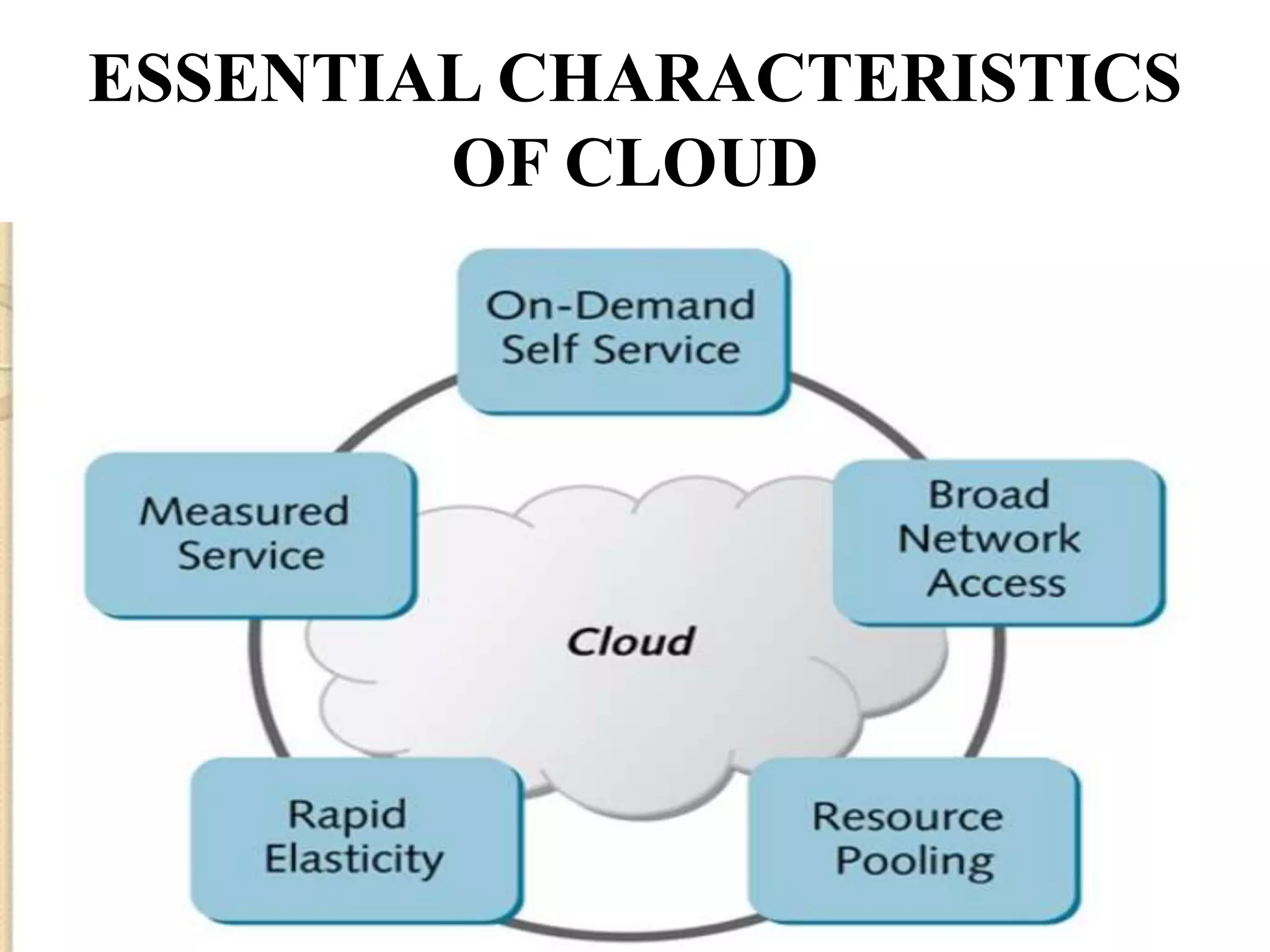
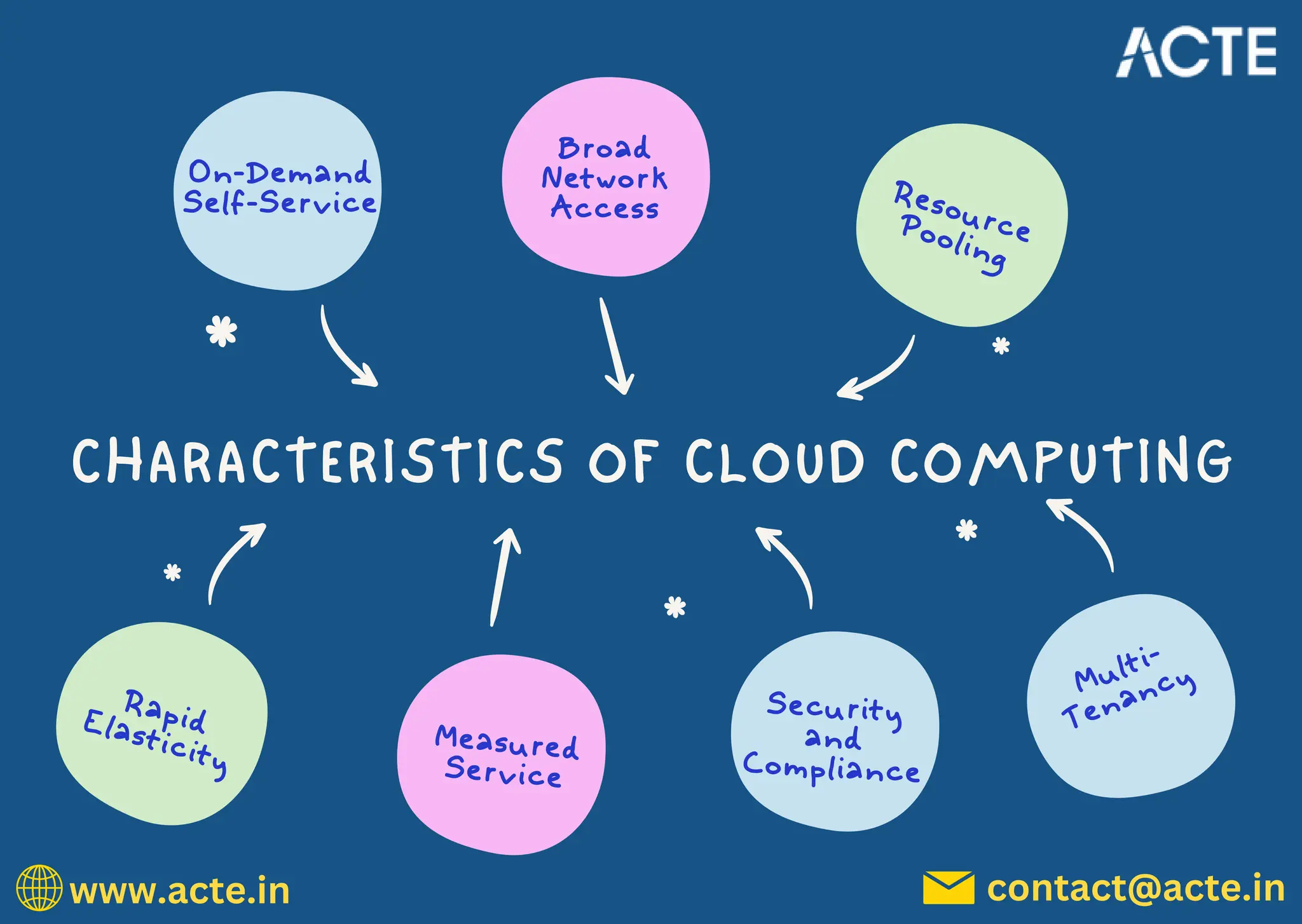
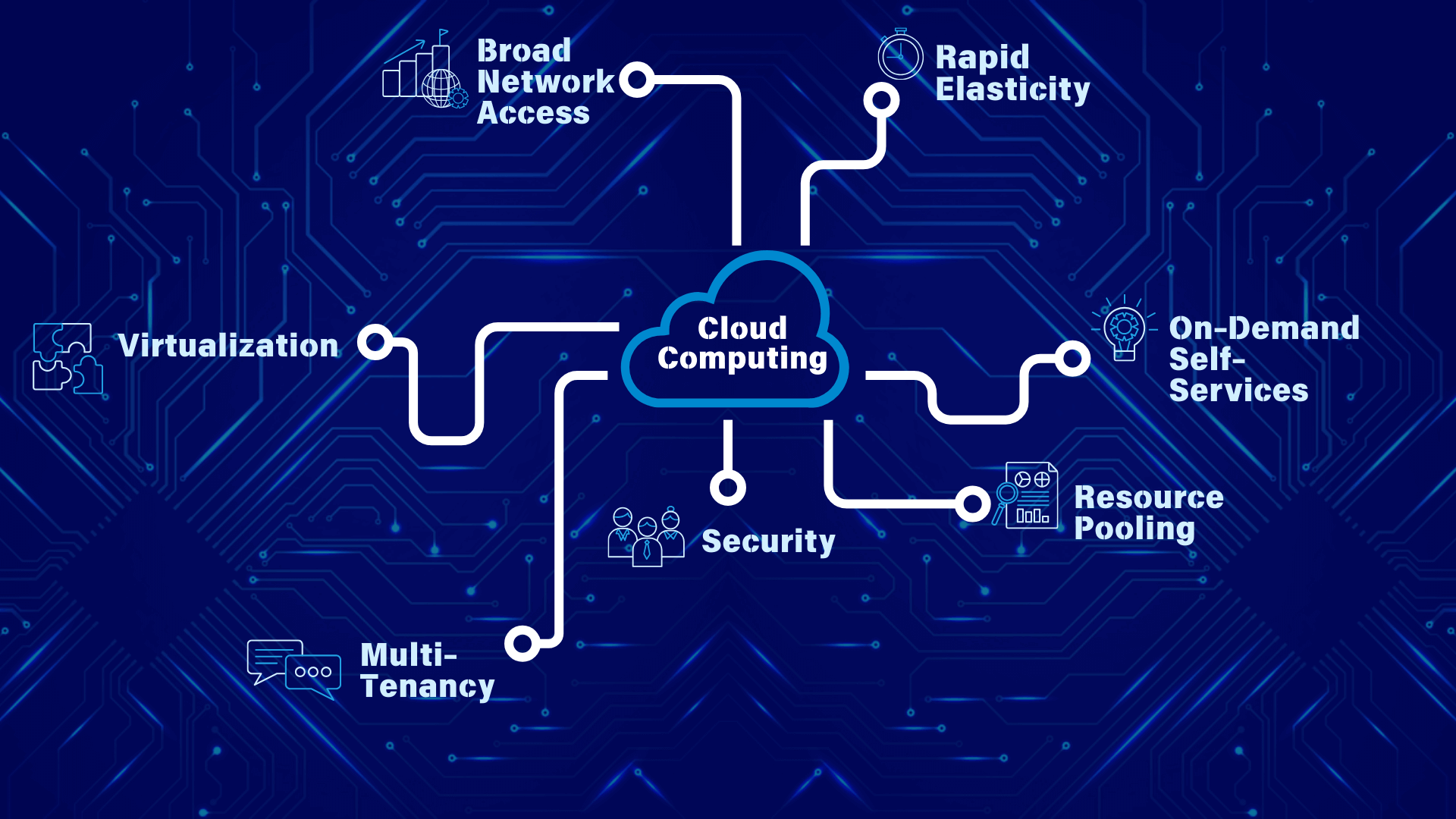
Cloud computing is defined by five essential characteristics that distinguish it from traditional legacy hosting: on-demand self-service, broad network access, resource pooling, rapid elasticity, and measured service. These five pillars, established by the National Institute of Standards and Technology (NIST), ensure that a service provides the flexibility, scalability, and efficiency required for modern digital infrastructure in 2026.
To truly understand how cloud computing functions, one must look beyond the simple idea of "remote servers." The cloud is a model for enabling ubiquitous, convenient, on-demand network access to a shared pool of configurable computing resources. Whether you are an enterprise architect or a business leader, understanding these core features is the first step in optimizing your cloud strategy, controlling costs, and ensuring operational resilience.
1. On-Demand Self-Service
On-demand self-service is the cornerstone of cloud agility. It allows users to provision computing capabilities, such as server time, network storage, and software applications, automatically without requiring human interaction with the service provider’s staff.
The Shift from Manual to Automated Provisioning
In the era of traditional IT, requesting a new server often involved a lengthy bureaucratic process. A developer would submit a ticket, which was then reviewed by a procurement team, approved by a manager, and eventually fulfilled by a system administrator who physically racked a server or manually configured a virtual machine. This process could take days, weeks, or even months.
In 2026, cloud platforms have perfected the self-service portal and Application Programming Interface (API) ecosystem. A user can log into a console (like AWS, Azure, or Google Cloud) or use an Infrastructure as Code (IaC) tool to deploy an entire global network architecture in minutes. This autonomy is vital for DevOps and Agile methodologies, where the ability to "fail fast" and iterate quickly depends on immediate access to resources.
Technical Implications of Self-Service
This characteristic relies heavily on sophisticated automation and orchestration layers. When a user requests a resource, the cloud provider’s management software identifies available capacity, configures the necessary hypervisors or container orchestrators, sets up networking rules (firewalls, load balancers), and assigns storage—all through pre-defined scripts and workflows. This eliminates human error and ensures that environments are consistent and reproducible.
2. Broad Network Access
Broad network access ensures that cloud services are available over the network and can be accessed through standard mechanisms by a wide range of client platforms. This characteristic addresses the "anywhere, anytime, any device" requirement of modern business.
Supporting a Heterogeneous Environment
For a service to be considered a true cloud, it must be accessible via "thin" or "thick" client platforms. This includes:
- Mobile Devices: Smartphones and tablets using specialized apps or mobile browsers.
- Laptops and Workstations: Traditional computers running full-scale development environments or enterprise software.
- IoT and Edge Devices: In 2026, this includes millions of sensors and localized processing units that feed data back to central cloud repositories.
The Role of Connectivity and Standard Protocols
Broad network access implies that the cloud provider uses standard communication protocols (such as HTTP/HTTPS, TCP/IP, and REST) to ensure compatibility. In 2026, the proliferation of 5G and early 6G adoption has significantly enhanced this characteristic, allowing for ultra-low latency access to cloud-based AI and real-time data processing. However, this also introduces the need for robust security frameworks like Zero Trust Architecture, as the "network perimeter" has essentially disappeared.
3. Resource Pooling
Resource pooling is the "magic" behind the economic efficiency of cloud computing. The provider’s computing resources are pooled together to serve multiple consumers using a multi-tenant model, with different physical and virtual resources dynamically assigned and reassigned according to consumer demand.
Understanding Multi-Tenancy
Multi-tenancy allows multiple customers (tenants) to share the same physical hardware while remaining logically isolated from one another. Think of it like an apartment building: residents share the building's foundation, plumbing, and electrical wiring (the infrastructure), but each has their own private, secure apartment (the virtual environment).
Location Independence and Abstraction
A key element of resource pooling is a sense of location independence. The customer generally has no control or knowledge over the exact location of the provided resources (e.g., which specific rack or data center floor the server is on). However, users can specify location at a higher level of abstraction, such as a country, state, or a specific cloud "Region" or "Availability Zone." This is crucial for compliance with data sovereignty laws, such as GDPR in Europe or various regional data protection acts active in 2026.
Resources that are typically pooled include:
- Storage: Distributed file systems and object storage.
- Processing Power: CPU and GPU cycles (increasingly important for AI workloads).
- Memory: Dynamic RAM allocation for virtual machines and containers.
- Bandwidth: Network throughput shared across the provider's backbone.
4. Rapid Elasticity
Rapid elasticity is the ability of a cloud system to scale resources outward and inward commensurate with demand. To the consumer, the capabilities available for provisioning often appear to be unlimited and can be appropriated in any quantity at any time.
Scalability vs. Elasticity
While often used interchangeably, there is a subtle difference. Scalability is the infrastructure's ability to handle increased load. Elasticity is the speed and automation with which that scaling happens.
- Horizontal Scaling (Scaling Out): Adding more instances of a resource (e.g., adding five more web servers to a cluster).
- Vertical Scaling (Scaling Up): Increasing the power of an existing resource (e.g., adding more RAM to a specific database server).
Practical Applications in 2026
In 2026, elasticity is often handled by AI-driven "Auto-scaling" groups. For example, an e-commerce platform during a flash sale will experience a massive spike in traffic. An elastic cloud system detects the CPU load increasing and automatically spins up dozens of new server instances to handle the load. Once the sale ends and traffic drops, the system automatically terminates the unneeded instances to save money. This "breathing" capability ensures that companies do not pay for idle hardware that was only needed for peak periods.
5. Measured Service
Measured service is the feature that transforms computing into a utility, much like electricity or water. Cloud systems automatically control and optimize resource use by leveraging a metering capability at some level of abstraction appropriate to the type of service.
Pay-as-You-Go Economics
Resource usage can be monitored, controlled, and reported, providing transparency for both the provider and the consumer of the utilized service. Common metrics include:
- Storage used (per GB/month).
- Processing time (per second or millisecond for serverless functions).
- Data transfer (bandwidth in/out).
- Active user accounts (for SaaS products).
The Rise of FinOps
By 2026, the complexity of measured services has led to the discipline of FinOps (Cloud Financial Management). Because every click and every gigabyte has a cost, organizations now use sophisticated dashboards to track spending in real-time. This transparency prevents "bill shock" and allows businesses to attribute specific IT costs to individual departments or products, leading to much more accurate financial forecasting.
Comparison Summary of Cloud Characteristics
| Characteristic | Primary Focus | Key Benefit for Business | 2026 Context/Trend |
|---|---|---|---|
| On-Demand Self-Service | User Autonomy | Faster time-to-market; reduced IT bottlenecks. | Increased use of AI assistants for resource setup. |
| Broad Network Access | Universal Connectivity | Remote work support; global reach. | High-speed 5G/6G and Edge computing integration. |
| Resource Pooling | Efficiency & Scale | Lower costs through economies of scale. | Sustainability-focused pooling to reduce carbon footprint. |
| Rapid Elasticity | Dynamic Scaling | High availability; cost optimization during low use. | Predictive scaling using machine learning. |
| Measured Service | Transparency | Utility-based pricing; clear ROI tracking. | Granular "per-millisecond" billing for serverless. |
Technical Deep-Dive: How the 5 Characteristics Enable Modern Architectures
The intersection of these five characteristics has paved the way for advanced technical architectures that were nearly impossible under the traditional data center model.
Serverless Computing
Serverless architecture is perhaps the ultimate expression of these five features. In a serverless model (like AWS Lambda or Azure Functions), the provider handles all resource pooling and elasticity. The user simply uploads code (on-demand self-service), which is accessible via API (broad network access), and pays only for the exact duration the code runs (measured service).
Microservices and Containers
The ability to scale rapidly and provide self-service access allows developers to break down large, monolithic applications into hundreds of small, independent "microservices." Each microservice can live in a container that scales independently of the others. This ensures that a failure in one part of the system (like a recommendation engine) does not crash the entire application (the checkout process).
The "Green" Cloud in 2026
By 2026, Resource Pooling has become a central part of corporate sustainability goals. Because cloud providers can run their hardware at much higher utilization rates than individual companies (who often have servers sitting idle 80% of the time), the overall energy consumption per workload is significantly lower. Leading providers now offer "Carbon Footprint" dashboards as part of their Measured Service, allowing companies to report on their environmental impact accurately.
Frequently Asked Questions
What is the most important characteristic of cloud computing?
There is no single "most important" characteristic, as all five must be present to meet the NIST definition of cloud computing. However, Rapid Elasticity is often cited as the most transformative for businesses, as it allows them to handle unexpected growth without massive upfront capital investment in hardware.
Can a private cloud still have these five characteristics?
Yes. A private cloud is a cloud environment dedicated to a single organization. To be a true "cloud," it must still offer on-demand self-service to its internal users, pool resources across different departments, provide broad network access via the internal network, scale elastically, and measure usage for internal chargebacks.
How does resource pooling ensure security?
Security in a pooled environment is managed through logical isolation. Cloud providers use advanced hypervisors and virtual network overlays to ensure that one customer cannot see or access another customer's data, even though they are using the same physical CPU or storage disk. In 2026, hardware-level encryption and "Confidential Computing" have further strengthened this isolation.
Is "Broad Network Access" just another name for the Internet?
No. While the Internet is the most common medium, broad network access refers to the ability to access services through standard protocols on any device. This could be over a private leased line, a Virtual Private Network (VPN), or a localized 5G network. The focus is on the standardization of access, not just the connection type.
How has "Measured Service" changed by 2026?
By 2026, measured service has moved beyond simple "pay-by-the-hour" models. It now includes "Value-Based Metering," where users might pay based on the volume of data processed by an AI model or the number of successful transactions, rather than just raw server uptime. This aligns IT costs directly with business value.
Final Recommendations for Cloud Adoption
To leverage these five characteristics effectively in 2026, organizations should move away from "Lift and Shift" migrations—where old applications are simply moved to the cloud without changes. Instead, prioritize Cloud-Native development that can take full advantage of Rapid Elasticity and On-Demand Self-Service.
- Implement FinOps Early: Use the Measured Service data to set up automated budget alerts and prevent runaway costs from Elastic resources.
- Focus on Automation: Use Infrastructure as Code (IaC) to turn On-Demand Self-Service into a repeatable, governed process.
- Audit for Multi-Tenancy: Ensure your security protocols are designed for a Resource Pooled environment, utilizing modern encryption and identity management.
- Optimize for Access: Ensure your applications are designed with Broad Network Access in mind, providing a seamless experience across mobile, web, and IoT endpoints.
By aligning your IT strategy with these five core features, you ensure that your infrastructure is not just "off-site," but truly cloud-enabled, providing the resilience and agility needed for the 2026 digital economy.