Navigating permanent life insurance requires balancing financial strength, dividend performance, policy flexibility, and cost. Five providers stand out as the top choices for cash value life insurance plans: Northwestern Mutual, New York Life, Massachusetts Mutual (MassMutual), Guardian Life, and Pacific Life. These carriers excel in building long-term cash accumulation, offering robust rider options, and maintaining high financial stability ratings.
Understanding Cash Value Life Insurance
Cash value life insurance is a type of permanent life insurance that combines a death benefit with a tax-advantaged savings component known as the cash value account. Unlike term life insurance, which expires after a set number of years, permanent insurance remains active for the insured's entire life, provided premiums are paid. A portion of each premium payment goes toward administrative costs and the cost of insurance, while the remainder is deposited directly into the cash value account. This account grows on a tax-deferred basis, meaning policyholders do not pay income taxes on the growth while it remains inside the policy.
The appeal of cash value life insurance extends beyond estate planning. Policyholders can access their accumulated funds during their lifetime through policy loans or withdrawals. This flexibility makes cash value plans popular vehicles for supplementing retirement income, funding education, or managing short-term liquidity needs. However, these policies are significantly more expensive than term insurance, and early cancellation often incurs surrender charges. Understanding how these plans function is essential before committing to a long-term financial contract.
Core Types of Cash Value Policies
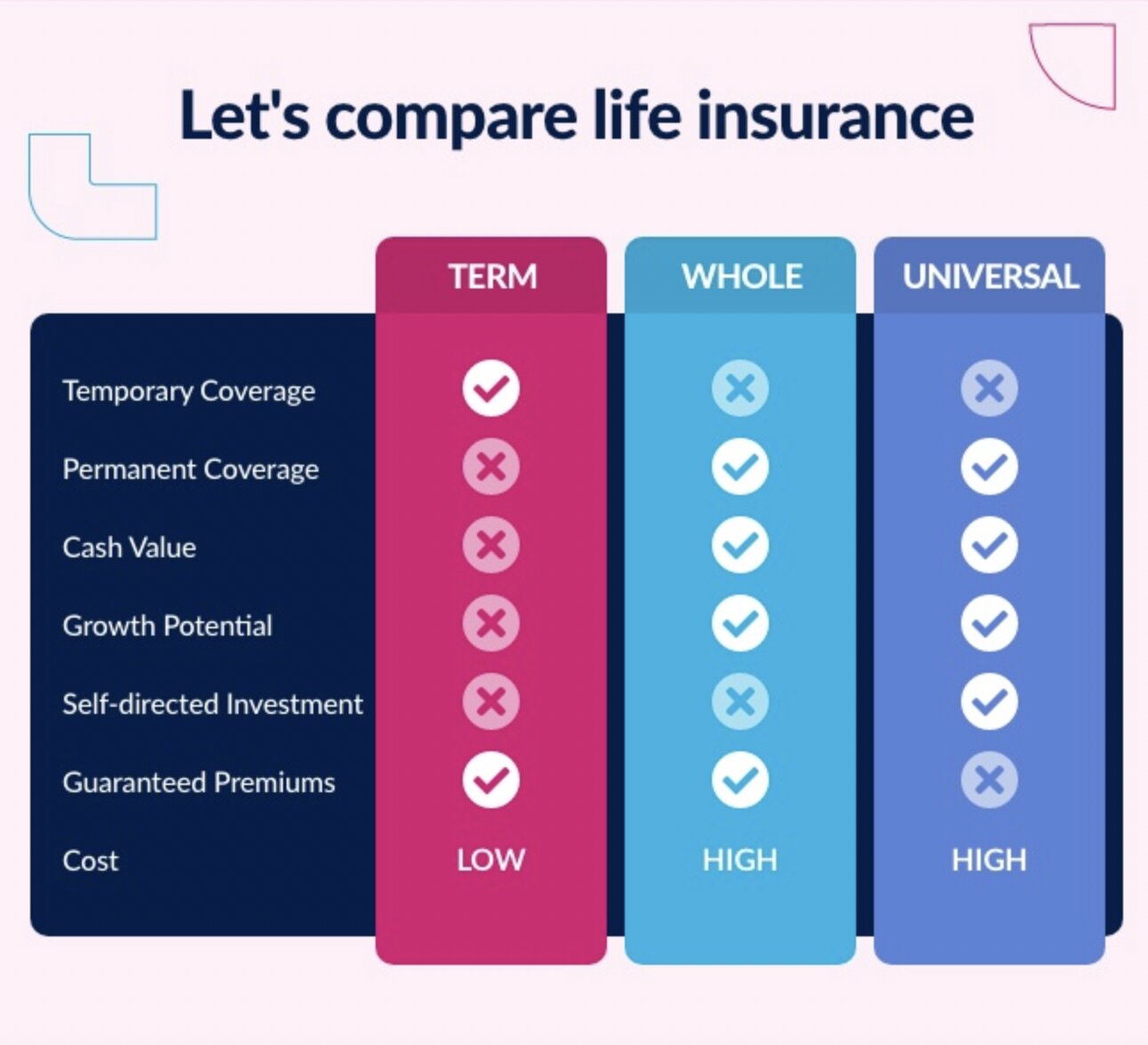
When evaluating the market, buyers generally encounter four distinct structural variations of permanent insurance:
- Whole Life Insurance: The most traditional and predictable form of cash value insurance. It offers guaranteed death benefits, fixed premium schedules, and a guaranteed minimum interest rate credited to the cash value. Mutual companies often pay non-guaranteed annual dividends that can enhance the cash value growth.
- Universal Life (UL) Insurance: Provides greater flexibility than whole life. Policyholders can adjust their premium payments and death benefits within certain contract limits, provided the cash value is sufficient to cover monthly administrative expenses.
- Indexed Universal Life (IUL) Insurance: Ties the interest credited to the cash value to the performance of a stock market index, such as the S&P 500, while offering a guaranteed floor (often 0%) to protect against market downturns.
- Variable Universal Life (VUL) Insurance: Allows policyholders to invest their cash value directly into sub-accounts that resemble mutual funds. This structure offers the highest growth potential but also exposes the principal to direct market risk.
Key Criteria for Evaluating Cash Value Providers
Selecting the right insurance carrier involves analyzing several quantitative and qualitative factors. Because permanent life insurance contracts span decades, the stability and integrity of the issuing company are paramount.
Financial Strength Ratings
An insurance company’s ability to pay claims and distribute dividends decades into the future depends entirely on its financial health. Independent rating agencies such as A.M. Best, Moody’s, Standard & Poor’s, and Fitch evaluate insurers based on capitalization, investment risk management, and operational performance. Policyholders should look for companies with ratings of "A" (Excellent) or higher. Higher ratings indicate a superior capacity to meet ongoing policyholder obligations, even during severe economic downturns.
Dividend History and Performance
For policies issued by mutual companies—which are owned by their policyholders rather than outside shareholders—dividends represent a significant driver of cash value growth. While dividends are never legally guaranteed, a consistent, long-term track record of dividend distribution reflects prudent underwriting, strong investment portfolios, and disciplined expense management. Reviewing a company's historical dividend interest rate scale helps set realistic expectations for future cash accumulation.
Policy Riders and Customization
A standard life insurance policy can often be tailored to individual financial strategies through policy riders. Common and valuable riders include:
- Paid-Up Additions (PUA) Rider: Allows policyholders to pump extra cash into the policy to accelerate cash value growth without increasing the net amount at risk.
- Waiver of Premium: Ensures that the insurance company covers the premium payments if the insured becomes totally disabled.
- Accelerated Death Benefit: Permits the policyholder to access a portion of the death benefit early if diagnosed with a terminal illness.
The 5 Best Companies for Cash Value Life Insurance Plans
Based on financial strength, product design, historical dividend performance, and consumer satisfaction, the following five companies represent the premier choices for cash value life insurance in 2026.
1. Northwestern Mutual
Northwestern Mutual is widely recognized as an industry leader in whole life insurance. Operating as a mutual company, it consistently commands a massive market share and maintains top-tier financial strength ratings from major agencies.
The company's primary strength lies in its proprietary whole life product suite, which is designed to optimize long-term cash value accumulation. Northwestern Mutual has maintained a stable and competitive dividend payout history for well over a century, rewarding long-term policyholders. Furthermore, their integrated financial planning approach pairs clients with dedicated advisors to align life insurance with broader wealth management strategies.
- Pros: Exceptional financial stability, long-standing history of consistent dividend payments, and sophisticated whole life product engineering.
- Cons: Products can be complex, and policy structuring relies heavily on proprietary agent networks.
2. New York Life
New York Life is another mutual insurance giant with a reputation for ultra-conservative fiscal management and robust balance sheets. The company offers a diverse portfolio of whole life, universal life, and variable universal life insurance policies.
New York Life stands out for its flexibility within whole life designs, allowing policyholders to customize premium payment schedules—such as 10-pay, 20-pay, or pay-to-age-65 structures—to match their peak earning years. Their dividend scale consistently performs near the top of the industry, making them a preferred choice for individuals seeking secure, conservative wealth preservation.
- Pros: Top-tier financial ratings, versatile whole life payment options, and a strong mutual corporate structure.
- Cons: Underwriting guidelines can be strict, leading to higher premium quotes for applicants with minor health issues.
3. Massachusetts Mutual Life Insurance Company (MassMutual)
MassMutual is frequently cited by financial experts as a top contender for cash-value maximization, particularly through its whole life products paired with paid-up additions riders.
MassMutual balances competitive dividend payouts with innovative policy design. Their whole life insurance plans offer robust guarantees while allowing policyholders to inject liquidity quickly into the cash value account. Additionally, MassMutual offers a strong suite of digital tools for policy management and robust customer support infrastructure.
- Pros: High dividend payout history, excellent cash value growth velocity with appropriate riders, and comprehensive policy options.
- Cons: Universal life options may not be as competitively priced or flexible as those offered by dedicated stock companies.
4. Guardian Life
The Guardian Life Insurance Company of America is a standout choice for individuals looking to leverage cash value life insurance through advanced strategies, such as Bank On or infinite banking concepts.
Guardian is known for its consumer-friendly policy provisions and high early cash value availability relative to competitors. Their whole life products feature flexible dividend options, and their underwriting is often accommodating for various risk profiles. Guardian’s commitment to mutual ownership ensures that policyholder interests remain aligned with company performance.
- Pros: High early-year cash value growth, favorable underwriting for advanced strategies, and strong mutual dividends.
- Cons: Premium rates can be higher upfront compared to non-participating or term alternatives.
5. Pacific Life
For buyers interested in the growth potential of indexed universal life (IUL) or variable universal life (VUL) insurance, Pacific Life is a premier provider. Unlike the mutual companies dominated by whole life products, Pacific Life excels in accumulation-focused universal life insurance.
Pacific Life offers a wide array of investment sub-accounts and equity index crediting strategies, making it attractive to high-net-worth individuals seeking higher potential returns tied to market performance. They provide advanced policy design features that manage downside risk while maximizing tax-advantaged accumulation space.
- Pros: Excellent selection of IUL and VUL products, sophisticated investment options, and strong caps on indexed accounts.
- Cons: Universal life products carry inherent market risks and require active monitoring compared to guaranteed whole life plans.
Comparative Overview of Top Cash Value Providers
The following table summarizes key attributes across the top five cash value life insurance companies to help differentiate their core offerings.
| Company Name | Primary Corporate Structure | Dominant Product Focus | Key Strengths | Best Suited For |
|---|---|---|---|---|
| Northwestern Mutual | Mutual | Whole Life | Consistent dividends, massive asset base | Long-term conservative wealth accumulation |
| New York Life | Mutual | Whole Life, Universal Life | Flexible premium payment schedules | Estate planning and guaranteed growth |
| MassMutual | Mutual | Whole Life | Fast cash value growth with riders | Maximizing early and mid-term liquidity |
| Guardian Life | Mutual | Whole Life | Early cash value access, flexible design | Advanced banking and accumulation strategies |
| Pacific Life | Stock / Mutual Mix | IUL, VUL, Universal Life | Broad equity indexing and variable options | Market-linked growth seekers and high earners |
Financial Considerations and Costs
Purchasing a cash value life insurance policy requires evaluating several financial commitments. Because these policies are designed to last a lifetime, monthly or annual premiums are substantially higher than those for term insurance.
Premium Allocation and Expenses
When a premium payment is made, it does not immediately enter the cash value account. First, the insurer deducts a "load" fee, which covers underwriting, agent commissions, and administrative overhead. Next, the cost of insurance (COI)—which rises as the insured ages—is deducted. Only the remaining balance enters the cash value account to earn interest or dividends. In the early years of a policy, surrender charges can consume a large portion of the cash value if the contract is terminated prematurely.
Tax Implications and Regulations
Cash value life insurance offers significant tax advantages under current United States tax law:
- Tax-Deferred Growth: Interest, dividends, and capital gains accumulate inside the policy without triggering annual income taxes.
- Tax-Free Policy Loans: Policyholders can borrow against their cash value without paying income tax, provided the policy remains in force. If the policy lapses or is surrendered with an outstanding loan balance, the loan amount can become taxable income.
- Tax-Free Death Benefit: Beneficiaries generally receive the death benefit free of federal income tax.
To maintain these tax advantages, policies must comply with Internal Revenue Code (IRC) Section 7702, which defines the statutory limits on how much cash can be funded relative to the death benefit. Policies that exceed these funding limits are classified as Modified Endowment Contracts (MECs), which permanently lose their tax-free loan benefits.
Common Mistakes to Avoid
Navigating the cash value life insurance market can be complex. Avoiding common pitfalls ensures that the policy aligns with long-term financial objectives.
- Treating the Policy as a Short-Term Investment: Cash value life insurance is illiquid in its early years. Canceling a policy within the first five to ten years often results in a net financial loss due to surrender charges and administrative fees.
- Underfunding the Contract: Failing to pay the planned premiums can cause the cash value to deplete, leading to a policy lapse and potential tax liabilities on outstanding loans.
- Ignoring the Cost of Insurance: As the insured ages, the internal cost of maintaining the death benefit increases. In universal life policies, rising COI charges can require higher premium payments to keep the policy active.
- Relying Solely on Non-Guaranteed Projections: When reviewing policy illustrations, agents often project future performance based on current dividend scales or interest rates. Buyers should carefully examine guaranteed minimum scenarios to understand the worst-case financial trajectory.
Frequently Asked Questions
What is the main difference between whole life and universal life cash value plans?
Whole life insurance offers guaranteed premiums, a guaranteed death benefit, and fixed interest rates backed by the insurer, often supplemented by non-guaranteed dividends. Universal life insurance provides flexible premium payments and adjustable death benefits, tying cash value growth to current interest rates, market indices, or sub-account investments, which introduces variable performance risks.
How do I access the cash value inside my life insurance policy?
Policyholders can access cash value through policy loans or direct withdrawals. Policy loans allow you to borrow against your cash value balance from the insurance company, using the cash value as collateral. While interest is charged on the loan, the remaining cash value continues to earn interest or dividends. Withdrawals permanently reduce the cash value and can lower the death benefit.
Are the dividends from mutual insurance companies guaranteed?
No. Dividends are never legally guaranteed by insurance companies. However, major mutual insurers with long operating histories—such as Northwestern Mutual, New York Life, and MassMutual—have paid annual dividends to policyholders consecutively for over a century, even through major economic crises like the Great Depression and the 2008 financial recession.
What happens to the cash value when the insured person passes away?
In most standard permanent life insurance policies, the beneficiary receives only the stated death benefit. The accumulated cash value is absorbed by the insurance company unless the policy specifically includes a "return of cash value" rider or a "cash value option" (such as Option B in universal life), which pays out both the base death benefit and the accumulated cash value combined.
How long does it take for a cash value life insurance policy to build significant value?
Generally, it takes anywhere from 5 to 10 years for a cash value policy to build substantial cash accumulation. In the early years, premium payments are heavily absorbed by administrative fees, agent commissions, and initial insurance costs. Cash value growth accelerates significantly in later decades as the internal savings compound tax-deferred.
Practical Next Steps
Selecting the right cash value life insurance plan requires a clear assessment of personal financial goals, risk tolerance, and time horizon. To proceed effectively:
- Define Your Objective: Determine whether you are seeking conservative, guaranteed wealth preservation (whole life) or growth-oriented market participation (indexed or variable universal life).
- Consult Independent Financial Professionals: Speak with licensed independent agents or fiduciary financial advisors who can compare quotes and policy designs across multiple carriers rather than pushing a single proprietary product.
- Review Detailed Illustrations: Request formal policy illustrations showing both guaranteed and non-guaranteed performance projections over a 20-to-30-year horizon before signing any contract.