Filing the Articles of Incorporation is the foundational legal step to forming a corporation in California. By submitting this document to the California Secretary of State, you officially create a separate legal entity distinct from its owners, establish its purpose, and define its initial capital structure. This process requires adherence to specific statutory requirements under the California Corporations Code.
Understanding the Role of Articles of Incorporation
In the state of California, the Articles of Incorporation serve as the "birth certificate" of a corporation. Before this document is filed, your business is merely an idea or an informal operation. Once the Secretary of State approves the filing, the entity gains legal status, allowing it to enter contracts, own property, and sue or be sued in its own name.
For entrepreneurs and business owners, the primary intent of this filing is to establish a corporate structure that offers limited liability protection. This legal shield separates the personal assets of the shareholders from the debts and liabilities of the business. However, to maintain this protection, you must adhere to ongoing corporate formalities, such as maintaining separate bank accounts, holding annual meetings, and filing periodic reports with the state.
Statutory Prerequisites and Name Requirements
Before preparing the documentation, you must ensure your business name complies with California regulations. Under the California Corporations Code, your chosen name must not be misleadingly similar to an existing entity already on file with the Secretary of State.
- Name Availability: You can conduct a free search via the Secretary of State’s bizfileOnline portal to ensure the name is available.
- Designators: The name must include a corporate designator such as "Corporation," "Incorporated," or "Limited," or an abbreviation of these terms (e.g., "Corp.," "Inc.," or "Ltd.").
- Restricted Terms: Certain words, such as "Bank," "Trust," or "Professional," require special approval or professional licensure documentation.
Essential Components of the Articles of Incorporation
The California Secretary of State provides a standardized form—Form ARTS-GS (General Stock Corporation)—which covers the mandatory provisions required by law. If your corporation has unique needs, such as multiple classes of shares or specific bylaws regarding management, you may need to draft custom articles. Regardless of the format, the document must include the following:
- Corporate Name: The exact name that will be registered.
- Statement of Purpose: A general clause stating that the purpose of the corporation is to engage in any lawful act or activity for which a corporation may be organized under the General Corporation Law.
- Agent for Service of Process: You must designate a person or a registered corporate agent who will accept legal documents (such as lawsuits or subpoenas) on behalf of the corporation. This person must reside in California.
- Share Structure: The number of shares the corporation is authorized to issue. If you have different classes of shares (e.g., Common and Preferred), you must define the rights, preferences, and restrictions of each class.
- Principal Office Address: The physical address of the corporation's primary business office.
Step-by-Step Filing Process
In 2026, the California Secretary of State processes the vast majority of filings through their digital portal, bizfileOnline. This system is designed to expedite the creation of new entities.
- Account Registration: If you are the primary filer, create an account on the official bizfileOnline website.
- Form Selection: Select "Articles of Incorporation" from the menu. The system will prompt you for the specific type of corporation (General Stock is the most common).
- Data Entry: Input the entity name, address, agent details, and share counts as identified in your planning phase.
- Electronic Signature: As the incorporator, you will electronically sign the document.
- Fee Payment: The filing fee is payable via credit card or other authorized digital payment methods.
- Processing: Once submitted, the system typically provides a receipt immediately. Depending on the current volume, the Secretary of State processes most electronic filings within a few business days.
Comparative Overview of Corporate Structures
When deciding on the structure of your business, it is helpful to contrast the requirements of a standard General Stock Corporation with other entity types.
| Feature | General Stock Corporation | Limited Liability Company (LLC) |
|---|---|---|
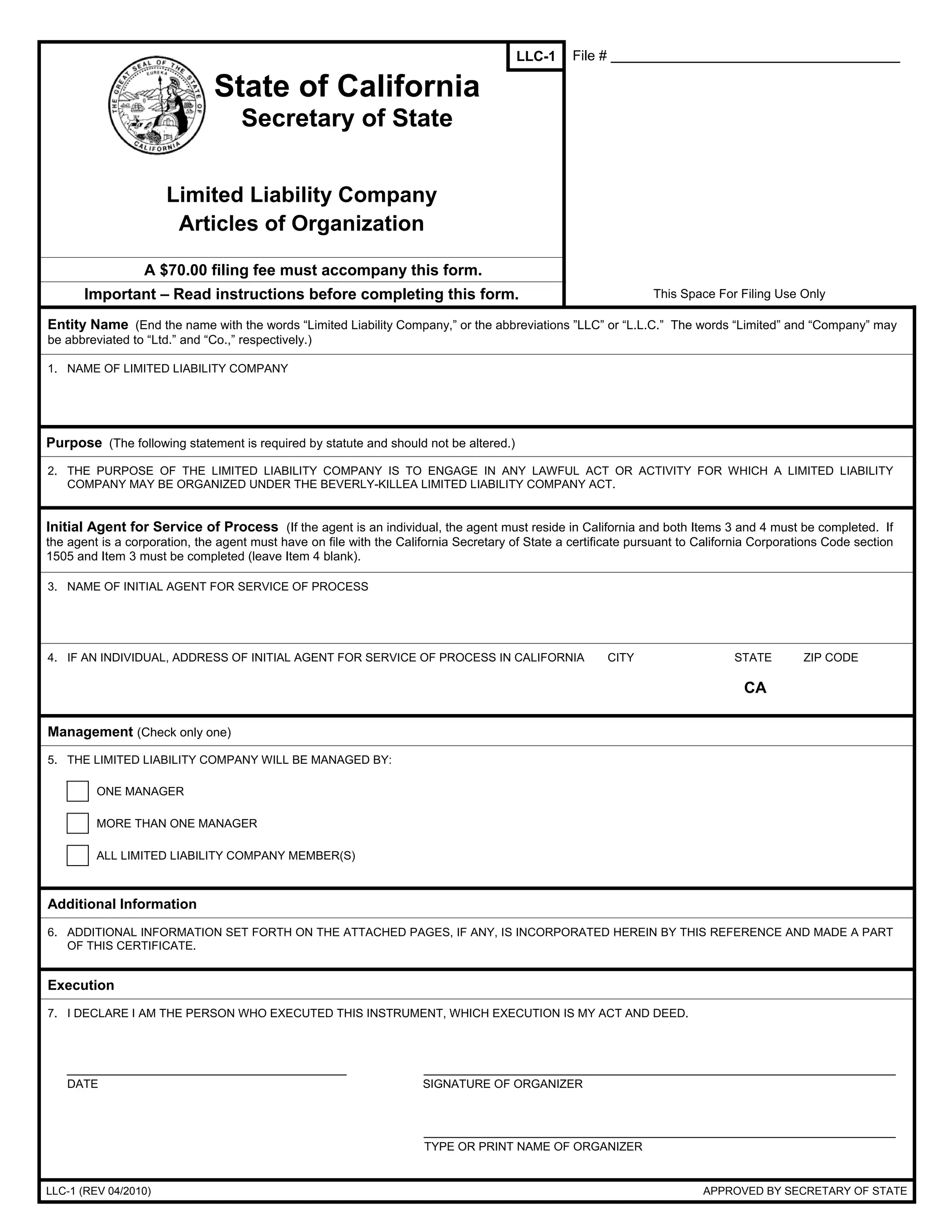
| Governing Document | Articles of Incorporation | Articles of Organization |
| Ownership | Shares held by shareholders | Membership interests held by members |
| Management | Board of Directors and Officers | Members or Managers |
| Formalities | High (Bylaws, Meetings, Minutes) | Moderate (Operating Agreement) |
| Tax Treatment | C Corp or S Corp election | Pass-through (usually) |
Post-Incorporation Obligations
Filing the Articles of Incorporation is only the beginning. To remain in "good standing" in California, a corporation must fulfill ongoing legal and tax obligations:
- Initial Statement of Information (Form SI-550): Within 90 days of filing the Articles of Incorporation, every domestic corporation must file an initial Statement of Information with the Secretary of State. This discloses the names and addresses of current directors and officers.
- Bylaws: You must adopt corporate bylaws. These are the internal rules that govern how the corporation functions, including how meetings are called, how directors are elected, and how officers are appointed.
- Organizational Meeting: After filing, the incorporator (or the initial Board of Directors) should hold an organizational meeting to issue shares, adopt bylaws, and appoint officers.
- Tax Compliance: You must register with the California Franchise Tax Board and the Employment Development Department if you intend to hire employees.
Common Pitfalls and Troubleshooting
Even with a standardized form, applicants frequently encounter issues that lead to rejected filings.
Inaccurate Agent Information: The Agent for Service of Process must have a physical California address. A Post Office Box is insufficient for this role. If the designated agent is not reachable, the corporation risks a default judgment in the event of a lawsuit.
Missing Share Information: Failure to specify the number of shares can lead to rejection. Even if you are the sole owner, you must authorize a specific number of shares (e.g., 10,000) and issue some of them to yourself or other founders.
Naming Conflicts: Using a name that is too similar to an existing corporation is a common error. Before committing to your name, perform a thorough search on the Secretary of State's database. If your name is rejected, you will need to re-file or select a new name, which may require you to restart the payment process.
Failure to File Statement of Information: Many new business owners confuse the Articles of Incorporation with the Statement of Information. Both are required. Missing the 90-day deadline for the Statement of Information can result in penalties and a suspension of your corporate powers by the Franchise Tax Board.
Seeking Professional Guidance
While the California Secretary of State provides tools to simplify the filing process, corporate law is complex. Determining the appropriate share structure, drafting custom articles for unique governance needs, or deciding between C-Corp and S-Corp tax statuses often requires consultation with a qualified business attorney or tax professional. This guide is for informational purposes and does not constitute legal or tax advice. Laws may change, and individual circumstances often involve complexities—such as intellectual property assignment or founder vesting agreements—that the standardized state forms do not address.
Frequently Asked Questions
Can I file the Articles of Incorporation by mail? Yes, you can file by mail, but processing times are significantly longer compared to online submissions. The Secretary of State encourages the use of the online portal for faster processing and immediate receipt of filed documents.
What is the difference between an incorporator and a director? The incorporator is the person who signs and submits the Articles of Incorporation to the state. They have no role in the company once the filing is complete. The directors are the individuals who govern the corporation and are appointed during the organizational meeting held after the filing.
Do I need an attorney to file the Articles of Incorporation in California? California does not legally require an attorney to file these documents. However, an attorney is highly recommended if your corporation will have multiple shareholders, complex equity arrangements, or requires specific provisions to protect minority shareholder rights.
What is the cost associated with filing? The filing fee for Articles of Incorporation in California is established by statute. As of 2026, the standard filing fee for a stock corporation is $100. Always check the official Secretary of State website for current fee schedules, as they are subject to legislative adjustments.
Can I change the name of the corporation later? Yes. If you decide to change your corporate name, you must file an "Amendment of Articles of Incorporation" with the Secretary of State and pay the required filing fee. This process updates the public record to reflect the new entity name.
Next Steps for Your Business
To move forward with your incorporation, start by performing a name search on the Secretary of State's portal. Once your name is selected, prepare your internal documents, such as your bylaws and a simple shareholder agreement, even before you submit your filing. By preparing these documents concurrently, you ensure that once the Articles are filed, you are prepared to manage your corporation in compliance with California law. Immediately after your filing is accepted, schedule your organizational meeting to formalize the company's internal structure and issue your initial stock certificates.